
EPInformer
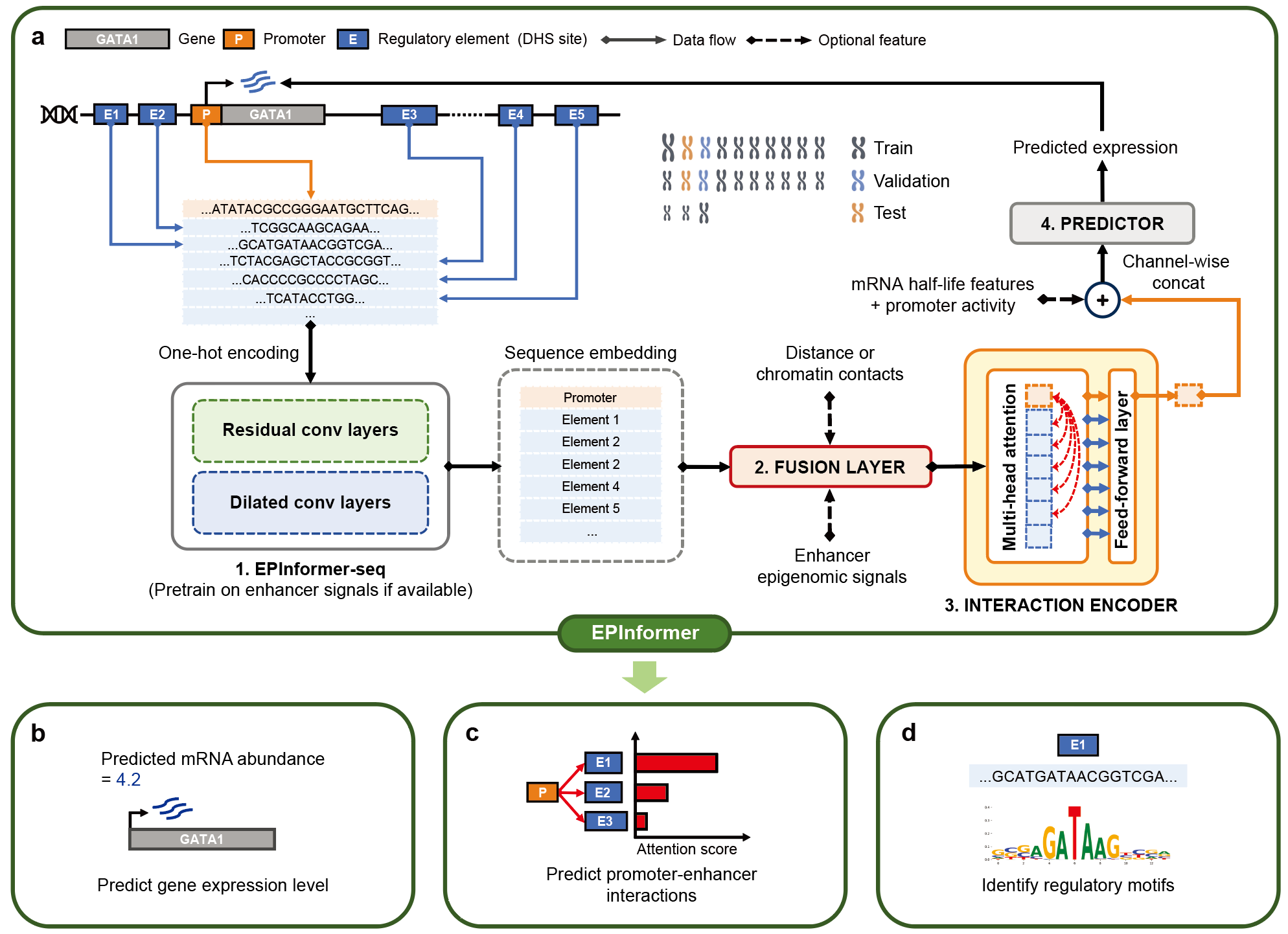
EPInformer workflows for gene-expression prediction from DNA sequence, epigenomic signals, and chromatin contacts.
- 64
- 4 mo ago
Repo pinellolab/EPInformer, read from GitHub 12 h ago. pinellolab has not joined Take My Repo.
In short
pinellolab/EPInformer is a public repo on GitHub by pinellolab. EPInformer workflows for gene-expression prediction from DNA sequence, epigenomic signals, and chromatin contacts. It declares no license on GitHub. Public does not mean open source: without a license, nobody is granted the right to reuse it. It is written mainly in Jupyter Notebook, has 64 stars and last changed on 2026-07-17. Nobody has reviewed it on Take My Repo yet, which says nothing about its quality. Read from GitHub on 2026-11-23.
AI models this project points to

EPInformer
EPInformer is a scalable deep-learning framework for gene-expression prediction that integrates promoter-enhancer sequences, epigenomic signals, and chromatin contacts. It supports three core applications:
- Predicting gene expression from promoter-enhancer sequence and multimodal epigenomic inputs.
- Prioritizing cell-type-specific enhancer-gene interactions and performing in-silico perturbation.
- Predicting enhancer activity and identifying sequence motifs that drive it.
The framework is described in Nature Communications: EPInformer: scalable and integrative prediction of gene expression from promoter-enhancer sequences with multimodal epigenomic profiles.
This repository provides the code and training recipes for evaluating EPInformer variants on RNA-seq and CAGE-seq expression data.
For a guided end-to-end run, start with
K562_walkthrough.ipynb. Two additional, executable demonstrations are
included:
github_enhancer_activity_demo.ipynbreproduces the published KLF1 enhancer-activity and in-silico mutagenesis example.predict_enhancer_and_expression.ipynbdownloads the pinned Hugging Face checkpoints when needed and reproduces the reported K562 encoder, RNA, and CAGE performance.
The notebook guide describes their data requirements and kernel setup.
Pipeline
This pipeline supports six cell lines (K562, GM12878, H1, HepG2, HUVEC, and NHEK). K562 and
GM12878 can be reproduced from raw ENCODE inputs with the config-driven pipeline. The other four
cell lines use the supplied activity tables and precomputed ABC links before entering the same
encoder and expression-training stages. The models are defined in
EPInformer/models.py:
- Enhancer-activity encoder — predicts 256 bp enhancer activity (H3K27ac·DNase) from sequence.
- Gene-expression model (
EPInformer_v2) — predicts RNA / CAGE from a gene's promoter plus its ABC-nominated enhancers, reusing the pretrained encoder (frozen) as the sequence backbone.
Run Part 1 before Part 2: the expression model uses the frozen encoder trained in Part 1.
Reproduction results
All metrics are pooled out-of-fold Pearson R from 12-fold leave-chromosome-out evaluation. Encoder
numbers use forward/reverse-complement-averaged inference; expression numbers use the shipped f3
configuration.
Part 1 — enhancer encoder (log2 activity):
| H1 | HepG2 | K562 | HUVEC | NHEK | GM12878 | |
|---|---|---|---|---|---|---|
| ours | 0.820 | 0.743 | 0.740 | 0.742 | 0.677 | 0.617 |
Part 2 — gene expression, shipped f3 config (frozen encoder + 3 enhancer features + promoter signal):
| K562 | GM12878 | HepG2 | HUVEC | NHEK | H1 | |
|---|---|---|---|---|---|---|
| RNA | 0.856 | 0.860 | 0.845 | 0.839 | 0.828 | 0.781 |
| CAGE | 0.867 | 0.890 | — | — | — | — |
CAGE labels are available only for K562 and GM12878; the other four cell lines are RNA-only. The H1, HepG2, HUVEC, and NHEK expression results are newly evaluated in this pipeline.
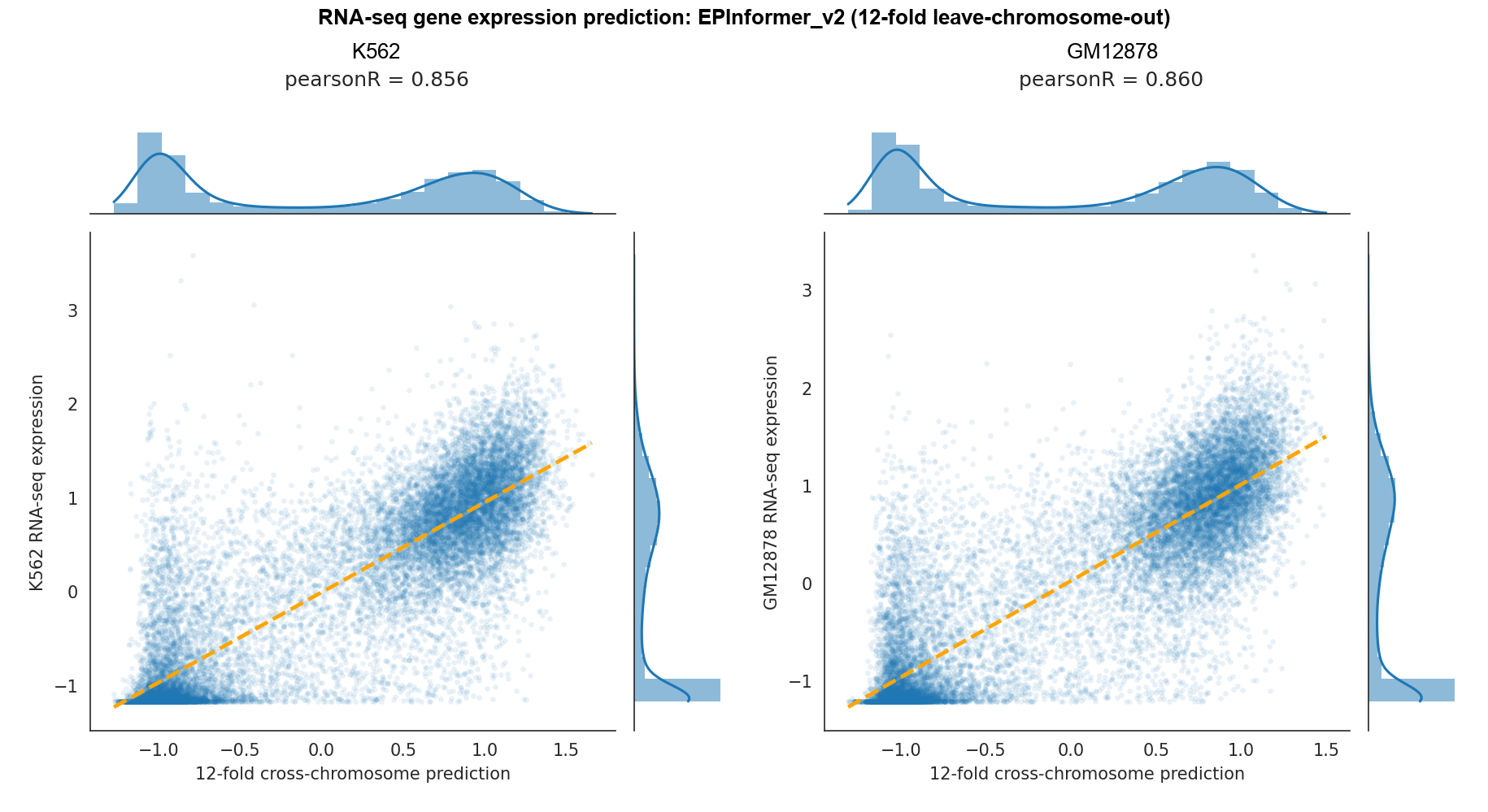
Shipped expression configuration (
f3): three enhancer features (distance, activity, and Hi-C contact) plus promoter activity, with the pretrained encoder frozen.
Datasets
All inputs are public: chromatin and Hi-C data are from ENCODE, expression labels are from Xpresso/FANTOM (Zenodo), and the reference genome is hg38.
ENCODE accessions (per cell)
DNase (accessibility) + H3K27ac (activity; 2 filtered bio-reps where available) + H3K27ac narrowPeak (the encoder's summit source) + cell-specific Hi-C:
| Cell (Roadmap) | DNase | H3K27ac rep(s) | narrowPeak | Hi-C (.hic) |
|---|---|---|---|---|
| K562 (E123) | ENCFF257HEE | ENCFF232RQF | ENCFF544LXB | ENCFF621AIY |
| GM12878 (E116) | ENCFF729UYK, ENCFF020WZB | ENCFF269GKF, ENCFF201OHW | ENCFF023LTU | ENCFF318GOM |
| H1 (E003) | ENCFF761ZRE | ENCFF860ABR, ENCFF693IFG | ENCFF689CJG | — (none in ENCODE — 5C/ChIA-PET only) |
| HepG2 (E118) | ENCFF691HJY | ENCFF862NDZ, ENCFF926NHE, ENCFF745JCH | ENCFF392KDI* | ENCFF805ALH |
| HUVEC (E122) | ENCFF091KTX | ENCFF374DGO, ENCFF609TUB | ENCFF077LGZ | ENCFF091YKP |
| NHEK (E127) | ENCFF117RNM | ENCFF770JWP, ENCFF051NTC | ENCFF666UYC | ENCFF776JNR |
- K562 ships single-rep — its H3K27ac reps differ hugely in depth, so pooling dilutes.
- GM12878 uses both filtered reps per assay — this is what reaches 0.617.
- HepG2 has 3 filtered H3K27ac reps (mean-pooled); its narrowPeak (
*) is inferred, not cited. - Wired in
config/samples.tsv,config/encoder_narrowpeaks.json,config/extra_cells_bams.json.
Other inputs
Genome: supply
hg38.fa→data/reference/hg38/hg38.fa(not downloaded by any script).ABC reference (gene bounds, chrom sizes, K562 quantile-norm):
bash scripts/download_abc_reference.sh data/reference/hg38.Expression labels + Xpresso features + 12-fold CV split — Zenodo 13232430 (
expression_data.zip) → unzip intodata/:GM12878_K562_18377_gene_expr_fromXpresso_with_sequence_strand.csv—Actual_{cell}RNA for all 6 cells +{cell}_CAGE_128*3_sumfor K562/GM12878.leave_chrom_out_crossvalidation_split_18377genes.csv— the fold assignment.
ABC average Hi-C (hg38; used automatically when a cell-specific
.hicis absent or unavailable): ENCODEENCFF134PUN(annotationENCSR382HAW, 5 kb). Split it intodata/reference/abc_avg_hic/by_chrombefore running the pipeline:python scripts/split_avg_hic.py --in /path/to/ENCFF134PUN.bed.gz \ --out data/reference/abc_avg_hic/by_chromThis is the default
reference.average_hic_dirinconfig/config.yaml. The pipeline uses it automatically when the sample has no usable Hi-C file; a valid cell-specific.hicalways takes precedence.
Setup
conda env create -f environment.yml && conda activate epinformer_repro
# key deps: torch, h5py, pyfaidx, kipoiseq, pyranges, macs2, hicstraw, pyBigWig, scipy, scikit-learn, pandas
bash scripts/download_abc_reference.sh data/reference/hg38          # ABC reference
# then: place hg38.fa at data/reference/hg38/hg38.fa, and unzip Zenodo expression_data.zip into data/
Run commands from the repository root. Before downloading data or submitting training jobs, check the configuration and environment with:
python run_pipeline.py --config config/config.yaml --samples K562 --stages links --dry-run
python -m unittest -q tests.test_pipeline_regressions
Compute and storage requirements
- The ABC links and HDF5 encoding stages are CPU/memory-heavy; the supplied SLURM job requests 12 CPUs, 128 GiB RAM, and up to 48 hours.
- A 12-fold encoder run is a 12-task GPU array. Each task requests 32 GiB host RAM and one GPU.
- A full expression-training task loads the 18,377-gene HDF5 into memory. Use the supplied 64 GiB SLURM allocation and a GPU with at least about 20 GiB memory; measured host usage is roughly 40–43 GiB.
- Checkpoints alone are small, but raw BAM/Hi-C files and generated HDF5/activity data can require
substantial shared storage. Review the download plan with
--dry-runfirst.
Pretrained checkpoints (optional):
JiecongLin/EPInformer
provides 12-fold enhancer encoders and validated gene-expression checkpoints for all six supported
cell lines: RNA models for K562, GM12878, H1, HepG2, HUVEC, and NHEK, plus CAGE models for K562
and GM12878. f1, f2, and f3 feature configurations are available. Gene-expression checkpoints
are organized under
expression_models/{cell}/{RNA,CAGE}/{f1,f2,f3}/.
from huggingface_hub import hf_hub_download

ckpt = hf_hub_download(
    repo_id="JiecongLin/EPInformer",
    filename="enhancer_encoders/K562/fold_8.pt",
    revision="667a74e6a1358bee35fd1951570839bdeb5dec24",
)
See the project wiki for the full guide.
Part 1 — Enhancer-activity encoder
1a. Data preprocessing — download ENCODE → ABC → 256 bp activity CSV
# DNase/H3K27ac BAMs + Hi-C (K562/GM12878). The pipeline config expects data/.
python scripts/download_encode_data.py --cell-types K562,GM12878 --output-dir data

# GM12878 needs 2 filtered reps per assay (reaches 0.617):
python scripts/download_encode_data.py --from-manifest config/gm12878_encoder_bams.json
for f in data/GM12878/{DNase,H3K27ac}/ENCFF*.bam; do samtools index "$f"; done

# H3K27ac narrowPeaks = the encoder's summit source:
python scripts/download_encode_data.py --from-manifest config/encoder_narrowpeaks.json
gunzip -f reference/*_H3K27ac.*.narrowPeak.gz

# ABC nomination + encoder CSV
python run_pipeline.py --config config/config.yaml --samples K562,GM12878 --stages links
#   -> batch_output/{cell}/links/{cell}_peak_5bins_around_summit_activity_sequence.csv   (encoder data)
#   -> batch_output/{cell}/links/{EnhancerList,GeneList}.txt + Predictions/...            (for Part 2)
1b. Train the encoder (12-fold, 5-bin / L1KL recipe)
python train_seqEncoder.py --cell K562 \
    --data-csv batch_output/K562/links/K562_peak_5bins_around_summit_activity_sequence.csv \
    --loss l1kl --batch-size 256 --output-dir results/seqencoder/K562 --epochs 50
# HPC, all 12 folds:   CELL=K562 sbatch slurm/train_seqencoder_12fold.slurm
1c. Evaluate
The training job writes single-reverse-strand test predictions (K562 pooled Pearson R is about 0.734). The headline 0.740 result averages forward and reverse-complement predictions. On SLURM, regenerate those predictions from the 12 saved checkpoints and then pool them:
CELL=K562 \
  DATA_CSV=batch_output/K562/links/K562_peak_5bins_around_summit_activity_sequence.csv \
  CKPT_DIR=results/seqencoder/K562/checkpoints \
  OUTPUT_DIR=results/seqencoder/K562_fwdRC \
  sbatch slurm/eval_seqencoder_fwdrc.slurm

# Run after the forward+RC job completes:
python evaluate.py encoder --pred_dir results/seqencoder/K562_fwdRC
For a quick check of the training job's default single-strand outputs, evaluate
results/seqencoder/K562 directly.
Part 2 — Gene-expression model
Reuses the Part 1 encoder (frozen) + the ABC enhancer–gene links from step 1a.
2a. Data preprocessing — ABC links → factored gene HDF5
python run_pipeline.py --config config/config.yaml --samples K562,GM12878 --stages encoding
#   -> batch_output/{cell}/encoding/{cell}_samples.h5
#      (promoter + enhancer one-hot sequence, and activity / dhs / distance / contact features)
2b. Train EPInformer_v2 — the shipped f3 config
python train_EPInformer.py --model_type EPInformer-v2 --cell K562 --expr_type RNA \
    --n_enh_feats 3 --use_prm_signal \
    --h5_path   batch_output/K562/encoding/K562_samples.h5 \
    --expr_csv  data/GM12878_K562_18377_gene_expr_fromXpresso_with_sequence_strand.csv \
    --split_csv data/leave_chrom_out_crossvalidation_split_18377genes.csv \
    --use_pretrained_encoder --pretrained_encoder_dir results/seqencoder/K562/checkpoints \
    --gene_list batch_output/K562/links/GeneList.txt \
    --output_dir EPInformer_models/K562 --epochs 50
# HPC, all 12 folds (f3 is the slurm default):   CELL=K562 sbatch slurm/train_epinformer_12fold.slurm
#   CAGE instead of RNA:   EXPR_TYPE=CAGE ...
#   feature ablation:      USE_PRM_SIGNAL=0 N_ENH_FEATS=1|2|3 ...   (f1=dist, f2=+activity, f3=+Hi-C)
--n_enh_feats 3 --use_prm_signal selects the shipped f3 configuration described above. The
encoder is frozen by default; --no_freeze_encoder (slurm NO_FREEZE=1) fine-tunes it end-to-end.
2c. Evaluate (target RNA ~0.86 / CAGE ~0.88)
python evaluate.py expression --pred_dir EPInformer_models/K562
# writes a pooled evaluation summary and scatter plot
Other cell lines (H1 / HepG2 / HUVEC / NHEK) — RNA only
No CAGE labels exist for these. Their encoders train on pre-built activity CSVs, and the
gene HDF5 is built from precomputed ABC links (scripts/build_gene_h5_for_cell.py — no
raw BAMs needed; contact = ABC average Hi-C). Per cell (e.g. HepG2):
Questions
What is EPInformer?
pinellolab/EPInformer is a public repo on GitHub by pinellolab. EPInformer workflows for gene-expression prediction from DNA sequence, epigenomic signals, and chromatin contacts.
Is EPInformer open source?
It declares no license on GitHub. Public does not mean open source: without a license, nobody is granted the right to reuse it.
Does EPInformer run on macOS, Windows or Linux?
Its maker has not tagged a system, so it is unknown here. Its README says what it needs.