
employees
.NET Core + Razor Pages example of object oriented design.
- 0
- 20 mo ago
Repo primaryobjects/employees, read from GitHub 1 min ago. primaryobjects has not joined Take My Repo.
In short
primaryobjects/employees is a public repo on GitHub by primaryobjects. .NET Core + Razor Pages example of object oriented design. It declares no license on GitHub. Public does not mean open source: without a license, nobody is granted the right to reuse it. It is written mainly in C#, has 0 stars and last changed on 2025-03-22. Nobody has reviewed it on Take My Repo yet, which says nothing about its quality. Read from GitHub on 2026-11-21.
Build a Real-World Web App with .NET Core and Razor Pages
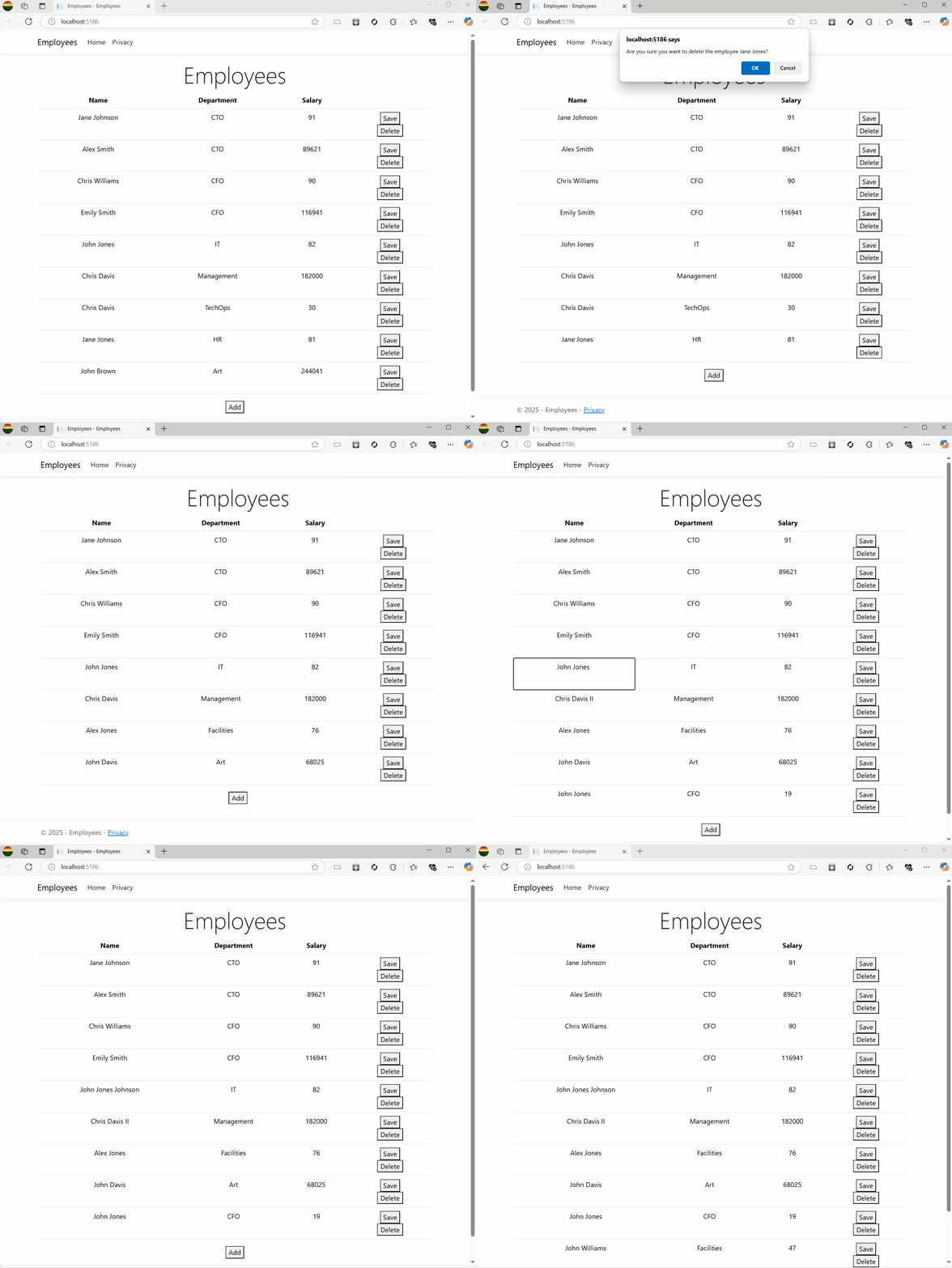
This project demonstrates the power of object-oriented programming (OOP) concepts like abstract classes, polymorphism, and dynamic updates using Razor Pages in C# .NET Core. Follow along to learn how to build a dynamic web application that allows you to manage employees with features like adding, editing, and deleting records - without refreshing the page.

Features
- Dynamic Employee Management: Add, edit, and delete employees dynamically using AJAX.
- Object-Oriented Design: Explore the use of an abstract
Employeeclass and its concrete subclasses. - Razor Pages: Build a clean and modular web application using Razor Pages.
- AJAX Integration: Update the UI dynamically without full-page reloads.
- Polymorphism in Action: See how different employee types (e.g., full-time, contractor) are handled seamlessly.
Technologies Used
- .NET Core: Backend framework for building the web application.
- Razor Pages: Simplified page-based architecture for building web UIs.
- C#: Programming language used for backend logic.
- AJAX: For dynamic updates to the UI.
- HTML/CSS: For structuring and styling the web pages.
Project Structure
Employees
│
├── Employees
│   ├── Pages
│   │   ├── Index.cshtml          # Main Razor Page for the app
│   │   ├── Index.cshtml.cs       # Backend logic for Index Razor Page
│   │   ├── Shared
│   │   │   ├── _EmployeeTable.cshtml # Partial view for the employee table
│   ├── Controllers (Optional)    # For future Web API integration
│   ├── Types
│   │   ├── Employee.cs           # Abstract base class for employees
│   │   ├── Concrete
│   │   │   ├── FullTimeEmployee.cs # Concrete subclass for full-time employees
│   │   │   ├── Contractor.cs     # Concrete subclass for contractors
│   ├── Managers
│   │   ├── EmployeeManager.cs    # Utility for generating employee data
│
└── readme.md                     # Project documentation
Key Concepts
1. Abstract Classes
The Employee class is an abstract base class that defines common properties and methods for all employee types. Concrete subclasses like FullTimeEmployee and Contractor inherit from this base class.
2. Polymorphism
The application demonstrates polymorphism by treating all employee types uniformly while allowing specific behavior for each subclass.
3. Dynamic Updates with AJAX
AJAX is used to handle form submissions (e.g., Save, Delete) without reloading the page. This improves user experience and performance.
4. Razor Pages
The project uses Razor Pages for a clean and modular architecture. The _EmployeeTable partial view is dynamically updated using AJAX.
How to Run the Project
-
Clone the Repository:
git clone <repository-url>
cd Employees
-
Build the Project: Open the project in Visual Studio or use the .NET CLI:
dotnet build
-
Run the Application:
dotnet run
-
Access the App: Open your browser and navigate to
http://localhost:5000.
How It Works
-
Employee Management:
- The
Index.cshtmlpage displays a table of employees. - The
_EmployeeTable.cshtmlpartial view is used to render the table dynamically.
- The
-
AJAX Integration:
- JavaScript intercepts form submissions (e.g., Save, Delete) and sends AJAX requests to Razor Page handlers.
- The table is updated dynamically without a full-page reload.
-
Object-Oriented Design:
- The
Employeebase class defines shared properties likeName,Department, andGetRate(). - Subclasses like
Contractor,SalaryE,ployee, andHourlyEmployeeextend the base class with specific behavior.
- The
Future Enhancements
- Web API Integration: Add RESTful endpoints for better scalability and integration with front-end frameworks like React or Angular.
- Authentication: Secure the application with user authentication and role-based access control.
- Pagination: Add pagination for managing large datasets.
Conclusion
This project is a hands-on demonstration of building a real-world web application using Razor Pages in .NET Core. It showcases the power of OOP concepts like abstract classes and polymorphism while integrating modern web development techniques like AJAX for a seamless user experience.
License
MIT
Author
Kory Becker https://primaryobjects.com
Questions
What is employees?
primaryobjects/employees is a public repo on GitHub by primaryobjects. .NET Core + Razor Pages example of object oriented design.
Is employees open source?
It declares no license on GitHub. Public does not mean open source: without a license, nobody is granted the right to reuse it.
Does employees run on macOS, Windows or Linux?
Its maker tagged it for macOS, Windows and Linux, or as Docker or cross-platform. That is declared by the maker; Take My Repo has not tested it.
How do I install employees?
Open "Take it" on its page: Take My Repo writes an install plan for your machine and hands it to your AI agent (Claude Code, Codex or Cursor), which asks you before each step. Take My Repo has not tested it on any machine.
Is employees still maintained?
Its last change on GitHub was on 2025-03-22. Take My Repo does not judge from that whether it is maintained.
What do people who ran employees say?
Nobody has reviewed it on Take My Repo yet, which says nothing about its quality.