MonitorControl
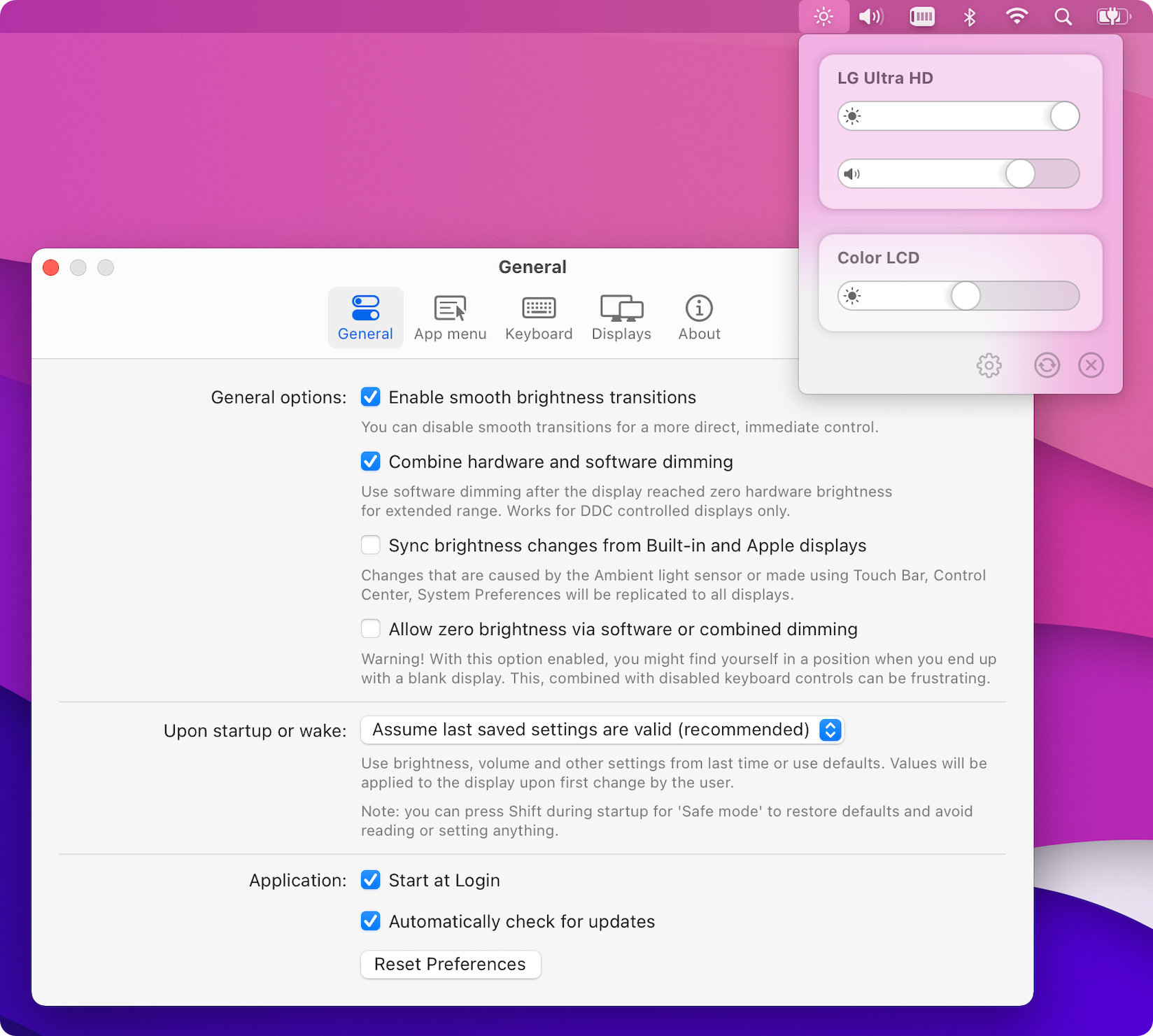
🖥 Control your display's brightness & volume on your Mac as if it was a native Apple Display. Use Apple Keyboard keys or custom shortcuts. Shows the native macOS OSDs.
- 35k
- Swift
- MIT
- 6 wk ago
A modular, primitive-first, python-first PyTorch library for Reinforcement Learning.
Repo pytorch/rl, read from GitHub 1 d ago. pytorch has not joined Take My Repo.
pytorch/rl is a public repo on GitHub by pytorch. A modular, primitive-first, python-first PyTorch library for Reinforcement Learning. It declares the MIT license on GitHub. It is written mainly in Python, has 3,642 stars and last changed on 2026-11-25. Nobody has reviewed it on Take My Repo yet, which says nothing about its quality. Read from GitHub on 2026-11-25.
🖥 Control your display's brightness & volume on your Mac as if it was a native Apple Display. Use Apple Keyboard keys or custom shortcuts. Shows the native macOS OSDs.



TorchRL is a PyTorch-native toolkit for reinforcement learning, decision making, robotics, and simulation. It is not a single algorithm implementation or a narrow benchmark suite: it is a collection of composable pieces for building RL systems while keeping the code close to the PyTorch programming model. Recent work has made this especially strong for recurrent RL, MuJoCo-based control, multi-agent training, replay-buffer and collector infrastructure, and reusable loss/value-estimation components.
The library is built around three ideas:
That common data model is TensorDict,
a dictionary-like tensor container with PyTorch operations, device transfers,
shared-memory support, memmaps, lazy views, and nn.Module wrappers.
Getting started | API reference | Tutorials | Knowledge base | Examples | SOTA implementations
TorchRL 0.15 introduces powerful new capabilities for robot learning, offline RL, data interoperability, and training at scale.
buffer.as_dataset() with a
PyTorch DataLoader, or buffer.export(...) to exchange trajectory data
with LeRobot and Hugging Face Datasets.
PyTorch data integration ·
LeRobot tutorialreplay_write_mode="trajectory" to write complete
episodes to replay, with new readiness and policy-version controls.
Collectors and execution modelsTorchRL represents an RL interaction as a TensorDict that moves through a small number of reusable components:
TensorDict
  -> policy module writes actions and log-probs
  -> environment reads actions and writes next observations, rewards, done flags
  -> collector batches trajectories from one or many workers
  -> replay buffer stores, samples, prioritizes, and transforms data
  -> loss module reads named keys and writes differentiable losses
  -> optimizer updates ordinary PyTorch parameters
The same object can carry observations, pixels, actions, rewards, masks, recurrent states, agent groups, sampled indices, priorities, or custom task fields. The result is less glue code and fewer hidden assumptions about what each algorithm or environment returns.
A local rollout is just a TensorDict passed between a PyTorch module and an environment:
import torch
from tensordict.nn import TensorDictModule
from torch import nn

from torchrl.envs import PendulumEnv, StepCounter, TransformedEnv

# A PyTorch-native environment with an ordinary transform stack.
env = TransformedEnv(PendulumEnv(), StepCounter(max_steps=200))

# Policies are regular nn.Modules wrapped with explicit TensorDict keys.
policy = TensorDictModule(
    nn.Sequential(
        nn.LazyLinear(64),
        nn.Tanh(),
        nn.Linear(64, 1),
        nn.Tanh(),
    ),
    in_keys=["observation"],
    out_keys=["action"],
)

rollout = env.rollout(max_steps=32, policy=policy)
assert rollout.batch_size == torch.Size([32])
assert rollout["next", "reward"].shape[:1] == torch.Size([32])
Nothing in this pattern is specific to Pendulum. The same keys-and-TensorDict interface is used by batched environments, multi-agent tasks, collectors, replay buffers, recurrent modules, transforms, and losses.
RL code tends to accumulate special cases: tuples from one environment, dicts from another, separate arrays for recurrent states, masks next to data rather than inside it, and losses that silently assume a particular batch layout. TorchRL uses TensorDict to make those assumptions explicit.
TensorDict supports common tensor operations while preserving named fields:
# These operations preserve the structure and operate on every compatible value.
batch = torch.stack(list_of_tensordicts, dim=0)
batch = batch.reshape(-1)
batch = batch.to("cuda")
mini_batch = batch[:128]

# Nested keys make multi-agent, recurrent, and next-state data explicit.
reward = batch["next", "reward"]
agent_obs = batch["agents", "observation"]
hidden = batch["recurrent_state", "h"]
This is the reason TorchRL components compose: a collector can emit a TensorDict, a replay buffer can store it without losing structure, a transform can add or remove keys, and a loss can read exactly the keys it needs.
TorchRL includes native environments, wrappers for popular environment libraries, and vectorized containers for running many environments at once. The environment API exposes specs for observations, actions, rewards, and done flags, so policies and transforms can check shapes, devices, dtypes, and bounds before a training job runs for hours.
Environment support includes:
PendulumEnv, and custom MuJoCo tasks
built on MujocoEnv.SerialEnv, ParallelEnv, and batched wrappers for local vectorization and
multiprocessing.ActionScaling), action
flattening (FlattenAction), auto-reset, frame stacking, state reconstruction,
and more.Transforms are first-class TorchRL modules. They can run on-device, participate in specs, and be inserted, removed, or composed without wrapping the whole environment in opaque adapter layers. Macro-control primitives expand high-level commands into sequences of low-level actions.
from torchrl.envs import Compose, DoubleToFloat, ObservationNorm, TransformedEnv
from torchrl.envs.libs.gym import GymEnv

base_env = GymEnv("HalfCheetah-v4", device="cuda:0")
env = TransformedEnv(
    base_env,
    Compose(
        ObservationNorm(in_keys=["observation"]),
        DoubleToFloat(),
    ),
)
Collectors are the bridge between policies and environments. A collector owns the execution loop, batches trajectories, handles devices, and can update policy weights while environments keep running.
TorchRL includes single-process, async, multiprocess, and distributed collectors. This lets the same policy and loss code be used across small smoke tests, GPU-heavy simulation, CPU environment farms, or asynchronous evaluation setups.
from torchrl.collectors import Collector

collector = Collector(
    create_env_fn=env,
    policy=policy,
    frames_per_batch=1024,
    total_frames=1_000_000,
)

for data in collector:
    # data is a TensorDict with time, environment, and key structure preserved.
    train_step(data)
For larger jobs, the collector family adds async execution, multiple worker processes, weight updaters, evaluator loops, profiling hooks, and fake-data helpers for testing downstream code without stepping an expensive environment.
TorchRL 0.14 made it easier to scale data collection across local processes and
distributed workers through a shared Collector API. For example, if make_env
creates an environment, use multiple local processes with:
multi_collector = Collector(
    make_env, policy, num_collectors=4, sync=True, frames_per_batch=1024
)
Here sync=True waits for all four workers. This call returns a
MultiSyncCollector, the implementation that manages synchronous worker
processes.
The same Collector API supports several execution modes:
Collector(make_env, policy, ...) collects in the current
process.num_collectors=4, sync=True collects across four
local workers and waits for each when forming a batch.num_collectors=4, sync=False receives data as
workers finish.backend="ray", "rpc", or "distributed" selects
a distributed execution backend.For asynchronous environment stepping and batched policy inference,
AsyncBatchedCollector combines an AsyncEnvPool, which runs environments
independently, with an inference server that groups their policy requests:
from torchrl.collectors import AsyncBatchedCollector

collector = AsyncBatchedCollector(
    [make_env] * 4, policy=policy, frames_per_batch=1024, env_backend="threading"
)
The async collector can also write to replay in the background. In 0.15,
replay_write_mode="trajectory" writes complete episodes to replay,
buffer.sample(wait=True) waits for sampleable data on supported buffers, and
multi_collector.worker_policy_versions() reports each worker's policy version
when track_policy_version=True.
See collector APIs, distributed collectors, async environments, and collectors and replay.
TorchRL replay buffers are modular: storage, sampler, writer, collate function,
transforms, prefetching, priority updates, and device movement are separate
pieces. That makes it possible to use the same interface for simple in-memory
replay, memmap-backed storage, prioritized replay, CUDA-aware sampling, offline
datasets, or custom storage layouts. HERReplayBuffer relabels goals for
goal-conditioned RL. For compact observations, NextObservationDelta and
NextStateReconstructor support reconstruction when sampling from replay.
from torchrl.data import LazyMemmapStorage, TensorDictPrioritizedReplayBuffer

buffer = TensorDictPrioritizedReplayBuffer(
    storage=LazyMemmapStorage(1_000_000),
    alpha=0.7,
    beta=0.5,
    batch_size=256,
    prefetch=2,
)

buffer.extend(collector_batch)
sample = buffer.sample()
pytorch/rl is a public repo on GitHub by pytorch. A modular, primitive-first, python-first PyTorch library for Reinforcement Learning.
It declares the MIT license on GitHub.
Its maker tagged it for Linux. That is declared by the maker; Take My Repo has not tested it.
Open "Take it" on its page: Take My Repo writes an install plan for your machine and hands it to your AI agent (Claude Code, Codex or Cursor), which asks you before each step. Take My Repo has not tested it on any machine.
Its last change on GitHub was on 2026-11-25. GitHub counts 348 open issues and pull requests. Take My Repo does not judge from that whether it is maintained.
你想蒸馏的下一个员工,何必是同事。蒸馏任何人的思维方式——心智模型、决策启发式、表达DNA。Distill how anyone thinks.
:house_with_garden: Open source home automation that puts local control and privacy first.
π RuView turns commodity WiFi signals into real-time spatial intelligence, vital sign monitoring, and presence detection — all without a single pixel of video.
Nobody has reviewed it on Take My Repo yet, which says nothing about its quality.
Take My Repo cannot say: it does not audit code and has not run rl. What is known comes from GitHub. It declares the MIT license on GitHub. Its last change was on 2026-11-25. It has 3,642 stars, which measure popularity, not safety. Nobody has reviewed it on Take My Repo yet, which says nothing about its quality. Read the source before you run it. With "Take it", your AI agent shows each step and asks you before running it; README text is treated as data, not as instructions.