hummingbot
Open source software that helps you create and deploy high-frequency crypto trading bots
- 21k
- Python
- Apache-2.0
- 2 d ago
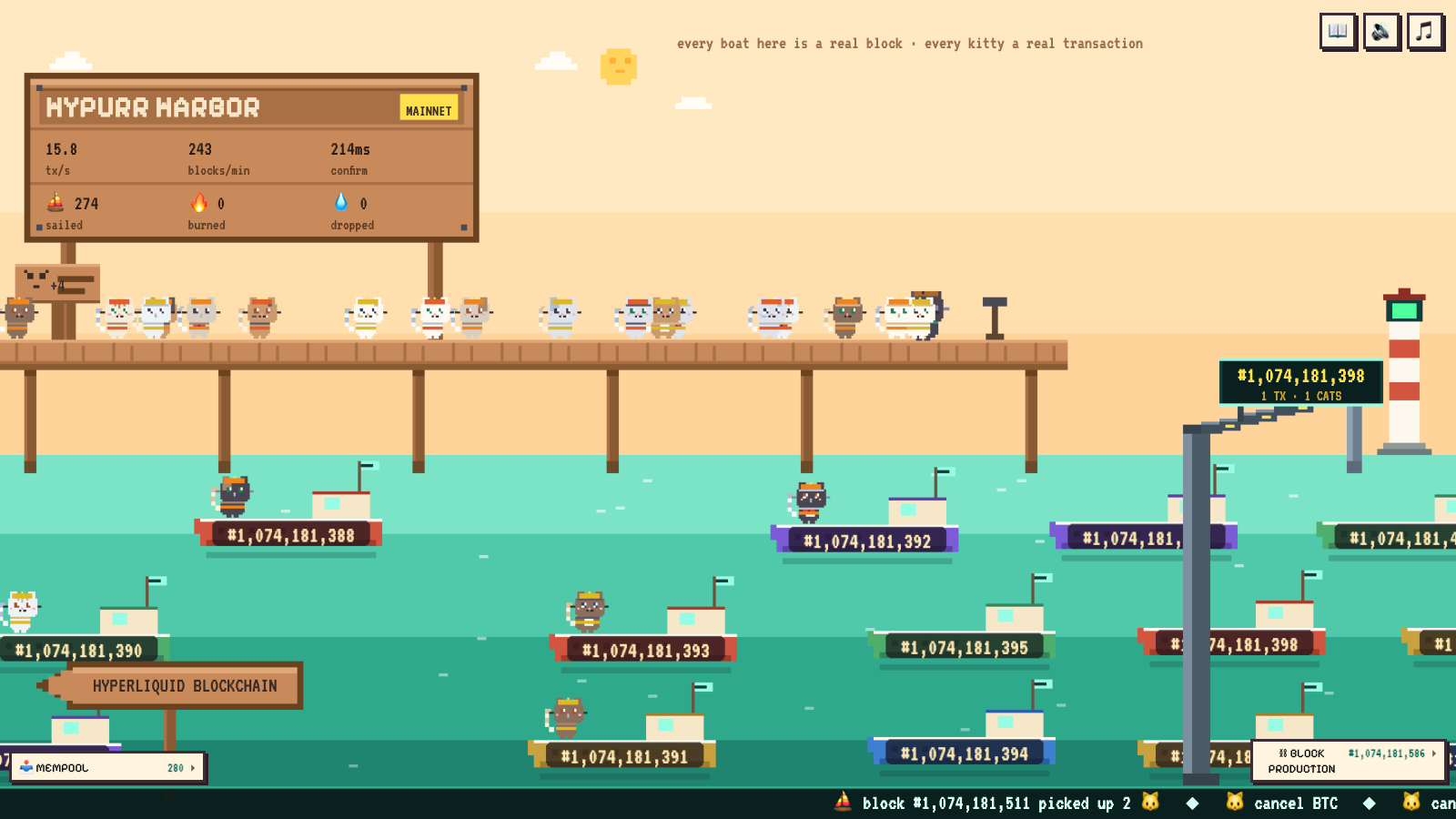
Retro pixel-art visualization of the Hyperliquid mempool: cats are live transactions, boats are blocks. Powered by Quicknode gRPC streams.
Repo quicknode/HYPURR-HARBOR, read from GitHub 14 min ago. quicknode has not joined Take My Repo.
quicknode/HYPURR-HARBOR is a public repo on GitHub by quicknode. Retro pixel-art visualization of the Hyperliquid mempool: cats are live transactions, boats are blocks. Powered by Quicknode gRPC streams. It declares the MIT license on GitHub. It is written mainly in TypeScript, has 2 stars and last changed on 2026-07-23. Nobody has reviewed it on Take My Repo yet, which says nothing about its quality. Read from GitHub on 2026-11-22.
A retro pixel-art harbor where the Hyperliquid blockchain plays out in real time. Every pending transaction is a little cat waiting on the pier. Every block is a boat. When a block confirms, the cats whose transactions made it in hop aboard and sail away. Nothing is replayed or delayed: boats arrive at true HyperBFT cadence, several per second.
Built on a single Quicknode Hyperliquid endpoint. One URL covers the gRPC streams, the info API, and the hypercore JSON-RPC used here.
grouping: {"p": N}). Hi-vis kitties are cancels, which consensus lets board before every taker.There are a few easter eggs. The Konami code is one of them. Typing a certain four letter word cats say is another.
Quicknode Hyperliquid endpoint
  │
  ├─ gRPC :10000  MEMPOOL_TXS + BLOCKS streams
  ├─ /info        coin names → asset id filters
  └─ /hypercore   hl_getBlock anchors rounds to block heights
  │
  ▼
server/index.js  (Node relay, ~500 lines)
  │  WebSocket, one compact JSON message per event
  ▼
Vite + TypeScript frontend, PixiJS v8 harbor engine
The relay subscribes to two gRPC streams: MEMPOOL_TXS for pending transactions and BLOCKS for confirmations. It rebroadcasts them to browsers over a WebSocket with no batching, so on-screen timing is on-chain timing.
A few details that took real effort to get right:
Rounds vs heights. The raw BLOCKS stream numbers blocks by HyperBFT consensus round, which is not the block height you see on explorers. The relay calls hl_getLatestBlockNumber and hl_getBlock on the endpoint's /hypercore path, matches block timestamps against the live stream, and from that one anchor derives the exact height of every boat. Hulls show · · · until the anchor lands (usually under a second), then every boat gets its real height, retroactively.
Coin filtering. Raw mempool actions carry numeric asset ids, not coin names. The relay fetches meta and spotMeta from the endpoint's /info path to translate names like BTC into ids, then applies them as server-side stream filters so the firehose never leaves Quicknode.
Credit politeness. Upstream gRPC streams only run while someone is watching. The first browser to connect starts them; thirty seconds after the last one leaves, they stop. Per-stream watchdogs resubscribe if a stream goes quiet.
No cat left behind. The animation engine guarantees a cat never vanishes mid-air. Hops only start if the landing is reachable, boats with cats aboard are never rushed off-screen, and every cat ends its story on a deck, in a sparkle, or with a splash.
Rendering is PixiJS v8 (WebGPU with WebGL fallback) drawing into a small logical backbuffer that scales with your window's aspect ratio, supersampled 3x for crisp pixels. Every sprite is drawn procedurally and texture-cached; there are no image assets except one sound. Text lives on a separate canvas layer so labels stay sharp at any zoom.
You need Node 20 or newer.
git clone https://github.com/quicknode/HYPURR-HARBOR.git
cd HYPURR-HARBOR
npm install
npm run dev        # → http://localhost:5173
With no credentials the harbor runs in demo mode, generating synthetic traffic at realistic cadence so you can see everything working immediately.
.env.example to .env and fill it in:QN_GRPC_URL=your-endpoint.hype-mainnet.quiknode.pro:10000
QN_GRPC_TOKEN=your-token
QN_HTTP_URL=https://your-endpoint.hype-mainnet.quiknode.pro/YOUR_TOKEN
QN_FILTER_COINS=BTC,ETH
BOATS=all
npm run dev. The badge flips from DEMO to MAINNET.| Variable | What it does |
|---|---|
QN_GRPC_URL |
Endpoint host with :10000, where the gRPC streams live |
QN_GRPC_TOKEN |
Endpoint token. Leave empty for demo mode |
QN_HTTP_URL |
Full HTTP URL of the same endpoint, used for /info and /hypercore |
QN_FILTER_COINS |
Comma separated coins to filter the mempool. Empty means everything |
BOATS |
all gives every block a boat, relevant only blocks touching your coins |
PORT |
Relay port, defaults to 8787 |
HOST |
Bind address. Set 127.0.0.1 when the relay sits behind a reverse proxy |
A word of warning: the unfiltered mempool is a firehose. QN_FILTER_COINS=BTC,ETH keeps the pier lively without melting it.
npm run build      # type-check + bundle to dist/
npm start          # serves dist/ and the WebSocket relay on :8787
Anything that runs npm start can host the whole app as a single process: Railway, Render, Fly.io, a VPS. Static-only platforms like Vercel cannot run it alone, because the relay has to stay alive to hold its gRPC streams open.
You can also split it: the static frontend on Vercel or any CDN, the relay on a small server behind a reverse proxy. Build the frontend with VITE_WS_URL=wss://your-relay-host/ws so it knows where to dial, and set HOST=127.0.0.1 on the relay so only the proxy can reach it. With Caddy the proxy config is one block:
relay.example.com {
    reverse_proxy 127.0.0.1:8787
}
All audio is synthesized in the browser (a generative synthwave radio included), except the meow, which is a real cat recorded by a Wikimedia contributor: Meow.ogg, licensed CC BY-SA 3.0, pitched per kitty. Click anywhere once to enable audio, toggle it with the 🔊 chip.
MIT, see LICENSE.
quicknode/HYPURR-HARBOR is a public repo on GitHub by quicknode. Retro pixel-art visualization of the Hyperliquid mempool: cats are live transactions, boats are blocks. Powered by Quicknode gRPC streams.
It declares the MIT license on GitHub.
Its maker has not tagged a system, so it is unknown here. Its README says what it needs.
Open "Take it" on its page: Take My Repo writes an install plan for your machine and hands it to your AI agent (Claude Code, Codex or Cursor), which asks you before each step. Take My Repo has not tested it on any machine.
Its last change on GitHub was on 2026-07-23. Take My Repo does not judge from that whether it is maintained.
Nobody has reviewed it on Take My Repo yet, which says nothing about its quality.
Open source software that helps you create and deploy high-frequency crypto trading bots
A guide to monitoring and operating EVM transactions in the mempool with Python
12 weeks, 26 lessons, 52 quizzes, classic Machine Learning for all
Bring data to life with SVG, Canvas and HTML. :bar_chart::chart_with_upwards_trend::tada:
The largest actively maintained set of Solana programs ('smart contracts') on the internet.
qn is a command-line interface for Quicknode, manage your Quicknode account and resources easily with a CLI created with both humans and agents in mind