graph-pathfinding-algorithms
Implementation and tests for graph pathfinding algorithms.
- 5
- MIT
- 5 mo ago
Repo rabestro/graph-pathfinding-algorithms, read from GitHub 13 min ago. rabestro has not joined Take My Repo.
In short
rabestro/graph-pathfinding-algorithms is a public repo on GitHub by rabestro. Implementation and tests for graph pathfinding algorithms. It declares the MIT license on GitHub. It is written mainly in Java, has 5 stars and last changed on 2026-06-14. Nobody has reviewed it on Take My Repo yet, which says nothing about its quality. Read from GitHub on 2026-11-23.
Graph search algorithms
The project implements an interface for the weighted graph, as well as two algorithms for finding a path in the graph.
There are implementations and tests for two algorithms:
The implementation is written in Java 17. API documentation is available. You can also see the specifications generated with the spock-reports.
Development Setup with Mise
This project uses mise to manage its toolchain (Java 17 and Gradle 7.5.1) and run development tasks.
To set up the development environment:
- Install
miseif you haven't already. - Trust the project configuration:
mise trust - Install the required tools (Java and Gradle):
mise install
Available Tasks
You can run various tasks defined in mise.toml:
- Build and Test: Run the test suite and build the project:
mise run build - Run Java Demo: Launch the Java application demo:
mise run demo-java - Run Groovy Demo: Launch the Groovy script demo:
mise run demo-groovy - Run Graph Shell: Launch the interactive console shell:
mise run demo-shell
Demo. Graph Shell
To demonstrate the work of search algorithms, I made a small console program 'Graph Shell'. The program
allows you to select one of three build-in graph samples and search for a path using two algorithms. The source
code of the program is located in graph-shell module.

Usage in other projects
These algorithms used in the Hypermetro project, where they are utilized to find the optimal route in the metro schema.
How to use the algorithms in your program
The first step is to create a graph structure. The Graph interface is generic, so you can use any Java type for vertex and any Number type for distance.
Example
In the following Java code we create a graph structure with eight nodes. We use Character class for vertex identification and Integer for the distance. You can see the graphic representation of the scheme here.
var graph = Graph.of(Map.of(
            'A', Map.of('B', 5, 'H', 2),
            'B', Map.of('A', 5, 'C', 7),
            'C', Map.of('B', 7, 'D', 3, 'G', 4),
            'D', Map.of('C', 20, 'E', 4),
            'E', Map.of('F', 5),
            'F', Map.of('G', 6),
            'G', Map.of('C', 4),
            'H', Map.of('G', 3)
    ));
The second step is creating a search algorithm class. You can choose one of the two algorithms.
Example
var fastest = new DijkstrasAlgorithm<Character>();
var shortest = new BreadthFirstSearch<Character>();
Now we can search for the route.
Example
var source = 'D';
var target = 'C';

var routeOne = shortest.findPath(graph, source, target);
var routeTwo = fastest.findPath(graph, source, target);
As result, you get a list with the path.
routeOne==['D','C']
        routeTwo==['D','E','F','G','C']
Unit Tests
Tests are written in Groove language. For unit testing, the Spock Framework was used. To test the operation of the algorithms, the following sample graphs were created.
Graph Samples
Small Graph Sample
flowchart LR
    A((A))
    B((B))
    C((C))
    A -->|7| B
    A -->|2| C
    B -->|3| A
    B -->|5| C
    C -->|1| A
    C -->|3| B
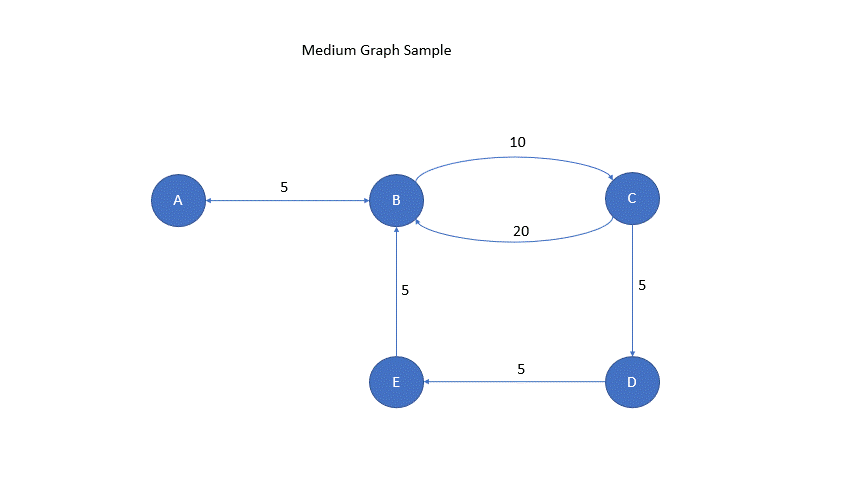
Medium Graph Sample
flowchart LR
    A --> |5 | B
    B --> |5 | A
    B --> |10| C
    C --> |5 | D
    C --> |20| B
    D --> |5 | E
    E --> |5 | B
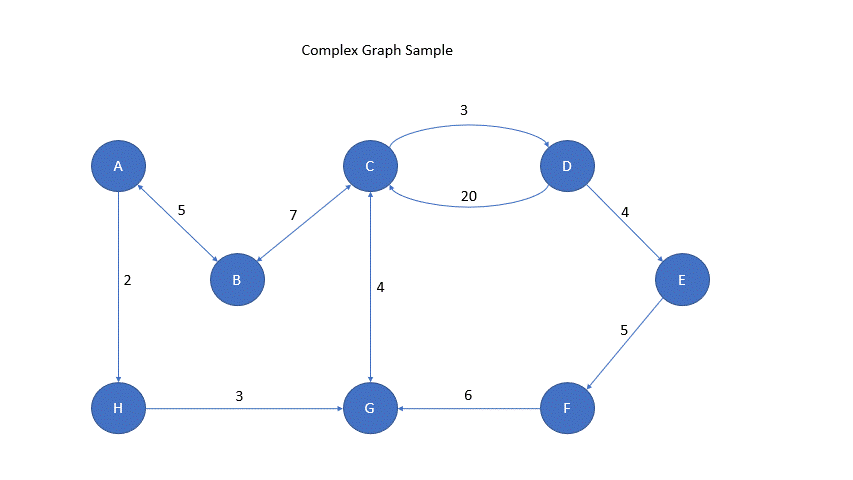
Complex Graph Sample
flowchart LR
    A --> |5 | B
    A --> |2 | H
    B --> |5 | A
    B --> |7 | C
    C --> |7 | B
    C --> |3 | D
    C --> |4 | G
    D --> |20| C
    D --> |4 | E
    E --> |5 | F
    G --> |4 | C
    H --> |3 | G
Questions
What is graph-pathfinding-algorithms?
rabestro/graph-pathfinding-algorithms is a public repo on GitHub by rabestro. Implementation and tests for graph pathfinding algorithms.
Is graph-pathfinding-algorithms open source?
It declares the MIT license on GitHub.
Does graph-pathfinding-algorithms run on macOS, Windows or Linux?
Its maker has not tagged a system, so it is unknown here. Its README says what it needs.
How do I install graph-pathfinding-algorithms?
Open "Take it" on its page: Take My Repo writes an install plan for your machine and hands it to your AI agent (Claude Code, Codex or Cursor), which asks you before each step. Take My Repo has not tested it on any machine.
Is graph-pathfinding-algorithms still maintained?
Its last change on GitHub was on 2026-06-14. Take My Repo does not judge from that whether it is maintained.
What do people who ran graph-pathfinding-algorithms say?
Nobody has reviewed it on Take My Repo yet, which says nothing about its quality.