Cirq
Python framework for creating, editing, and running Noisy Intermediate-Scale Quantum (NISQ) circuits.
- 5.1k
- Python
- Apache-2.0
- 3 d ago
Core principles of Quantum Physics and Quantum Computing
Repo rafaelfgx/QuantumComputing, read from GitHub 16 h ago. rafaelfgx has not joined Take My Repo.
rafaelfgx/QuantumComputing is a public repo on GitHub by rafaelfgx. Core principles of Quantum Physics and Quantum Computing. It declares the MIT license on GitHub. It is written mainly in Python, has 1 stars and last changed on 2026-11-11. Nobody has reviewed it on Take My Repo yet, which says nothing about its quality. Read from GitHub on 2026-11-23.
Python framework for creating, editing, and running Noisy Intermediate-Scale Quantum (NISQ) circuits.
It seems like magic, but it is simply nature and the universe in their most intrinsic and fundamental state!
The universe is not classical! Our intuition is limited, shaped by large, slow, and predictable scales!
When we go down to the fundamental level, reality is not deterministic! It is wave-like, probabilistic, and deeply relational!
For centuries, we tried to force the universe to think like classical machines! But now we do the opposite: we build machines that think like the universe itself!
Qubits are not tricks. Superposition is not a mystery. Entanglement is not a miracle. They are facts of nature!
Explore many possibilities simultaneously! It's like calculating multiple parallel universes and then collapsing into the correct result!
Simulate nature at its deepest and most intrinsic level, because everything that exists in the universe obeys quantum laws!
Simulate complex molecules, create new materials, and dramatically accelerate drug discovery!
For specific tasks, a quantum computer can solve problems in a fraction of the time (seconds, hours, days) that classical supercomputers would take millions or billions of years!
It can break current cryptography with ease, while at the same time making possible cryptography grounded in the very laws of physics - impossible to spy on or break without being detected!
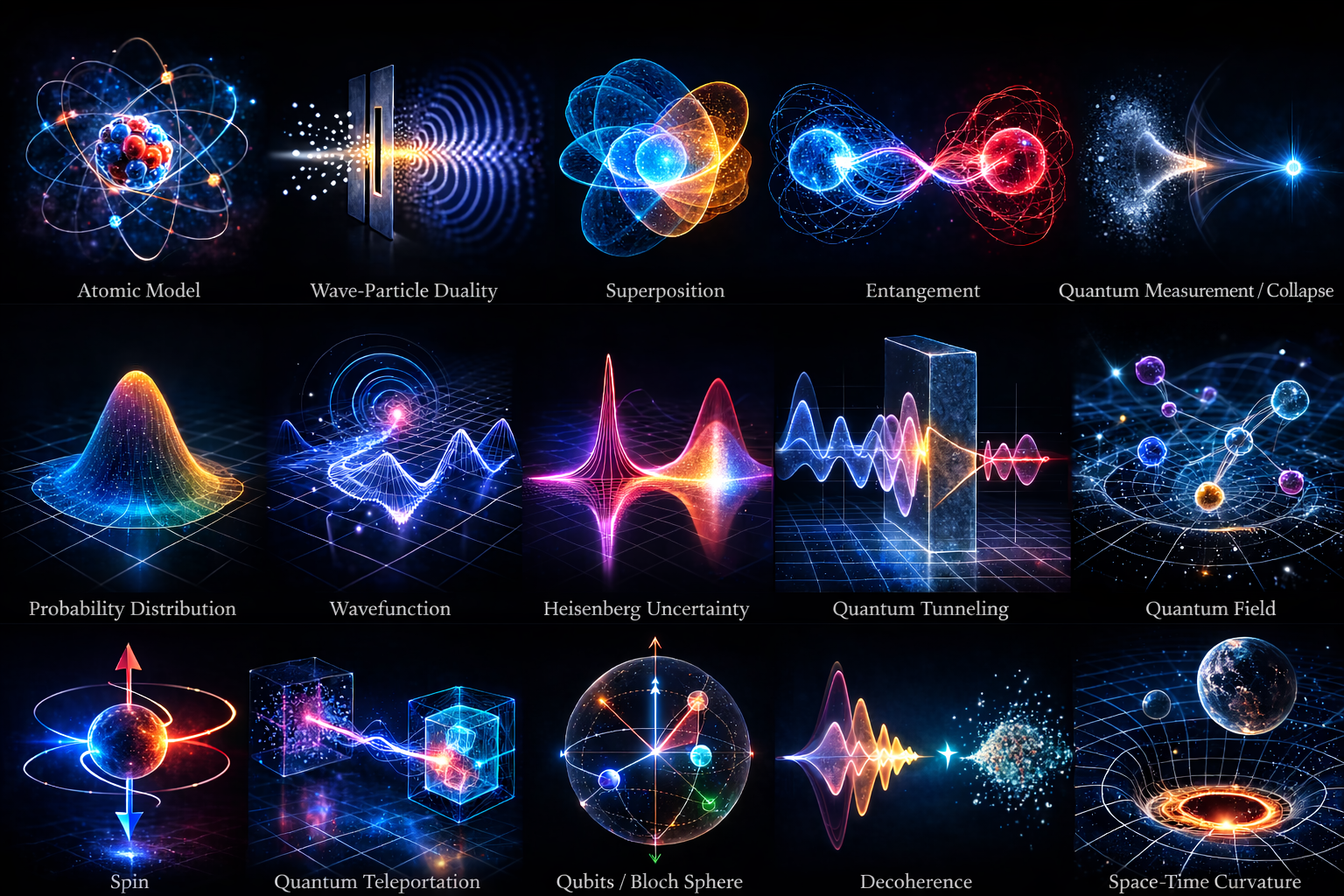
Definition: This principle states that bound physical systems possess only discrete energy levels. Transitions occur through the absorption or emission of fixed amounts called quanta.
Example: Electrons in an atom occupy specific orbitals. Moving between them requires a photon with the exact energy difference.
Analogy: This is similar to a staircase. One can stand on specific steps but never in the empty space between them.
Definition: Quantum entities such as photons or electrons exhibit both wave and particle properties depending on the experimental setup.
Example: In the Double-Slit Experiment electrons create an interference pattern as waves yet are detected at localized positions as particles.
Analogy: This is like a cylinder that appears as a circle from one side and a rectangle from another. It is a single object revealing different faces depending on the perspective.
Definition: An Observable is a measurable physical quantity such as position or momentum. An Operator is a mathematical function that acts on a quantum state to extract the value of that observable.
Example: Applying the Hamiltonian operator to the wave function of a hydrogen atom yields its allowed energy values.
Analogy: This is like using a thermometer to reveal the temperature of a room.
Definition: An Eigenstate is a specific state where the measurement of a particular observable yields a definite result. The Eigenvalue is that specific numerical result.
Example: An electron in an energy eigenstate always yields the same energy value upon measurement.
Analogy: This is like a radio preset. Selecting a specific station always provides that exact frequency.
Definition: Quantum mechanics uses the Born rule to predict the probability distribution of measurement outcomes rather than deterministic paths.
Example: The squared modulus of the wave function indicates the probability density of finding an electron in a particular region.
Analogy: This is like a heat map showing where a player spends time on a field instead of the exact coordinates at every second.
Definition: This is the fundamental partial differential equation that describes how the probability amplitude or wave function of a physical system evolves over time.
Example: This equation is used to determine the stationary states and allowed energy levels of an atom.
Analogy: This is like a weather model that predicts how a storm system will shift and develop over time across a map.
Definition: A quantum system can exist in a linear combination of all its possible states simultaneously until a measurement is performed.
Example: A qubit represents a coherent superposition of both 0 and 1 until it is read by a detector.
Analogy: This is like a spinning coin. It remains a blur of both heads and tails until the spinning stops.
Definition: Measurement causes a quantum system to transition from a superposition of multiple potential outcomes into a single eigenstate.
Example: An electron exists in a cloud of probabilities until detection forces the system to manifest in only one localized position.
Analogy: This is like a lottery draw. Before the draw every ticket is a potential winner but the act of drawing the number collapses all possibilities into a single reality.
Definition: This is a fundamental limit stating that non-commuting observables such as position and momentum cannot be known with arbitrary precision simultaneously.
Example: Increasing the accuracy of the position measurement necessarily increases the uncertainty in the momentum measurement.
Analogy: This is like a blurred motion photo. Capturing a clear image of the object freezes the motion while capturing the motion blurs the object.
Definition: This principle states that quantum objects possess mutually exclusive properties that require different experimental conditions to be observed.
Example: An experiment designed to determine which path a particle takes will destroy the wave interference pattern.
Analogy: This is like an optical illusion where two different perspectives are needed to see the whole picture but the focus can only remain on one at a time.
Definition: This rule states that no two identical fermions can occupy the same quantum state within a quantum system simultaneously.
Example: This principle explains the structure of the periodic table and why electrons occupy different shells in an atom.
Analogy: This is like a theater with numbered seats. Two people cannot sit in the same chair at once.
Definition: This is a phenomenon where particles become correlated such that the quantum state of each particle cannot be described independently of the others.
Example: Measuring the spin of one entangled particle instantly determines the spin of its partner regardless of the spatial separation.
Analogy: This is like magic gloves. Finding that the glove in one city is the right one instantly makes the glove in another city the left one.
Definition: This is a quantum mechanical process where a particle penetrates a potential energy barrier that is higher than its total energy.
Example: This allows nuclear fusion in the sun by enabling protons to overcome the Coulomb barrier.
Analogy: This is like a ghost walking through a wall. The particle simply appears on the other side without going over the top.

The primary unit of quantum information that utilizes quantum mechanical properties. It exists in a state representing multiple logical values simultaneously until observed.
The complete description of a quantum system at a specific moment. It encompasses all possible measurement probabilities and the relationship between its constituent parts.
A specialized symbolic language designed to represent quantum states and their interactions. It provides a standardized way to denote state vectors and their mathematical counterparts.
A fundamental value associated with a quantum state that determines the likelihood of the system collapsing into a specific outcome upon interaction with a measuring device.
The phenomenon where different computational paths overlap. This allows for the strategic reinforcement of correct solutions and the systematic cancellation of incorrect ones.
The continuous and reversible transformation of a quantum system over time. This process ensures that the total information within the system is preserved during computational operations.
A logical operation that modifies the state of qubits by applying specific physical interactions. It serves as the fundamental building block for constructing quantum algorithms.
The process of extracting information from a quantum system which causes the superposition to collapse. This forces the system into a single and definite classical state.
A fundamental principle of quantum mechanics stating that it is physically impossible to create an identical and independent replica of an arbitrary and unknown quantum state.
The unwanted interaction between a quantum system and its environment that leads to the decay of quantum properties. This effectively turns quantum information into classical noise.
A generalized framework used to describe the state of a quantum system. It is particularly effective for modeling mixed states that occur when a system is influenced by noise or environmental factors.
The measurable advantage in efficiency regarding time or memory that a quantum algorithm achieves over the most advanced classical algorithms for a specific problem.
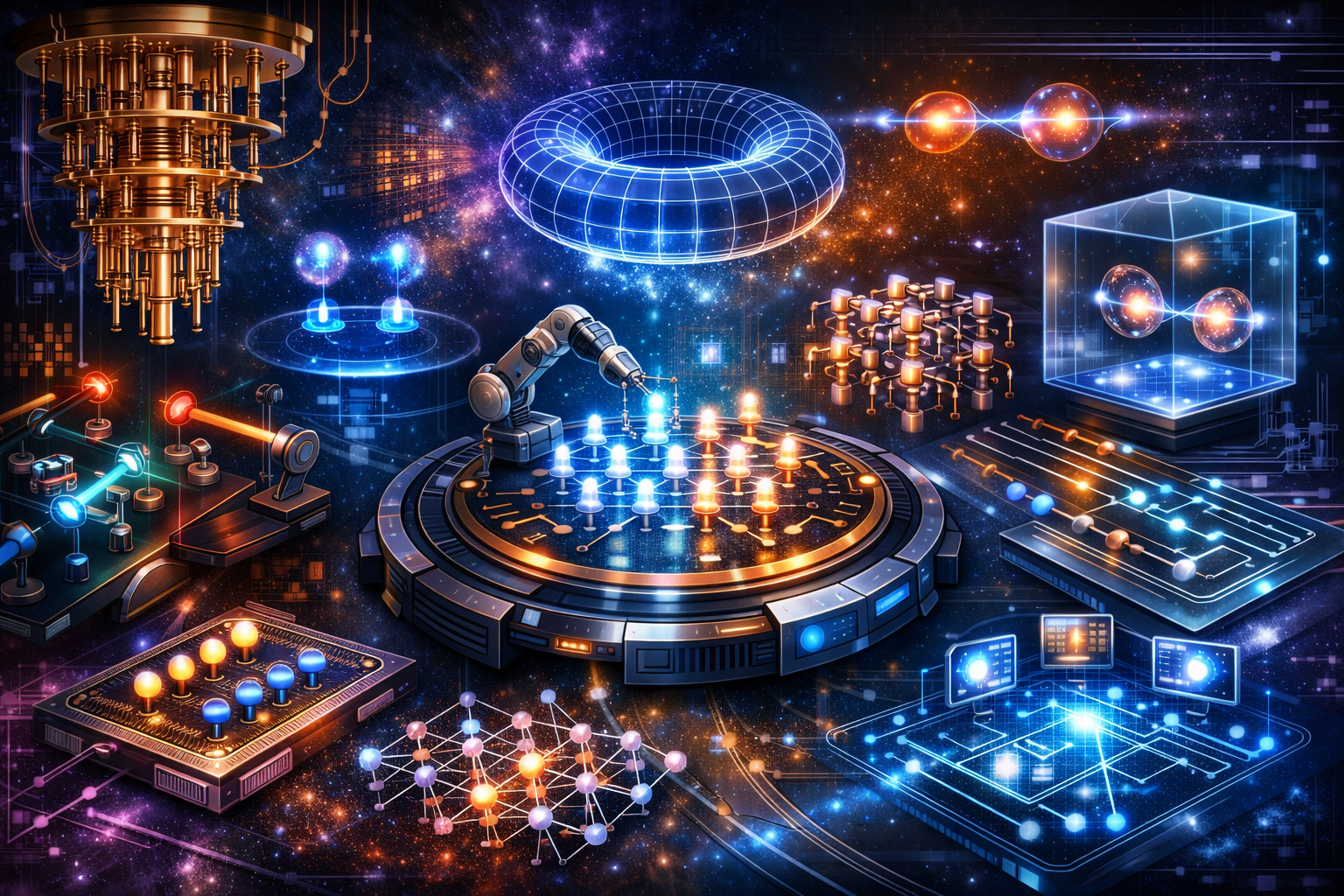
The various technological implementations used to create qubits such as superconducting circuits or trapped ions. Each method offers different advantages regarding stability and control.
The distinction between the actual hardware components and the error resistant units they form. Multiple physical qubits are often grouped together to create one stable logical qubit.
The hardware component that performs quantum operations on qubits. It serves as the physical engine of a quantum computer by executing logic gates and managing state transformations.
A hardware or logical structure composed of multiple qubits that work in unison. It stores and processes a high volume of information through collective quantum states.
A structured sequence of quantum gates and measurements organized to perform a computational task. It traces the flow of information from initialization to the final result.
The practice of executing a quantum circuit multiple times to collect statistical data. This is necessary because individual quantum results are probabilistic rather than deterministic.
A collection of protocols and codes designed to protect quantum information from noise. It functions by distributing logical data across multiple physical qubits to detect and fix errors.
A device capable of performing any quantum computation by applying a universal set of quantum gates to qubits. It represents the theoretical gold standard for general purpose quantum computing.
A robust approach to quantum computing that uses the topological properties of certain quasiparticles to store information. This method provides natural protection against environmental noise.
The use of quantum states to transmit data between different locations. This enables secure information exchange through unique properties like teleportation and cryptographic key distribution.
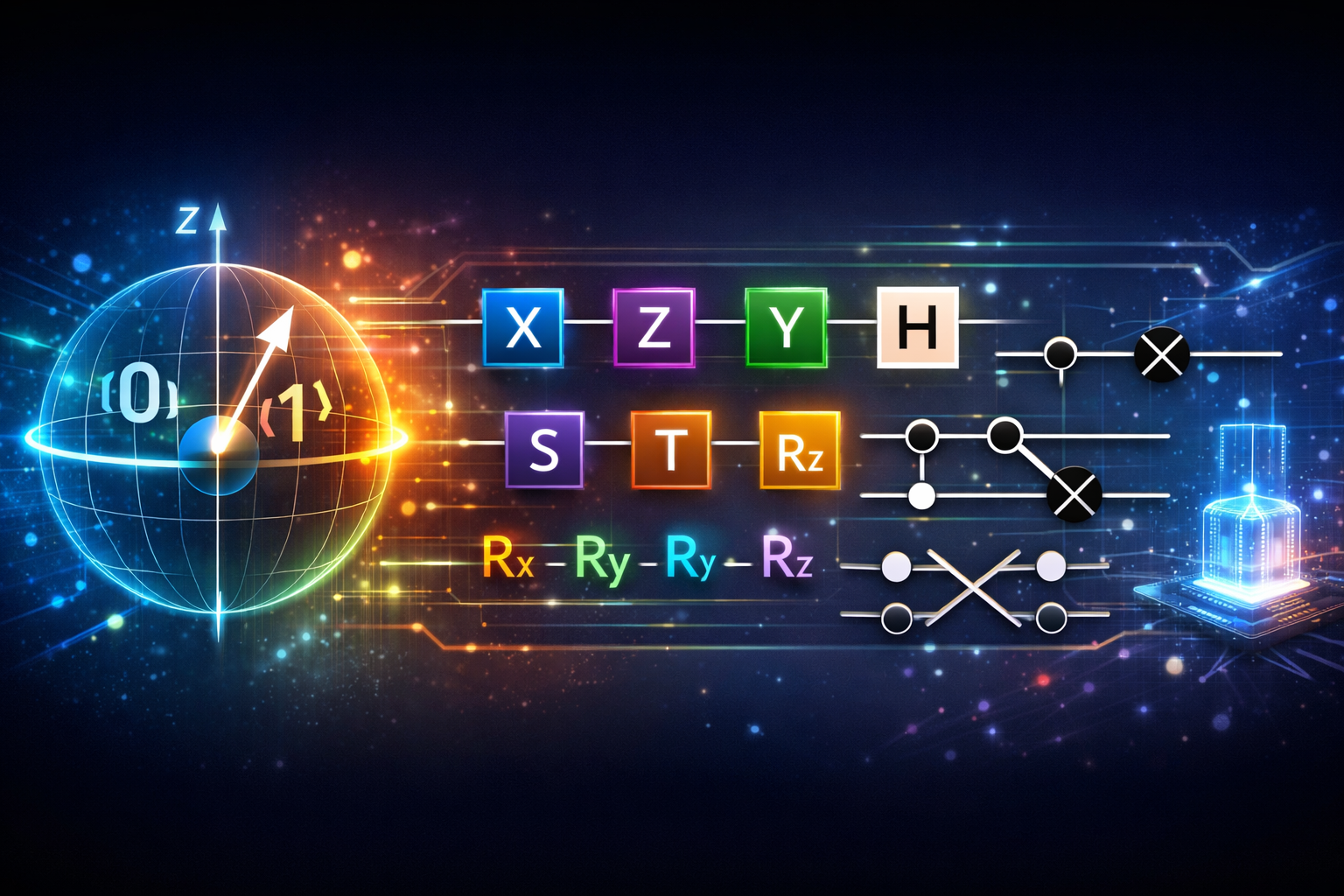
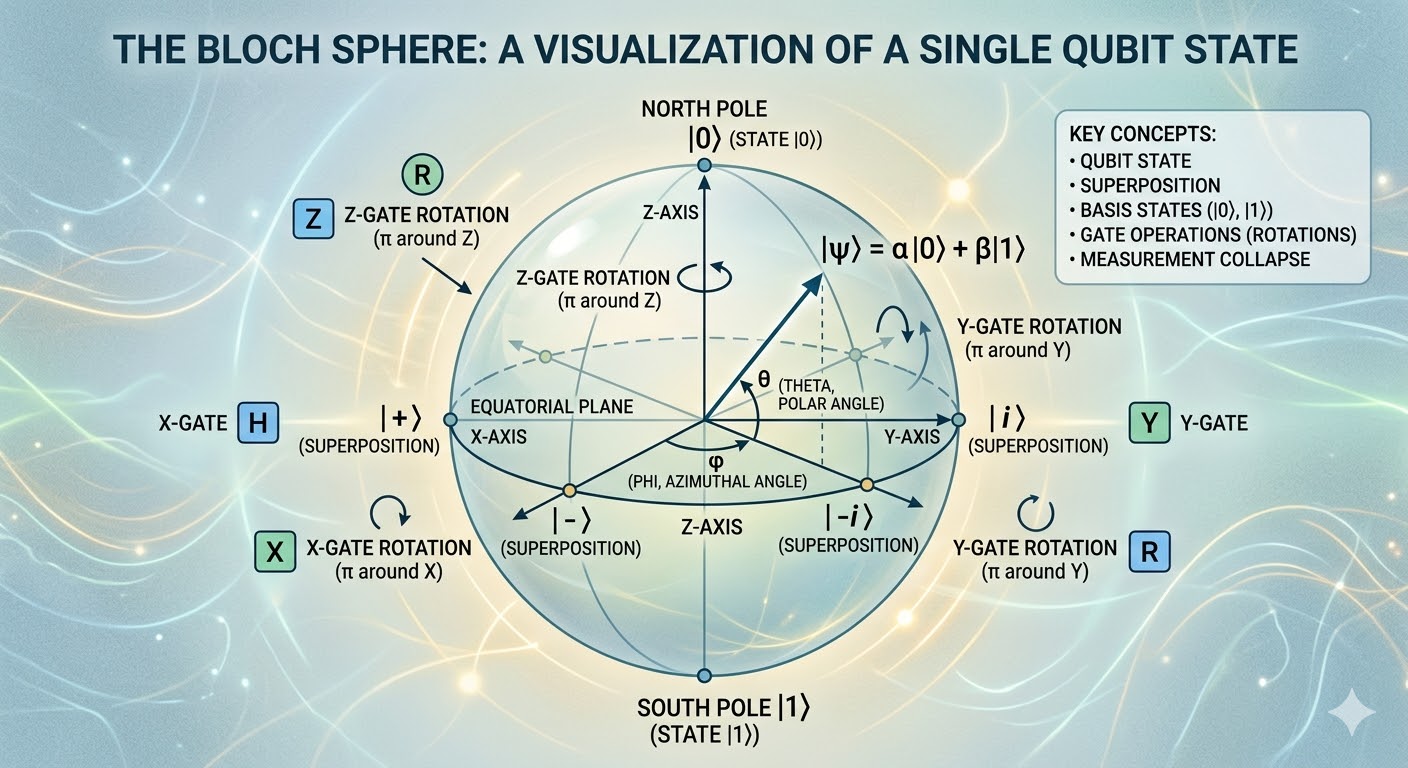
In quantum computing, quantum gates are unitary operations applied to qubits. They transform the quantum state of one or more qubits and are the fundamental building blocks of quantum circuits. A qubit state can be represented as |ψ⟩ = α|0⟩ + β|1⟩ where α and β are complex amplitudes.
Logical Purpose: Create superposition from computational basis states
Transformation: |0⟩ → (|0⟩ + |1⟩)/√2, |1⟩ → (|0⟩ − |1⟩)/√2
Logical Role: Enables quantum parallelism and interference and changes measurement basis
Common Uses: Initialization of algorithms, creating superposition registers, Grover's and Shor's algorithms
Logical Purpose: Flip the logical value of a qubit
Transformation: |0⟩ → |1⟩, |1⟩ → |0⟩
rafaelfgx/QuantumComputing is a public repo on GitHub by rafaelfgx. Core principles of Quantum Physics and Quantum Computing.
It declares the MIT license on GitHub.
Its maker has not tagged a system, so it is unknown here. Its README says what it needs.
Open "Take it" on its page: Take My Repo writes an install plan for your machine and hands it to your AI agent (Claude Code, Codex or Cursor), which asks you before each step. Take My Repo has not tested it on any machine.
List of Computer Science courses with video lectures.
Quantum circuit accelerator on classical silicon. 8 qubits, 238 gates, 200MHz. Because irony is a valid design methodology.
The quip network mining stack. This includes a coordinator and links all of the official quip network miners.
Its last change on GitHub was on 2026-11-11. Take My Repo does not judge from that whether it is maintained.
Nobody has reviewed it on Take My Repo yet, which says nothing about its quality.
Take My Repo cannot say: it does not audit code and has not run QuantumComputing. What is known comes from GitHub. It declares the MIT license on GitHub. Its last change was on 2026-11-11. It has 1 stars, which measure popularity, not safety. Nobody has reviewed it on Take My Repo yet, which says nothing about its quality. Read the source before you run it. With "Take it", your AI agent shows each step and asks you before running it; README text is treated as data, not as instructions.