M5-Forecasting-Accuracy
Deploying machine learning easily
- 4
- MIT
- 4 y ago
Repo raphaelsty/M5-Forecasting-Accuracy, read from GitHub 18 min ago. raphaelsty has not joined Take My Repo.
In short
raphaelsty/M5-Forecasting-Accuracy is a public repo on GitHub by raphaelsty. Deploying machine learning easily. It declares the MIT license on GitHub. It is written mainly in Jupyter Notebook, has 4 stars and last changed on 2023-05-01. Nobody has reviewed it on Take My Repo yet, which says nothing about its quality. Read from GitHub on 2026-11-25.
Similar repos

Hi,
Deploying and maintaining machine learning algorithms in a production environment is not an easy task. The drift of data over the time tends to degrade the performance of the algorithms because the models are static. Data Scientist re-train models from scratch to update them. This task is tedious and monopolizes highly qualified human resources.
I would like to present a solution to these problems. I will use online learning and the open-source Creme library (I am a core developer of Creme) to overcome the difficulties of deploying a machine learning model in production.
I will illustrate my point with data from the M5-Forecasting-Accuracy kaggle competition which is well suited to the use case of Creme. The objective of the M5-Forecasting-Accuracy competition is to estimate the daily sales of 30490 products for the next 28 days.
My goal is not to develop a competitive model, but to show the simplicity of an online learning model for an event-based dataset such as M5-Forecasting-Accuracy.
First of all, I would like to share with you the deployment process I follow to deploy a machine learning algorithm such as LightGBM or scikit-learn models for a task similar to the M5-Forecasting-Accuracy competition.
I will then compare the deployment of batch learning algorithms to the deployment of online learning algorithms. To do so, I will use the Creme and Chantilly libraries. I'll walk you through the entire process and deploy my API to predict the targets of the Kaggle competition M5-Forecasting-Accuracy.
Max Halford is the main developer of Creme and he's the one who initiated the project, he did a blog post here. This is a good introduction to the philosophy of online learning and especially Creme philosophy. Feel free to have a look at it if you are interested in the subject.

Model deployment when fitting data in one row:
Deploying a model that learns by batch requires a well-oiled organization. I describe here the process I followed to deploy this kind of algorithm in production. I would like to point out that we all had different experiences with deploying algorithms in production. You may not agree with all of the points I'm making.
I distinguish two main steps in the organization of the project when deploying a machine learning algorithm in production:
The prototyping phase phase is dedicated to the selection of the algorithm and the selection of the features to solve the problem.
The engineering phase phase is dedicated to the creation of robust machine learning systems. It aims at deploying the model in production, allows re-training the model on a regular basis.
Prototyping:
The first thing to do during the prototyping phase phase is to define a method for evaluating the quality of the model. Which objective do you want to optimize? Then you have to define a validation process. Usually this is cross-validation. After defining the validation process, the whole point is to find the most suitable model with carefully selected hyperparameters. Without forgetting the feature engineering stage, which is the key to most problems.
The prototyping step is difficult and exciting. We rely on our expertise in the field concerned, our creativity and our scientific culture.
Engineering:
It seems interesting to me to choose to deploy the product sales prediction algorithm behind an API. The API is a practical solution to allow the largest number of users and softwares to query the trained model.
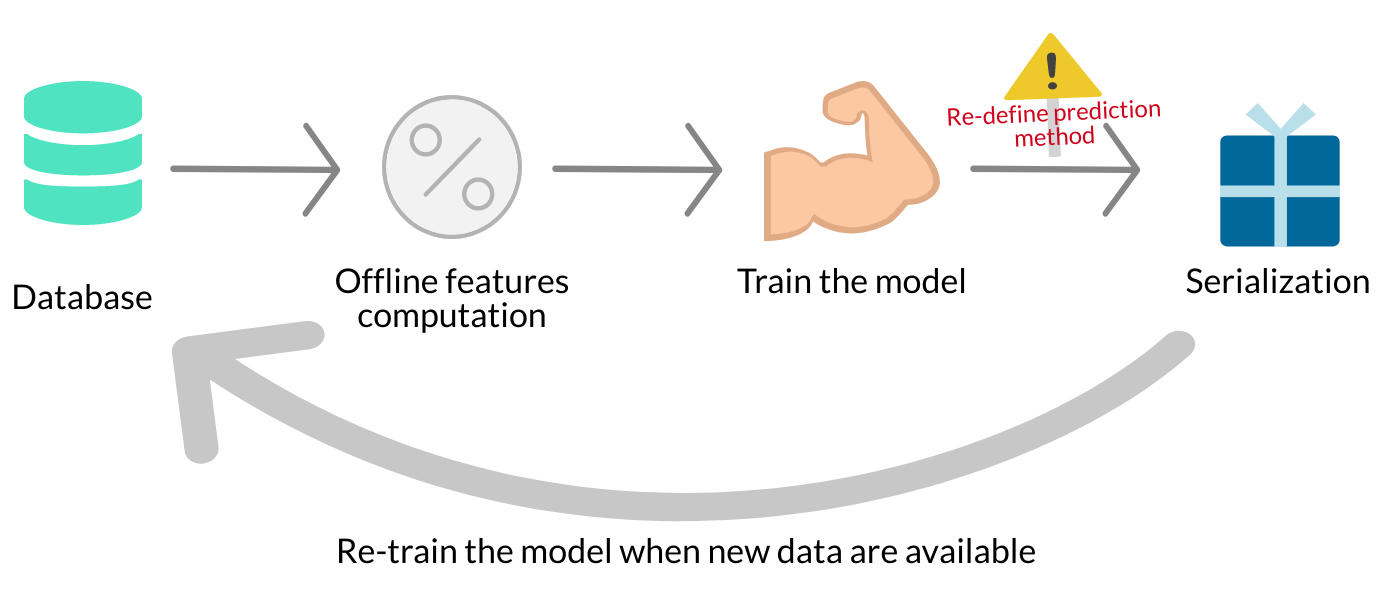
During the engineering phase I distinguish two modules. The first one is dedicated to the training of the model and its serialization. I call the first module Offline. The second one is dedicated to the behavior of the model in the production environment. I call this second module Online. I call it online because I host this second module in the cloud.
There is a lot of engineering work to ensure consistency between the offline training part and the online inference part. Any transformations that have been applied to the data during training must be applied to the data during the inference phase. This requires the development of code that is different from the training phase, but which produces the same results.
The development phase should lead to the creation of different sub-category modules:
Offline:
module 1: Script dedicated to the calculation of features for the model training. The feature computation should be vectorized to speed up the process.
module 2: Script for training, and evaluating the model. The training of the model is based on the features computed by the module 1.
module 3: Script dedicated to the serialization of the model. It is important to redefine the model prediction method before serializing the model. Libraries like Scikit-Learn do not develop models so that they can quickly make predictions for a single observation. You can find more information here. The sklearn-onnx library is an interesting solution to this problem. I already used treelite and this is a suitable alternative for LightGBM.
Online:
- module 4: Script for calculating features for the production environment. Usually the predictions in the production environment are made via the call of an API. The feature calculation should not be vectorized because it is performed for a single observation when calling the API. As a result, the source code of module 4 differs from the source code of module 1.
Deployment:
- Module 5: API definition. When a call is made, the API must load the serialized model, calculate the features using module 4 and make a prediction. The model could also be loaded into memory at API startup.

Tests:
- It is strongly recommended to integrate multiple unit tests such as unit tests for offline feature computation and unit test for online feature calculation. Non regression test to ensure that the offline model produces the same results as the online model are necessary too.
After deploying an algorithm in production, you will need to re-train the model regularly and maintain the architecture. Deploying a learning machine algorithm that learns by batch is tedious. It's a long-term project that requires a lot of rigor. Such a project represents a significant technological debt and monopolizes highly qualified human resources on a daily basis.
Model deployment with Creme and Chantilly
Creme is an online learning library. Creme allows to train machine learning models on data flows.
Each Creme model has a fit_one method. The fit_one method allows to update the model when there is a new observation available for training. Similar to neural networks, there is no need to re-train the model from scratch when new observations come in.
Creme is not a suitable solution for Kaggle. Learning in batch allows the model to converge faster. I won't choose Creme to get a medal on Kaggle. However, in everyday life, Creme is a viable and flexible solution for modeling a complex problem.
I am going to make a tutorial to show how to deploy in production a Creme algorithm trained to predict the target of the M5-Forecasting-Accuracy competition. I'll use the library Chantilly to deploy my solution in production. Chantilly is a library under development that allows you to easily deploy the models from Creme in production.
Here is what the data from the M5-Forecasting-Accuracy kaggle competition looks like after some pre-processing:
| id | date | y | |:------------------: |:----------: |:-: |:-: |:-: | | HOBBIES_1_001_CA_1 | 2016-04-25 | 1 | | HOBBIES_1_001_CA_2 | 2016-04-25 | 0 | | HOBBIES_1_001_CA_3 | 2016-04-25 | 3 |
The field id is composed of the product identifier HOBBIES_1_001 and the store identifier CA_1. The variable to be predicted is the variable y. My API will use the fields id and date to make predictions.
Prototyping
As usual, during the prototyping phase, I define the validation process and the measures used to evaluate the quality of the models I develop. Online learning allows to do progressive validation which is the online counterpart of cross-validation. The progressive validation allows to take into account the temporality of the problem. For reasons of simplicity, I choose to use the MAE metric to evaluate the quality of my model.
After a few tries on my side, I choose to train a KNNRegressor and a LinearRegression per product and per store to predict the number of sales. It represents 30490 * 2 models models. I will choose the best of the two models for each of the products thanks to the validation score.
Engineering
Install creme:
pip install creme
I'm importing the packages that I need to train my models
import copy
import collections
import datetime
import random
import tqdm
from creme import compose
from creme import feature_extraction
from creme import linear_model
from creme import metrics
from creme import neighbors
from creme import optim
from creme import preprocessing
from creme import stats
from creme import stream
I use this first function to parse the date and extract the number of the day.
def extract_date(x):
    """Extract features from the date."""
    import datetime
    if not isinstance(x['date'], datetime.datetime):
        x['date'] = datetime.datetime.strptime(x['date'], '%Y-%m-%d')
    x['wday'] = x['date'].weekday()
    return x
get_metadata allows you to extract the identifier of the product and the store where the product is sold.
def get_metadata(x):
    key = x['id'].split('_')
    x['item_id'] = f'{key[0]}_{key[1]}_{key[2]}'
    x['store_id'] = f'{key[3]}_{key[4]}'
    return x
Below I define the feature extraction pipeline. I use the module feature_extraction.TargetAgg to calculate the features on the target variable. I calculate many rolling averages with various window sizes. I use different aggregates to calculate these rolling averages.
extract_features = compose.TransformerUnion(

    compose.Select('wday'),

    feature_extraction.TargetAgg(by=['item_id'], how=stats.RollingMean(1)),
    feature_extraction.TargetAgg(by=['item_id'], how=stats.RollingMean(2)),
    feature_extraction.TargetAgg(by=['item_id'], how=stats.RollingMean(3)),
    feature_extraction.TargetAgg(by=['item_id'], how=stats.RollingMean(4)),
    feature_extraction.TargetAgg(by=['item_id'], how=stats.RollingMean(5)),
    feature_extraction.TargetAgg(by=['item_id'], how=stats.RollingMean(6)),
    feature_extraction.TargetAgg(by=['item_id'], how=stats.RollingMean(7)),

    feature_extraction.TargetAgg(by=['wday'], how=stats.RollingMean(1)),
    feature_extraction.TargetAgg(by=['wday'], how=stats.RollingMean(2)),
    feature_extraction.TargetAgg(by=['wday'], how=stats.RollingMean(3)),
    feature_extraction.TargetAgg(by=['wday'], how=stats.RollingMean(4)),
    feature_extraction.TargetAgg(by=['wday'], how=stats.RollingMean(5)),
    feature_extraction.TargetAgg(by=['wday'], how=stats.RollingMean(6)),
    feature_extraction.TargetAgg(by=['wday'], how=stats.RollingMean(7)),
    feature_extraction.TargetAgg(by=['wday'], how=stats.RollingMean(8)),
    feature_extraction.TargetAgg(by=['wday'], how=stats.RollingMean(9)),
    feature_extraction.TargetAgg(by=['wday'], how=stats.RollingMean(10)),
    feature_extraction.TargetAgg(by=['wday'], how=stats.RollingMean(11)),
    feature_extraction.TargetAgg(by=['wday'], how=stats.RollingMean(12)),
    feature_extraction.TargetAgg(by=['wday'], how=stats.RollingMean(13)),
    feature_extraction.TargetAgg(by=['wday'], how=stats.RollingMean(14)),
    feature_extraction.TargetAgg(by=['wday'], how=stats.RollingMean(15)),
    feature_extraction.TargetAgg(by=['wday'], how=stats.RollingMean(16)),
    feature_extraction.TargetAgg(by=['wday'], how=stats.RollingMean(17)),
    feature_extraction.TargetAgg(by=['wday'], how=stats.RollingMean(18)),
    feature_extraction.TargetAgg(by=['wday'], how=stats.RollingMean(19)),
    feature_extraction.TargetAgg(by=['wday'], how=stats.RollingMean(20)),
    feature_extraction.TargetAgg(by=['wday'], how=stats.RollingMean(25)),
    feature_extraction.TargetAgg(by=['wday'], how=stats.RollingMean(30)),
)
I will train two models per product and per store, which represents 30490 * 2 models. The first model is a KNeighborsRegressor. The second is a linear model. I noticed that these two models are complementary. I will select the best of the two models for each product as the model I will deploy in production.
The code below allows me to declare my two pipelines, the first one dedicated to KNN and the second one to the linear model.
# Init pipeline dedicated to KNN
knn = (
    compose.FuncTransformer(get_metadata) |
    compose.FuncTransformer(extract_date) |
    extract_features |
    preprocessing.StandardScaler() |
    neighbors.KNeighborsRegressor(window_size=30, n_neighbors=15, p=2)
)


# Init pipeline dedicated to linear model
lm = (
    compose.FuncTransformer(get_metadata) |
    compose.FuncTransformer(extract_date) |
    extract_features |
    preprocessing.MinMaxScaler() |
    linear_model.LinearRegression(optimizer=optim.SGD(0.005), intercept_lr=0.001)
)
Questions
What is M5-Forecasting-Accuracy?
raphaelsty/M5-Forecasting-Accuracy is a public repo on GitHub by raphaelsty. Deploying machine learning easily.
Is M5-Forecasting-Accuracy open source?
It declares the MIT license on GitHub.
Does M5-Forecasting-Accuracy run on macOS, Windows or Linux?
Its maker has not tagged a system, so it is unknown here. Its README says what it needs.
How do I install M5-Forecasting-Accuracy?
Open "Take it" on its page: Take My Repo writes an install plan for your machine and hands it to your AI agent (Claude Code, Codex or Cursor), which asks you before each step. Take My Repo has not tested it on any machine.