The-Pelican-Test
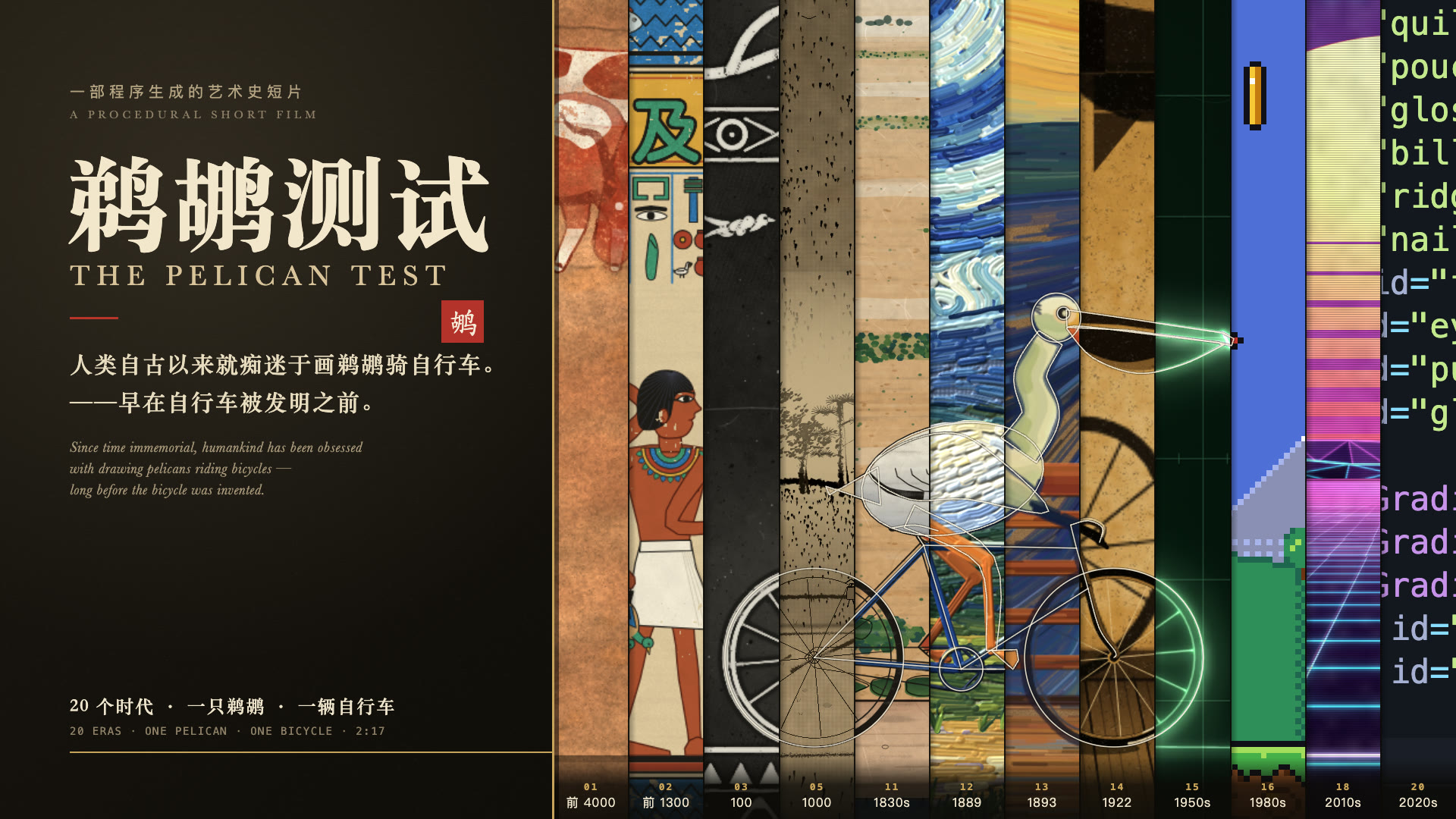
《鹈鹕测试》一只鹈鹕骑着自行车穿越二十个时代的艺术史——画面与音乐全部由代码生成 · A 2:17 film drawn and scored entirely by code: a pelican rides a bicycle through 20 eras of art
- 106
- JavaScript
- MIT
- 5 wk ago
Visual exploration of large art corpora for art history — DINOv3, SigLIP 2, e-means, UMAP, FAISS, MCP. Maps 80,716 WikiArt works on one PC. By Riyadh HADJBA, art history student, University of Strasbourg.
Repo riyadhHDA/pixplot-v2, read from GitHub 14 min ago. riyadhHDA has not joined Take My Repo.
riyadhHDA/pixplot-v2 is a public repo on GitHub by riyadhHDA. Visual exploration of large art corpora for art history — DINOv3, SigLIP 2, e-means, UMAP, FAISS, MCP. Maps 80,716 WikiArt works on one PC. By Riyadh HADJBA, art history student, University of Strasbourg. It declares the GPL-3.0 license on GitHub. It is written mainly in Python, has 0 stars and last changed on 2026-11-23. Nobody has reviewed it on Take My Repo yet, which says nothing about its quality. Read from GitHub on 2026-11-24.
《鹈鹕测试》一只鹈鹕骑着自行车穿越二十个时代的艺术史——画面与音乐全部由代码生成 · A 2:17 film drawn and scored entirely by code: a pelican rides a bicycle through 20 eras of art
English · Français · Project website
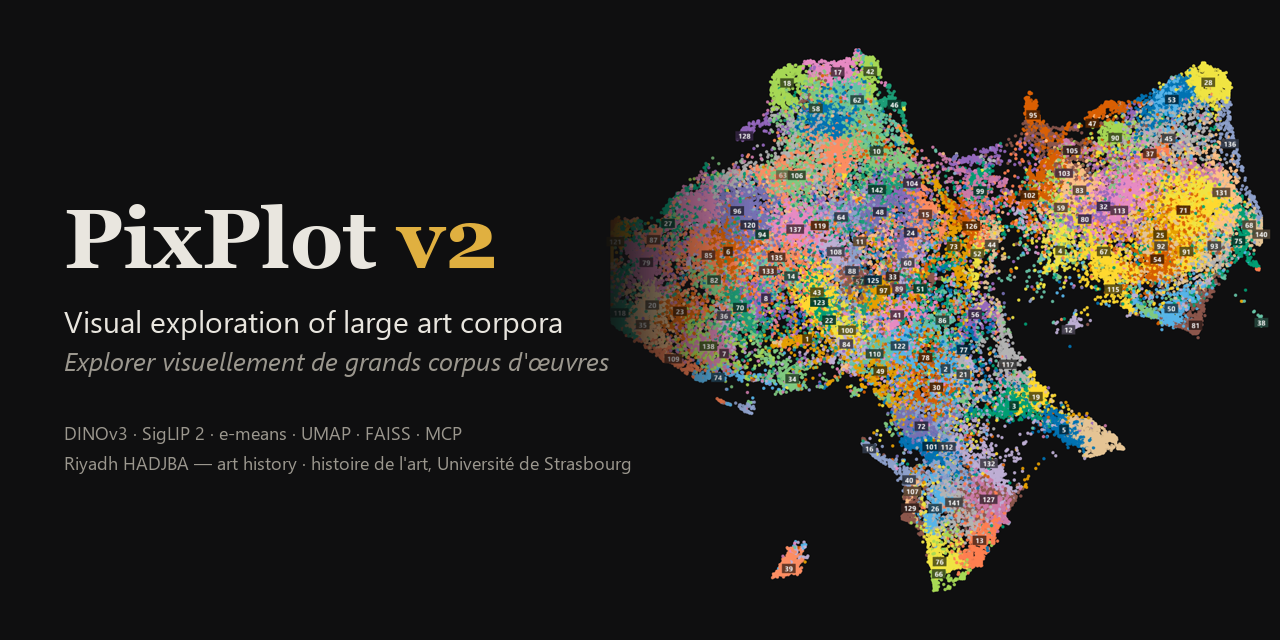
PixPlot v2 is a local tool for exploring large art-history image collections by visual similarity. It rewrites the idea behind the Yale DHLab's PixPlot (2018) from scratch around current vision models (DINOv3, SigLIP 2) so the whole workflow runs on a single desktop PC.
Because the models only see pixels, a high similarity score never proves influence or attribution. The tool keeps roles separate: PixPlot computes and indexes, an MCP assistant can help search and compare, and verification stays with the historian.
Start from a folder of images, a museum IIIF collection or a dataset such as WikiArt, with or without metadata. PixPlot then answers art historians' questions. The examples come from WikiArt 81k; every result is a lead to check, not a conclusion.
| Your question | What PixPlot does | Example on WikiArt |
|---|---|---|
| Who copied, quoted or reworked whom? | Nearest neighbours under four regards, a comparator and a "Pourquoi ?" button that shows the zones answering each other. | Van Gogh's Sower finds Millet's at rank 1; so does Rubens's copy of Titian's Rape of Europa. |
| Where does this motif come back? | Search for a detail drawn on an image, or for a zone described in words, across 1.6 million zones. | "A halo", "a skull", "a blessing hand": the exact zone is framed in every work found. |
| Which works deal with this theme? | Free-text search (French or English) and conceptual axes: the whole corpus placed between two words. | "Annunciation in a garden"; the corpus laid out between "sacred" and "profane". |
| Is my catalogue reliable? | A To check list of labels contradicted by all neighbours, and duplicate detection. | 4,884 labels to check; 839 works entered twice, 702 of them under two different styles (the same Corot as "Romantic" and "Realist"). |
| What brings these two works together? | The same pair seen through form, subject, colour and touch; disagreements between regards (same composition, different subject…). | A layout reused for another theme; one subject painted by two hands. |
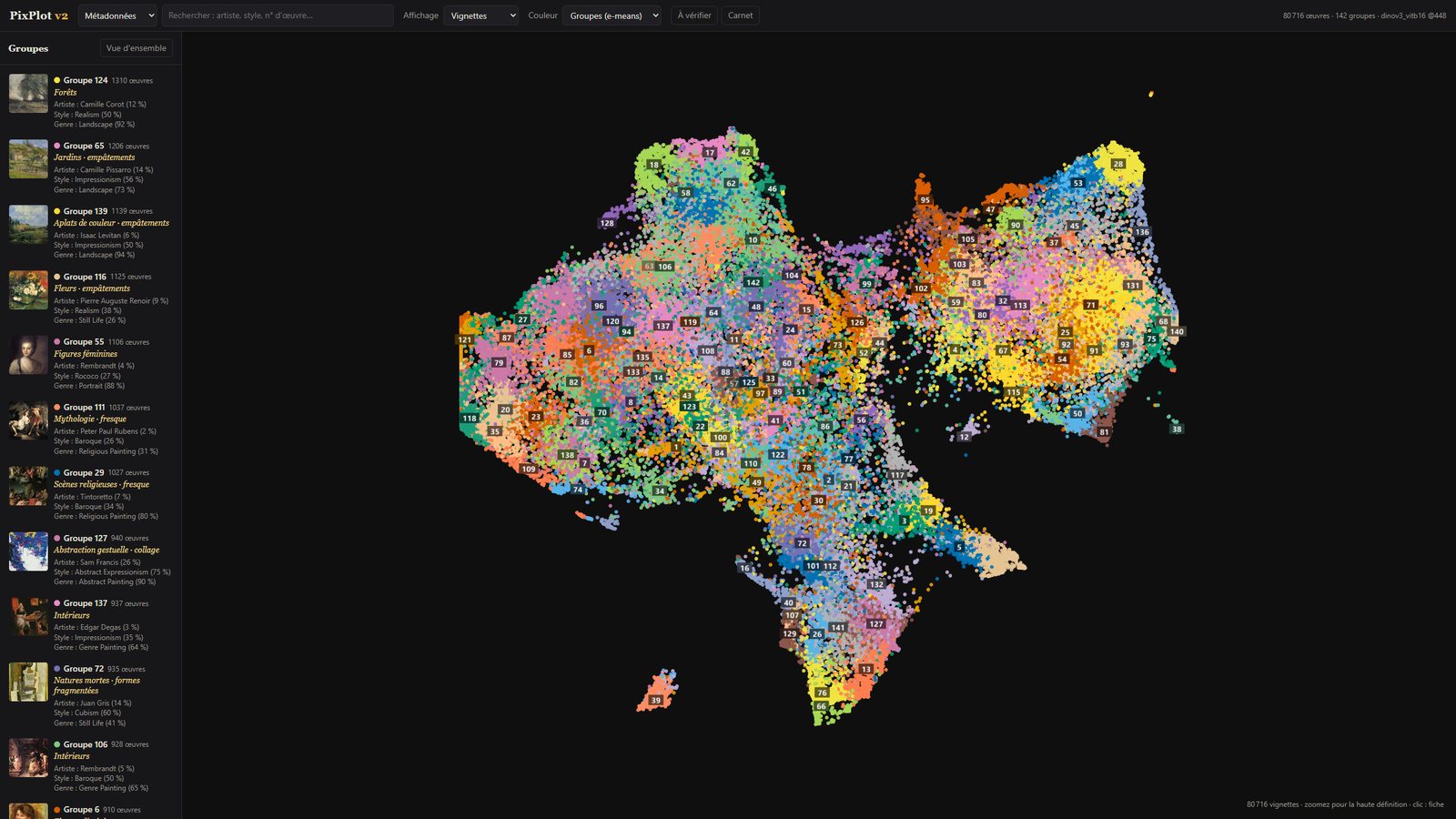
| What is my corpus made of? | A map of named groups (art-history vocabulary and Iconclass), combined filters, timeline and geographic views, a report on what is missing. | "Baroque" + "portrait" = 980 works, lit up on the map in 14 ms. |
| How do I keep track of my research? | A research notebook, Research Pack export (.zip: images, sourced metadata, scores, method, corpus datasheet) and an assistant plugged in through MCP that searches and compares with you. | A file ready for a seminar, a thesis or a colleague's review. |
| Which model sees what? | Benchmarks on pairs validated by the historian; every model has a card (training data, biases). | Four models set aside after measurement (TIPSv2, PE-Spatial, SSCD, Depth Anything), figures published (ARCHITECTURE § 19, 24, 27, 28). |
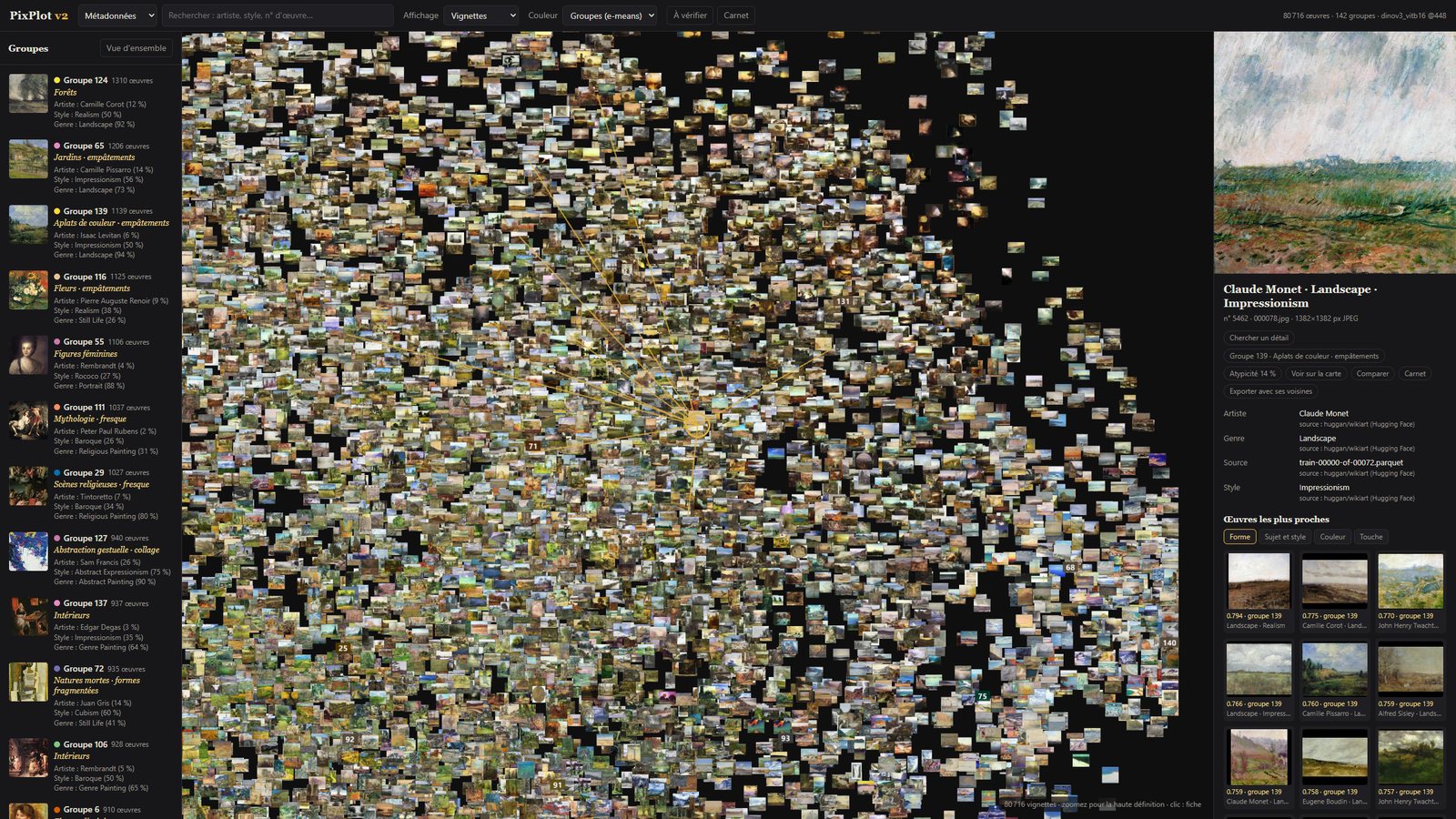
All of WikiArt (80,716 artworks, 81,444 images, 33.7 GB) runs end to end in ≈ 1 h 21 on a Windows 11 PC with an AMD Radeon RX 7900 GRE and 16 GB of RAM: ingestion, DINOv3 and SigLIP 2 embeddings, an index of 1.58 million image regions, clustering, map layout, blind audit and benchmark. The Atlas opens in roughly 3 seconds with all thumbnails rendered, and a text or detail query returns in 0.25 s.
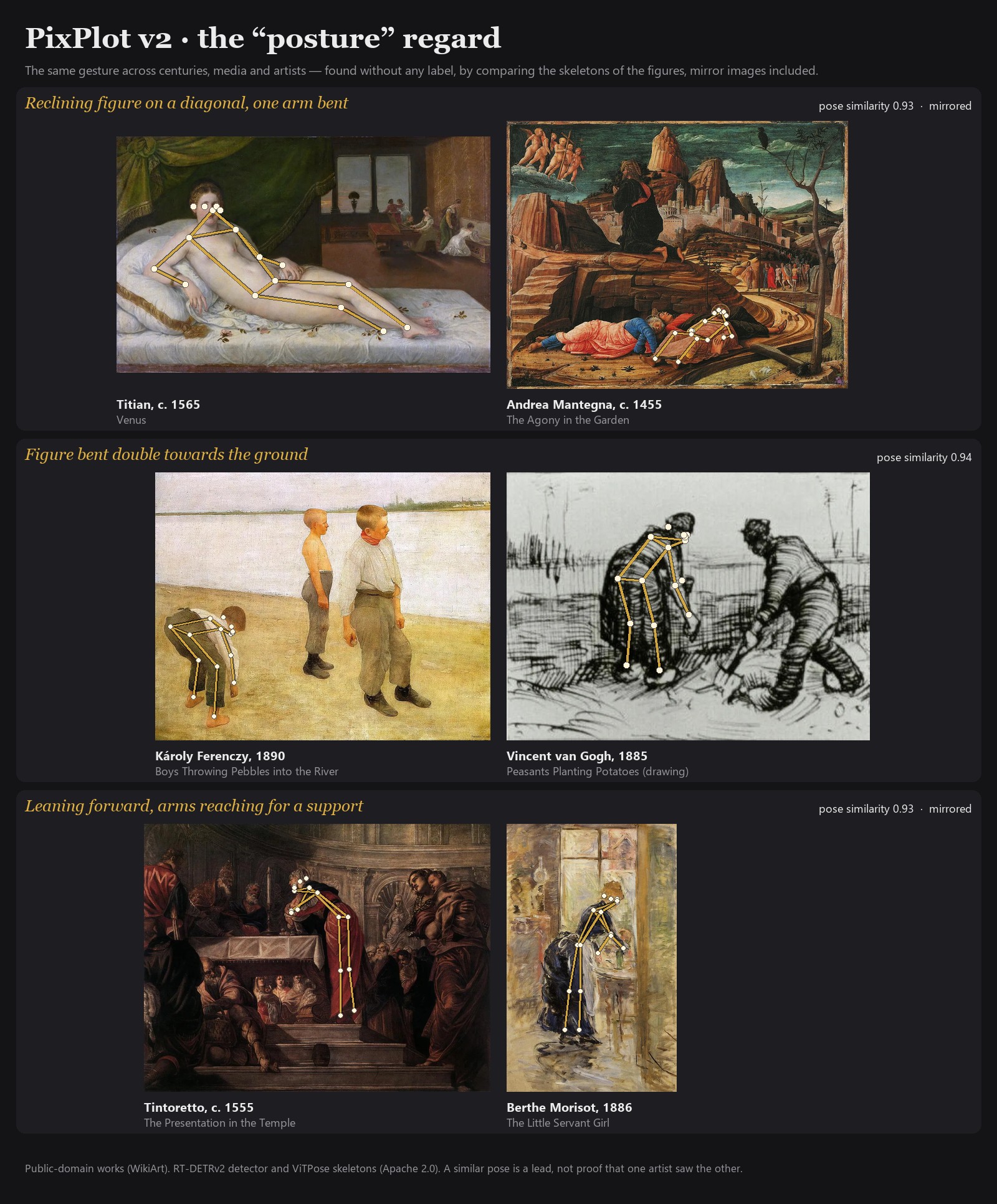
The "posture" regard (on trial) finds the figures, estimates their skeletons and compares the poses, mirror images included. Without any label, it brings a Venus by Titian close to Mantegna's sleeping apostle, or a boy by Ferenczy close to a peasant woman drawn by Van Gogh: gestural formulas (Aby Warburg's Pathosformeln) that the other regards do not see. Of 37 "same gesture" pairs it proposed, 25 were validated on review. A similar pose remains a lead, not proof that one artist saw the other (ARCHITECTURE § 35).
| Four separate spaces | Form (DINOv3: silhouettes, layout), subject (SigLIP 2: theme, genre, school), colour (CIELAB palette) and touch (brushwork and grain from DINOv3 layer 6). Comparing spaces helps see why two works match or diverge. |
| Search | By metadata, by free text in French or English (SigLIP 2), by described zone ("a halo", "a skull" across 1.6M regions) or by detail by drawing a box directly on a painting. |
| Groups | Spherical clustering (e-means) and nested Leiden communities, with tentative names proposed from an art-history vocabulary. |
| Web Atlas | Interactive offline deck.gl map, records with sourced metadata and neural-free visual measures (balance, symmetry, chromatic entropy, after Stork), a comparator (up to six works with a "Pourquoi ?" zone matcher), combined filters (artist, style, genre, group…), a research notebook, one map per space, 2D conceptual axes on two words (after 2D CLIP), plus timeline and geographic views (typed/dated places, offline world map). |
| Catalogue audit | Blind audit (pixels only), a To check list of works whose label is contradicted by all their neighbours (either a cataloguing error or an unusual work) and duplicates: works entered twice and their variants (pixplot doublons). |
| IIIF museum imports | pixplot import-iiif ingests IIIF v2/v3 manifests and collections with normalised metadata and rights fields. |
| MCP server (20 tools) | Connects Claude or any compatible assistant to search, inspect images and crops, compare works, run visual measures, probe conceptual axes and add notes to the notebook. |
| Traceability | Every computation is saved in a dated run (manifest.json with model, parameters and parent run). Exporting a Research Pack (.zip) bundles images, sourced metadata and scores. |
Across all 80,716 works (ARCHITECTURE.md § 11–12), share of the 10 nearest neighbours carrying the same label as the query work:
| Space | artist | style | genre | Pointillism | Fauvism |
|---|---|---|---|---|---|
| form (DINOv3) | 33.9% | 52.4% | 76.8% | 21% | 20% |
| subject (SigLIP 2) | 42.9% | 62.0% | 79.5% | 44% | 26% |
| touch | 35.0% | 49.6% | 62.8% | 62% | 30% |
"Artist" column recomputed on 2026-11-19 over 1,090 artists, after recovering the artist of 35,185 "Unknown Artist" works through MMArt (§ 34): the task is harder than with 129 artists (before: 50.8 / 61.6 / 53.0%); the ranking of the regards does not change.
python -m venv .venv
.venv\Scripts\activate                 # Linux / macOS: source .venv/bin/activate
pip install -e ".[dev,ml]"             # install PyTorch first (AMD ROCm wheels): docs/INSTALL_GPU.md
pytest

pixplot ingest "D:/MyImages"           # catalogue, thumbnails, duplicates
pixplot import-metadata meta.csv       # artist, date, style… ("path" column required)
pixplot embed                          # DINOv3 vectors (GPU), resumable
pixplot analyze                        # groups, UMAP map, neighbourhoods
pixplot serve --open                   # opens the Atlas at http://127.0.0.1:8765
To run the whole pipeline at once with a timed log: bash scripts/full_pipeline.sh data/my_corpus "My source".
pixplot doctor                          # Python, PyTorch, GPU
pixplot import-iiif URL --out D:/Museum # museum collection (IIIF v2/v3 manifest or collection)
pixplot embed --encoder siglip2_so400m  # text↔image space ("subject")
pixplot embed --encoder dinov3_vitb16_texture   # "touch" space
pixplot embed --encoder color_lab       # "colour" space (no GPU)
pixplot embed --encoder colorhist       # whole pipeline without GPU, for testing
pixplot index [--encoder NAME]          # FAISS index of the latest run
pixplot index --regions                 # region index → "Search a detail" in the Atlas
pixplot maps                            # one UMAP map per space (subject, colour, touch)
pixplot communities                     # nested Leiden communities (families ⊃ groups) per space
pixplot disagreements                   # pairs close in one space and far in another
pixplot zonebench                       # searching a region with words: RichArt benchmark
pixplot zones                           # region index (20 per work, SigLIP 2): "a halo", "a skull"
pixplot corpus                          # corpus report: missing metadata, model bias cards
pixplot places --derive                 # typed and dated places derived from metadata
pixplot import-places places.csv        # typed and dated places from CSV
pixplot name-groups                     # name groups (SigLIP 2 + art-history vocabulary)
pixplot suspects                        # labels contradicted by all neighbours
pixplot search-text "Annunciation in a garden"
pixplot similar 42 --html sheet.html    # nearest neighbours as an HTML sheet
pixplot audit                           # blind audit against labels
pixplot bench                           # compare runs (labels, known pairs)
pixplot pairs generate | bench          # pair benchmark: which space finds which kind of kinship
pixplot pack --text "Annunciation" -k 20 --question "…"   # Research Pack (.zip)
pixplot corpus --datasheet                                  # corpus datasheet (provenance, rights, gaps; in French)
pixplot mcp                             # MCP server: see docs/MCP.md
pixplot status
riyadhHDA/pixplot-v2 is a public repo on GitHub by riyadhHDA. Visual exploration of large art corpora for art history — DINOv3, SigLIP 2, e-means, UMAP, FAISS, MCP. Maps 80,716 WikiArt works on one PC. By Riyadh HADJBA, art history student, University of Strasbourg.
It declares the GPL-3.0 license on GitHub.
Its maker has not tagged a system, so it is unknown here. Its README says what it needs.
Open "Take it" on its page: Take My Repo writes an install plan for your machine and hands it to your AI agent (Claude Code, Codex or Cursor), which asks you before each step. Take My Repo has not tested it on any machine.
Open Source Computer Vision Library
江山时序 · 中国历史交互地图时间轴 (403 BCE – Present) | Interactive Historical Atlas of China across 18 dynasties, 198 territory snapshots, ancient-to-modern place genealogy & classical poetry routes
The agent harness performance optimization system. Skills, instincts, memory, security, and research-first development for Claude Code, Codex, Opencode, Cursor and beyond.
Reverse engineer anything with agents, from app behavior down to native binaries.
Its last change on GitHub was on 2026-11-23. Take My Repo does not judge from that whether it is maintained.
Nobody has reviewed it on Take My Repo yet, which says nothing about its quality.
Take My Repo cannot say: it does not audit code and has not run pixplot-v2. What is known comes from GitHub. It declares the GPL-3.0 license on GitHub. Its last change was on 2026-11-23. It has 0 stars, which measure popularity, not safety. Nobody has reviewed it on Take My Repo yet, which says nothing about its quality. Read the source before you run it. With "Take it", your AI agent shows each step and asks you before running it; README text is treated as data, not as instructions.