coding-interview-university
A complete computer science study plan to become a software engineer.
- 365k
- CC-BY-SA-4.0
- 2 wk ago
Concurrent trie-hash map library
Repo rmind/thmap, read from GitHub 6 h ago. rmind has not joined Take My Repo.
rmind/thmap is a public repo on GitHub by rmind. Concurrent trie-hash map library. It declares the BSD-2-Clause license on GitHub. It is written mainly in C, has 96 stars and last changed on 2023-10-30. Nobody has reviewed it on Take My Repo yet, which says nothing about its quality. Read from GitHub on 2026-11-23.
Concurrent trie-hash map library -- a general purpose associative array, combining the elements of hashing and radix trie. Highlights:
The implementation is written in C11 and distributed under the 2-clause BSD license.
NOTE: Delete operations (the key/data destruction) must be synchronised with the readers using some reclamation mechanism. You can use the Epoch-based Reclamation (EBR) library provided HERE.
References (some, but not all, key ideas are based on these papers):
thmap_t *thmap_create(uintptr_t baseptr, const thmap_ops_t *ops, unsigned flags)
ops parameter can
used to set the custom allocate/free operations (see the description
of thmap_ops_t below). In such case, the baseptr is the base (start)
address of the address space mapping (it must be word-aligned). If ops
is set to NULL, then malloc(3) and free(3) will be used as the
default operations and baseptr should be
set to zero. Currently, the supported flags are:THMAP_NOCOPY: the keys on insert will not be copied and the given
pointers to them will be expected to be valid and the values constant
until the key is deleted; by default, the put operation will make a
copy of the key.THMAP_SETROOT: indicate that the root of the map will be manually
set using the thmap_setroot routine; by default, the map is initialised
and the root node is set on thmap_create.void thmap_destroy(thmap_t *hmap)
void *thmap_get(thmap_t *hmap, const void *key, size_t len)
NULL if the key is not found (see the caveats section).void *thmap_put(thmap_t *hmap, const void *key, size_t len, void *val)
val to test whether the insert was successful.void *thmap_del(thmap_t *hmap, const void *key, size_t len)
NULL. The memory associated with the entry is
not released immediately, because in the concurrent environment (e.g.
multi-threaded application) the caller may need to ensure it is safe to
do so. It is managed using the thmap_stage_gc and thmap_gc routines.void *thmap_stage_gc(thmap_t *hmap)
thmap_gc. Not calling the
G/C function for the returned reference would result in a memory leak.void thmap_gc(thmap_t *hmap, void *ref)
thmap_stage_gc.If the map is created using the THMAP_SETROOT flag, then the following
functions are applicable:
void thmap_setroot(thmap_t *thmap, uintptr_t root_offset)
thmap_ops_t::alloc routine. Return 0 on success
and -1 on failure (if already set).uintptr_t thmap_getroot(const thmap_t *thmap)
The thmap_ops_t structure has the following members:
uintptr_t (*alloc)(size_t len)len. The address must be relative to the
base address specified during map creation and must be word-aligned.void (*free)(uintptr_t addr, size_t len)len
is guaranteed to match the original allocation length.Internally, offsets from the base pointer are used to organise the access
to the data structure. This allows user to store the data structure in the
shared memory, using the allocation/free functions. The keys will also be
copied using the custom functions; if THMAP_NOCOPY is set, then the keys
must belong to the same shared memory object.
The implementation was extensively tested on a 24-core x86 machine, see the stress test for the details on the technique.
The implementation uses pointer tagging and atomic operations. This requires the base address and the allocations to provide at least word alignment.
While the NULL values may be inserted, thmap_get and thmap_del
cannot indicate whether the key was not found or a key with a NULL value
was found. If the caller needs to indicate an "empty" value, it can use a
special pointer value, such as (void *)(uintptr_t)0x1.
The library has been benchmarked using different key profiles (8 to 256 bytes), set sizes (hundreds, thousands, millions) and ratio between readers and writers (from 60:40 to 90:10). In all cases it demonstrated nearly linear scalability (up to the number of cores). Here is an example result when matched with the C++ libcuckoo library:
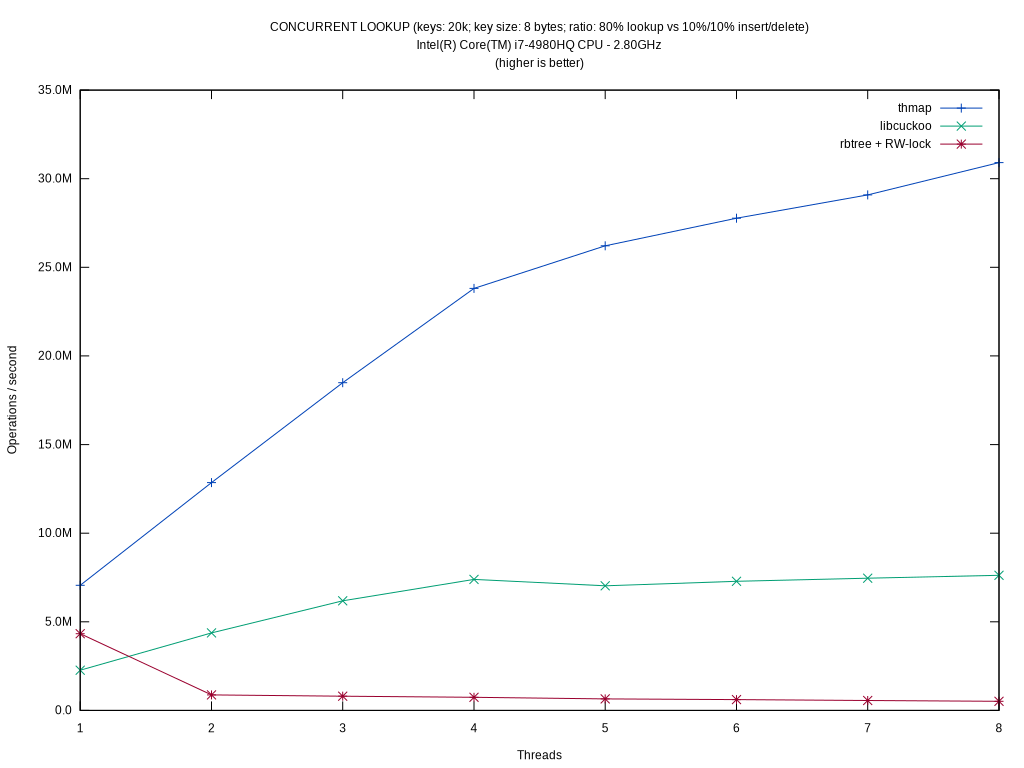
Disclaimer: benchmark results, however, depend on many aspects (workload, hardware characteristics, methodology, etc). Ultimately, readers are encouraged to perform their own benchmarks.
Simple case backed by malloc(3), which could be used in multi-threaded environment:
thmap_t *kvmap;
struct obj *obj;

kvmap = thmap_create(0, NULL);
assert(kvmap != NULL);
...
obj = obj_create();
thmap_put(kvmap, "test", sizeof("test") - 1, obj);
...
obj = thmap_get(kvmap, "test", sizeof("test") - 1);
...
thmap_destroy(kvmap);
Just build the package, install it and link the library using the
-lthmap flag.
cd pkg && make rpmcd pkg && make debrmind/thmap is a public repo on GitHub by rmind. Concurrent trie-hash map library.
It declares the BSD-2-Clause license on GitHub.
Its maker has not tagged a system, so it is unknown here. Its README says what it needs.
Open "Take it" on its page: Take My Repo writes an install plan for your machine and hands it to your AI agent (Claude Code, Codex or Cursor), which asks you before each step. Take My Repo has not tested it on any machine.
Its last change on GitHub was on 2023-10-30. Take My Repo does not judge from that whether it is maintained.
Nobody has reviewed it on Take My Repo yet, which says nothing about its quality.
A complete computer science study plan to become a software engineer.
Rust / Wasm framework for creating reliable and efficient web applications