
ecs-game-engine-java
An ECS (Entity Component System) game engine framework in Java.
- 11
- MIT
- 2 mo ago
Repo rohingosling/ecs-game-engine-java, read from GitHub 1 min ago. rohingosling has not joined Take My Repo.
In short
rohingosling/ecs-game-engine-java is a public repo on GitHub by rohingosling. An ECS (Entity Component System) game engine framework in Java. It declares the MIT license on GitHub. It is written mainly in Java, has 11 stars and last changed on 2026-09-15. Nobody has reviewed it on Take My Repo yet, which says nothing about its quality. Read from GitHub on 2026-11-22.
ECS Game Engine (Java Version)


An ECS (Entity Component System) game engine framework in Java.
The repo includes two example applicaitons showing how to use the engine.
- A simple "Hello World" application demonstrating setup of a basic component, entity, and system, to write "Hello World!" to the terminal.
- A particle physics demo that uses all features of the engine.
📑 Table of Contents
- 📖 About
- ⚛️ Particle Simulator Demo
- 🚀 Quickstart
- 🎮 Controls
- 📁 Project Structure
- 🔗 Module Dependencies
- 📋 Requirements
- ▶️ Running from the IDE
- 📦 Building a Standalone Executable
- ⚙️ Configuration
- 🏛️ Architecture Overview
- 📄 License
📖 About
This project was developed in as an academic exercise in ECS (Entity Component System) game engine architecture. The engine implements the core features of a typical general purpose ECS game engine.
This Java version is a port of an earlier C++ version I wrote in 2004. The academic exercise in 2014 required a Java program. So I decided to save some time and port the core features of my original C++ version to Java.
Core ECS Elements
-
Entities
- Containers that represent objects in a game world.
- e.g. Players, NPCs, weapons, bullets, menus, backgrounds, etc).
- Entities are effectively nothing more than an ID.
-
Components
- Pure data containers attached to entities.
- e.g. Hit-points, position, geometry, state, etc.
-
Systems
- Stateless processors that operate on entities and their components each frame.
- Systems handle things like rendering, AI, physics, collisions, force accumulation, etc, whatever else your game needs to do.
-
ECS Game Engine
- During initialization, components are registered with systems registered to process them.
- e.g. A physics component storing gravitational data would be registered with a gravity computation system.
- e.g. A game world geometry component would be registered with a world-to-screen projection system or a rendering system.
- Each frame of a game, all systems are executed in the order they are added to a game engine.
- Each system iterates over all entities in the game.
- For each entity, the system iterates over all components attached to the entity, looking components registered with the system.
- The data held by components registered with the system is accumulated and processed by the system.
- During initialization, components are registered with systems registered to process them.
Levels and Layers
- Levels, UI screens, and layers are implemented by extending the core ECS game engine.
- An application class is then used to orchestrate the ECS game engine instances and maintain high level application state.
Utility and Support Libraries
A number of generic utility and support libraries are included with the engine to handle peripheral functionality around the core ECS engine.
-
CommandManager
- Command queue to control entities, components, and systems. All external or internal impulses are triggered by commands.
- e.g. Player keystroke -> Movement command -> Entity position.
- e.g. AI movement impulse -> Movement command -> Entity position.
-
EventManager
- Event queue and event listener, that allows entities and systems to raise events, or listen for events they are registered to listen for.
-
GlobalCache
- Simple key-value data store for sharing data across ECS engine instances.
- e.g. Particle counts configured in the menu screen, made available to the simulation screen.
-
ResourceManager
- Asset registry for loading, caching, and retrieving game resources.
- e.g. Sprite images, background images, sound effects, data files, etc.
-
AWTJavaPlatform
- AWT/Swing rendering and input abstraction layer.
- Provides windowing, double-buffered drawing, and a keyboard event handler template for subclassing.
-
UtilityClassLibrary
- Shared utility classes used across the engine and applications.
- Includes Vector2D, math utilities, application settings loader, console logger, string table localization, and text formatting.
⚛️ Particle Simulator Demo
The included demo implements a particle physics simulation that demonstrates all features of the ECA game engine.
The particle simulation itself simulates particles interacting under configurable physics:
- Gravity - Newtonian gravitational attraction between all particle pairs.
- Repulsion - Short-range repulsive force using a smooth polynomial kernel.
- Collision - Billiard-ball elastic collision with iterative resolution.
- Friction - Global and anisotropic friction coefficients.
- Trails - Per-particle motion trails with configurable depth and opacity.
- User control -- Select individual particles and accelerate them with the keyboard.
Particles are organized into four color-coded groups (red, green, blue, yellow), each with distinct physical properties. Application and simulation properties can be adjusted via settings.properties. Particle group sizes may be set in two ways, either in settings.properties or via the settings menu in the application.
🚀 Quickstart
- Go to the Releases page on the GitHub repository.
- Under the latest release, download the
.zipfile (e.g., Particle.Simulator.v1.0.zip) - Extract the zip to a folder of your choice.
- Open the extracted folder and double-click
particle-simulator.exe.
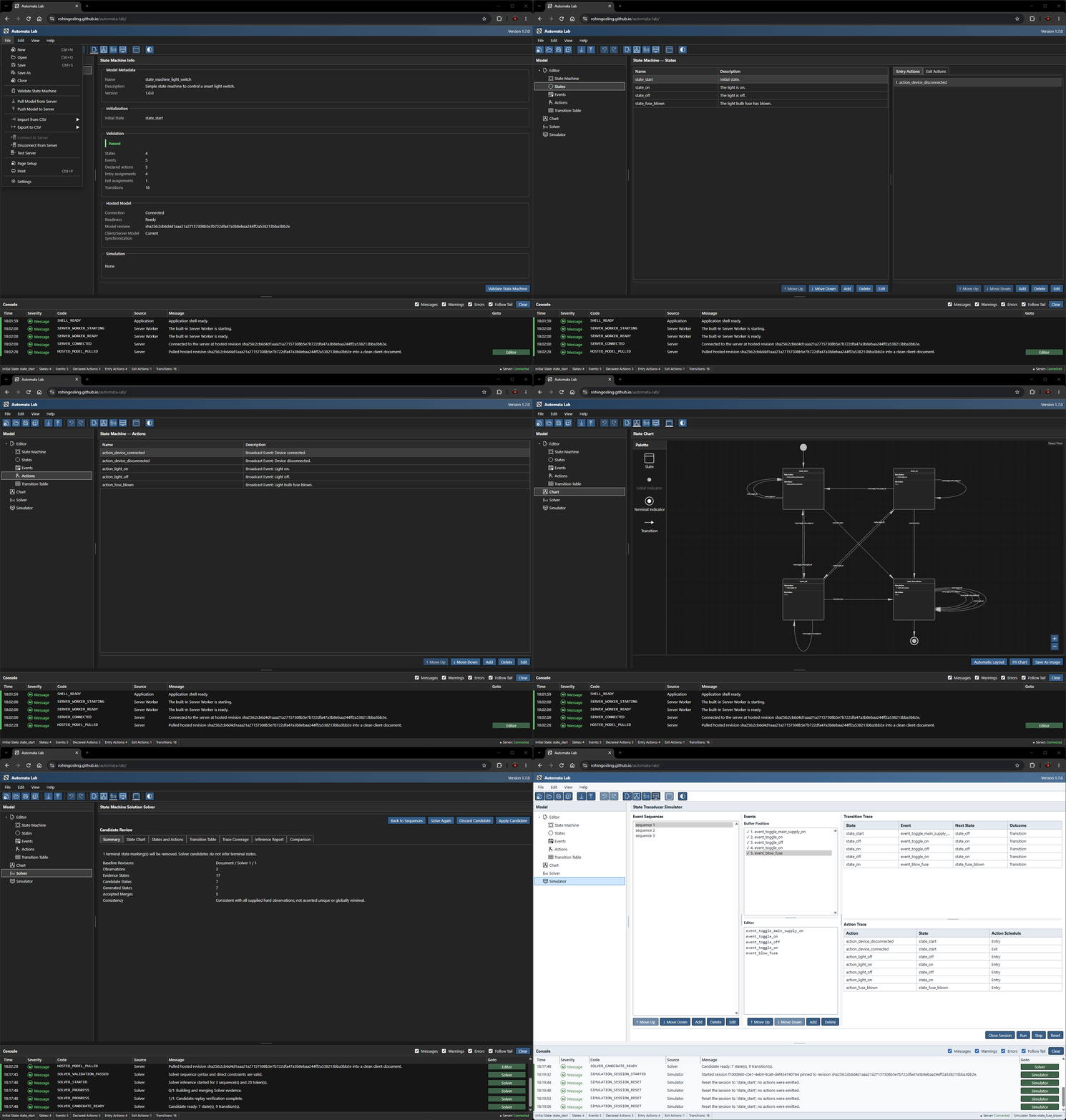
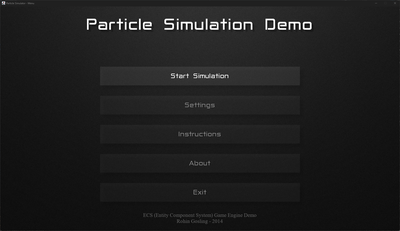
▪ From the main menu, select Settings. |
 |
▪ Use the left and right arrow keys to increment or decrement particle counts per group. |
 |
▪ Use the Tab key to cycle through selected particles. Shift+Tab to cycle back.▪ Use the arrow keys to accelerate the selected particle.▪ If a particle is selected, press the Esc key to deselect the particle.▪ Press the Esc key when no partilces are selected to exit the simulation and return to the main menu. |
|
🎮 Controls
Menu
| Key | Action |
|---|---|
| Up / Down Arrow | Cycle through menu buttons |
| Left / Right Arrow | Adjust particle count on settings screen |
| Enter | Activate the selected button |
| Esc | Go back one menu level |
Simulation
| Key | Action |
|---|---|
| Arrow Keys | Accelerate the selected particle |
| Tab | Select the next particle |
| Shift + Tab | Select the previous particle |
| P | Pause / unpause |
| T | Toggle particle trails |
| W | Toggle wireframe overlay |
| Esc | Deselect all particles, or exit to menu |
📁 Project Structure
v2/
├── build.sh                          Build script (jpackage)
├── Library/
│   ├── ECSGameEngine/                ECS core (engine, entity, component, system)
│   ├── CommandManager/               Command queue pattern for input decoupling
│   ├── ResourceManager/              Asset registry with load/unload lifecycle
│   ├── AWTJavaPlatform/              Swing/AWT windowing and double-buffered rendering
│   ├── UtilityClassLibrary/          Vector2D, GMath, ApplicationSettings, logging
│   ├── EventManager/                 Event publish/subscribe system
│   └── GlobalCache/                  Cross-screen key-value data store
│
└── Demo/
    ├── HelloWorld/                   Minimal engine demo
    └── ParticleDemo/                 Particle simulator (main demo)
        ├── settings.properties       All configurable values
        ├── src/                      Application, engines, systems, components, etc.
        ├── test/                     JUnit 5 unit tests (569 tests)
        └── Resources/               Images, fonts, sounds, text
🔗 Module Dependencies
ParticleDemo → ECSGameEngine → CommandManager → UtilityClassLibrary
                             → ResourceManager
                             → UtilityClassLibrary
             → AWTJavaPlatform → UtilityClassLibrary
             → GlobalCache
📋 Requirements
- JDK 14+ (developed with OpenJDK 25)
- IntelliJ IDEA for IDE-driven development
- JUnit 5 for tests (jars included in
lib/junit5/)
▶️ Running from the IDE
Open the project in IntelliJ IDEA and import the modules under Library/ and Demo/ (each module has a src folder, and most also have a test folder). Add the JUnit 5 jars from lib/junit5/ as a library for the test modules, then run Demo/ParticleDemo/src/rohin/gameengine/application/Main.java with the working directory set to the project root. For a command-line workflow, use build.sh (package) and run-tests.sh (tests). The module dependency graph is shown above under Module Dependencies.
📦 Building a Standalone Executable
The build script uses jpackage to create a self-contained Windows application with a bundled JRE. No Java installation is required on the target machine.
./build.sh                # Portable app directory
./build.sh --installer    # Windows installer (.exe) — requires WiX 3+
Output is placed in build/particle-simulator/. The launcher is particle-simulator.exe.
⚙️ Configuration
All simulation parameters are configurable in Demo/ParticleDemo/settings.properties, including:
- Physics constants (gravity, repulsion, friction, elasticity)
- Particle group properties (mass, radius, count)
- Visual settings (trails, shadows, sprites, HUD)
- Menu layout and fonts
- Initial particle velocities
🏛️ Architecture Overview
ECS Game Loop
while running:
    commandManager.flush()          // execute queued commands
    for each system: system.update(t)  // run all systems
    regulateFrameRate()             // target 90 FPS
Particle Simulation System Pipeline
| Order | System | Role |
|---|---|---|
| 1 | ParticleGroupPropagator | Copy group properties to individual particles |
| 2 | Gravity | Newtonian gravitational attraction (F = Gm1m2/r^2) |
| 3 | Repulsion | Short-range repulsive force (smooth polynomial kernel) |
| 4 | ForceAccumulator | Resolve user input forces, apply F=ma, clear accumulators |
| 5 | Physics | Integrate velocity, apply friction |
| 6 | Collider | Boundary and particle-particle elastic collision |
| 7 | Renderer | Draw background, trails, shadows, sprites, wireframe, HUD |
Input Handling
All user input flows through CommandManager. Keyboard events post ICommand objects that encapsulate their effect on game state. This decouples input source from game logic. The same commands could be issued by an AI agent.
Math
For the sake of interest, here's all the math I used in the particle demo.
Gravity
Gravitational attraction between two particles using Newtonian mechanics, with a softening parameter $\epsilon$ to prevent singularities at close range.
$$\vec{d} = \vec{p}_2 - \vec{p}_1$$
$$F = \frac{G , m_1 , m_2}{|\vec{d}|^2 + \epsilon^2}$$
$$\hat{n} = \frac{\vec{d}}{|\vec{d}|}$$
$$\vec{F}_1 = F , \hat{n}, \quad \vec{F}_2 = -F , \hat{n}$$
Where:
- $G$ is the gravitational constant
- $m_1, m_2$ are the particle masses
- $\epsilon$ is the softening parameter
- $\hat{n}$ is the unit direction vector from particle 1 to particle 2
Repulsion
Short-range repulsive force using a smooth quadratic kernel. Active only when particles are within a threshold distance but not overlapping. Kind of simulates the strong nuclear force.
$$d_{\min} = r_1 + r_2$$
$$d_{\text{threshold}} = 2 , d_{\min}$$
$$s = \frac{|\vec{d}| - d_{\min}}{d_{\text{threshold}} - d_{\min}}, \quad s \in [0, 1]$$
$$F = R , (1 - s)^2$$
$$\vec{F}_1 = F , \hat{n}, \quad \vec{F}_2 = -F , \hat{n}$$
Where:
- $R$ is the repulsive constant
- $s$ is the normalized gap ($0$ at contact, $1$ at the threshold edge)
- $r_1, r_2$ are the particle radii
- The force is only applied when $d_{\min} < |\vec{d}| < d_{\text{threshold}}$
Force Accumulation
All forces (gravity, repulsion, user input) are summed into a force accumulator per particle. Newton's second law converts the net force into acceleration, which is then integrated into velocity using explicit Euler integration.
$$\vec{F}_{\text{net}} = \vec{F}_{\text{gravity}} + \vec{F}_{\text{repulsion}} + \vec{F}_{\text{user}}$$
$$\vec{a} = \frac{\vec{F}_{\text{net}}}{m}$$
$$\vec{v}' = \vec{v} + \vec{a} , \Delta t$$
The force accumulator is reset to $\vec{0}$ after each frame.
Physics
Position is integrated using explicit Euler integration. Friction is applied as a per-frame damping coefficient.
$$\vec{p}' = \vec{p} + \vec{v} , \Delta t$$
$$\vec{v}' = \vec{v} \cdot k_f$$
Where:
- $\Delta t$ is the frame time in seconds
- $k_f$ is the friction coefficient (e.g., $0.995$), applied per frame
For user-controlled particles, anisotropic friction is applied — the friction coefficient differs per axis depending on whether the user is providing input on that axis:
$$v'_x = v_x \cdot \begin{cases} k_f & \text{if user input on } x \ k_a & \text{otherwise} \end{cases}$$
$$v'_y = v_y \cdot \begin{cases} k_f & \text{if user input on } y \ k_a & \text{otherwise} \end{cases}$$
Where $k_a$ is the anisotropic friction coefficient (stronger damping on the uncontrolled axis).
Elastic Collision Physics (Billiard Ball Physics)
Wall collisions clamp the particle position to the boundary and reflect the velocity, scaled by an elasticity coefficient $e$:
$$v'_n = -|v_n| \cdot e$$
$$p' = \text{clamp}(p, ; r, ; w - r)$$
Where $v_n$ is the velocity component normal to the wall, and $w$ is the world boundary.
Particle-particle collisions use impulse-based resolution. Overlapping particles are first separated proportionally to their masses, then an impulse is applied along the collision normal.
Overlap separation:
$$\delta = d_{\min} - |\vec{d}|$$
$$\vec{p}'_1 = \vec{p}_1 - \hat{n} \cdot \delta \cdot \frac{m_2}{m_1 + m_2}$$
$$\vec{p}'_2 = \vec{p}_2 + \hat{n} \cdot \delta \cdot \frac{m_1}{m_1 + m_2}$$
Impulse (applied only when particles are approaching, i.e., $v_{\text{rel}} < 0$):
$$v_{\text{rel}} = (\vec{v}_2 - \vec{v}_1) \cdot \hat{n}$$
$$e = \frac{e_1 + e_2}{2}$$
$$j = \frac{-(1 + e) , v_{\text{rel}}}{\dfrac{1}{m_1} + \dfrac{1}{m_2}}$$
$$\vec{v}'_1 = \vec{v}_1 - \frac{j , \hat{n}}{m_1}$$
$$\vec{v}'_2 = \vec{v}_2 + \frac{j , \hat{n}}{m_2}$$
Where:
- $j$ is the impulse magnitude
- $e$ is the averaged coefficient of restitution
- $\hat{n}$ is the collision normal (unit vector from particle 1 to particle 2)
World-Space to Screen-Space Projection
All particle positions are stored in normalized world coordinates. The projection to screen pixels uses the screen height and a zoom factor.
$$k = h_{\text{screen}} \cdot z$$
$$x_{\text{screen}} = x_{\text{world}} \cdot k - \frac{d}{2}$$
$$y_{\text{screen}} = y_{\text{world}} \cdot k - \frac{d}{2}$$
$$d = 2 , r \cdot k$$
Where:
- $k$ is the world-to-screen conversion factor
- $h_{\text{screen}}$ is the screen height in pixels
- $z$ is the zoom factor
- $r$ is the particle radius in world units
- $d$ is the particle diameter in screen pixels
- The $\frac{d}{2}$ offset centers the sprite on the particle position
📄 License
Released under the MIT License — Copyright © 2014 Rohin Gosling.
Questions
What is ecs-game-engine-java?
rohingosling/ecs-game-engine-java is a public repo on GitHub by rohingosling. An ECS (Entity Component System) game engine framework in Java.
Is ecs-game-engine-java open source?
It declares the MIT license on GitHub.
Does ecs-game-engine-java run on macOS, Windows or Linux?
Its maker tagged it for Windows. That is declared by the maker; Take My Repo has not tested it.
How do I install ecs-game-engine-java?
Open "Take it" on its page: Take My Repo writes an install plan for your machine and hands it to your AI agent (Claude Code, Codex or Cursor), which asks you before each step. Take My Repo has not tested it on any machine.
Is ecs-game-engine-java still maintained?
Its last change on GitHub was on 2026-09-15. GitHub counts 0 open issues and pull requests. Take My Repo does not judge from that whether it is maintained.
What do people who ran ecs-game-engine-java say?
Nobody has reviewed it on Take My Repo yet, which says nothing about its quality.