TOAD
AI-based pathology predicts origins for cancers of unknown primary - Nature
- 186
- Python
- AGPL-3.0
- 5 y ago
DeepCatch: performance-weighted multi-modal fusion for ultra-early cfDNA cancer detection. Fragmentomics, methylation, sequence.
Repo rollroyces/deepcatch, read from GitHub 12 min ago. rollroyces has not joined Take My Repo.
rollroyces/deepcatch is a public repo on GitHub by rollroyces. DeepCatch: performance-weighted multi-modal fusion for ultra-early cfDNA cancer detection. Fragmentomics, methylation, sequence. It declares the MIT license on GitHub. It is written mainly in Python, has 89 stars and last changed on 2026-11-23. Nobody has reviewed it on Take My Repo yet, which says nothing about its quality. Read from GitHub on 2026-11-23.
AI-based pathology predicts origins for cancers of unknown primary - Nature
An Open Source Machine Learning Framework for Everyone
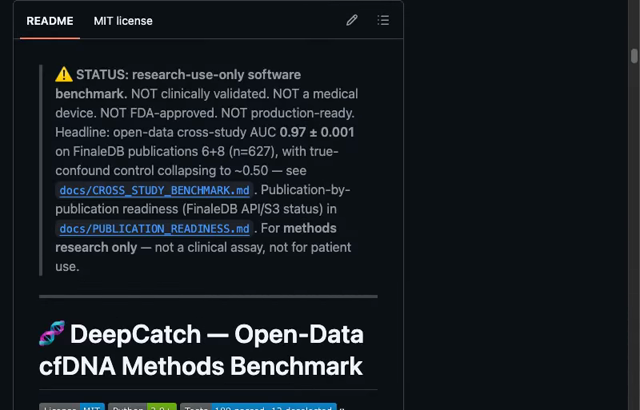
⚠️ STATUS: research-use-only software benchmark. NOT clinically validated. NOT a medical device. NOT FDA-approved. NOT production-ready. Headline: open-data cross-study AUC 0.9684 ± 0.0027 on FinaleDB publications 6+8 (n=627) with default GC correction (legacy baseline 0.9770 is inflated by ~0.009 of GC-axis proxy detection; both numbers reported in the table below). True-confound control collapses to ~0.48 — see
docs/CROSS_STUDY_BENCHMARK.md. Publication-by-publication readiness (FinaleDB API/S3 status) indocs/PUBLICATION_READINESS.md. External validation on held-out public publications (never trained on): AUC 0.9444 [0.8731, 1.0] on FinaleDB publication 7 (WGS, n=31), 0.708 on publication 1 (WGS, n=52), 0.7385 pooled over the publications carrying both classes. Transfer between whole-genome studies is real but far from uniform. The pooled 0.968 is a within-cohort number — leave-one-study-out gives 0.6805. Seedocs/EXTERNAL_VALIDATION.md. For methods research only — not a clinical assay, not for patient use.
()
DeepCatch is an open-source computational framework for multi-cancer early detection (MCED) from cell-free DNA (cfDNA). It combines tumor-informed mutation panels with a tumor-naive fragmentomics channel, tracks patients longitudinally with Bayesian Kalman filtering, and predicts tissue-of-origin — a two-stage CET (Capture → Enhance → Triage) pipeline.
Manuscripts: paper.md (JOSS format) · paper/METHODS_PAPER.md (long-form methods) · paper/paper.tex (preprint source, compiled by CI) — submission guide in paper/README.md.
This project has the analysis pipeline; it does not have the clinical plasma. Everything published here runs on public data (FinaleDB, TCGA, GEO) and therefore cannot say anything about performance on a real screening population. If you run cfDNA sequencing and have a cohort with cancer/control labels, you are exactly the collaborator this project needs — and the analysis side is already built, validated and open source.
What is already in place, so a collaboration starts from a working baseline rather than from scratch:
| Piece | State |
|---|---|
| 5-channel DELFI feature extractor (5 Mb / 100 kb ratios + coverage, FSD-196) | ready, self-contained (src/fragmentomics/finale_features.py) |
| Cross-study benchmark with per-study harmonization and two confound controls | ready (scripts/cross_study_finallydb.py) |
| Leave-one-study-out transfer measurement | ready (scripts/cross_study_loso.py) |
| Public external-cohort fetcher (no IRB, no data-use agreement) | ready (scripts/fetch_external_cohort.py) |
| Mutation-panel LLR with CADD / AlphaMissense weighting | ready (real TCGA-LUAD, AUC 0.921 @ 0.1% ctDNA) |
| Regularized late fusion / Bayesian model averaging | ready (src/foundation/regularized_fusion.py) |
What a collaborator contributes: the cohort (plasma + labels + stage), and the clinical interpretation. What we contribute: feature extraction, harmonization, the statistical protocol (DeLong CIs, sens@spec grids, PPV at screening prevalence, leave-one-cohort-out), and the code.
Scope that would be useful, in order of what unblocks the most:
Everything is MIT-licensed and every number in the repository traces to a committed JSON artifact, so a collaborator can audit the analysis end to end before deciding anything. See TEAM.md §2 for the contribution model, CONTRIBUTING.md for how to set the project up, run the tests and bring a cohort in, and docs/PRODUCTION_ROADMAP.md for the validation plan.
How to reach us: open a External cohort validation (collaboration) issue — the template asks for cohort metadata only, so no patient data ever has to leave your institution. Questions about the analysis itself are better in Discussions. Code contributions are governed by CONTRIBUTING.md and CODE_OF_CONDUCT.md.
Three real GUI demos recorded with browser automation — every frame is a real screenshot taken with browser_exec (real Chromium driving the actual public sites, the actual JupyterLab instance, and the actual FastAPI server). No terminal playback needed, no JS dependencies, no fabricated slides. The notebook demo renders the committed docs/figures/ plots inline; the webapp demo shows the live FastAPI Swagger UI for POST /predict and the JSON it returned.
Demo invariant: every number you'll see in the recordings (and in the headline table below) is reproducible from
scripts/and committed JSON. No fabricated numbers. No clinical interpretation.
browser_exec navigated to github.com/rollroyces/deepcatch and to rollroyces.github.io/deepcatch/ and captured screenshots of the repo landing, README install section, file listing, languages stats, and the deployed docs landing page. Compiled into a WebM.
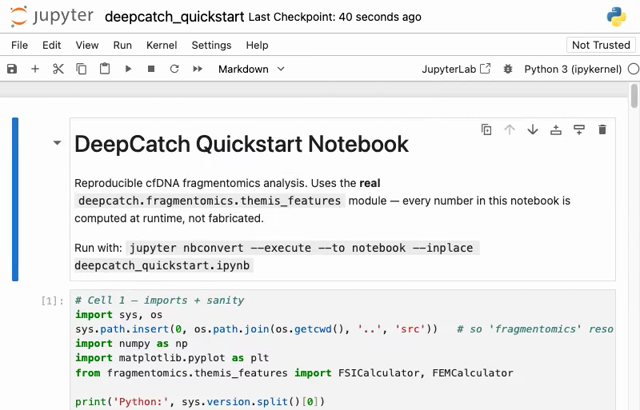
The new notebooks/deepcatch_quickstart.ipynb runs against the repository's own src/fragmentomics package (it puts ../src on the path itself) — fragment-length synthesis, FSI computation, 5-mer end motif frequencies, plus the four committed benchmark figures. A test executes the notebook's cells, so it cannot quietly stop working. Recorded live in JupyterLab on 127.0.0.1:8889.
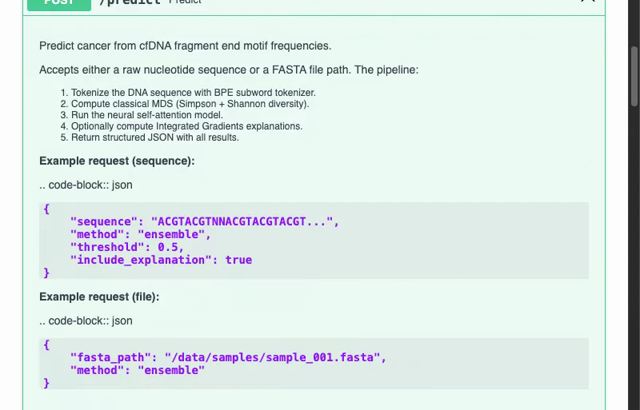
Real uvicorn api.main:app server on 127.0.0.1:8000. The recording shows Swagger UI's /predict operation expanded, "Try it out" → editable JSON body → "Execute" → the actual server response (classical MDS + neural probability + Integrated-Gradients top motifs).
All 3 videos are compilations of real
browser_execscreenshots (real Chromium instances) — not fabricated slide-deck mockups. The original terminal asciicasts are preserved underdocs/demo/terminal/for reference.
scripts/cross_study_finallydb.py with --gc-correction (default) and --include-motifs flags.src/foundation/regularized_fusion.py).docs/METHYLATION_PIPELINE.md.docs/CROSS_STUDY_BENCHMARK.mdrollroyces/deepcatch is a public repo on GitHub by rollroyces. DeepCatch: performance-weighted multi-modal fusion for ultra-early cfDNA cancer detection. Fragmentomics, methylation, sequence.
It declares the MIT license on GitHub.
Its maker has not tagged a system, so it is unknown here. Its README says what it needs.
Open "Take it" on its page: Take My Repo writes an install plan for your machine and hands it to your AI agent (Claude Code, Codex or Cursor), which asks you before each step. Take My Repo has not tested it on any machine.
1st to MICCAI DigestPath2019 challenge (https://digestpath2019.grand-challenge.org/Home/) on colonoscopy tissue segmentation and classification task. (MICCAI 2019) https://teacher.bupt.edu.cn/zhuchuang/en/index.htm
🤗 Transformers: the model-definition framework for state-of-the-art machine learning models in text, vision, audio, and multimodal models, for both inference and training.
CpG methylation-based cfDNA cancer detection (Phase 0: FinaleMe smoke validation) — methylation-channel models, CpG site discovery, and pipeline for ultra-early detection. See deepcatch for the full multi-modal system.
Its last change on GitHub was on 2026-11-23. Take My Repo does not judge from that whether it is maintained.
Nobody has reviewed it on Take My Repo yet, which says nothing about its quality.
Take My Repo cannot say: it does not audit code and has not run deepcatch. What is known comes from GitHub. It declares the MIT license on GitHub. Its last change was on 2026-11-23. It has 89 stars, which measure popularity, not safety. Nobody has reviewed it on Take My Repo yet, which says nothing about its quality. Read the source before you run it. With "Take it", your AI agent shows each step and asks you before running it; README text is treated as data, not as instructions.