
fastsdcpu
Fast stable diffusion on CPU and AI PC
- 2.2k
- MIT
- 2 d ago
Repo rupeshs/fastsdcpu, read from GitHub 7 h ago. rupeshs has not joined Take My Repo.
In short
rupeshs/fastsdcpu is a public repo on GitHub by rupeshs. Fast stable diffusion on CPU and AI PC. It declares the MIT license on GitHub. It is written mainly in Python, has 2,218 stars and last changed on 2026-11-21. Nobody has reviewed it on Take My Repo yet, which says nothing about its quality. Read from GitHub on 2026-11-23.
Similar repos
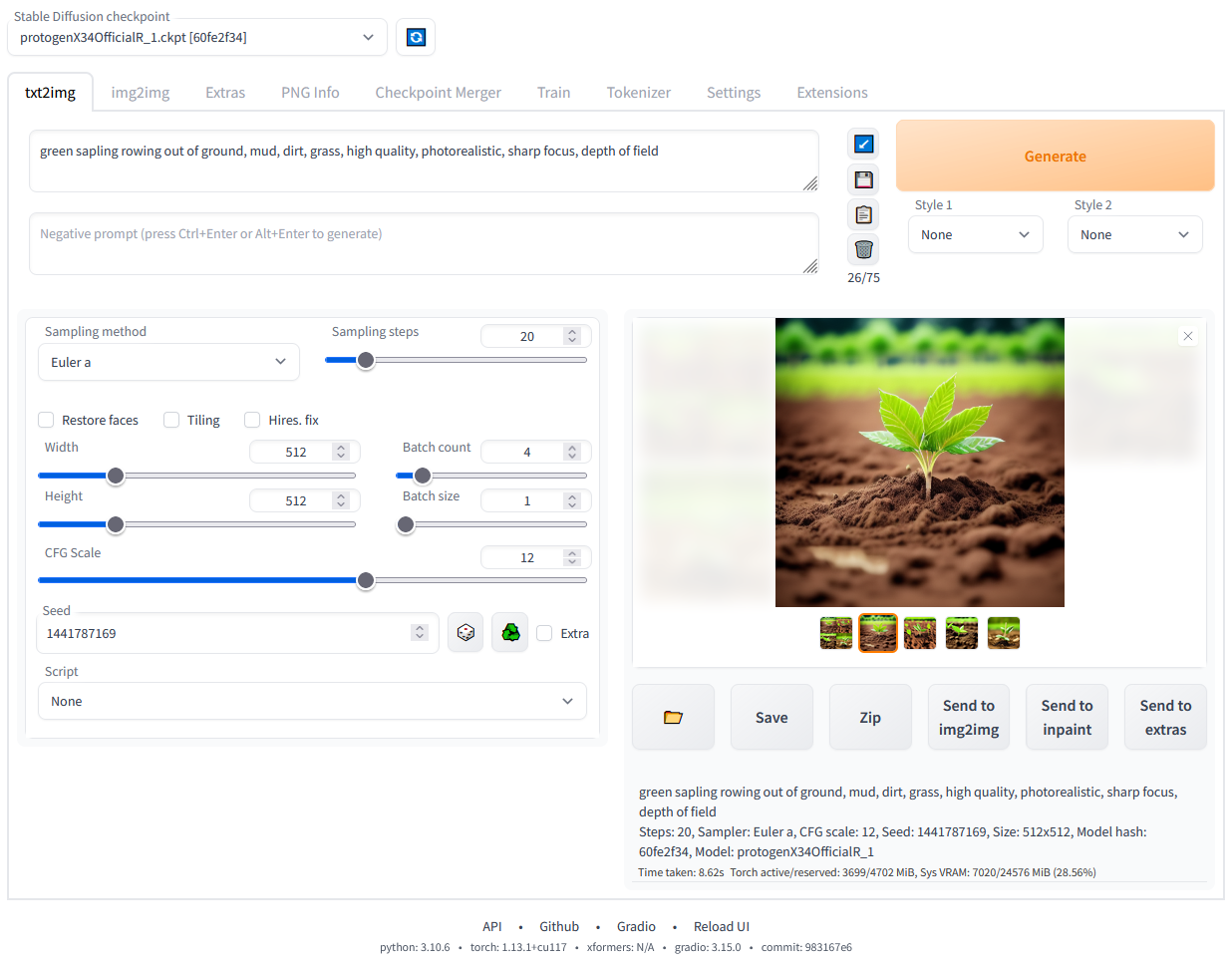
stable-diffusion-webui
Stable Diffusion web UI

AI models this project points to
- rupeshs/taef1-openvinoLinked in the README
- rupeshs/hyper-sd-sdxl-1-stepLinked in the README
- rupeshs/hyper-sd-sdxl-1-step-openvino-int8Linked in the README
- stabilityai/sdxl-turboLinked in the README
- rupeshs/SDXL-Lightning-2stepsLinked in the README
- rupeshs/SDXL-Lightning-2steps-openvino-int8Linked in the README
- rupeshs/sd-turbo-openvinoLinked in the README
- rupeshs/sdxl-turbo-openvino-int8Linked in the README
FastSD CPU :sparkles:
FastSD CPU is a faster version of Stable Diffusion on CPU. Based on Latent Consistency Models ,
Adversarial Diffusion Distillation and distilled few steps models.
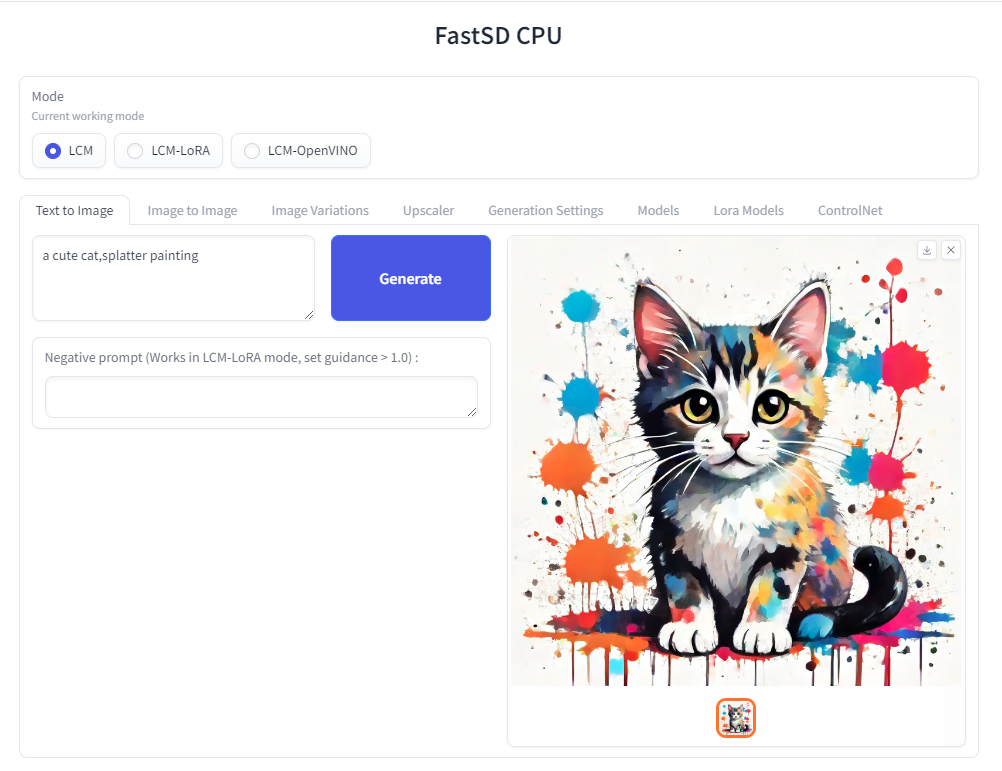 The following interfaces are available :
- Desktop GUI, basic text to image generation (Qt,faster)
- WebUI (Advanced features,Lora,controlnet etc)
- CLI (CommandLine Interface)
🚀 Using OpenVINO(SDXS-512-0.9), it took 0.82 seconds (820 milliseconds) to create a single 512x512 image on a Core i7-12700.
📰 News
- 2026-10-31 - Added Fibo 2.0 Edit Turbo support (OpenVINO, INT4), instruction based image editing (4 steps)
- 2026-10-25 - Added FLUX.3 Image Klein support (OpenVINO, INT4), text-to-image and image editing (2 to 4 steps)
- 2026-10-18 - Add Iris 3B Turbo OpenVINO support for pixel-space image generation (No VAE)
- 2026-07-05 - Add bonsai image (1 bit) GGUF support, Flux2 Klein GGUF support
- 2026-06-21 - Added FLUX.2-klein-4B support(OpenVINO), image editing support, photo restoration, colorization (2 to 4 steps)
- 2026-05-01 - Docker support, HF demo
- 2025-12-22 - FastSD engine integrated into Intel's OpenVINO™ AI Plugins for GIMP
- 2025-05-17 - Added SANA Sprint(OpenVINO) support,Tiny AutoEncoder 1.3(Mocha Croissant) support
- 2025-04-20 - Added MCP server support,faster uv based installation,Claude desktop, Open WebUI support
- 2024-11-03 - Added Intel Core Ultra Series 2 (Lunar Lake) NPU support
- 2024-10-02 - Added GGUF diffusion model(Flux) support
- 2024-09-03 – Added Intel AI PC GPU, NPU support 🚀
Table of Contents 👇
- Supported Platforms
- Dependencies
- Memory requirements
- Features
- Architecture
- Benchmarks
- OpenVINO Support
- Iris 3B OpenVINO (pixel-space)
- FLUX.3 Image Klein OpenVINO
- Fibo 2.0 Edit Turbo OpenVINO
- Image Editing support
- Installation
- Real-time text to image (EXPERIMENTAL)
- Models
- How to use Lora models
- How to use controlnet
- Docker support
- Android + Termux
- Raspberry Pi 4
- API Support
- GGUF support (Flux)
- AI PC Support - OpenVINO
- MCP Server Support
- Open WebUI Support
- ComfyUI support
- GIMP Plugin
- License
- Contributors
Supported platforms⚡️
FastSD CPU works on the following platforms:
- Windows
- Linux
- Mac
- Android + Termux
- Raspberry PI 4
Dependencies 📦
- Python 3.10 or higher
- uv - fast Python package and project manager
Memory requirements
Minimum system RAM requirement for FastSD CPU.
Model (LCM,OpenVINO): SD Turbo, 1 step, 512 x 512
Model (LCM-LoRA): Dreamshaper v8, 3 step, 512 x 512
| Mode | Min RAM |
|---|---|
| LCM | 2 GB |
| LCM-LoRA | 4 GB |
| OpenVINO(Flux2) | 8 GB |
| OpenVINO(Iris 3B)(1024 x 1024) | 8.4 GB |
If we enable Tiny decoder(TAESD) we can save some memory(2GB approx) for example in OpenVINO mode memory usage will become 9GB.
:exclamation: Please note that guidance scale >1 increases RAM usage and slow inference speed.
Features ✨
- Desktop GUI, web UI and CLI
- Supports 256,512,768,1024 image sizes
- Supports Windows,Linux,Mac
- Saves images and diffusion setting used to generate the image
- Settings to control,steps,guidance and seed
- Added safety checker setting
- Maximum inference steps increased to 25
- Added OpenVINO support
- Fixed OpenVINO image reproducibility issue
- Fixed OpenVINO high RAM usage,thanks deinferno
- Added multiple image generation support
- Application settings
- Added Tiny Auto Encoder for SD (TAESD) support, 1.4x speed boost (Fast,moderate quality)
- Safety checker disabled by default
- Added SDXL,SSD1B - 1B LCM models
- Added LCM-LoRA support, works well for fine-tuned Stable Diffusion model 1.5 or SDXL models
- Added negative prompt support in LCM-LoRA mode
- LCM-LoRA models can be configured using text configuration file
- Added support for custom models for OpenVINO (LCM-LoRA baked)
- OpenVINO models now supports negative prompt (Set guidance >1.0)
- Real-time inference support,generates images while you type (experimental)
- Fast 2,3 steps inference
- Lcm-Lora fused models for faster inference
- Supports integrated GPU(iGPU) using OpenVINO (export DEVICE=GPU)
- 5.7x speed using OpenVINO(steps: 2,tiny autoencoder)
- Image to Image support (Use Web UI)
- OpenVINO image to image support
- Fast 1 step inference (SDXL Turbo)
- Added SD Turbo support
- Added image to image support for Turbo models (Pytorch and OpenVINO)
- Added image variations support
- Added 2x upscaler (EDSR and Tiled SD upscale (experimental)),thanks monstruosoft for SD upscale
- Works on Android + Termux + PRoot
- Added interactive CLI,thanks monstruosoft
- Added basic lora support to CLI and WebUI
- ONNX EDSR 2x upscale
- Add SDXL-Lightning support
- Add SDXL-Lightning OpenVINO support (int8)
- Add multilora support,thanks monstruosoft
- Add basic ControlNet v1.1 support(LCM-LoRA mode),thanks monstruosoft
- Add ControlNet annotators(Canny,Depth,LineArt,MLSD,NormalBAE,Pose,SoftEdge,Shuffle)
- Add SDXS-512 0.9 support
- Add SDXS-512 0.9 OpenVINO,fast 1 step inference (0.8 seconds to generate 512x512 image)
- Default model changed to SDXS-512-0.9
- Faster realtime image generation
- Add NPU device check
- Revert default model to SDTurbo
- Update realtime UI
- Add hypersd support
- 1 step fast inference support for SDXL and SD1.5
- Experimental support for single file Safetensors SD 1.5/SDXL models(Civitai models), simply add local model path to configs/stable-diffusion-models.txt file.
- Add REST API support
- Add Aura SR (4x)/GigaGAN based upscaler support
- Add Aura SR v2 upscaler support
- Add FLUX.1 schnell OpenVINO int 4 support
- Add CLIP skip support
- Add token merging support
- Add Intel AI PC support
- AI PC NPU(Power efficient inference using OpenVINO) supports, text to image ,image to image and image variations support
- Add TAEF1 (Tiny autoencoder for FLUX.1) openvino support
- Add Image to Image and Image Variations Qt GUI support,thanks monstruosoft
- Add single file SDXL safetensor file support,thanks monstruosoft
- Add FLUX.2-klein-4B OpenVINO support
- Add image editing support
- Add bonsai image (1 bit) GGUF support, Flux 2 Klein GGUF model support
- Add Iris 3B Turbo OpenVINO support for pixel-space image generation (VAE-free)
- Add FLUX.3 image kelin(OpenVINO) support, text to image and image editing(2 to 4 steps)
- Add Fibo 2.0 Edit Turbo (OpenVINO) support, instruction based image editing(4 steps)
Architecture
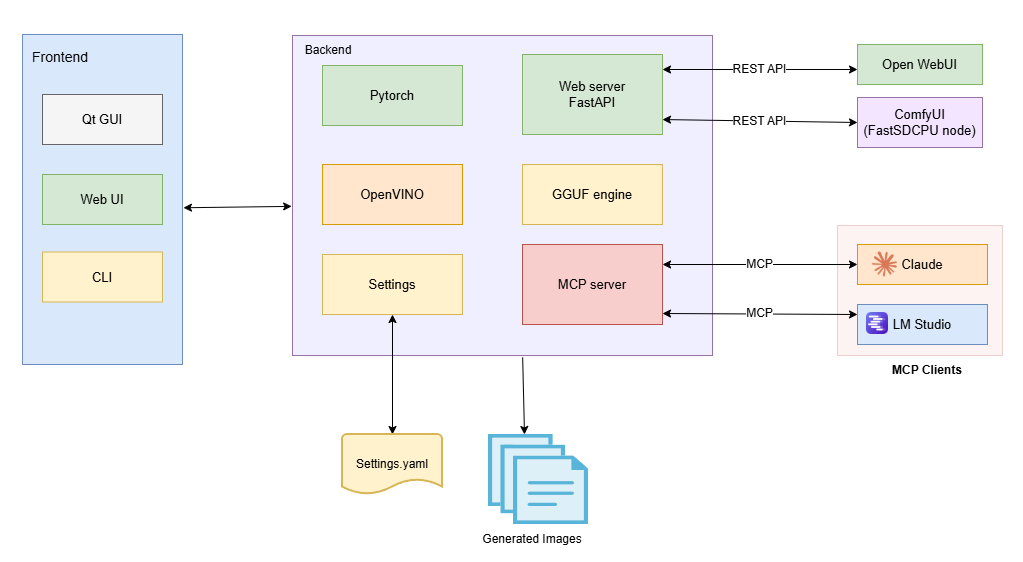
FastSDCPU follows a loosely coupled architecture focusing on maintainability and usability.
Key Design Principles
Separation of Concerns: The core diffusion pipelines (Pytorch, OpenVINO, GGUF) are decoupled from the user interfaces.
Interface Flexibility: A unified underlying engine powers multiple frontend experiences seamlessly, including the Desktop GUI (Qt), the Advanced WebUI, and the Command Line Interface (CLI).
Extensibility: The modular setup allows easy integration of new features, such as the MCP server protocol and custom third-party plugins like GIMP.
Fast Inference Benchmarks
🚀 Fast 1 step inference with Hyper-SD
Stable diffuion 1.5
Works with LCM-LoRA mode.
Fast 1 step inference supported on runwayml/stable-diffusion-v1-5 model,select rupeshs/hypersd-sd1-5-1-step-lora lcm_lora model from the settings.
Stable diffuion XL
Works with LCM and LCM-OpenVINO mode.
Hyper-SD SDXL 1 step - rupeshs/hyper-sd-sdxl-1-step
Hyper-SD SDXL 1 step OpenVINO - rupeshs/hyper-sd-sdxl-1-step-openvino-int8
Inference Speed
Tested on Core i7-12700 to generate 768x768 image(1 step).
| Diffusion Pipeline | Latency |
|---|---|
| Pytorch | 19s |
| OpenVINO | 13s |
| OpenVINO + TAESDXL | 6.3s |
Fastest 1 step inference (SDXS-512-0.9)
:exclamation:This is an experimental model, only text to image workflow is supported.
Inference Speed
Tested on Core i7-12700 to generate 512x512 image(1 step).
SDXS-512-0.9
| Diffusion Pipeline | Latency |
|---|---|
| Pytorch | 4.8s |
| OpenVINO | 3.8s |
| OpenVINO + TAESD | 0.82s |
🚀 Fast 1 step inference (SD/SDXL Turbo - Adversarial Diffusion Distillation,ADD)
Added support for ultra fast 1 step inference using sdxl-turbo model
:exclamation: These SD turbo models are intended for research purpose only.
Inference Speed
Tested on Core i7-12700 to generate 512x512 image(1 step).
SD Turbo
| Diffusion Pipeline | Latency |
|---|---|
| Pytorch | 7.8s |
| OpenVINO | 5s |
| OpenVINO + TAESD | 1.7s |
SDXL Turbo
| Diffusion Pipeline | Latency |
|---|---|
| Pytorch | 10s |
| OpenVINO | 5.6s |
| OpenVINO + TAESDXL | 2.5s |
🚀 Fast 2 step inference (SDXL-Lightning - Adversarial Diffusion Distillation)
SDXL-Lightning works with LCM and LCM-OpenVINO mode.You can select these models from app settings.
Tested on Core i7-12700 to generate 768x768 image(2 steps).
| Diffusion Pipeline | Latency |
|---|---|
| Pytorch | 18s |
| OpenVINO | 12s |
| OpenVINO + TAESDXL | 10s |
SDXL-Lightning - rupeshs/SDXL-Lightning-2steps
SDXL-Lightning OpenVINO - rupeshs/SDXL-Lightning-2steps-openvino-int8
2 Steps fast inference (LCM)
FastSD CPU supports 2 to 3 steps fast inference using LCM-LoRA workflow. It works well with SD 1.5 models.

FLUX.1-schnell OpenVINO support
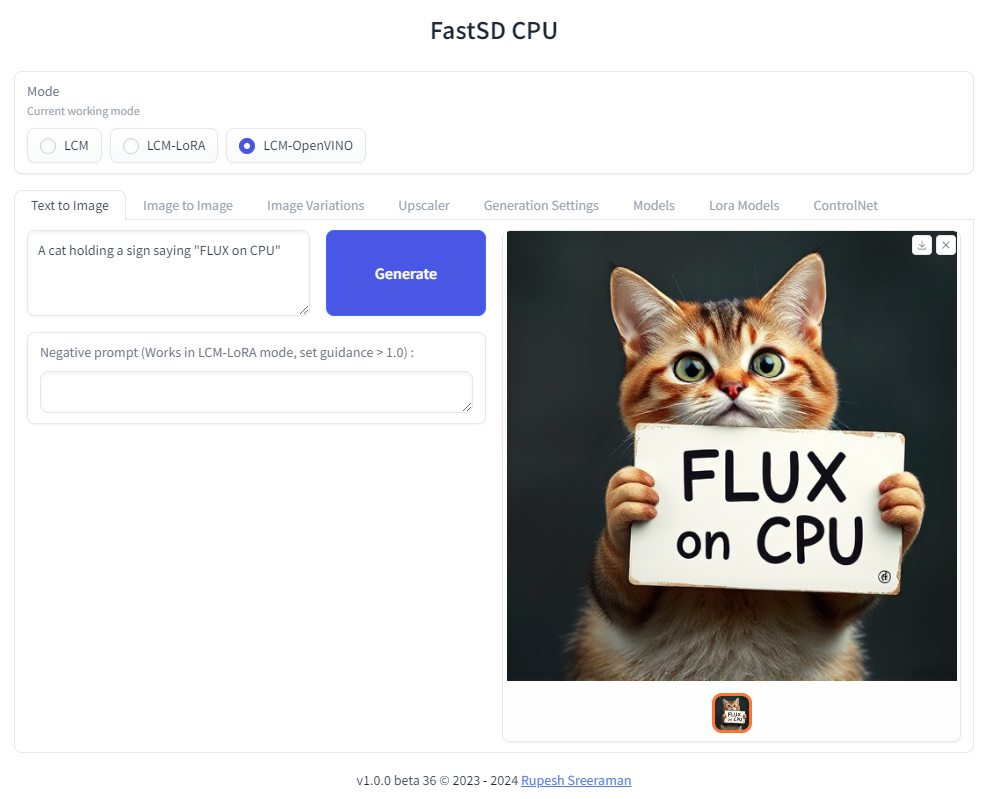
:exclamation: Important - Please note the following points with FLUX workflow
- As of now only text to image generation mode is supported
- Use OpenVINO mode
- Use int4 model - rupeshs/FLUX.1-schnell-openvino-int4
- 512x512 image generation needs around 30GB system RAM
Questions
What is fastsdcpu?
rupeshs/fastsdcpu is a public repo on GitHub by rupeshs. Fast stable diffusion on CPU and AI PC.
Is fastsdcpu open source?
It declares the MIT license on GitHub.
Does fastsdcpu run on macOS, Windows or Linux?
Its maker has not tagged a system, so it is unknown here. Its README says what it needs.
How do I install fastsdcpu?
Open "Take it" on its page: Take My Repo writes an install plan for your machine and hands it to your AI agent (Claude Code, Codex or Cursor), which asks you before each step. Take My Repo has not tested it on any machine.
Is fastsdcpu still maintained?
Its last change on GitHub was on 2026-11-21. Take My Repo does not judge from that whether it is maintained.





