simdjson
Parsing gigabytes of JSON per second : used by Facebook/Meta Velox, the Node.js runtime, ClickHouse, WatermelonDB, Apache Doris, Milvus, StarRocks
- 25k
- C++
- Apache-2.0
- 4 d ago
Pure-managed, SIMD-accelerated image codecs for .NET: JPEG, PNG, WebP, TIFF, GIF, JPEG 2000 and JBIG2, plus EXIF and ICC. No native dependencies, NativeAOT-compatible; the JPEG decoder beats libjpeg-turbo on our benchmark corpus.
Repo sdcb/SimdCodecs, read from GitHub 2 h ago. sdcb has not joined Take My Repo.
sdcb/SimdCodecs is a public repo on GitHub by sdcb. Pure-managed, SIMD-accelerated image codecs for .NET: JPEG, PNG, WebP, TIFF, GIF, JPEG 2000 and JBIG2, plus EXIF and ICC. No native dependencies, NativeAOT-compatible; the JPEG decoder beats libjpeg-turbo on our benchmark corpus. It declares the MIT license on GitHub. It is written mainly in C#, has 143 stars and last changed on 2026-11-11. Nobody has reviewed it on Take My Repo yet, which says nothing about its quality. Read from GitHub on 2026-11-19.

English | 简体中文
Pure-managed image codecs for .NET 10: JPEG, PNG, TIFF, WebP, GIF, BMP, ICO / CUR, QOI, Netpbm, JPEG 2000 and JBIG2, plus EXIF and ICC, and HEIF / HEIC decoding as an opt-in package.
Every tile above was decoded by this library; the files are the LINQPad samples' images (how they were made).
dotnet add package Sdcb.SimdCodecs
using Sdcb.SimdCodecs;
using Sdcb.SimdCodecs.Abstractions;
using Sdcb.SimdCodecs.Jpeg;

byte[] file = File.ReadAllBytes("photo.webp");   // JPEG, PNG, TIFF, WebP, GIF, BMP, ICO, CUR, QOI, Netpbm, JPEG 2000 or JBIG2

// The facade sniffs the format from the magic bytes. One call gives the pixels in the layout you ask for,
// turned upright by the EXIF orientation; it throws NotSupportedException for a format it does not decode
// and InvalidDataException with the codec's reason for a damaged file.
using PixelBuffer image = ImageCodecs.Decode(file, PixelFormat.Rgba32, new DecodeOptions { ApplyOrientation = true });

// Encode it as a JPEG: SIMD, baseline / optimised Huffman / progressive, 4:2:0 or 4:4:4.
// Passing image.Metadata keeps the ICC profile and Exif (its Orientation is already reset to 1).
using FileStream output = File.Create("photo.jpg");
ImageCodecs.Encode(image.Pixels, image.Width, image.Height, image.Format, ImageFormat.Jpeg, output,
    stride: image.Stride, options: new JpegEncodeOptions { Quality = 90 }, metadata: image.Metadata);
Common tasks:
// A server checks the header before it allocates anything.
if (!ImageCodecs.TryReadInfo(file, out ImageInfo info) || (long)info.Width * info.Height > 50_000_000)
    return Results.BadRequest();

// Decode into memory you own (a bitmap, a Mat, an upload buffer) in any layout, at any row stride.
// See the skiasharp and opencvsharp samples for an SKBitmap and a Mat.
ImageCodecs.TryDecodeInto(file, buffer, stride, PixelFormat.Bgra32Premultiplied);

// A thumbnail: JPEG scales by 1/2-1/8 in the DCT domain, every other format by a box filter.
using IDecodedImage small = ImageCodecs.Decode(file, new DecodeOptions { ScaleDenominator = 8 });

// HEIF / HEIC (iPhone photos): install Sdcb.SimdCodecs.Heif and register it once at start-up.
ImageCodecs.Register(HeifImageDecoder.Registration);
ImageCodecs.Decode(file, format, options) / TryDecodeInto(file, buffer, stride, format, options): any PixelFormat (RGBA, BGRA, Bgra32Premultiplied for WPF / Direct2D / Skia, RGB, BGR for OpenCV, grey for OCR, and the 16-bit Rgba64, Gray16, …) at any row stride. JPEG and PNG write the 8-bit layouts natively, with no RGBA frame in between; a colour JPEG's grey is its Y plane.ImageCodecs.Decode(file, options) / TryDecode(file, out image, options): the native layout (channel count, 8/16-bit or float samples, real bit depth) with the file's ICC, Exif and XMP in image.Metadata. Dispose the image to return pooled memory.DecodeOptions: Region (a crop; TIFF and HEIF read only the strips or tiles it touches, JPEG, PNG and WebP convert only its rows), ScaleDenominator (any power of two for every codec: JPEG 1/2–1/8 and JPEG 2000 resolution levels natively, the rest by a box filter; TryGetClosestSize says what a codec does natively), Pool (an ArrayPool<byte> for the pixels), ApplyOrientation (EXIF / TIFF orientation applied, the Exif Orientation reset to 1; GetOutputSize(info) sizes a buffer). Every entry point takes a CancellationToken.ImageCodecs.TryReadInfo(file, out info): from the headers alone: format, size, stored bit depth, colour encoding (PQ / HLG HDR?), resolution (DPI), EXIF orientation, frame or page count, whether there is a thumbnail.ImageCodecs.TryReadMetadata(file, out metadata) / TryDecodeThumbnail(file, out thumb): the Exif, XMP and ICC blocks for a transcoder to pass on, and the embedded preview (Exif IFD1, HEIF thmb). PixelTransform.Orient turns pixels you decoded without ApplyOrientation.ImageDecoder.Open(stream | path | memory) / OpenAsync(stream): a WIC-style session: Format, FrameCount, then GetFrame(i).Decode(options) or .CopyPixels(region, format, buffer, stride). A file path is memory-mapped; a non-seekable stream such as an upload is buffered for you.ImageCodecs.TryOpenFrames(file, out reader): every frame by index, in any layout: animated WebP / GIF / APNG frames with durations, multi-page TIFF and JBIG2 pages, the images of an icon. reader.EnumerateFramesInto(buffer, stride, format) plays them through one buffer.ImageCodecs.Encode(image, format, stream | writer, options) / Encode(pixels, width, height, pixelFormat, format, …) / CreateEncoder(format, writer): every encoder takes every PixelFormat, rows at any stride, and writes the image's metadata; GetClosestInputFormat shows where an 8-bit format narrows. The options are the format's own type (JpegEncodeOptions, WebpLossyEncodeOptions, …; null for its defaults); WebP with no options is lossy. An encoder session takes the image in bands and several frames for an animation.ImageCodecs.TryReadPlanarInfo / TryDecodePlanes: the YCbCr planes as coded (HEIF), for video pipelines and GPU upload.ImageCodecs.DetectFormat(file): also names formats it recognises but does not decode (AVIF, JPEG XL, …); IsDecodable(format) tells the two apart.The facade covers what every format has in common. Each format package has a richer API of its own: TIFF segment reads, WebP animation seeking by timestamp, Ultra HDR reconstruction, lossless JPEG (LosslessJpeg.FromMemory, SOF3, which the facade rejects) and more. What the facade and each codec do not do is listed in docs/known-gaps.md (in Chinese).
Upgrading from 1.x: docs/migrating-to-2.0.md.
| Format | Package | Decode | Encode | Highlights |
|---|---|---|---|---|
| JPEG | Sdcb.SimdCodecs.Jpeg |
✅ | ✅ | Baseline and progressive, any subsampling, CMYK / YCCK, scaled 1/2–1/8, lossless (SOF3); encodes baseline / optimised Huffman / progressive with EXIF, XMP and ICC |
| Ultra HDR JPEG | Sdcb.SimdCodecs.Jpeg.GainMap |
✅ | ✅ | Gain-map read, assemble and HDR reconstruction (Ultra HDR / Adobe) |
| PNG | Sdcb.SimdCodecs.Png |
✅ | ✅ | All bit depths; lossy palette quantization (the pngquant use case); APNG; HDR signalling (cICP, mDCV, cLLI) |
| TIFF | Sdcb.SimdCodecs.Tiff |
✅ | ✅ | Multi-page, BigTIFF, 8/16/32-bit integer and float, strips or tiles; JPEG, Deflate, LZW, PackBits, CCITT G3/G4 |
| WebP | Sdcb.SimdCodecs.Webp |
✅ | ✅ | Lossy, lossless, alpha, animation with seeking; byte-exact with libwebp; encodes lossy and lossless stills and animations |
| GIF | Sdcb.SimdCodecs.Gif |
✅ | ✅ | Animation with seeking; encodes exact or perceptually quantized palettes with dithering |
| BMP | Sdcb.SimdCodecs.Bmp |
✅ | ✅ | Every Windows and OS/2 variant, RLE, bit fields, embedded PNG; pixel-for-pixel identical to WIC |
| ICO / CUR | Sdcb.SimdCodecs.Ico |
✅ | ✅ | Every image of an icon or cursor, PNG or DIB, hotspots; multi-size encoding |
| QOI | Sdcb.SimdCodecs.Qoi |
✅ | ✅ | RGB and RGBA |
| Netpbm | Sdcb.SimdCodecs.Pnm |
✅ | ✅ | PBM, PGM, PPM plain and raw up to 16-bit, PAM, PFM float |
| JPEG 2000 | Sdcb.SimdCodecs.Jpeg2000 |
✅ | Part 1, for PDF /JPXDecode; JP2 alpha; resolution-reduced decode; tiles decoded on all cores |
|
| JBIG2 | Sdcb.SimdCodecs.Jbig2 |
✅ | T.88, for PDF /JBIG2Decode |
|
| HEIF / HEIC | Sdcb.SimdCodecs.Heif |
✅ | Phone photos: HEVC Main / Main 10 / Main Still Picture, grids, 16-bit for Main 10, YCbCr planes; byte-exact with ffmpeg | |
| EXIF | Sdcb.SimdCodecs.Exif |
✅ | ✅ | Reads JPEG, TIFF, PNG, WebP, HEIF and AVIF Exif; ExifWriter builds a block for the encoders |
| ICC | Sdcb.SimdCodecs.Color.Icc, Sdcb.SimdCodecs.Jpeg.IccInjector |
✅ | ✅ | Decoders return the embedded profile; a bundled sRGB v4 profile; splice a profile into an existing JPEG |
Sdcb.SimdCodecs is the facade and references every package above except HEIF; Sdcb.SimdCodecs.Abstractions holds the shared types (PixelFormat, DecodeOptions, IImageDecoder, …). All packages ship in lockstep under one version.
HEIF is a separate, opt-in package. HEVC is patent-encumbered and MIT conveys no patent licence, so the facade does not reference Sdcb.SimdCodecs.Heif: install it and call ImageCodecs.Register(HeifImageDecoder.Registration) once, after evaluating HEVC's patent obligations for your product.
LosslessJpeg.FromMemory). SIMD encoder: baseline, optimised Huffman or progressive; 4:4:4 / 4:2:0 / grey; restart intervals; embeds EXIF (APP1), XMP and an ICC profile (APP2).PngWriteOptions.Quantize reduces an image to at most 256 colours, translucency included, the way pngquant does: smaller than pngquant's file at equal SSIM on the benchmark corpus (benchmarks/Sdcb.SimdCodecs.Quantize.Benchmarks). APNG: PngAnimationDecoder composites every dispose / blend operation and seeks; PngAnimationEncoder writes changed rectangles, merging unchanged frames.WebpAnimationDecoder adds seeking by timestamp and the frame rectangles. WebpEncoder.EncodeLossless writes VP8L stills with alpha, effort 0–9; WebpEncoder.EncodeLossy writes VP8 stills, quality 0–100 and effort 0–6, with transparency in an ALPH plane; both can embed ICC / Exif / XMP. WebpAnimationEncoder and WebpEncoder.EncodeAnimation write animations, lossy, lossless or the smaller per frame, from whole canvases (reduced to the changed rectangle, unchanged frames merged) or from ANMF frames as given.BI_BITFIELDS / BI_ALPHABITFIELDS; RLE4 / RLE8 with deltas, OS/2 RLE24 and Huffman 1D; BI_PNG; top-down rows; V5 ICC; packed DIBs (clipboard, icon images). Encodes palettes (exact or quantized), RLE, 555 / 565, 24 / 32-bit. Checked pixel for pixel against WIC; the decisions the documentation leaves open are listed in the package README.Pf / PF) as float samples; only a file's first image. Encodes every format; plain output keeps lines within 70 characters. Matches ImageMagick exactly, both ways.cdef) for alpha; decode at a reduced resolution level; tiles, code-blocks and the wavelet run on all cores. Lossless decode is bit-identical to libopenjp2./JBIG2Decode, with global segments) and standalone files: generic, refinement, text and halftone regions, pattern and symbol dictionaries.ExifWriter builds a blob for JpegEncodeOptions.Exif and the other encoders.grid tiles decoded in parallel, clap / irot / imir applied, ICC passed through, nclx / VUI colour reported; Main 10 decodes to 16-bit samples; PQ / HLG refuse the 8-bit layouts. Alpha, gain maps, sequences and range-extension profiles are not decoded. See the package README.Single-threaded except where noted, AMD Ryzen 7 5800X, .NET 10. Time relative to the reference library: below 1.00× is faster.
| Operation | Compared with | Sdcb.SimdCodecs | ImageSharp 3.1.12 |
|---|---|---|---|
| JPEG decode to RGBA, 446 files | libjpeg-turbo 3.2.0 | 0.82×, 0 B allocated | 1.77× |
| PNG decode to RGBA, 1080p 8-bit RGB / RGBA photo | libpng 1.6.39 | 0.88× | 0.91× |
| WebP decode, 1080p lossy / lossy + alpha / lossless | libwebp 1.6.0 | 0.88× / 0.53× / 0.72× | |
| HEIF decode to RGBA, 8 cores | libheif 1.23.1 | 0.20–0.32×, 75 MB peak (libheif 80 MB) | |
| BMP decode / encode, 1080p | WIC | 0.20× / 0.05–0.08× | 1.62× / 0.06× |
| QOI decode / encode, 1080p | ImageSharp 3.1.12 | 0.29× / 0.49× | 1.00× |
| Netpbm decode / encode, 1080p | ImageSharp 3.1.12 | 0.23× / 0.54× | 1.00× |
| JPEG 2000 decode, 1600×1200 lossless / lossy | libopenjp2 2.5.4 | 1.96× / 2.03× |
Each row links to its full results, corpus and method. JPEG 2000 is the one codec still slower than its native reference on one core; on all cores it is 1.15–1.75× libopenjp2 with its own threads on (record). How to measure, and the rules every change follows: benchmarks/README.md.
Sdcb.SimdCodecs reads and writes images; it does not resize, draw or filter them. Decode into an SKBitmap or an OpenCV Mat for that (the skiasharp and opencvsharp samples), or keep ImageSharp for processing and use this library for the codecs.
| ImageSharp | Sdcb.SimdCodecs |
|---|---|
Image.Load<Rgba32>(bytes) |
ImageCodecs.Decode(bytes, PixelFormat.Rgba32) returns a PixelBuffer (Pixels, Width, Height, Stride) |
image.CopyPixelDataTo(span) |
ImageCodecs.TryDecodeInto(bytes, span, 0, PixelFormat.Rgba32): no intermediate image |
image.ProcessPixelRows(…) / image[x, y] |
buffer.Pixels / buffer.WritablePixels, rows buffer.Stride bytes apart |
Image.Identify(bytes) |
ImageCodecs.TryReadInfo(bytes, out ImageInfo info) |
Image.DetectFormat(bytes) |
ImageCodecs.DetectFormat(bytes) |
Image.LoadAsync(stream) |
await ImageDecoder.OpenAsync(stream), then decoder.GetFrame(0).Decode() |
image.Mutate(x => x.AutoOrient()) |
new DecodeOptions { ApplyOrientation = true }, or PixelTransform.Orient afterwards |
image.Mutate(x => x.Crop(rect)) |
new DecodeOptions { Region = new PixelRect(x, y, width, height) }: only the region is converted |
new DecoderOptions { TargetSize = … } |
new DecodeOptions { ScaleDenominator = 2 / 4 / 8 }; ImageCodecs.TryGetClosestSize picks one for a target size |
image.SaveAsJpeg(stream, new JpegEncoder { Quality = 90 }) |
ImageCodecs.Encode(image, ImageFormat.Jpeg, stream, new JpegEncodeOptions { Quality = 90 }) |
image.SaveAsPng(stream) |
ImageCodecs.Encode(image, ImageFormat.Png, stream); PngWriteOptions { Quantize = new() } for a pngquant-style palette PNG |
new WebpEncoder { FileFormat = WebpFileFormatType.Lossless } |
new WebpLosslessEncodeOptions() (with no options WebP is lossy) |
image.Metadata.ExifProfile |
image.Metadata.Exif (the raw block); ExifReader.FromBytes(…) from Sdcb.SimdCodecs.Exif parses it |
image.Frames[i] (GIF, WebP, APNG, TIFF pages) |
ImageDecoder.Open(bytes).GetFrame(i), or ImageCodecs.TryOpenFrames |
Configuration.MemoryAllocator |
new DecodeOptions { Pool = ArrayPool<byte>.Shared } |
In the Encode rows image is an IDecodedImage from ImageCodecs.Decode(bytes); a PixelBuffer is encoded with ImageCodecs.Encode(buffer.Pixels, buffer.Width, buffer.Height, buffer.Format, format, stream, stride: buffer.Stride). Both are IDisposable, like an ImageSharp Image. Two things work differently: pixels come out as stored unless ApplyOrientation is set, and an 8-bit PixelFormat from a 16-bit or HDR source is a plain conversion, not tone mapping (a float or PQ / HLG image refuses the 8-bit layouts rather than guessing).
Each package ships runnable samples in linqpad-samples/, which LINQPad lists in its NuGet browser (source: src/<package>/linqpad-samples/):
| Package | Samples |
|---|---|
Sdcb.SimdCodecs |
quick-start (one-call Decode to a PixelFormat, ApplyOrientation, decode into your own buffer, failure reasons), all-formats, decode-options (metadata, thumbnail, scaled / region / pooled decode, 16-bit and premultiplied output, ImageDecoder sessions), encode (ImageCodecs.Encode to every format, streamed and animated encoder sessions), skiasharp (straight into an SKBitmap in Skia's premultiplied native layout), opencvsharp (straight into a BGR or grey Mat) |
Sdcb.SimdCodecs.Jpeg |
encode (quality, subsampling, progressive, EXIF/XMP), scaled-decode |
Sdcb.SimdCodecs.Jpeg.GainMap |
ultrahdr (write and read an Ultra HDR JPEG) |
Sdcb.SimdCodecs.Png |
read-write, quantize (lossy palette PNG: size, quality, dithering) |
Sdcb.SimdCodecs.Tiff |
multi-page (incl. CCITT Group 4), float-and-tiles, write |
Sdcb.SimdCodecs.Exif |
read-exif |
Sdcb.SimdCodecs.Webp |
decode, animation |
Sdcb.SimdCodecs.Gif |
decode, encode |
Sdcb.SimdCodecs.Bmp |
bmp (every layout written, read back and compared) |
Sdcb.SimdCodecs.Ico |
icons (a multi-size icon and a cursor, written and read back) |
Sdcb.SimdCodecs.Qoi |
qoi (QOI against PNG on size and speed, decoding into a padded BGRA buffer) |
Sdcb.SimdCodecs.Pnm |
netpbm (P1–P7 plain and raw, a hand-written PPM, 16-bit PGM, PFM) |
Sdcb.SimdCodecs.Heif |
decode (phone-camera grids, Main 10, a clap crop; ReadInfo / Decode / DecodeTo), facade (registering with the facade; BGRA with a padded stride, Gray8) |
They download their images from https://cv-public.sdcb.ai/simdcodecs/samples/v1/; how those were made and where they come from is in tools/sample-assets. The HEIF samples use the HEIF test images (…/test-images/heif/, CC0; see tests/Sdcb.SimdCodecs.Tests/Oracle/heif/fetch.sh).
dotnet build SimdCodecs.slnx -c Release
dotnet test  SimdCodecs.slnx -c Release
Oracle-backed tests skip when their reference tool is missing; set REQUIRE_ORACLES=1 to make a missing oracle fail instead (CI does). How to get each oracle is in AGENTS.md, which also holds the clean-room rules every contribution follows. Benchmarks are built on their own, by path: see benchmarks/README.md.
Sdcb.SimdCodecs (facade)
 ├─ Abstractions
 ├─ Png ──────────┬─ Color.Icc ─ Abstractions
 │                └─ Abstractions
 ├─ Tiff ─────────┬─ Png
 │                └─ Abstractions
 ├─ Jpeg ─────────── Abstractions
 ├─ Jpeg.GainMap ─┬─ Jpeg
 │                ├─ Color.Icc
 │                └─ Abstractions
 ├─ Jbig2 ────────── Abstractions
 ├─ Jpeg2000 ─────── Abstractions
 ├─ Webp ─────────── Abstractions
 ├─ Gif ──────────── Abstractions
 ├─ Bmp ──────────┬─ Png
 │                └─ Abstractions
 ├─ Ico ──────────┬─ Bmp
 │                ├─ Png
 │                └─ Abstractions
 ├─ Qoi ──────────── Abstractions
 └─ Pnm ──────────── Abstractions

Exif ─ Tiff        Jpeg.IccInjector (no dependencies)
Heif ─ Abstractions   (not referenced by the facade: registered by the application)
The MQ arithmetic decoder (JBIG2, JPEG 2000), the T.4 fax code tables (JBIG2, TIFF, BMP), the palette quantizer (GIF, BMP), the stream and array writers (QOI, Netpbm) and the EXIF orientation reader (JPEG, PNG, WebP; its reset to 1 also in Abstractions and the facade) are shared as source (src/Shared), compiled into each package that uses them: no package uses another's internals.
If the WeChat group is full or the QR code has expired, join the QQ group C#/.NET Computer Vision 579060605.
MIT — see LICENSE. Derived from SharpAstro/Codecs (released under the Unlicense).
sdcb/SimdCodecs is a public repo on GitHub by sdcb. Pure-managed, SIMD-accelerated image codecs for .NET: JPEG, PNG, WebP, TIFF, GIF, JPEG 2000 and JBIG2, plus EXIF and ICC. No native dependencies, NativeAOT-compatible; the JPEG decoder beats libjpeg-turbo on our benchmark corpus.
It declares the MIT license on GitHub.
Its maker has not tagged a system, so it is unknown here. Its README says what it needs.
Open "Take it" on its page: Take My Repo writes an install plan for your machine and hands it to your AI agent (Claude Code, Codex or Cursor), which asks you before each step. Take My Repo has not tested it on any machine.
Its last change on GitHub was on 2026-11-11. Take My Repo does not judge from that whether it is maintained.
Nobody has reviewed it on Take My Repo yet, which says nothing about its quality.
Parsing gigabytes of JSON per second : used by Facebook/Meta Velox, the Node.js runtime, ClickHouse, WatermelonDB, Apache Doris, Milvus, StarRocks
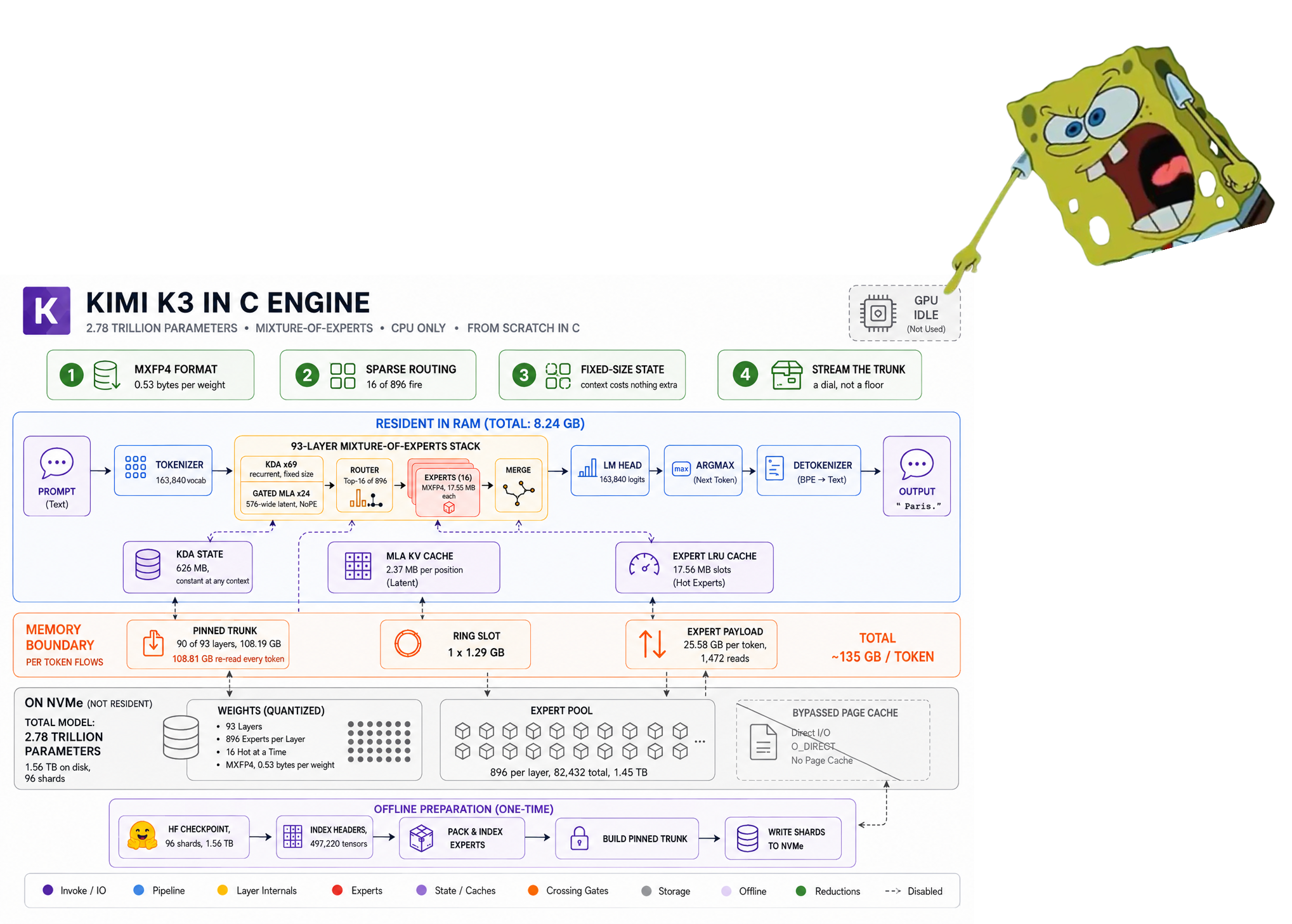
A 2.78-trillion-parameter Kimi K3 running inference on a single CPU in 8.24 GB of RAM. Portable C99: no BLAS, no framework, no GPU.
A powerful and flexible frontend & AI gateway for large language models, supporting 21+ mainstream AI model providers.
纯 C# PP-OCRv6 推理库:多平台手写 Kernel / GEMM 等算子、超高性能、低内存需求、超高准确率。 自带托管 ONNX 解释器,不依赖 Paddle Inference、ONNX Runtime 或 OpenCV 原生库。
High-performance pure C# arbitrary-precision arithmetic: BigInt, BigRational and correctly-rounded Real. No native dependencies.