
AFFiNE
There can be more than Notion and Miro. AFFiNE(pronounced [ə‘fain]) is a next-gen knowledge base that brings planning, sorting and creating all together. Privacy first, open-source, customizable and ready to use.
- 78k
- TypeScript
- 7 h ago
List of Rust books
Repo sger/RustBooks, read from GitHub 5 h ago. sger has not joined Take My Repo.
sger/RustBooks is a public repo on GitHub by sger. List of Rust books. It declares no license on GitHub. Public does not mean open source: without a license, nobody is granted the right to reuse it. It has 5,687 stars and last changed on 2026-10-24. Nobody has reviewed it on Take My Repo yet, which says nothing about its quality. Read from GitHub on 2026-11-24.
There can be more than Notion and Miro. AFFiNE(pronounced [ə‘fain]) is a next-gen knowledge base that brings planning, sorting and creating all together. Privacy first, open-source, customizable and ready to use.
Welcome! This book will teach you about the Rust programming language. Rust is a systems programming language focused on three goals: safety, speed, and concurrency. It maintains these goals without having a garbage collector, making it a useful language for several use cases other languages aren’t good at: embedding in other languages, programs with specific space and time requirements, and writing low-level code, like device drivers and operating systems. It improves on current languages targeting this space by having several compile-time safety checks that produce no runtime overhead while eliminating all data races. Rust also aims to achieve ‘zero-cost abstractions’ even though some of these abstractions feel like those of a high-level language. Even then, Rust still allows precise control like a low-level language would.
This is Rust-101, a small tutorial for the Rust language. It is intended to be an interactive, hands-on course: I believe the only way to really learn a language is to write code in it, so you should be coding during the course. If you have any questions that are not answered here, check out the "Additional Resources" below. In particular, the IRC channel is filled with awesome people willing to help you! I spent lots of time there ;-) I will assume some familiarity with programming, and hence not explain the basic concepts common to most languages. Instead, I will focus on what makes Rust special.
Rust by Example (RBE) is a collection of runnable examples that illustrate various Rust concepts and standard libraries. To get even more out of these examples, don't forget to install Rust locally and check out the official docs. Additionally for the curious, you can also check out the source code for this site.
This book was designed for easily diving into and getting skilled with Rust, and it's very easy to use: All you need to do is to make each exercise compile without ERRORS and Panics!
This course will teach you Rust's core concepts, one exercise at a time. You'll learn about Rust's syntax, its type system, its standard library, and its ecosystem. We don't assume any prior knowledge of Rust, but we assume you know at least another programming language. We also don't assume any prior knowledge of systems programming or memory management. Those topics will be covered in the course.
This is a free Rust course developed by the Android team at Google. The course covers the full spectrum of Rust, from basic syntax to advanced topics like generics and error handling. The course is also available as a PDF.
The course explores a wide array of topics in the Rust programming language, gradually introducing them through the development of a grep-like program.

Rust is a new language that already has good textbooks. But sometimes its textbooks are difficult because they are for native English speakers. Many companies and people now learn Rust, and they could learn faster with a book that has easy English. This textbook is for these companies and people to learn Rust with simple English.
This small book describes how to use Rust and WebAssembly together.
This book is for anyone interested in compiling Rust to WebAssembly for fast, reliable code on the Web. You should know some Rust, and be familiar with JavaScript, HTML, and CSS. You don't need to be an expert in any of them.
This book is a guide to asynchronous programming in Rust. It is designed to help you take your first steps and to discover more about advanced topics. We don't assume any experience with asynchronous programming (in Rust or another language), but we do assume you're familiar with Rust already. If you want to learn about Rust, you could start with The Rust Programming Language.
This book has two main parts: part one is a beginners guide, it is designed to be read in-order and to take you from total beginner to intermediate level. Part two is a collection of stand-alone chapters on more advanced topics. It should be useful once you've worked through part one or if you already have some experience with async Rust.
While systems programming languages have greatly evolved since the introduction of C more than 40 years ago, our capacity for dumb mistakes with enormous consequences has remained unchanged, with vivid examples regularly in the news. This O'Reilly report examines Rust, a new systems programming language that combines safety and security with performance on a par with C and C++.

Rust is a highly concurrent and high-performance language that focuses on safety and speed, memory management, and writing clean code. It also guarantees thread safety, and it aims to improve the performance of existing applications. It has been backed by Mozilla to solve the critical problem of concurrency.
Learn to program with Rust 2021 Edition, in an easy, step-by-step manner on Unix, the Linux shell, macOS, and the Windows command line. As you read this book, you’ll build on the knowledge you gained in previous chapters and see what Rust has to offer.
Beginning Rust starts with the basics of Rust, including how to name objects, control execution flow, and handle primitive types. You’ll see how to do arithmetic, allocate memory, use iterators, and handle input/output. Once you have mastered these core skills, you’ll work on handling errors and using the object-oriented features of Rust to build robust Rust applications in no time.
Only a basic knowledge of programming in C or C++ and familiarity with a command console are required. After reading this book, you’ll be ready to build simple Rust applications.
Those who are new to Rust and who have at least some prior experience with programming in general: some C/C++ is recommended particularly.
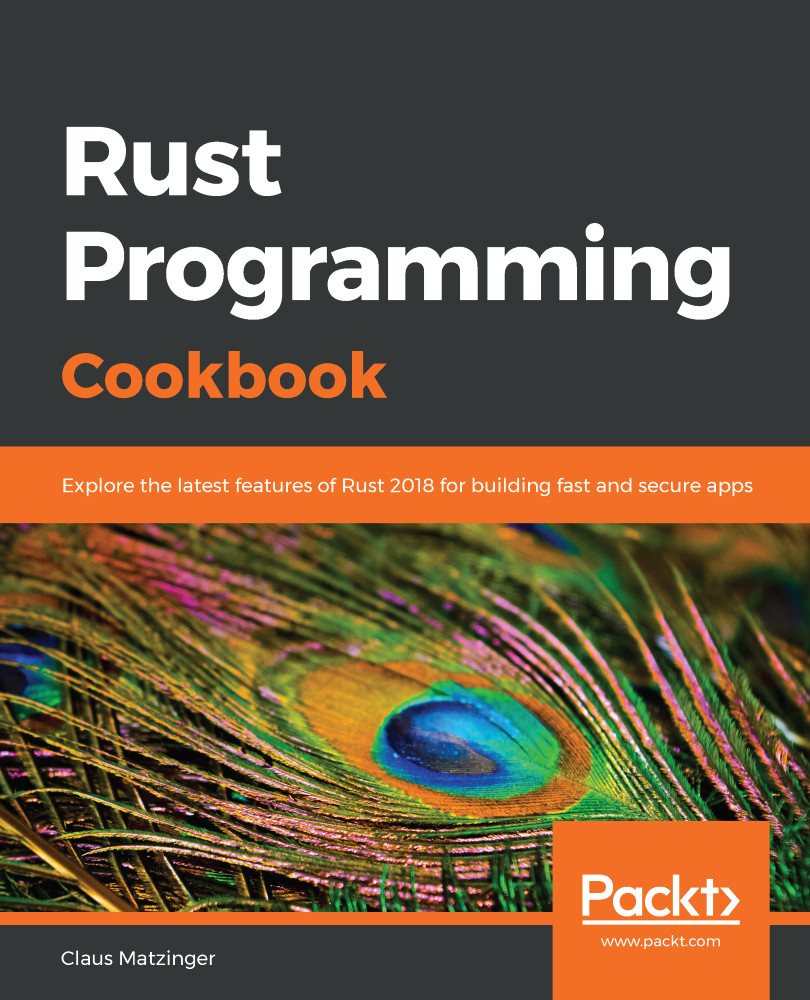
Rust 2018, Rust's first major milestone since version 1.0, brings more advancement in the Rust language. The Rust Programming Cookbook is a practical guide to help you overcome challenges when writing Rust code. This Rust book covers recipes for configuring Rust for different environments and architectural designs, and provides solutions to practical problems. It will also take you through Rust's core concepts, enabling you to create efficient, high-performance applications that use features such as zero-cost abstractions and improved memory management. As you progress, you'll delve into more advanced topics, including channels and actors, for building scalable, production-grade applications, and even get to grips with error handling, macros, and modularization to write maintainable code. You will then learn how to overcome common roadblocks when using Rust for systems programming, IoT, web development, and network programming. Finally, you'll discover what Rust 2018 has to offer for embedded programmers. By the end of the book, you'll have learned how to build fast and safe applications and services using Rust.

Mozilla’s Rust is gaining much attention with amazing features and a powerful library. This book will take you through varied recipes to teach you how to leverage the Standard library to implement efficient solutions.
The book begins with a brief look at the basic modules of the Standard library and collections. From here, the recipes will cover packages that support file/directory handling and interaction through parsing. You will learn about packages related to advanced data structures, error handling, and networking. You will also learn to work with futures and experimental nightly features. The book also covers the most relevant external crates in Rust.
Rust is low-level enough to provide fine-grained control over memory while providing safety through compile-time validation. This makes it uniquely suitable for writing low-level networking applications.
This book is divided into three main parts that will take you on an exciting journey of building a fully functional web server. The book starts with a solid introduction to Rust and essential networking concepts. This will lay a foundation for, and set the tone of, the entire book. In the second part, we will take an in-depth look at using Rust for networking software. From client-server networking using sockets to IPv4/v6, DNS, TCP, UDP, you will also learn about serializing and deserializing data using serde. The book shows how to communicate with REST servers over HTTP. The final part of the book discusses asynchronous network programming using the Tokio stack. Given the importance of security for modern systems, you will see how Rust supports common primitives such as TLS and public-key cryptography.
Beginning with an introduction to Rust, you’ll learn the basic aspects such as its syntax, data types, functions, generics, control flows, and more. After this, you’ll jump straight into building your first project, a Tetris game. Next, you’ll build a graphical music player and work with fast, reliable networking software using Tokio, the scalable and productive asynchronous IO Rust library.
Throughout this book, you’ll explore various features of Rust Programming including its SDL features, event loop, File I/O, and the famous GTK+ widget toolkit. Through these projects, you’ll see how well Rust performs in terms of concurrency—including parallelism, reliability, improved performance, generics, macros, and thread-safety. We’ll also cover some asynchronous and reactive programming aspects of Rust.

Get familiar with writing programs in the trending new systems programming language that brings together the powerful performance of low-level languages with advanced features like thread-safety in multi-threaded code.
sger/RustBooks is a public repo on GitHub by sger. List of Rust books.
It declares no license on GitHub. Public does not mean open source: without a license, nobody is granted the right to reuse it.
Its maker has not tagged a system, so it is unknown here. Its README says what it needs.
Open "Take it" on its page: Take My Repo writes an install plan for your machine and hands it to your AI agent (Claude Code, Codex or Cursor), which asks you before each step. Take My Repo has not tested it on any machine.
什么?你敢放心的把后背交给 AI? 我赌你不敢,那就来学学 AI 时代最酷、最安全、最快的语言吧。本书拥有全面且深入的讲解、生动贴切的示例、德芙般丝滑的内容,这可能是目前最用心的 Rust 中文学习教程 / Book
Its last change on GitHub was on 2026-10-24. Take My Repo does not judge from that whether it is maintained.
Nobody has reviewed it on Take My Repo yet, which says nothing about its quality.
Take My Repo cannot say: it does not audit code and has not run RustBooks. What is known comes from GitHub. It declares no license on GitHub. Public does not mean open source: without a license, nobody is granted the right to reuse it. Its last change was on 2026-10-24. It has 5,687 stars, which measure popularity, not safety. Nobody has reviewed it on Take My Repo yet, which says nothing about its quality. Read the source before you run it. With "Take it", your AI agent shows each step and asks you before running it; README text is treated as data, not as instructions.


