
raea
Render Anything Engine: tell your AI what to make. Videos, motion graphics, 3D and games as React and TypeScript, rendered on your own GPU. Rust + Bevy, macOS, Linux and Windows.
- 3.3k
- TypeScript
- 56 min ago
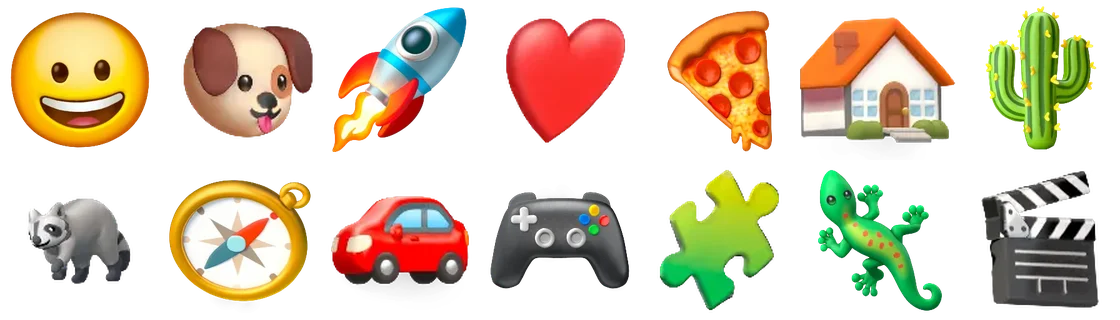
3D emoji you can turn: Noto Emoji 3D renders made into Gaussian splats, published as sprite atlases with live recolouring. Unofficial.
Repo shinyobjectz/Splatoto, read from GitHub 1 min ago. shinyobjectz has not joined Take My Repo.
shinyobjectz/Splatoto is a public repo on GitHub by shinyobjectz. 3D emoji you can turn: Noto Emoji 3D renders made into Gaussian splats, published as sprite atlases with live recolouring. Unofficial. It declares the MIT license on GitHub. It is written mainly in Python, has 1 stars and last changed on 2026-11-15. Nobody has reviewed it on Take My Repo yet, which says nothing about its quality. Read from GitHub on 2026-11-22.
3D emoji you can turn. Each one began as a front render from Noto Emoji 3D and became a 3D Gaussian splat. Splatoto publishes them as sprite atlases: pictures of each emoji seen from many angles, ready to make an emoji turn toward the cursor or spin, with no 3D engine.
Unofficial. Splatoto is not made, endorsed or supported by Google. Noto is a trademark of Google LLC. The pictures are a derivative of Noto Emoji's 3D renders, licensed under the SIL Open Font License 1.1 (see Licence).

Status (2026-11-15): the library of 4,007 is being rendered. The first release follows when it's done.
Each emoji has up to five pictures, named by Noto's file code: the lowercase hex code points joined by _, without fe0f. For example 😀 is 1f600, ❤️ is 2764 and 👍🏽 is 1f44d_1f3fd.
| File | What it holds | Size (typical) |
|---|---|---|
<code>.webp |
The cursor cone. 9 × 5 views: yaw −45° to 45° in 11.25° steps, tilt +25° to −25° in 12.5° steps | ~105 KB |
<code>_360.webp |
A full turn. 32 × 5 views: yaw 0° to 348.75° in 11.25° steps, the same five tilts | ~350 KB |
<code>_front.webp |
The front view alone, 256 px | ~15 KB |
<code>_parts.webp, <code>_360_parts.webp |
Parts maps for recolouring, in the same cells as the two atlases: per pixel, red = the body colour, green = dark features (eyes, mouth), blue = whites; what's left is accent | ~30 / 100 KB |
_360.webp is only included for emoji whose back passed an automatic check. Yellow faces, hands and skin-toned people can come out with dark, ghosted backs, which never show in the cone. index.json says which emoji have one.Releases ship one zip per Unicode group (Smileys & Emotion, People & Body, Animals & Nature, …) plus index.json, which lists every code with its name, group and the files it has.
<script type="module" src="web/splatoto-emoji.js"></script>

<splatoto-emoji code="1f600" base="./sprites/" size="64"></splatoto-emoji>     <!-- turns toward the cursor -->
<splatoto-emoji code="1f680" base="./sprites/" mode="spin"></splatoto-emoji>   <!-- spins (needs _360) -->
<splatoto-emoji code="1f600" recolor="tint #3a7bff"></splatoto-emoji>   <!-- a blue smiley; eyes and teeth stay -->
<splatoto-emoji code="2764" recolor="gold"></splatoto-emoji>
Looks: tint #hex (the body only), mono #hex (every coloured part takes the hue), hue DEG, pastel, neon, gold, chrome, clay, ink, negative. web/recolor.js recolours the finished atlas using its parts map: it moves colours in CIELAB and keeps each pixel's offset from its part's colour, so shading and highlights carry over. It needs pixel access to the images, so serve them from the same origin as the page (or with CORS). web/demo.html?base=./sprites/ is a playground for every look.
tools/recolor.py does the same to a splat itself (.ply or .spz), for 3D use.
Set the atlas as background-image, set background-size to 900% 500% (cone) or 3200% 500% (360), and pick a cell with background-position: calc(col / (cols − 1) * 100%) calc(row / 4 * 100%).
3D/png/512 at commit 99701e0), cropped to the emoji and centred on grey.tools/canon.py uses that camera to turn each splat so the original view faces +Z with +Y up, centred, with its larger side 1 unit long.tools/emoji_ship.py renders every view with gsplat (orthographic) and scores the front against the source picture (silhouette overlap and colour error). It also checks the back. IDOL sometimes carries a front's baked rim shading round to the back, which shows as a dark copy of the front on yellow and skin-toned subjects (smileys, hands, people). A back fails when its median lightness is under 0.72 of the front's and the body colour is yellow or skin (hue 35–100°, chroma over 20). Dark backs on other things, like a game controller or a clapperboard, are real and pass.tools/recolor.py splits each splat's colours into groups (k-means in CIELAB, joined into hue families) and names them body, feature, white or accent. The parts maps are those groups' weights rendered through the same views.tools/ holds the pipeline as it was run: emoji_modal.py (IDOL on Modal GPUs), emoji_ship.py (pose, renders, parts, checks, packing), recolor.py (colour groups and looks), spz.py (a Niantic SPZ v3 writer and reader), render_sprite.py (a CPU reference rasteriser), orient_search.py (how IDOL's file frame was matched to its camera) and groups.py (Unicode groups and names).
samples/): SIL Open Font License 1.1, derived from Noto Emoji. Copyright 2013 Google LLC; see OFL.txt. Under the OFL you may use, change and redistribute them, including in commercial work, but you may not sell them on their own, and derivatives must stay under the OFL.tools/, web/): MIT, see LICENSE.shinyobjectz/Splatoto is a public repo on GitHub by shinyobjectz. 3D emoji you can turn: Noto Emoji 3D renders made into Gaussian splats, published as sprite atlases with live recolouring. Unofficial.
It declares the MIT license on GitHub.
Its maker has not tagged a system, so it is unknown here. Its README says what it needs.
Open "Take it" on its page: Take My Repo writes an install plan for your machine and hands it to your AI agent (Claude Code, Codex or Cursor), which asks you before each step. Take My Repo has not tested it on any machine.
Its last change on GitHub was on 2026-11-15. GitHub counts 0 open issues and pull requests. Take My Repo does not judge from that whether it is maintained.
Nobody has reviewed it on Take My Repo yet, which says nothing about its quality.
Render Anything Engine: tell your AI what to make. Videos, motion graphics, 3D and games as React and TypeScript, rendered on your own GPU. Rust + Bevy, macOS, Linux and Windows.
Design-system and vocabulary drift, enforced. Tailwind themes become law, rogue values get receipts, words live in a database agents inherit — one org ontology across every repo.
🧊 a little buddy who lives on your Mac — talks, sees your screen, remembers how you work
