ECC
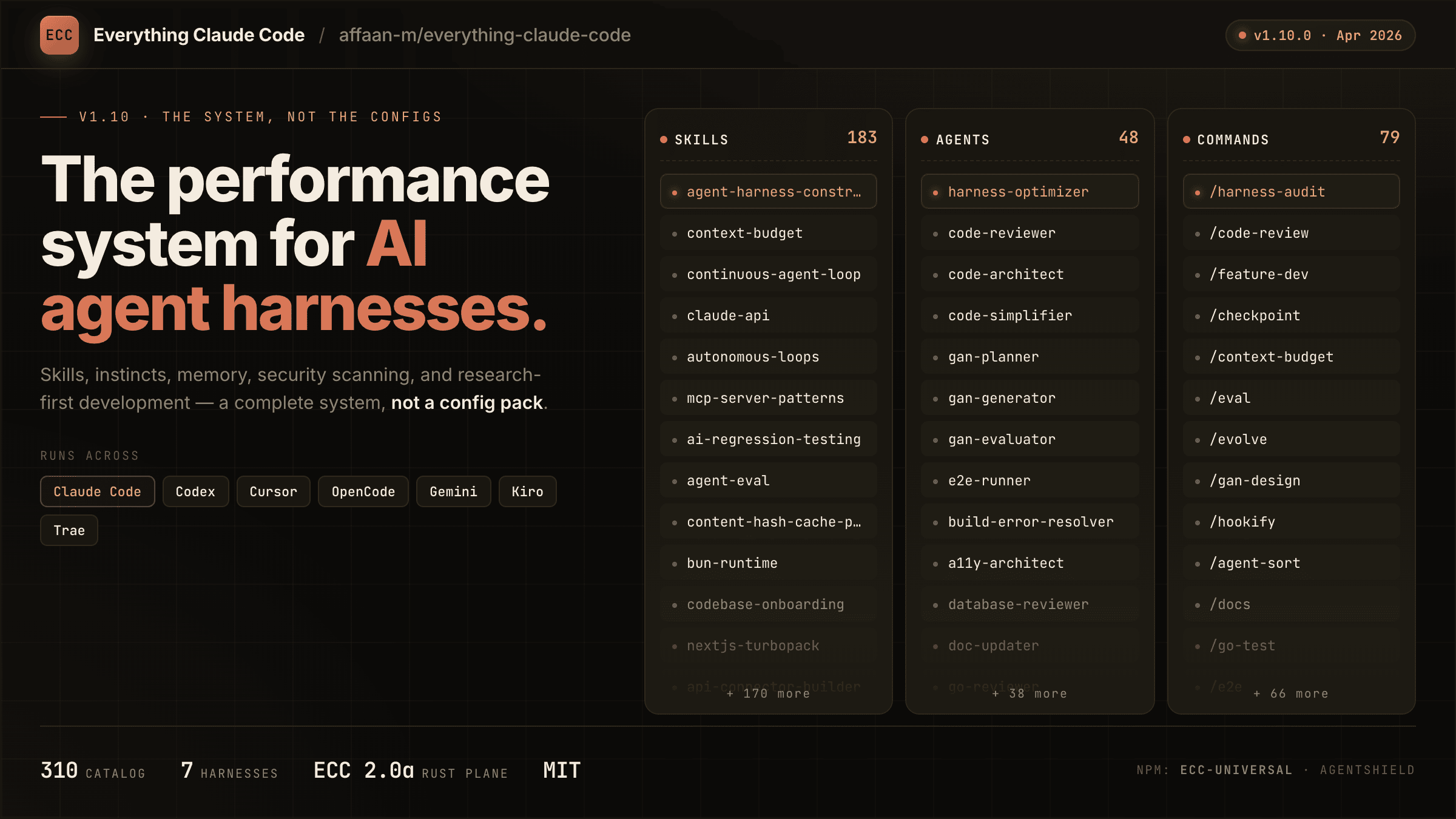
The agent harness performance optimization system. Skills, instincts, memory, security, and research-first development for Claude Code, Codex, Opencode, Cursor and beyond.
- 309k
- JavaScript
- MIT
- 3 d ago
🔍 AI codebase analysis — turn any GitHub repo into an evidence-backed technical brief: architecture, risks, and a build-vs-rewrite verdict, every claim cited.
Repo sx4im/codebrief, read from GitHub 1 h ago. sx4im has not joined Take My Repo.
sx4im/codebrief is a public repo on GitHub by sx4im. 🔍 AI codebase analysis — turn any GitHub repo into an evidence-backed technical brief: architecture, risks, and a build-vs-rewrite verdict, every claim cited. It declares the MIT license on GitHub. It is written mainly in TypeScript, has 2 stars and last changed on 2026-06-19. Nobody has reviewed it on Take My Repo yet, which says nothing about its quality. Read from GitHub on 2026-11-22.

Codebrief turns any GitHub repository into an evidence-backed technical brief — system narrative, decision archaeology, a landmine map, and a build-on-vs-rewrite verdict — so you can take over an unfamiliar codebase with confidence. Every claim cites the commit, PR, file, or metric it came from.
Live demo · How it works · Quick start · Tech stack
If Codebrief is useful to you, a ⭐ helps others discover it.
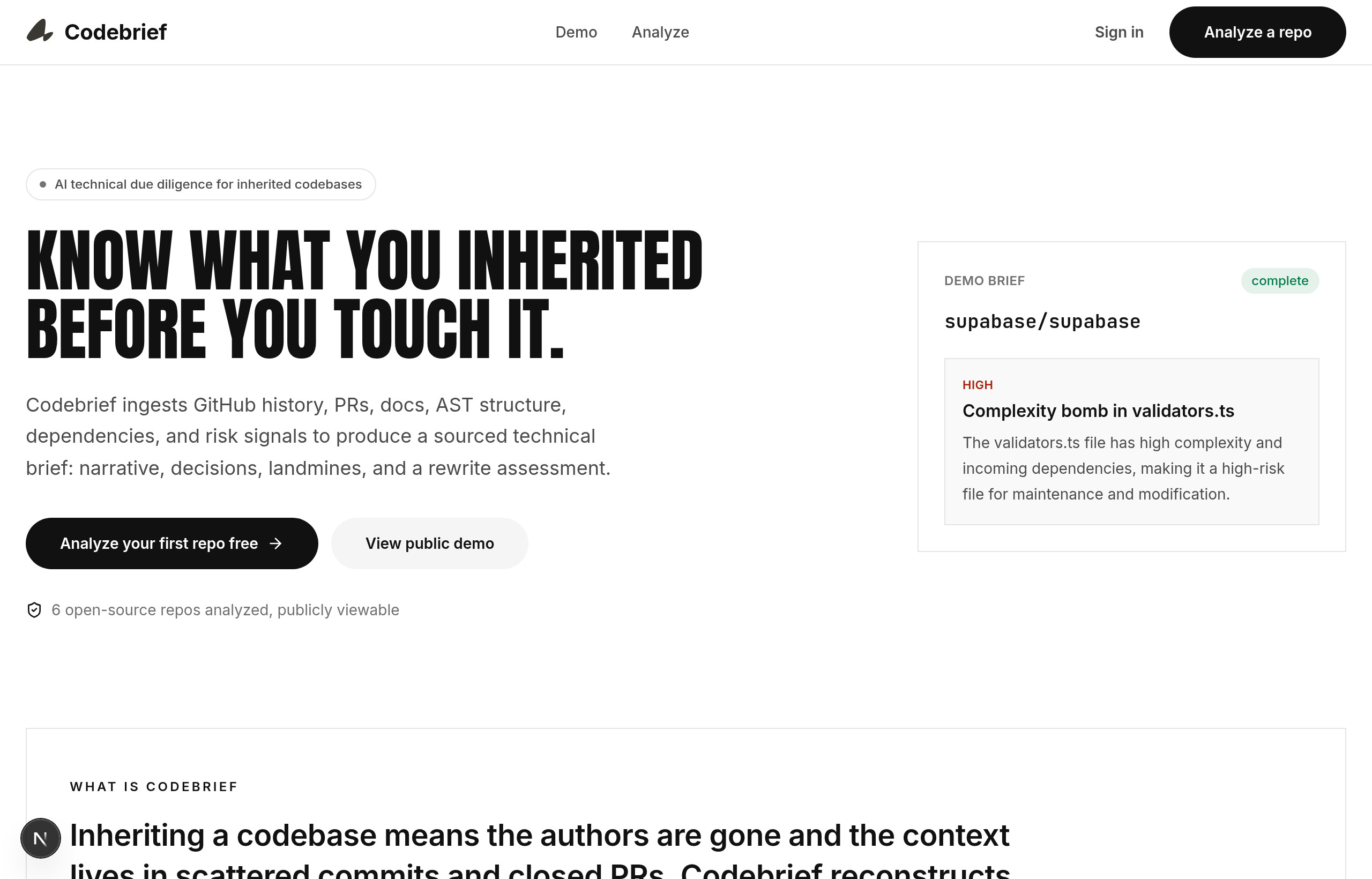
Inheriting a codebase is one of the riskiest moments in software: the original authors are gone, the context lives in scattered commits and closed PRs, and the README rarely tells you where the bodies are buried. Codebrief reconstructs that missing context automatically.
Point it at a repository and a multi-agent pipeline ingests the Git history, parses the source with tree-sitter, scores risk, and synthesizes a structured brief where every claim cites the commit, PR, file, or metric it came from. No hand-wavy summaries — just sourced, auditable findings.
[!NOTE] Codebrief is free and open source. Public demo briefs require no account.
Every analysis produces a single, scrollable brief with sourced sections:
| Section | What it answers |
|---|---|
| System narrative | A business-level explanation of what the system does, its data model, and architecture pattern — with citations. |
| Decision archaeology | Why the codebase looks the way it does, reconstructed from commits, PRs, and discussion threads. |
| Landmine map | The risky files and patterns — severity, why they matter, remediation, and effort estimates. |
| Rewrite assessment | A grounded build-on vs. rewrite verdict with reasons, risks, and an explicit uncertainty statement. |
| Architecture diagram | An interactive dependency graph; select any module to inspect its coupling and landmines. |
| Grounded Q&A | Ask follow-up questions answered only from the analyzed evidence. |
| Exports | One-click PDF and Markdown for sharing with stakeholders. |
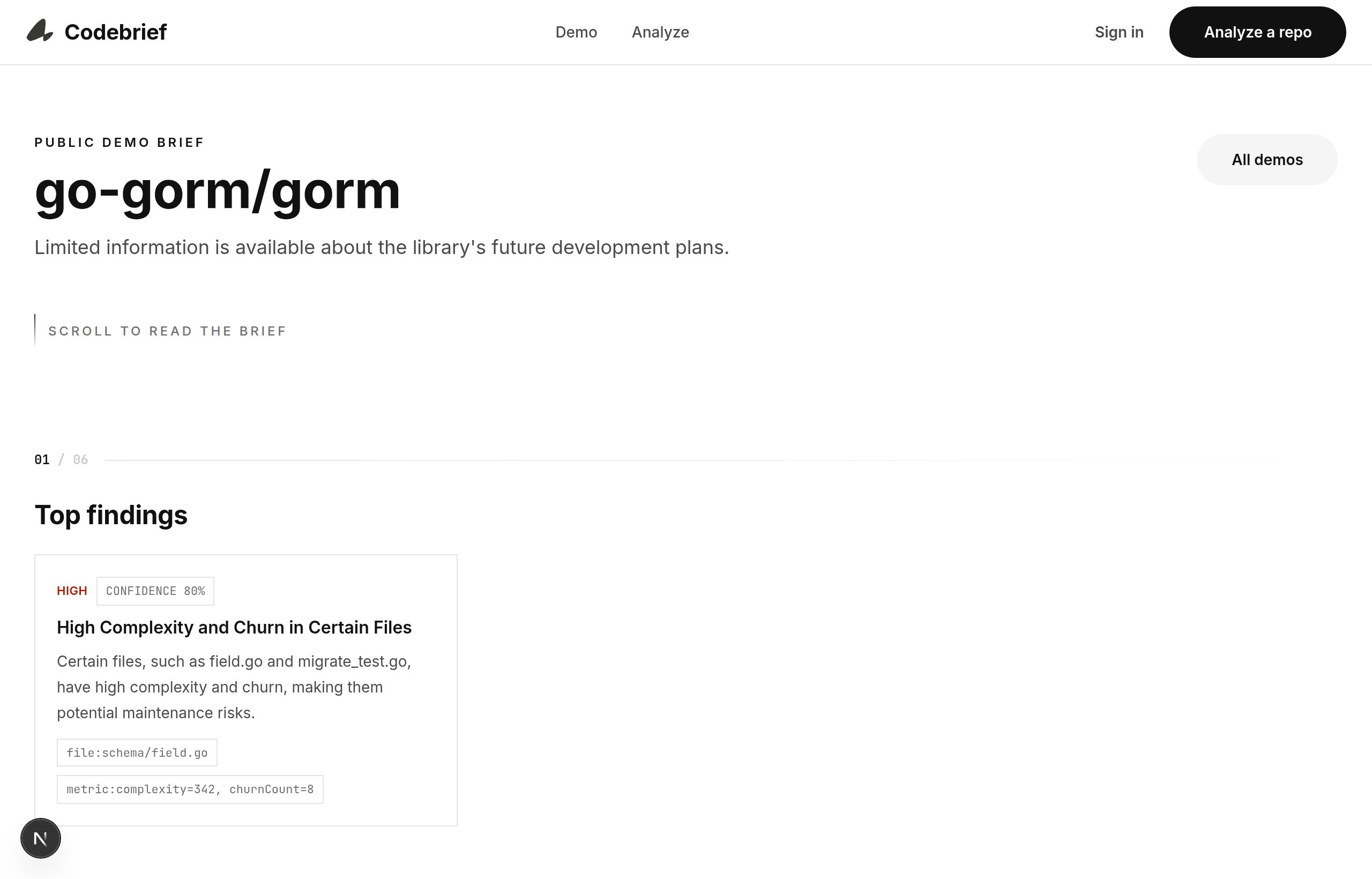
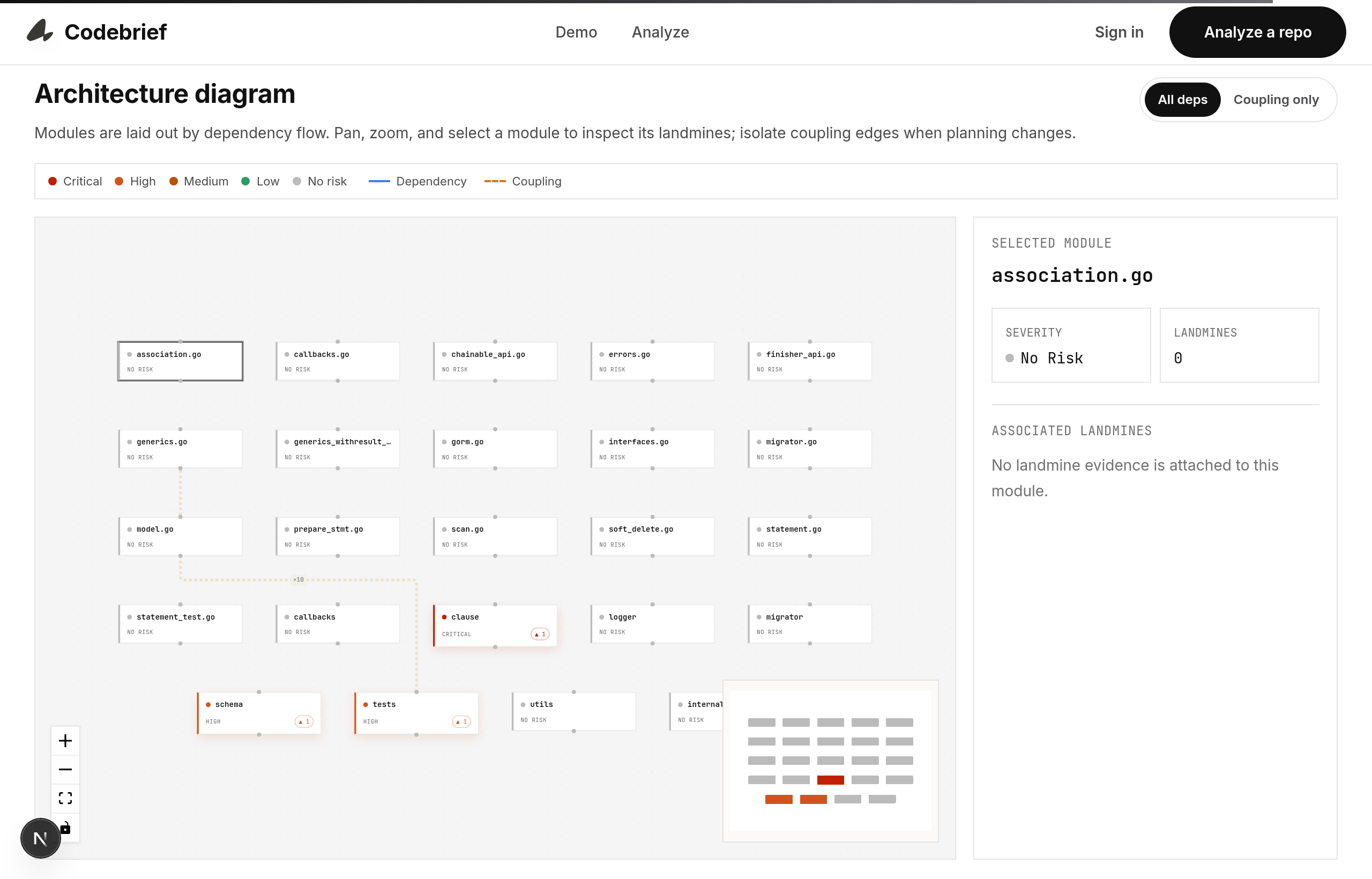
Pre-generated briefs for well-known open-source projects are publicly viewable — no sign-in required:
/demo           → gallery of demo briefs
/demo/[slug]    → a full brief (e.g. /demo/gorm, /demo/supabase, /demo/django)
Run the app locally (see Quick start) and open http://localhost:3000/demo.
Codebrief runs a sequential, durable pipeline. Each stage persists its output before the next begins, so a failed run can be retried with clean inputs and live progress streams to the UI over websockets.
flowchart LR
    A["GitHub repo"] --> B["Ingestion<br/>commits, PRs, files"]
    B --> C["Static analysis<br/>tree-sitter AST, risk scoring"]
    C --> D["Multi-agent synthesis"]
    D --> E["Architecture"]
    D --> F["History"]
    D --> G["Risk"]
    D --> H["Synthesis"]
    E --> V["Source validation<br/>every claim must cite evidence"]
    F --> V
    G --> V
    H --> V
    V --> S["Postgres + R2<br/>artifacts"]
    S --> O["Technical brief<br/>web, PDF, Markdown"]
Grounding is enforced, not hoped for. After every agent call, outputs are validated against their citations. Invalid citations trigger one correction retry; claim-like output that still can't be sourced is downgraded to confidence: 0 rather than shipped as fact. Unrecoverable output fails the analysis instead of polluting the brief.
| Layer | Technology |
|---|---|
| Web | Next.js (App Router), React, Tailwind CSS, Framer Motion |
| Auth | Clerk |
| AI | NVIDIA NIM (OpenAI-compatible SDK) — multi-agent, serialized with backoff |
| Pipeline | Node worker, BullMQ on Redis |
| Code analysis | tree-sitter (TS/TSX, Python, Go, Ruby, …) |
| Data | PostgreSQL via Drizzle ORM |
| Artifact storage | Cloudflare R2 (S3-compatible) |
| Realtime | Socket.io progress streaming |
| Exports | Puppeteer (PDF), Markdown serializer |
| Observability | Sentry (browser · server · edge) |
| Validation | Zod schemas shared across web + pipeline |
This is an npm-workspaces monorepo.
codebrief/
├── apps/web/            # Next.js app: dashboard, analysis APIs, brief viewer, exports, demos
├── packages/pipeline/   # BullMQ worker: ingestion, AST, agents, validation, storage, websockets
├── shared/types/        # Zod schemas & TypeScript types (briefs, events, GitHub records)
├── src/m0/              # M0 spike: source validation, AST, risk scoring, agent-retry tests
├── drizzle/             # SQL migrations
└── assets/              # Brand assets & documentation screenshots
PUPPETEER_EXECUTABLE_PATH)git clone https://github.com/sx4im/codebrief.git
cd codebrief
npm install
cp .env.example .env
Fill in .env with your Clerk, GitHub, Postgres, Redis, NVIDIA NIM, and R2 values. No secrets are hardcoded — the app surfaces explicit configuration errors instead of faking output when credentials are missing.
npm run db:migrate
Start the web app, the pipeline worker, and the websocket progress server in separate shells:
npm run dev:web      # http://localhost:3000
npm run dev:worker   # BullMQ analysis worker
npm run dev:ws       # Socket.io progress server
Open http://localhost:3000, browse the demos, or start a live analysis from /projects/new.
Check deployment readiness without exposing secrets:
curl http://localhost:3000/api/health
curl http://localhost:3000/api/health?deep=1
All gates pass on a clean checkout:
npm run typecheck          # tsc across every workspace
npm test                   # pipeline + web unit/integration suites
npm run build -w apps/web  # production Next.js build
npm audit                  # dependency audit
PDF export is exercised end-to-end through the real route (briefToHtml → puppeteer-core → Chrome) when PUPPETEER_EXECUTABLE_PATH is set; otherwise the route cleanly falls back to HTML.
| Command | Description |
|---|---|
npm run dev:web |
Run the Next.js web app |
npm run dev:worker |
Run the BullMQ analysis worker |
npm run dev:ws |
Run the Socket.io progress server |
npm run db:migrate |
Apply database migrations |
npm run db:studio |
Open Drizzle Studio |
npm run pipeline:corpus -- --mode=dry-run --scope=quick |
Prepare the multi-language corpus manifest |
npm run pipeline:build-demo-briefs |
Regenerate the public demo briefs |
npm run typecheck · npm test |
Full verification |
MIT © 2026 Saim Shafique
sx4im/codebrief is a public repo on GitHub by sx4im. 🔍 AI codebase analysis — turn any GitHub repo into an evidence-backed technical brief: architecture, risks, and a build-vs-rewrite verdict, every claim cited.
It declares the MIT license on GitHub.
Its maker has not tagged a system, so it is unknown here. Its README says what it needs.
Open "Take it" on its page: Take My Repo writes an install plan for your machine and hands it to your AI agent (Claude Code, Codex or Cursor), which asks you before each step. Take My Repo has not tested it on any machine.
Its last change on GitHub was on 2026-06-19. GitHub counts 0 open issues and pull requests. Take My Repo does not judge from that whether it is maintained.
Nobody has reviewed it on Take My Repo yet, which says nothing about its quality.
The agent harness performance optimization system. Skills, instincts, memory, security, and research-first development for Claude Code, Codex, Opencode, Cursor and beyond.
Reverse engineer anything with agents, from app behavior down to native binaries.
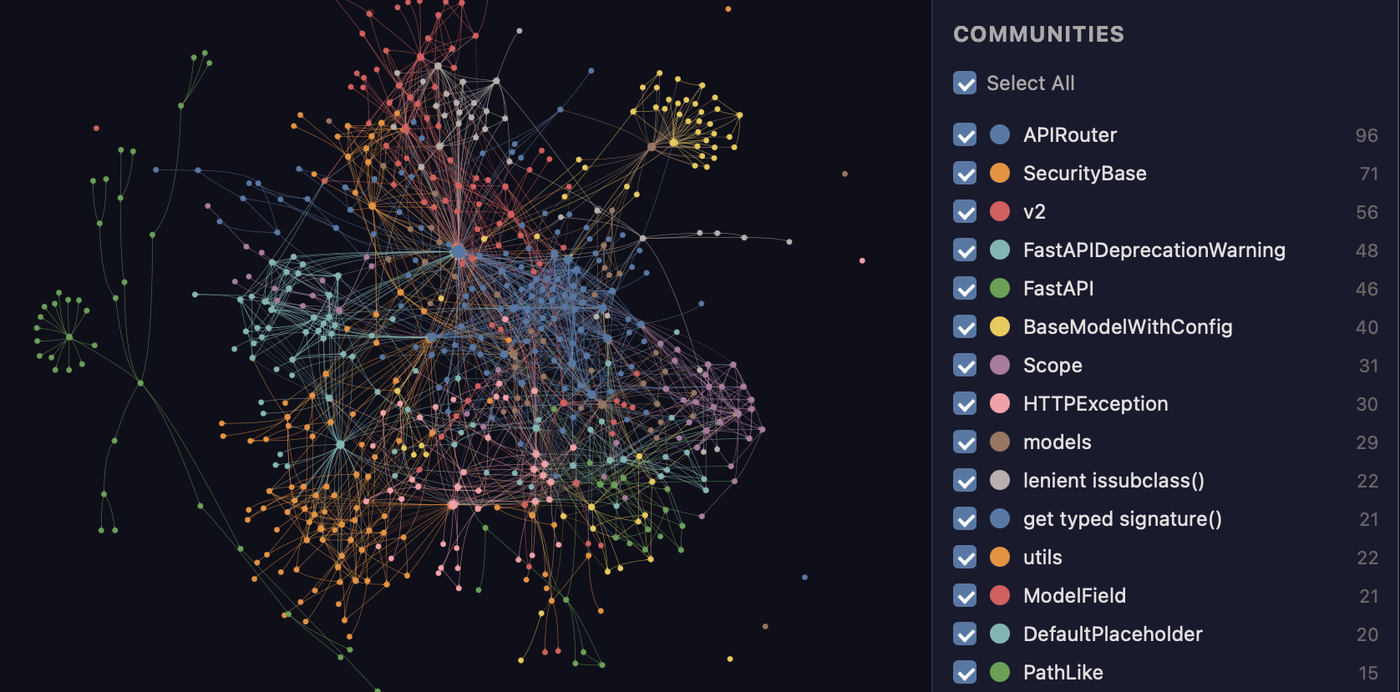
Turn any codebase, with its docs, SQL schemas, configs, and PDFs, into a queryable knowledge graph. A /graphify skill for Claude Code, Cursor, Codex, and Gemini CLI: local deterministic AST parsing, every edge explained, no vector store.
Local code intelligence for developers and AI agents. Connect code, docs and infrastructure in a persistent graph, with CBM Lens, MCP tools, agent integrations and change-aware test selection.
Free programming books library: 670+ books across 32 languages, searchable and free forever
Blind A/B testing for AI agent skills, .cursorrules, CLAUDE.md, and system prompts. Detects placebo and harmful instructions.
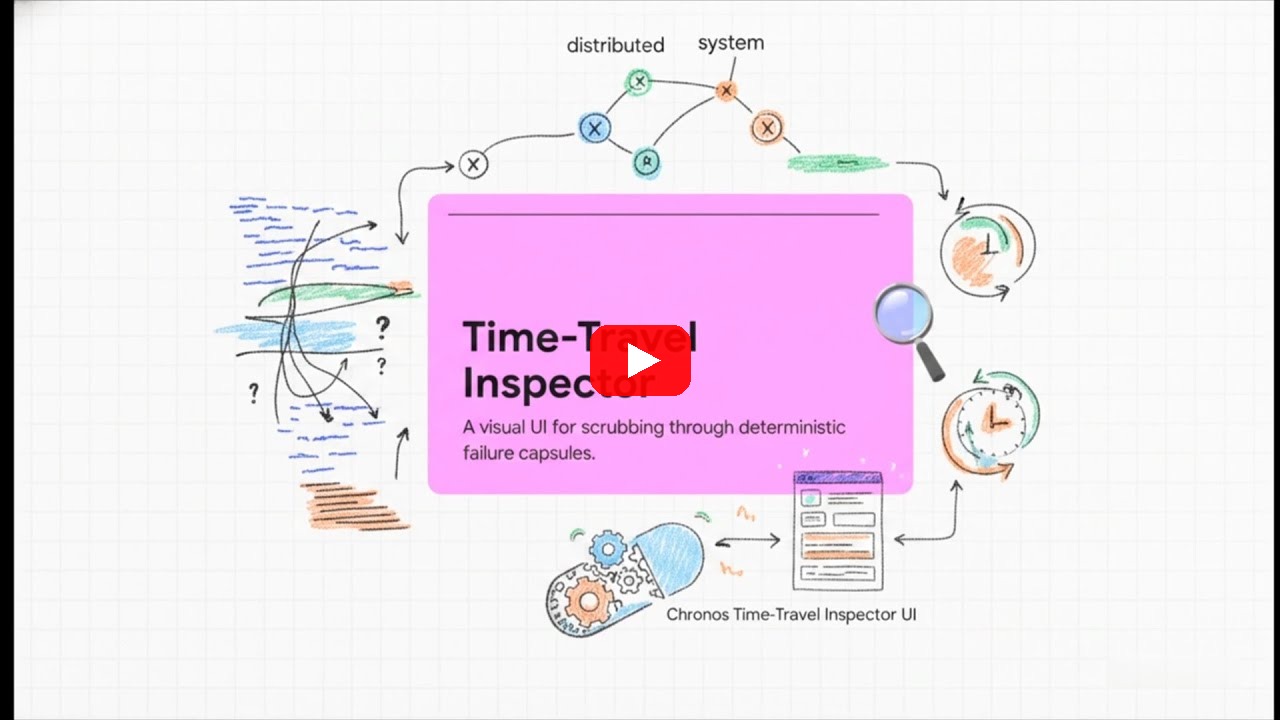
Deterministic Simulation Testing (DST) framework for TypeScript & Node.js. Reproduce distributed systems race conditions, network partitions, and heisenbugs bit-for-bit from a single integer seed. Inspired by FoundationDB & TigerBeetle.
AI whiteboard that solves STEM problems as you draw them. Draw equations on an infinite canvas, select any region, and get step-by-step LaTeX solutions powered by NVIDIA NIM vision AI.
Momentra is a modern, responsive platform for showcasing diverse photography collections. From landscapes to portraits, it offers an elegant and organized space to present visual stories.
Python contracts for AI-agent tool results. Block empty, partial, stale and unverified JSON, HTTP, MCP and stdio observations.