StringiFor
Strings Fortran Manipulator with steroids
- 93
- 6 d ago
Repo szaghi/StringiFor, read from GitHub 3 d ago. szaghi has not joined Take My Repo.
In short
szaghi/StringiFor is a public repo on GitHub by szaghi. Strings Fortran Manipulator with steroids. It declares no license on GitHub. Public does not mean open source: without a license, nobody is granted the right to reuse it. It is written mainly in Fortran, has 93 stars and last changed on 2026-11-16. Nobody has reviewed it on Take My Repo yet, which says nothing about its quality. Read from GitHub on 2026-11-20.

StringiFor
Strings Fortran Manipulator, with steroids
A string type for modern Fortran with the methods you miss from Python: split, join, replace, strip, slice, justify, regular expressions, cast to and from numbers, read and write files, UTF-8 aware. One type, one module, pure Fortran 2008.

A real session of the short program of the quick start below: every answer is one method of the string type.
| 🔤 A real string type One type holding a string of any length: arrays whose elements have different lengths, no trim() everywhere, no silent truncation. A first string |
🔗 A drop-in for characterAssignment, //, the comparison operators and the intrinsics (trim, index, len_trim, repeat, ...) accept a string wherever a character goes. Strings and I/O |
✂️ Split, join, slicesplit and partition into tokens (the empty CSV fields kept, if you want), join arrays back, slice with a stride, reverse characters or words, replace, strip, compact whitespace, squeeze repeats, transliterate sets of characters. String manipulation |
🔠 Case and layoutupper, lower, capitalize, camelCase, snake_case, Start Case; is_alpha, is_space, is_punct...; pad, center or justify to a width, expand tabs, wrap a paragraph in fully justified lines. Case conversion · Layout |
| 🔢 Numbers in, numbers out Assign any integer or real kind to a string, cast back with to_number, or with read_number and an error status; ask is_number, is_integer, is_real; hexadecimal representation with hex. Numbers |
📁 Files and paths Read a file into an array of lines or one string, write it back, read line by line; basedir, basename, extension, glob, wildcard match, temporary names. Files and paths |
| ⚖️ Comparisons that know more Longest common prefix of many strings, version numbers compared field by field, start_with, end_with, count. Comparing |
🎨 Encoding and colours Base64 encode and decode, escape and unescape, ANSI colours and styles for the terminal. Encoding · Colours |
🔍 Regular expressionsregex: search, match, groups by number or name, findall, split, sub with templates. The results of Python's re, in time linear in the text whatever the pattern: no catastrophic backtracking. Regular expressions |
🌐 UTF-8 and Unicode Methods that never cut a character in two; lengths and positions in characters or display columns with by=; check and repair UTF-8, C and XML escapes, Unicode whitespace, byte order marks, strsort. Unicode and UTF-8 |
| ⚡ Elemental by design Almost every method is pure or elemental: apply it to a whole array of strings in one statement, use it in pure procedures. Arrays of strings |
🧪 Tested by its own documentation Every method carries doctests in its source; every example of the documentation is a program compiled and run to produce the output shown. The examples |
| 🛠️ Standard Fortran, any build Fortran 2008, built with FoBiS, fpm, CMake or Make. Three small dependencies, fetched for you. Installation |
🔓 Multi-licensed GPL v3 for FOSS projects; BSD 2-Clause, BSD 3-Clause or MIT for closed source and commercial ones: pick the license that fits. Copyrights |
See it run
Real sessions of small programs, regenerated from their runs with the documentation: regular expressions, UTF-8, numbers.

 |
 |
Quick start
One type, string, and its methods. This is the whole program behind the session above: a select case on the
command, one method for each answer.
program sf
!< Quick start: a tiny command line tool, one StringiFor method for each command.
use stringifor
implicit none
type(string)              :: command, text, other
type(string), allocatable :: lines(:)
integer                   :: l

command = argument(1)
text = argument(2)
select case(command%chars())
case('upper')
  call show(text%upper()//'')
case('snake')
  call show(text%snakecase()//'')
case('reverse')
  call show(text%reverse_words()//'')
case('justify')
  call text%justify(lines=lines, width=34)
  do l = 1, size(lines)
    call show('|'//lines(l)//'|')
  enddo
case('newer')
  other = argument(3)
  call show(merge(text, other, text%compare_version(other) > 0)//'')
case('hex')
  call show('0x'//text%hex())
case('number')
  if (text%is_integer()) then
    call show('an integer')
  elseif (text%is_real()) then
    call show('a real')
  else
    call show('not a number')
  endif
endselect

contains
  function argument(n) result(arg)
  !< The n-th command line argument, as a string.
  integer, intent(in)       :: n
  type(string)              :: arg
  character(:), allocatable :: buffer
  integer                   :: length

  call get_command_argument(n, length=length)
  allocate(character(length) :: buffer)
  call get_command_argument(n, value=buffer)
  arg = buffer
  endfunction argument

  subroutine show(answer)
  !< Print an answer, in colour.
  character(*), intent(in) :: answer
  type(string)             :: coloured

  coloured = answer
  print '(A)', coloured%colorize(color_fg='cyan', style='bold_on')
  endsubroutine show
endprogram sf
$ sf justify "StringiFor gives Fortran a string type with the methods you miss from Python."
|StringiFor  gives Fortran a string|
|type  with  the  methods  you miss|
|from Python.                      |
Grows with your program
The same methods take you from a line of text to a report read from a file, cleaned, computed and laid out. This is the output of the program built step by step in the tutorial:
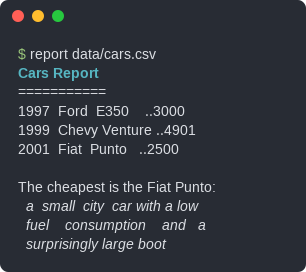
New to StringiFor? The tutorial builds a complete
program step by step; the cookbook has short recipes. Every
example is a compiled, runnable program in docs/examples/src, shown with its real output in the
documentation.
Install
One-line install
curl -fsSL https://github.com/szaghi/StringiFor/releases/latest/download/install.sh | bash
It installs the latest release into ~/.local with the build system you choose among those StringiFor ships
(--build fobis|fpm|cmake|make: a menu asks when you do not say), the compiler you name (--fc, --gnu, --intel),
one install per compiler (lib/stringifor/<compiler>-<version>/, include/stringifor/<compiler>-<version>/), and
makes it usable through pkg-config (pkg-config --cflags --libs stringifor, with
PKG_CONFIG_PATH=$HOME/.local/lib/pkgconfig). The release carries StringiFor's dependencies (BeFoR64, FACE, PENF), so
CMake and make need no network. Pass options after bash -s --, e.g. ... | bash -s -- --build cmake --prefix /opt/stringifor; --help lists them all, --uninstall removes the install. The installer is FoBiS's
(One-line installer).
FoBiS
Standalone — clone, fetch dependencies, and build:
git clone https://github.com/szaghi/StringiFor && cd StringiFor
fobis fetch                                    # fetch PENF, FACE, BeFoR64
fobis build --mode stringifor-static-gnu        # build static library
Or install directly in one command:
fobis install szaghi/StringiFor --mode stringifor-static-gnu
fobis install szaghi/StringiFor --mode stringifor-static-gnu --prefix /path/to/prefix
As a project dependency — declare StringiFor in your fobos and run fetch:
[dependencies]
deps_dir = src/third_party
StringiFor   = https://github.com/szaghi/StringiFor
fobis fetch           # fetch and build
fobis fetch --update  # re-fetch and rebuild
fpm
Add to your fpm.toml:
[dependencies]
StringiFor = { git = "https://github.com/szaghi/StringiFor" }
fpm build
CMake
cmake -B build && cmake --build build
Makefile
make              # static library
make TESTS=yes    # build the tests suite
A Fortran 2008 compiler is required (see Installation).
Authors
- Stefano Zaghi — @szaghi
Contributions are welcome — see the Contributing page.
Copyrights
This project is distributed under a multi-licensing system:
- FOSS projects: GPL v3
- Closed source / commercial: BSD 2-Clause, BSD 3-Clause, or MIT
Anyone interested in using, developing, or contributing to this project is welcome — pick the license that best fits your needs.
Questions
What is StringiFor?
szaghi/StringiFor is a public repo on GitHub by szaghi. Strings Fortran Manipulator with steroids.
Is StringiFor open source?
It declares no license on GitHub. Public does not mean open source: without a license, nobody is granted the right to reuse it.
Does StringiFor run on macOS, Windows or Linux?
Its maker has not tagged a system, so it is unknown here. Its README says what it needs.
How do I install StringiFor?
Open "Take it" on its page: Take My Repo writes an install plan for your machine and hands it to your AI agent (Claude Code, Codex or Cursor), which asks you before each step. Take My Repo has not tested it on any machine.
Is StringiFor still maintained?
Its last change on GitHub was on 2026-11-16. GitHub counts 1 open issue and pull requests. Take My Repo does not judge from that whether it is maintained.
What do people who ran StringiFor say?
Nobody has reviewed it on Take My Repo yet, which says nothing about its quality.