
RISE
Retrieving Interaction SpacE for Agentic Search
- 32
- MIT
- 3 wk ago
Repo texttron/RISE, read from GitHub 10 min ago. texttron has not joined Take My Repo.
In short
texttron/RISE is a public repo on GitHub by texttron. Retrieving Interaction SpacE for Agentic Search. It declares the MIT license on GitHub. It is written mainly in Python, has 32 stars and last changed on 2026-11-06. Nobody has reviewed it on Take My Repo yet, which says nothing about its quality. Read from GitHub on 2026-11-24.
RISE: Retrieving Interaction SpacE for Agentic Search
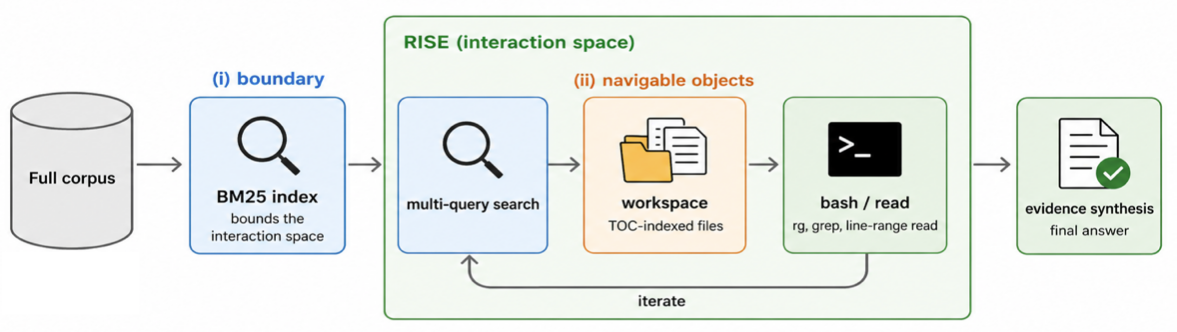
RISE treats retrieval as the constructor of a bounded interaction space: a
per-query workspace of files the agent explores with shell tools, rather than a
ranked list of snippets fed into the context window. It has two layers:
- RISE-BM25 — the boundary: a multi-query BM25 search hardlinks the union
of its top-K results into a per-query working directory; the agent then uses
bash(rg,grep, …) and line-rangereadonly inside it. - RISE — RISE-BM25 plus navigable objects: each corpus document is processed offline into a line-numbered table of contents (TOC) so shell tools jump to sub-document spans without full reads.
We compare against two baselines: the BrowseComp-Plus retrieval-agent
(BM25, top-5 snippets + get_document) and DCI (pure-shell agent over the
raw corpus filesystem, no retriever).
Layout
src/rise/            the package (agent loop, tools, retrieval, baselines, judging)
scripts/
  run_rise.py            RISE / RISE-BM25 runner
  run_retrieval_agent.py BCP retrieval-agent baseline
  run_dci.py             DCI pure-shell baseline
  judge.py               LLM-as-judge (BCP+ Appendix F prompt)
  build_bm25_index.py    build the BM25 index over the corpus
  build_filename_docid_map.py   map BM25 docids <-> corpus file paths
  summarize_runs.py      aggregate per-query results into a table
  structured/            offline TOC generation (RISE's consequence ii)
  fineweb_1m/            build the 1M setting (Table 2): 900k FineWeb-Edu distractors
data/
  queries_100.jsonl      the exact 100-query evaluation set used in the paper
Install
pip install -e .          # or: uv pip install -e .
cp .env.example .env      # then fill in API keys
Data
The corpus and indexes are large derived artifacts, so they are not in this repo. Reproduction needs four things; the first is included, the rest are built/downloaded once.
Query set — included.
data/queries_100.jsonl, one JSON object per line:query_id,query(the obfuscated question text),answer(gold answer string),gold_doc_ids. This is the exact 100-query sample used for every table in the paper — use it directly so your query set matches ours.BrowseComp-Plus corpus (100k docs). Download the official BrowseComp-Plus corpus from HuggingFace (
Tevatron/browsecomp-plus-corpus;docid/text/urlschema, samedocidscheme ourgold_doc_idsindex into) and export the documents to a flat file treecorpus/bcp_plus/<domain>/<title>.txt, plus the merged corpus parquet atcorpus/browsecomp_plus.parquet. (The 1M setting adds 900k FineWeb-Edu distractors; see Table 2 below.)BM25 index + docid↔path map. Build the index once from the corpus:
python scripts/build_bm25_index.py \
    --corpus corpus/browsecomp_plus.parquet --out runs/bm25_full
bm25s defaults are used ($k_1{=}1.5, b{=}0.75$). The agents address documents by file path but
gold_doc_ids/ BM25 results are docids, so you also need aruns/corpus_filename_docid_map.jsonmapping the two. This map is emitted by the official BrowseComp-Plus corpus-export step (the same one that writes the flat file tree); seescripts/build_filename_docid_map.pyfor the expected format. We do not vendor the upstream exporter.Structured corpus (for RISE, consequence ii). Either:
- download our prebuilt TOC-augmented corpus parquet from
https://huggingface.co/datasets/Tevatron/browsecomp-plus-md-toc-gpt5.4-nano(samedocid/text/urlschema as the original corpus, but eachtextcarries an inserted line-numbered TOC +##section headings) and export it to a flat file treecorpus/bcp_plus_structured/<domain>/<title>.txt, exactly as in step 2; or - rebuild it with
scripts/structured/(a one-timegpt-5.4-nanobatch pass that proposes section anchors, then a deterministic step that inserts a line-numbered TOC; see that folder's scripts). Cost ≈ $0.0014/doc.
- download our prebuilt TOC-augmented corpus parquet from
Reproducing the paper
All runs are over data/queries_100.jsonl; the judge is gpt-5.1 with the
BrowseComp-Plus Appendix F prompt. After each run, judge it and summarize:
python scripts/judge.py --run-dir runs/<RUN_DIR> --mode online --judge-model gpt-5.1
python scripts/summarize_runs.py runs/<RUN_DIR>
Note:
gpt-5.4-nanoruns must be launched withREASONING_EFFORT=high(the default ismedium); the other models usemedium. All runs use--concurrency 4in the paper.
Table 1 (100k headline) — three agent models × four architectures
Per model M ∈ {mimo-v2.5-pro, gpt-5.4-mini, gpt-5.4-nano} (and the
gpt-5.4 upper-bound probe):
# RISE (full method: bounded workspace + TOC documents)
python scripts/run_rise.py --model M --bm25-k 1000 --max-turns 100 \
    --concurrency 4 --structured-docs \
    --bc-plus-docs corpus/bcp_plus_structured \
    --out-root runs/rise_M_100k

# RISE-BM25 (boundary only, plain documents)
python scripts/run_rise.py --model M --bm25-k 1000 --max-turns 100 \
    --concurrency 4 --out-root runs/rise_bm25_M_100k

# retrieval-agent baseline (BM25 top-5 snippets + get_document)
python scripts/run_retrieval_agent.py --agent-model M \
    --per-search-k 5 --snippet-tokens 512 --max-iterations 100 \
    --concurrency 4 --out runs/retr_M_100k

# DCI baseline (pure shell over the full corpus, 300-call budget)
python scripts/run_dci.py --model M --max-model-calls 300 \
    --concurrency 4 --out-root runs/dci_M_100k
(gpt-5.4-nano: prepend REASONING_EFFORT=high. The gpt-5.4 row in Table 1
is run_rise.py --model gpt-5.4 --structured-docs, a state-of-the-art
upper-bound probe.)
Table 2 (100k → 1M scaling)
Build the 1M corpus. The 1M corpus is the 100k BrowseComp-Plus corpus plus
900,000 FineWeb-Edu distractors. The exact distractor sample used in the paper is
on the Hub at
Tevatron/browsecomp-plus-fineweb-edu-900k-distractors
(docid/text/url, docids fineweb_0 … fineweb_899999). After the 100k
setup (Data steps 2-3):
# downloads the 900k sample (sha256-checked), then writes
#   corpus/browsecomp_plus_1m.parquet          (1,000,195 docs: BCP first, then distractors)
#   corpus/bcp_plus_1m/                        (BCP tree hardlinked + fineweb/<docid>.txt)
#   runs/corpus_filename_docid_map_1m.json     (100k map + fineweb/<docid>.txt -> docid)
python scripts/fineweb_1m/build_1m_corpus.py
python scripts/build_bm25_index.py \
    --corpus corpus/browsecomp_plus_1m.parquet --out runs/bm25_full_1m
The distractors were sampled with scripts/fineweb_1m/sample_fineweb_distractors.py:
HuggingFaceFW/fineweb-edu config sample-10BT, streaming
shuffle(seed=42, buffer_size=20000), skip texts shorter than 200 characters,
de-duplicate on the FineWeb-Edu id, keep the first 900,000 (datasets==4.8.5).
Streaming shuffle is not guaranteed to be identical across datasets versions or
upstream shard changes, so use the Hub file rather than re-sampling if you want
to match the paper exactly.
Run. Same commands as Table 1, pointed at the 1M corpus/index:
run_rise.py / run_retrieval_agent.py with --index-dir runs/bm25_full_1m --bc-plus-docs corpus/bcp_plus_1m --filename-map runs/corpus_filename_docid_map_1m.json,
and run_dci.py with --corpus-dir corpus/bcp_plus_1m --filename-map runs/corpus_filename_docid_map_1m.json. At 1M we run RISE-BM25
(the structured corpus is not extended to the FineWeb distractors) and DCI only
on gpt-5.4-nano.
Table 3 (BM25 top-K ablation)
run_rise.py (plain / RISE-BM25) with --bm25-k ∈ {100, 1000, 10000}.
Notes
- Model routing is by name prefix in
src/rise/decompose.py:gpt-*→ OpenAI,mimo-*→ Xiaomi,deepseek-*→ DeepSeek (all OpenAI-compatible). summarize_runs.pyrecomputes every per-cell number from the per-query JSON, so reported accuracy / cost / tool-call means are reproducible from the raw run directory.- The judge and the structured-corpus generator are LLMs; absolute numbers may drift slightly with provider-side model updates. Tool-call counts and the qualitative orderings (RISE ≈ DCI accuracy at ~¼ the cost; DCI's wall-clock collapse at 1M) are stable.
- We notice that
gpt-5.4-nano, the weakest agent model, has noticeably higher run-to-run variance than the stronger tiers.
Citation
@article{rise2026,
  title  = {Towards Retrieving Interaction Spaces for Agentic Search},
  author = {Zhuang, Shengyao and Ni, Yuansheng and Fun, Hengxin and Lin, Jimmy and Ma, Xueguang},
  year   = {2026},
  journal= {arXiv preprint arXiv:2606.06880}
}
Questions
What is RISE?
texttron/RISE is a public repo on GitHub by texttron. Retrieving Interaction SpacE for Agentic Search.
Is RISE open source?
It declares the MIT license on GitHub.
Does RISE run on macOS, Windows or Linux?
Its maker has not tagged a system, so it is unknown here. Its README says what it needs.
How do I install RISE?
Open "Take it" on its page: Take My Repo writes an install plan for your machine and hands it to your AI agent (Claude Code, Codex or Cursor), which asks you before each step. Take My Repo has not tested it on any machine.
Is RISE still maintained?
Its last change on GitHub was on 2026-11-06. Take My Repo does not judge from that whether it is maintained.