
pep-maximum-security-model
PEP 480 - Surviving a Compromise of PyPI
- 2
- Unlicense
- 12 y ago
Repo theupdateframework/pep-maximum-security-model, read from GitHub 3 h ago. theupdateframework has not joined Take My Repo.
In short
theupdateframework/pep-maximum-security-model is a public repo on GitHub by theupdateframework. PEP 480 - Surviving a Compromise of PyPI. It declares the Unlicense license on GitHub. It is written mainly in Python, has 2 stars and last changed on 2015-01-09. It is archived: its maker no longer maintains it. Nobody has reviewed it on Take My Repo yet, which says nothing about its quality. Read from GitHub on 2026-11-24.
Title: Surviving a Compromise of PyPI: The Maximum Security Model Version: $Revision$ Last-Modified: $Date$ Author: Trishank Karthik Kuppusamy <trishank@nyu.edu>, Vladimir Diaz <vladimir.diaz@nyu.edu, Donald Stufft <donald@stufft.io>, Justin Cappos <jcappos@nyu.edu>
BDFL-Delegate: Richard Jones <r1chardj0n3s@gmail.com> Discussions-To: DistUtils mailing list <distutils-sig@python.org> Status: Draft Type: Standards Track Content-Type: text/x-rst Created: 8-Oct-2014 Requires: 458
Abstract
Proposed is an extension to PEP 458 that adds support for end-to-end signing and the maximum security model. End-to-end signing allows both PyPI and developers to sign for the distributions that are downloaded by clients. The minimum security model proposed by PEP 458 supports continuous delivery of distributions (because they are signed by online keys), but that model does not protect distributions in the event that PyPI is compromised. In the minimum security model, attackers may sign for malicious distributions by compromising the signing keys stored on PyPI infrastructure. The maximum security model, described in this PEP, retains the benefits of PEP 458 (e.g., immediate availability of distributions that are uploaded to PyPI), but additionally ensures that end-users are not at risk of installing forged software if PyPI is compromised.
This PEP discusses the changes made to PEP 458 but excludes its informational elements to primarily focus on the maximum security model. For example, an overview of The Update Framework or the basic mechanisms in PEP 458 are not covered here. The changes to PEP 458 include modifications to the snapshot process, key compromise analysis, auditing snapshots, and the steps that should be taken in the event of a PyPI compromise. The signing and key management process that PyPI MAY RECOMMEND is discussed but not strictly defined. How the release process should be implemented to manage keys and metadata is left to the implementors of the signing tools. That is, this PEP delineates the expected cryptographic key type and signature format included in metadata that MUST be uploaded by developers in order to support end-to-end verification of distributions.
Rationale
PEP 458 [1] proposes how PyPI should be integrated with The Update Framework (TUF) [2]. It explains how modern package managers like pip can be made more secure, and the types of attacks that can be prevented if PyPI is modified on the server side to include TUF metadata. Package managers can reference the TUF metadata available on PyPI to download distributions more securely.
PEP 458 also describes the metadata layout of the PyPI repository and employs the minimum security model, which supports continuous delivery of projects and uses online cryptographic keys to sign the distributions uploaded by developers. Although the minimum security model guards against most attacks on software updaters [5] [7], such as mix-and-match and extraneous dependencies attacks, it can be improved to support end-to-end signing and to prohibit forged distributions in the event that PyPI is compromised.
The main strength of PEP 458 and the minimum security model is the automated and simplified release process: developers may upload distributions and then have PyPI sign for their distributions. Much of the release process is handled in an automated fashion by online roles and this approach requires storing cryptographic signing keys on the PyPI infrastructure. Unfortunately, cryptographic keys that are stored online are vulnerable to theft. The maximum security model, proposed in this PEP, permits developers to sign for the distributions that they make available to PyPI users, and does not put end-users at risk of downloading malicious distributions if the online keys stored on PyPI infrastructure are compromised.
Threat Model
The threat model assumes the following:
- Offline keys are safe and securely stored.
- Attackers can compromise at least one of PyPI's trusted keys that are stored online, and may do so at once or over a period of time.
- Attackers can respond to client requests.
- Attackers may control any number of developer keys for projects a client does not want to install.
Attackers are considered successful if they can cause a client to install (or leave installed) something other than the most up-to-date version of the software the client is updating. When an attacker is preventing the installation of updates, the attacker's goal is that clients not realize that anything is wrong.
Definitions
The keywords "MUST", "MUST NOT", "REQUIRED", "SHALL", "SHALL NOT", "SHOULD", "SHOULD NOT", "RECOMMENDED", "MAY", and "OPTIONAL" in this document are to be interpreted as described in RFC 2119.
This PEP focuses on integrating TUF with PyPI; however, the reader is encouraged to read about TUF's design principles [2]. It is also RECOMMENDED that the reader be familiar with the TUF specification [3], and PEP 458 [1] (which this PEP is extending).
Terms used in this PEP are defined as follows:
- Projects: Projects are software components that are made available for integration. Projects include Python libraries, frameworks, scripts, plugins, applications, collections of data or other resources, and various combinations thereof. Public Python projects are typically registered on the Python Package Index [4].
- Releases: Releases are uniquely identified snapshots of a project [4].
- Distributions: Distributions are the packaged files that are used to publish and distribute a release.
- Simple index: The HTML page that contains internal links to the distributions of a project [4].
- Roles: There is one root role in PyPI. There are multiple roles whose responsibilities are delegated to them directly or indirectly by the root role. The term "top-level role" refers to the root role and any role delegated by the root role. Each role has a single metadata file that it is trusted to provide.
- Metadata: Metadata are files that describe roles, other metadata, and target files.
- Repository: A repository is a resource comprised of named metadata and target files. Clients request metadata and target files stored on a repository.
- Consistent snapshot: A set of TUF metadata and PyPI targets that capture the complete state of all projects on PyPI as they existed at some fixed point in time.
- The snapshot (release) role: In order to prevent confusion due to the different meanings of the term "release" used in PEP 426 [1] and the TUF specification [3], the release role is renamed to the snapshot role.
- Developer: Either the owner or maintainer of a project who is allowed to update TUF metadata, as well as distribution metadata and files for a given project.
- Online key: A private cryptographic key that MUST be stored on the PyPI server infrastructure. This usually allows automated signing with the key. An attacker who compromises the PyPI infrastructure will be able to immediately read these keys.
- Offline key: A private cryptographic key that MUST be stored independent of the PyPI server infrastructure. This prevents automated signing with the key. An attacker who compromises the PyPI infrastructure will not be able to immediately read these keys.
- Threshold signature scheme: A role can increase its resilience to key compromises by specifying that at least t out of n keys are REQUIRED to sign its metadata. A compromise of t-1 keys is insufficient to compromise the role itself. Saying that a role requires (t, n) keys denotes the threshold signature property.
Maximum Security Model
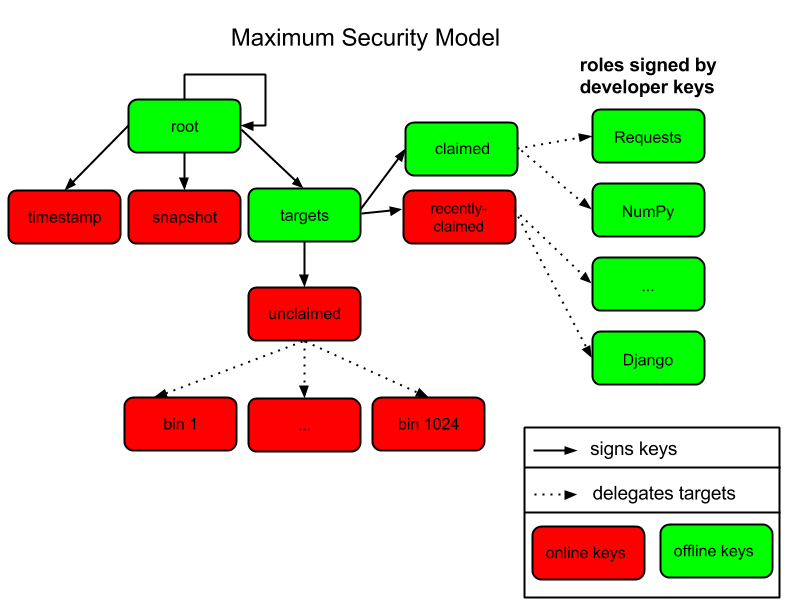
The maximum security model permits developers to sign their projects and to upload signed metadata to PyPI. If the PyPI infrastructure were compromised, attackers would be unable to serve malicious versions of a claimed project without having access to that project's developer key. Figure 1 depicts the changes made to the metadata layout of the minimum security model, namely that developer roles are now supported and that three new delegated roles exist: claimed, recently-claimed, and unclaimed. The bins role from the minimum security model has been renamed unclaimed and can contain any projects that have not been added to claimed. The unclaimed role functions just as before (i.e., as explained in PEP 458, projects added to this role are signed by PyPI with an online key). Offline keys provided by developers ensure the strength of the maximum security model over the minimum model. Although the minimum security model supports continuous delivery of projects, all projects are signed by an online key. That is, an attacker is able to corrupt packages in the minimum security model, but not in the maximum model, without also compromising a developer's key.

Figure 1: An overview of the metadata layout in the maximum security model. The maximum security model supports continuous delivery and survivable key compromise.
Projects that are signed by developers and uploaded to PyPI for the first time are added to the recently-claimed role. The recently-claimed role uses an online key, so projects uploaded for the first time are immediately available to clients. After some time has passed, PyPI administrators MAY periodically move (e.g., every month) projects listed in recently-claimed to the claimed role for maximum security. The claimed role uses an offline key, thus projects added to this role cannot be easily forged if PyPI is compromised.
The recently-claimed role is separate from the unclaimed role for usability and efficiency, not security. If new project delegations were prepended to unclaimed metadata, unclaimed would need to be re-downloaded every time a project obtained a key. By separating out new projects, the amount of data retrieved is reduced. From a usability standpoint, it also makes it easier for administrators to see which projects are now claimed. This information is needed when moving keys from recently-claimed to claimed, which is discussed in more detail in the "Producing Consistent Snapshots" section.
End-to-End Signing
End-to-end signing allows both PyPI and developers to sign for the metadata downloaded by clients. PyPI is trusted to make uploaded projects available to clients (PyPI signs the metadata for this part of the process), and developers sign the distributions that they upload to PyPI.
In order to delegate trust to a project, developers are required to submit a public key to PyPI. PyPI takes the project's public key and adds it to parent metadata that PyPI then signs. After the initial trust is established, developers are required to sign distributions that they upload to PyPI using the public key's corresponding private key. The signed TUF metadata that developers upload to PyPI includes information like the distribution's file size and hash, which package managers use to verify distributions that are downloaded.
The practical implications of end-to-end signing is the extra administrative work needed to delegate trust to a project, and the signed metadata that developers MUST upload to PyPI along with the distribution. Specifically, PyPI is expected to periodically sign metadata with an offline key by adding projects to the claimed metadata file and signing it. In contrast, projects are only ever signed with an online key in the minimum security model. End-to-end signing does require manual intervention to delegate trust (i.e., to sign metadata with an offline key), but this is a one-time cost and projects have stronger protections against PyPI compromises thereafter.
Metadata Signatures, Key Management, and Signing Distributions
This section discusses the tools, signature scheme, and signing methods that PyPI MAY recommend to implementors of the signing tools. Developers are expected to use these tools to sign and upload distributions to PyPI. To summarize the RECOMMENDED tools and schemes discussed in the subsections below, developers MAY generate cryptographic keys and sign metadata (with the Ed25519 signature scheme) in some automated fashion, where the metadata includes the information required to verify the authenticity of the distribution. Developers then upload metadata to PyPI, where it will be available for download by package managers such as pip (i.e., package managers that support TUF metadata). The entire process is transparent to the end-users (using a package manager that supports TUF) that download distributions from PyPI.
The first three subsections (Cryptographic Signature Scheme, Cryptographic Key Files, and Key Management) cover the cryptographic components of the developer release process. That is, which key type PyPI supports, how keys may be stored, and how keys may be generated. The two subsections that follow the first three discuss the PyPI modules that SHOULD be modified to support TUF metadata. For example, Twine and Distutils are two projects that SHOULD be modified. Finally, the last subsection goes over the automated key management and signing solution that is RECOMMENDED for the signing tools.
TUF's design is flexible with respect to cryptographic key types, signatures, and signing methods. The tools, modification, and methods discussed in the following sections are RECOMMENDATIONS for the implementors of the signing tools.
Cryptographic Signature Scheme: Ed25519
The package manager (pip) shipped with CPython MUST work on non-CPython interpreters and cannot have dependencies that have to be compiled (i.e., the PyPI+TUF integration MUST NOT require compilation of C extensions in order to verify cryptographic signatures). Verification of signatures MUST be done in Python, and verifying RSA [11] signatures in pure-Python may be impractical due to speed. Therefore, PyPI MAY use the Ed25519 signature scheme.
Ed25519 [12] is a public-key signature system that uses small cryptographic signatures and keys. A pure-Python implementation of the Ed25519 signature scheme is available. Verification of Ed25519 signatures is fast even when performed in Python.
Cryptographic Key Files
Questions
What is pep-maximum-security-model?
theupdateframework/pep-maximum-security-model is a public repo on GitHub by theupdateframework. PEP 480 - Surviving a Compromise of PyPI.
Is pep-maximum-security-model open source?
It declares the Unlicense license on GitHub.
Does pep-maximum-security-model run on macOS, Windows or Linux?
Its maker has not tagged a system, so it is unknown here. Its README says what it needs.
How do I install pep-maximum-security-model?
Open "Take it" on its page: Take My Repo writes an install plan for your machine and hands it to your AI agent (Claude Code, Codex or Cursor), which asks you before each step. Take My Repo has not tested it on any machine.