
VouchNet
VouchNet is a professional network designed around one non-negotiable premise: humans participate; AI is an explicitly authorized tool.
- 0
- MIT
- 4 wk ago
Repo theworker02/VouchNet, read from GitHub 53 min ago. theworker02 has not joined Take My Repo.
In short
theworker02/VouchNet is a public repo on GitHub by theworker02. VouchNet is a professional network designed around one non-negotiable premise: humans participate; AI is an explicitly authorized tool. It declares the MIT license on GitHub. It is written mainly in TypeScript, has 0 stars and last changed on 2026-10-28. Nobody has reviewed it on Take My Repo yet, which says nothing about its quality. Read from GitHub on 2026-11-24.
Similar repos
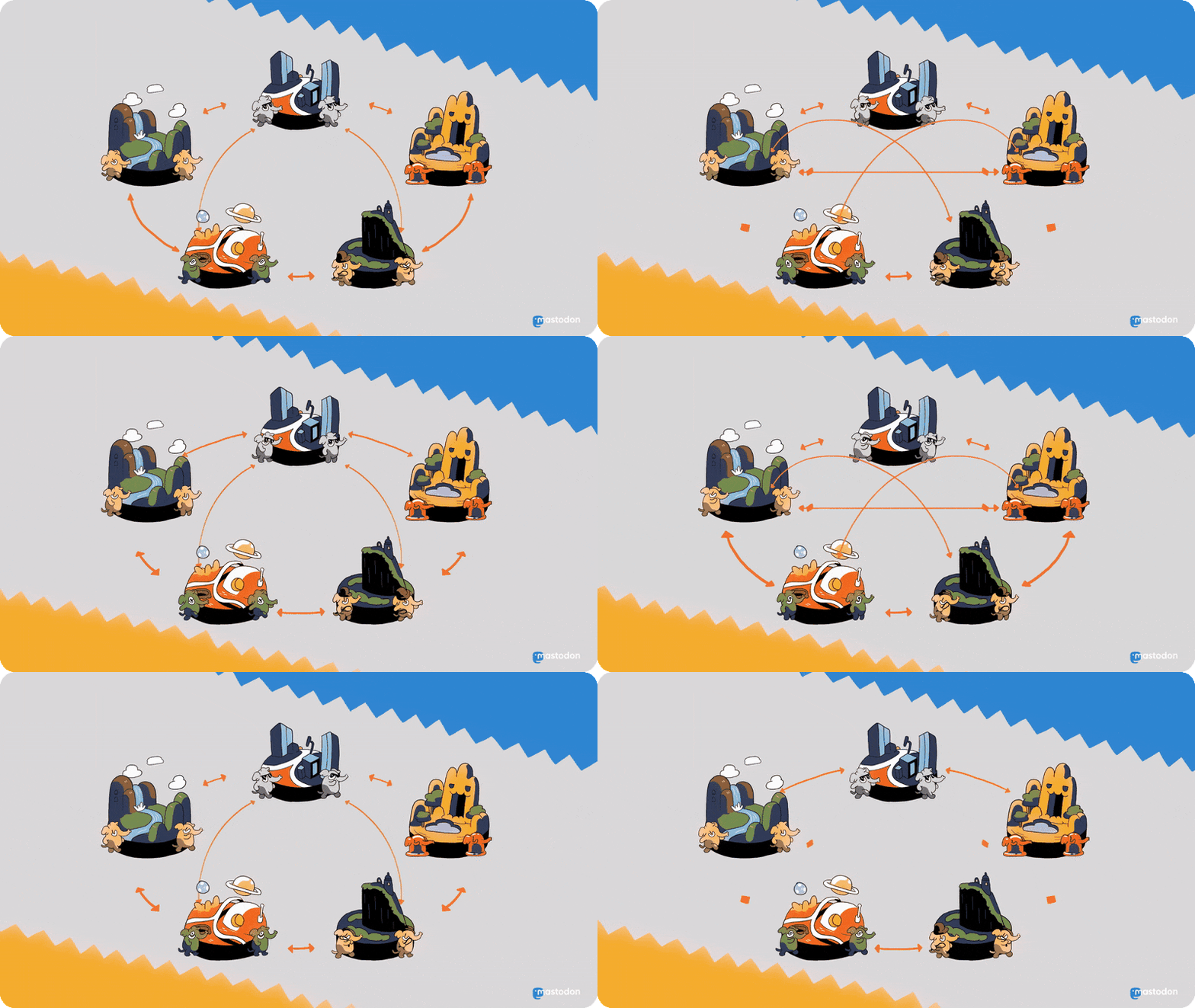
mastodon
Your self-hosted, globally interconnected microblogging community

VouchNet

A professional network for credible work, deliberate connections, and human participation.
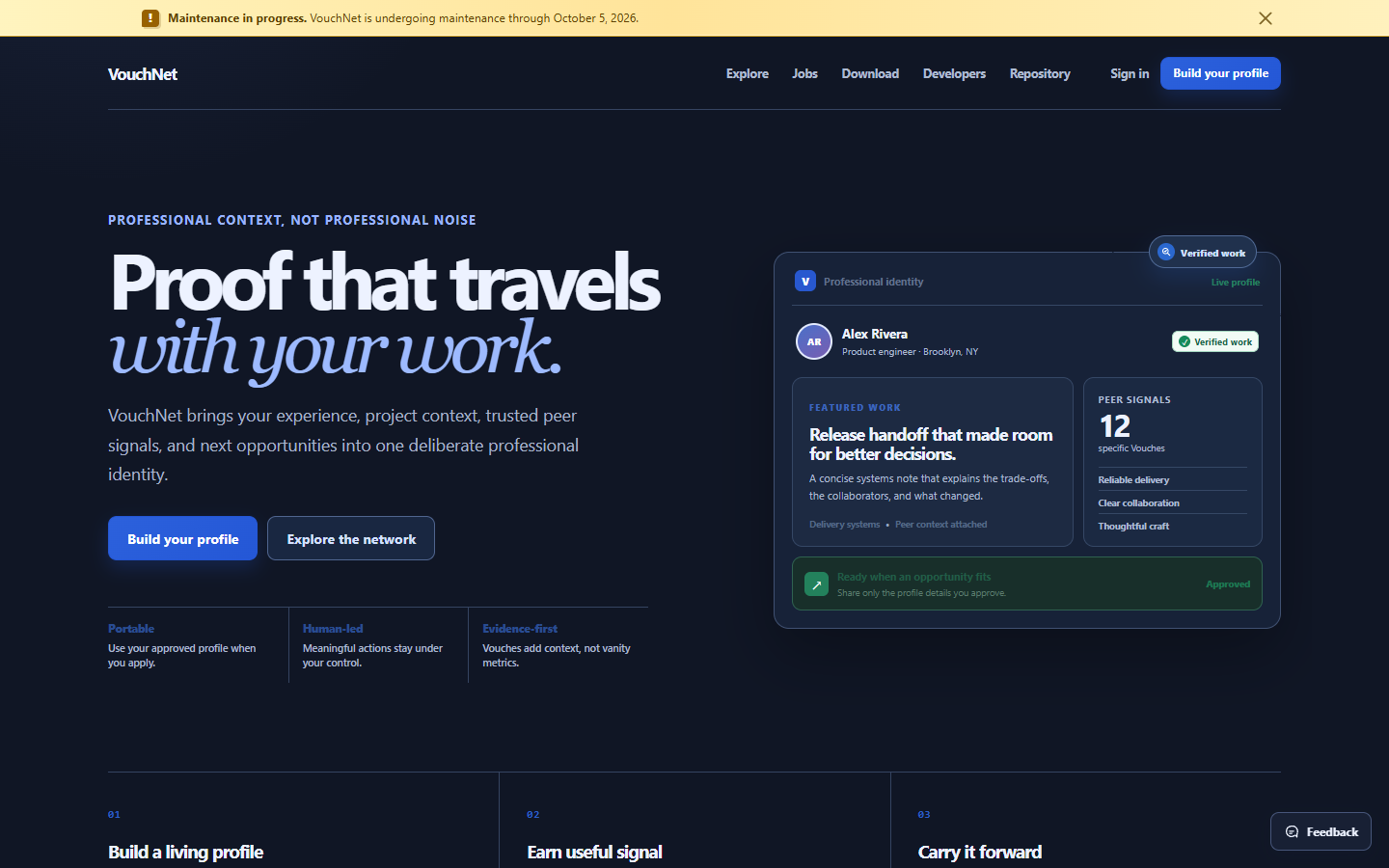
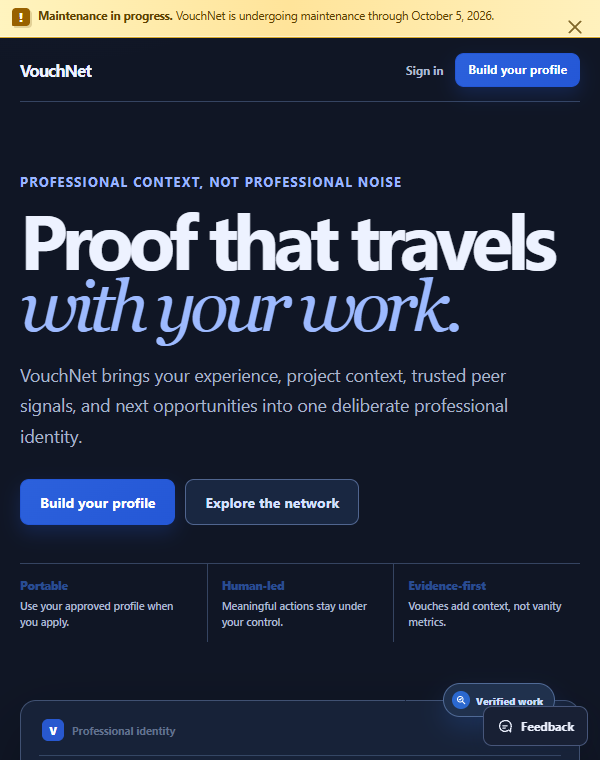
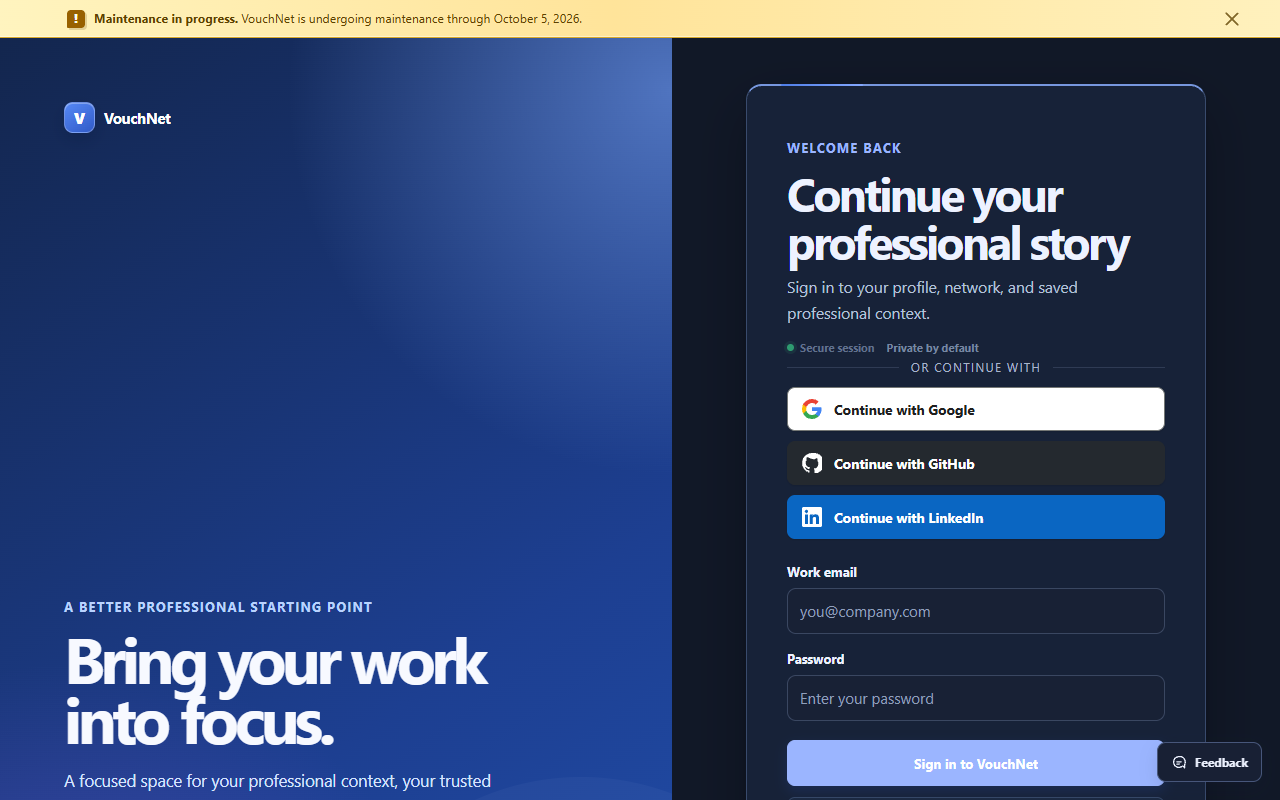
Screenshots
Purpose
VouchNet is an independent professional network designed around one durable rule:
Humans participate. AI is an explicitly authorized tool.
Human sessions, integrations, MCP clients, system workers, and moderators are distinct security principals. Protected social actions are designed to require server-verifiable human approval; client-side assertions never establish permission.
Why VouchNet
Professional networks are useful when they preserve context: what someone built, why it matters, and who can credibly speak to the work. VouchNet is being built for that signal. It favors public proof, deliberate relationships, transparent opportunities, and human decision-making over engagement loops or automated participation.
The platform is deliberately original. It does not use LinkedIn code, branding, assets, or APIs, and it does not attempt to make software agents appear to be ordinary members.
Open source and VouchNet+
The VouchNet source in this repository is available under the MIT License. You are welcome to inspect, learn from, adapt, and contribute to the core platform.
VouchNet+ is coming soon and remains in active development. It will be an optional hosted subscription for advanced member capabilities. The public MIT grant covers the code committed to this repository; it does not grant access to VouchNet-operated infrastructure, private service configuration, payment credentials, or future service-only VouchNet+ components that are not published here. The VouchNet name and visual identity are not licensed as trademarks.
Product principles
| Principle | What it means in the product |
|---|---|
| Human participation | A profile represents a person. Integrations and background systems use their own attributable actor types. |
| Proof before promotion | Projects, public links, technical work, and verified context are first-class profile material. |
| Transparent opportunity | Source-linked job listings show a numeric compensation range before an applicant leaves the platform. |
| Privacy by design | Visibility and block rules are enforced by server-side queries across public and authenticated routes. |
| Honest early-stage density | Curated organizations, jobs, and system-owned challenges are labelled as such; VouchNet never pads the network with fake people or engagement. |
Public surfaces
Visitors can explore useful professional context without creating an account:
- Profiles —
/in/[username]respects visibility settings and emits canonical/Open Graph metadata. - Projects —
/projects/[slug]presents a member-owned project with technology tags, repository, live-site links, a shareable badge, its contributors, and its build log. - Opportunities —
/opportunitieslists open requests from members, with detail pages at/opportunities/[slug]. - Discover —
/discovershows people building in public, project momentum, and open opportunities, ranked from recorded activity. - Organizations —
/company/[slug]presents source-reviewed directory records with clear status disclosure and public technology references. - Jobs —
/jobsprovides source-linked technical roles with transparent salary disclosure when it is supplied, shareable role detail pages at/jobs/[slug], clear external application links, and an employer launch workspace at/jobs/post. - Daily challenge —
/gamesis a short platform-owned technical self-check, never a simulated member post.
Build in Public
Members show work as it happens, and the network can see it:
- Projects with followers, invited contributors, and a dated build log.
- Vouches from people you worked with, written in the Vouch Console with a preview before you confirm. Profiles show them in a trust module and an inspector with provenance and history. Verification levels are Standard, Context, Organization (not reachable until organization domain verification ships), and Contribution.
- Reputation earned by participating: activity points × (1 + a vouch bonus capped at 15%), with daily caps and damping so it is hard to game.
- Opportunities at
/opportunities: requests for software, contracts, grants, bounties, and research collaborations, with one proposal per member and a review flow for the poster. - Discover at
/discover: people building, project momentum, open opportunities, and vouched builders. Each card explains why it is there.
How each piece works, including the reputation formula and discovery ranking, is in docs/BUILD_IN_PUBLIC.md.
Current product surface
VouchNet is an active early-stage product. The current vertical slices include:
- Email/password sign-up, login, server-side sessions, email verification, and password reset
- Professional profile onboarding, owner editing, and privacy-aware profile views
- People discovery, search, follows, Contact requests, blocks, and network management
- High-signal posts/feed with persisted, keyboard-accessible reactions and optimistic failure rollback
- Account settings, session controls, and production Resend/Netlify configuration paths
- VouchNet+ cross-client entitlements: the free network remains available to everyone, while active members receive analytics, featured proof, priority outreach, emerald identity signals, and advanced feed controls on both web and desktop
- A responsive Signal Desk application shell with a unified home, network, feed, and credential flow
- Public, SEO-ready profile and project pages; project publishing; copyable, dynamic SVG profile badges
- A source-reviewed organization directory and transparent external-job directory with salary ranges
- A secure organization-claim system: explicitly labelled Unclaimed records, verified company-domain eligibility, human review, Owner/Admin/Editor/Member boundaries, immutable governance events, and a review-only outreach queue that cannot send mail on its own
- Employer role intake and human-reviewed Greenhouse/Lever public-board sourcing, with a no-card two-calendar-month founding employer window
- A platform-owned daily technical challenge, published by an explicit system actor rather than a fake member
- PostgreSQL migrations, Docker-based local PostgreSQL + Redis, and typed API boundaries
- Redacted client-error telemetry with an administrator-only diagnostic queue
- Native applications and an Application Radar for reviewed employer-submitted roles
- Private, connection-gated direct messaging with persisted conversation state, safe HTTPS media/link attachments, and recipient read receipts
- A native Windows desktop foundation with shared-account PKCE sign-in, Windows Credential Manager refresh storage, deep links, command palette, and a service-backed feed
Incomplete routes intentionally show unavailable states rather than pretend the feature works. Internal job applications, broader organization services/job publishing, full notifications, the MCP gateway, desktop code signing, and the automatic updater remain in development. Public directory records are expressly not official organization pages until the domain-email and human-review claim workflow confirms control. See the implementation matrix for authoritative feature-by-feature status.
A note on early content
VouchNet seeds public structural data, not fabricated participation. The directory contains public source-reviewed organization records and source-linked roles, each displayed with its actual status. A platform challenge is explicitly attributed to the system actor. Social posts, comments, contacts, endorsements, and founder activity must come from real, accountable human accounts.
The first recommended cohort is a focused group of open-source CLI builders. The rationale, consent-based invite approach, and launch checks are in the launch playbook.
Architecture
apps/
  web/             Next.js UI, server rendering, and HTTP boundary
  desktop/         Tauri/Rust/React installed client for the same VouchNet service
  worker/          Future attributable background-work boundary
packages/
  api-client/      Published, typed OAuth client for external VouchNet integrations
  auth/            Session and identity contracts
  db/              Drizzle schema and SQL migrations
  permissions/     Human and machine actor/action vocabulary
  audit/           Append-oriented security audit contracts
  trust/           Trust-and-safety policy contracts
  mcp/             Scoped integration and approval vocabulary
  search/          Replaceable search-provider contract
  ui/              Shared interface primitives
docs/              Architecture, security, privacy, and deployment decisions
The application is a modular Next.js monolith with explicit package boundaries. It stays maintainable now while preserving a path to extract services later without coupling domain policy to React components. VouchNet Web and VouchNet Desktop are clients of the same account, network, and service; Desktop does not introduce another backend or a separate registration flow.
API client package
External employers and ATS integrations can use the published typed OAuth + directory client,
@theworker02/vouchnet-api-client on GitHub Packages. It supports Apply with
VouchNet (userinfo / applicant data) and the directory:read people, organizations, and jobs APIs
documented in docs/API.md. It does not bypass OAuth scopes, prepaid API credits, or
the oauthApi rate-limit tier. Package publishing is an explicit api-client-v* tag / workflow
operation.
Security principles
- Server-first authorization — protected routes resolve sessions and permissions on the server.
- Attributable actors — humans and automations never silently become the same principal.
- Approval-aware automation — integrations can prepare protected actions; approval is bound to the exact action and payload.
- Scoped credentials — MCP/API credentials are designed to be granular, revocable, rate-limited, and auditable.
- Privacy and blocking — social-graph queries apply visibility and block rules rather than relying on hidden UI controls.
- Secret hygiene —
.envfiles are ignored and.env.examplecontains placeholders only.
Read the architecture, authentication, automation policy, threat model, and security guide for the underlying decisions. Organization claims and role boundaries are documented in docs/ORGANIZATION_CLAIMS.md.
Run locally
Prerequisites
- Node.js 24
- pnpm 11
- Docker Desktop (for PostgreSQL and Redis)
Setup
cp .env.example .env
docker compose up -d
pnpm install
pnpm db:migrate
pnpm dev
Set a unique SESSION_SECRET with at least 32 characters in .env, then open the URL printed by
Next.js—normally http://localhost:3000.
Quality checks
pnpm typecheck
pnpm lint
pnpm format:check
pnpm test
pnpm build
Configuration
All configuration is server-side. Never commit a real .env file.
| Variable | Local development | Production |
|---|---|---|
DATABASE_URL |
Docker PostgreSQL connection | Hosted PostgreSQL connection |
REDIS_URL |
Docker Redis connection | Required for production abuse-rate limiting |
SESSION_SECRET |
Unique 32+ character value | Unique production-only secret |
RESEND_API_KEY |
Optional for local delivery | Required for transactional email |
EMAIL_FROM |
Test or verified sender | Sender on a Resend-verified domain |
Questions
What is VouchNet?
theworker02/VouchNet is a public repo on GitHub by theworker02. VouchNet is a professional network designed around one non-negotiable premise: humans participate; AI is an explicitly authorized tool.
Is VouchNet open source?
It declares the MIT license on GitHub.
Does VouchNet run on macOS, Windows or Linux?
Its maker has not tagged a system, so it is unknown here. Its README says what it needs.
How do I install VouchNet?
Open "Take it" on its page: Take My Repo writes an install plan for your machine and hands it to your AI agent (Claude Code, Codex or Cursor), which asks you before each step. Take My Repo has not tested it on any machine.




