Traduzir-paginas-web
Translate your page in real time using Google, Bing or Yandex
- 6.1k
- JavaScript
- MPL-2.0
- 4 wk ago
Deadwire is an Upstash-first recovery-intelligence control plane. It sits above Upstash Workflow and QStash; it does not replace their execution model. Deadwire groups DLQ entries into operational incidents, assembles provenance and side-effect evidence...
Repo theworker02/deadwire, read from GitHub 19 h ago. theworker02 has not joined Take My Repo.
theworker02/deadwire is a public repo on GitHub by theworker02. Deadwire is an Upstash-first recovery-intelligence control plane. It sits above Upstash Workflow and QStash; it does not replace their execution model. Deadwire groups DLQ entries into operational incidents, assembles provenance and side-effect evidence... It declares no license on GitHub. Public does not mean open source: without a license, nobody is granted the right to reuse it. It is written mainly in TypeScript, has 0 stars and last changed on 2026-09-29. Nobody has reviewed it on Take My Repo yet, which says nothing about its quality. Read from GitHub on 2026-11-24.
Translate your page in real time using Google, Bing or Yandex
📦🚀 Fully automated version management and package publishing


Failure intelligence and recovery control for durable workflows.
Why Deadwire · Quick start · Upstash integration · Recovery protocol · Security · Release materials
Upstash keeps workflows durable. Deadwire determines whether recovering them is safe.
Deadwire is an Upstash-first recovery-intelligence control plane. It sits above Upstash Workflow and QStash; it does not replace their execution model. Deadwire groups DLQ entries into operational incidents, assembles provenance and side-effect evidence, analyzes workflow-version compatibility, runs verifier-backed simulation, and gates recovery behind policy, approvals, flow control, canaries, and receipts.
The Upstash mark above is served from Upstash’s official domain and is used only to identify the supported integration. Deadwire is independent software and is not affiliated with, sponsored by, or endorsed by Upstash.
Retries solve transient faults. DLQs preserve failed work. Neither tells an operator whether retrying an execution after a deploy, an API contract change, or an uncertain payment side effect is actually correct.
Consider a checkout workflow with 8,147 failed executions. A deploy changes an external provider integration from payments-api/v2 to payments-api/v3; the response schema now differs. The operator has a bulk-resume button, but not the answers that matter:
Deadwire turns that ambiguity into an explicit, auditable decision.
incident: DW-193
affected_executions: 8147
common_failure_boundary: checkout.finalize → payments-api/v3
probable_change: payment provider response schema
recovery:
  safe_resume: 6921
  safe_restart: 811
  manual_review: 304
  external_side_effect_unknown: 111
The point is not a prettier DLQ. The point is recovery correctness.
| Capability | What Deadwire does | Why it matters for Upstash workflows |
|---|---|---|
| Incident clustering | Converts normalized DLQ failures into deterministic incident groups and shared dependency boundaries | Thousands of retries become one operator-sized incident |
| Evidence graph | Captures workflow provenance, source hashes, completed steps, sanitized shapes, trace identifiers, and side-effect metadata | Recovery decisions have supporting facts rather than intuition |
| Replay-risk analysis | Separates SAFE, UNSAFE, and UNKNOWN retry evidence |
Unknown effects cannot silently become duplicate payments or messages |
| Workflow compatibility | Detects candidate code changes before completed workflow boundaries | Protects persisted workflow state when code changes between failure and resume |
| Side-effect verification | Supports payment, delivery, outbox, object-output, and HTTP-contract verifier adapters | A replay can be proven or blocked per external boundary |
| Recovery policy | Enforces required roles, independent approvals, batch ceilings, and canary policy | Operational safety scales beyond a single person clicking resume |
| QStash recovery control | Builds exact resume previews with retries and flow-control headers | Uses Upstash control primitives rather than inventing a parallel runner |
| Recovery receipts | Records approved recovery intent and maps original DLQ IDs to resumed workflow runs | Provides a durable audit trail and reconciliation basis |
| Deployment intelligence | Correlates GitHub/Vercel/CI deployment signals with failed runs | Makes code-diff causality visible at the recovery boundary |
| Agent forensics | Detects low-progress loops and estimates wasted model calls | Extends recovery correctness to durable autonomous systems |
| Product demo | Includes a static GitHub Pages site and deterministic CLI walkthrough | Makes the product legible in a buyer, partner, or internal review |
 ┌──────────────────────────────────────────────────────────────────┐
 │                       Customer application                         │
 │  Upstash Workflow · QStash · Workflow Agents · external services  │
 └─────────────┬───────────────────────────────────────┬────────────┘
               │                                       │
       Deadwire SDK bridge                      failure callback / DLQ
               │                                       │
               └───────────────┬───────────────────────┘
                               ▼
                    HMAC-signed evidence ingestion
                               │
                               ▼
        evidence graph → incident clustering → deployment / trace correlation
                               │
                               ▼
            compatibility gate + side-effect verifiers + simulation
                               │
                               ▼
  receipt → independent approval → 1% canary → observe → ramp → reconcile
                               │
                               ▼
           QStash resume with required flow-control configuration
Deadwire is deliberately constrained in several important ways:
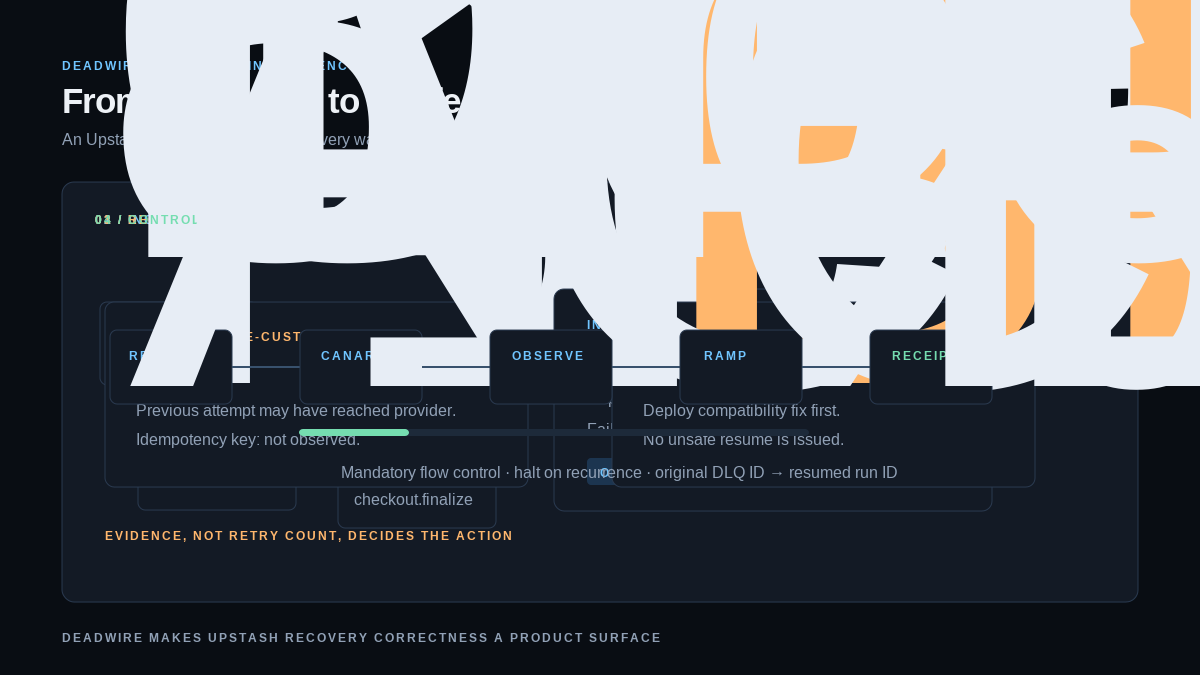
The animated walkthrough is a compact visual presentation built for technical demos, acquisition conversations, and GitHub Pages. It shows the four product moments that distinguish Deadwire from a DLQ interface:
Open the full-screen presentation to replay it, or press R inside the presentation to restart the animation. It uses fixture data only and does not depict a live customer incident.
npm install
npm run typecheck
npm test
The suite exercises incident clustering, retry safety, simulation gates, evidence signing, canary halting, deployment compatibility, trace correlation, agent loops, side-effect verification, Upstash DLQ normalization, and configuration diagnostics.
npm run dev
Open http://127.0.0.1:8787. The dashboard is explicitly fixture-seeded. It does not present fixture data as a connected Upstash account.
npm run demo
The command prints a compact incident summary, blast radius, recovery classifications, policy guardrails, and a deterministic decision ID.
Deadwire integrates through documented, owned application boundaries. It does not monkey-patch Upstash SDK internals or impersonate an Upstash control plane.
Use UpstashEvidenceBridge next to callbacks you own. The bridge records source hash, ordering, completion state, declared side-effect type, idempotency-key hash, provider-transaction hash, and sanitized request/response shape hashes.
import { HmacEvidenceEmitter, UpstashEvidenceBridge } from "deadwire";

const bridge = new UpstashEvidenceBridge(
  "tenant_acme",
  context.workflowRunId,
  {
    workflow: "checkout",
    workflowVersion: "v18",
    deploymentSha: process.env.GIT_SHA!,
    environment: "production",
  },
  new HmacEvidenceEmitter(
    process.env.DEADWIRE_EVIDENCE_URL!,
    process.env.DEADWIRE_INGEST_SECRET!,
  ),
);

await bridge.run(
  "charge-customer",
  chargeCustomer,
  () => context.run("charge-customer", chargeCustomer),
  {
    sideEffect: "payment",
    idempotencyKey,
    providerTransactionId,
    request: { customerId, amount },
  },
);

await bridge.flush();
The bridge intentionally keeps context.run in your control. It records evidence around your callback; it does not alter retry semantics or make a payment safe merely because it was observed.
See the complete illustrative route.
UpstashWorkflowAdapter supports paginated DLQ reads, individual DLQ-message reads, normalized failures, and resume previews. A trusted worker supplies an account-scoped QStash token only at runtime.
const adapter = new UpstashWorkflowAdapter({
  token: process.env.UPSTASH_QSTASH_TOKEN!,
});

const page = await adapter.listDlq();
const normalized = page.messages.map(normalizeUpstashDlq);
Normalization is deliberately conservative. Missing fields become unknown evidence, which pushes recovery toward manual review rather than an optimistic automatic classification.
npm run cli -- doctor
The diagnostic checks for a trusted QStash token, HMAC evidence secret, deployment SHA provenance, and production persistence. A missing evidence HMAC secret is a hard failure; missing optional integrations are warnings.
const preview = adapter.previewResume(dlqIds, {
  key: "incident-DW-193",
  parallelism: 5,
  rate: 1,
  period: "1s",
  retries: 3,
});
The preview is not a mutation. An approved RecoveryReceipt, a recovery batch in the correct state, and a trusted control worker are required before the real QStash resume client can act.
For product-level integration detail, see Upstash integration blueprint.
WorkflowEvidence is the minimum trustworthy unit Deadwire needs to reason about recovery:
interface WorkflowEvidence {
  tenantId: string;
  runId: string;
  provenance: {
    workflow: string;
    workflowVersion: string;
    deploymentSha: string;
    environment: string;
    sourceCommit?: string;
    traceId?: string;
    spanId?: string;
  };
  steps: Array<{
    step: string;
    stepHash: string;
    ordinal: number;
    completed: boolean;
    sideEffect: "payment" | "email" | "webhook" | "database-write" | "provisioning" | "object-write" | "none";
    idempotencyKeyHash?: string;
    providerTransactionIdHash?: string;
    requestShapeHash?: string;
    responseShapeHash?: string;
  }>;
  emittedAt: string;
}
theworker02/deadwire is a public repo on GitHub by theworker02. Deadwire is an Upstash-first recovery-intelligence control plane. It sits above Upstash Workflow and QStash; it does not replace their execution model. Deadwire groups DLQ entries into operational incidents, assembles provenance and side-effect evidence...
It declares no license on GitHub. Public does not mean open source: without a license, nobody is granted the right to reuse it.
The modern link attribution platform. Loved by world-class engineering teams at Twilio, Zillow, Jobber, Vercel, Raycast, and more.
(Autonomous Threat Disruption Engine) Defensive honeypot · asymmetric deception · local-first containment for infrastructure you own
Its maker has not tagged a system, so it is unknown here. Its README says what it needs.
Open "Take it" on its page: Take My Repo writes an install plan for your machine and hands it to your AI agent (Claude Code, Codex or Cursor), which asks you before each step. Take My Repo has not tested it on any machine.
Its last change on GitHub was on 2026-09-29. Take My Repo does not judge from that whether it is maintained.
Nobody has reviewed it on Take My Repo yet, which says nothing about its quality.
Take My Repo cannot say: it does not audit code and has not run deadwire. What is known comes from GitHub. It declares no license on GitHub. Public does not mean open source: without a license, nobody is granted the right to reuse it. Its last change was on 2026-09-29. It has 0 stars, which measure popularity, not safety. Nobody has reviewed it on Take My Repo yet, which says nothing about its quality. Read the source before you run it. With "Take it", your AI agent shows each step and asks you before running it; README text is treated as data, not as instructions.