
rea
Reverse engineer anything with agents, from app behavior down to native binaries.
- 476k
- TypeScript
- MIT
- 16 min ago
Diffmind — local-first AI code review, in your terminal
Repo thinkgrid-labs/diffmind, read from GitHub 12 h ago. thinkgrid-labs has not joined Take My Repo.
thinkgrid-labs/diffmind is a public repo on GitHub by thinkgrid-labs. Diffmind — local-first AI code review, in your terminal. It declares the MIT license on GitHub. It is written mainly in Rust, has 4 stars and last changed on 2026-11-22. Nobody has reviewed it on Take My Repo yet, which says nothing about its quality. Read from GitHub on 2026-11-23.
Reverse engineer anything with agents, from app behavior down to native binaries.
Review the change. See what it touches.
Diffmind reviews a git diff for security issues, bugs and quality problems.
It reads each change together with the function around it, the code that calls
it and the definitions it uses, taken from a code graph it builds of your
repository. A local model is the default, so there is no API key and the code
stays on your machine. The same engine runs in your terminal, in git hooks and
as a CI gate in GitHub Actions or any other CI.
# macOS and Linux (x86_64, arm64): checks the release SHA-256 when it can
curl -fsSL https://github.com/thinkgrid-labs/diffmind/releases/latest/download/install.sh | bash

# npm: the binary ships in a per-platform optional dependency
npm install -g @diffmind/cli

# from a clone of this repository
cargo install --path apps/tui-cli
Pin a version with curl -fsSL … | VERSION=v0.9.3 bash. On Windows, download
diffmind-x86_64-pc-windows-msvc.zip from
Releases and put
diffmind.exe on your PATH. Linux binaries are glibc-linked; on Alpine, use
a glibc base image or build from source.
diffmind download     # one-time: the default 1.5B model, 1.1 GB
cd your-repo
diffmind              # review this branch against the default branch
diffmind --tui        # the same review, step by step in the terminal
Nothing else needs configuring. The first review also builds the code graph.
Other targets: --last (last commit), --staged, a range such as
v1.2.0..HEAD, paths such as src/api/, or --stdin.
A commit that hardcodes a password and weakens a token check, plus one regex
rule in .diffmind/rules.toml:
+ADMIN_PASSWORD = "hunter2"
+password = "hunter2"
+
 def is_valid_token(token: str) -> bool:
     """Reject empty and obviously malformed session tokens."""
-    if not token:
-        return False
-    return len(token) == 32 and token.isalnum()
+    # if not token:
+    #     return False
+    return len(token) >= 0
diffmind --last with v0.9.3 and the default 1.5B model, on CPU. This is real
output with colours removed and lightly trimmed:
 HIGH  security  app/auth.py:1 [#1] (DM001)
 Issue  Security-sensitive logic has been entirely commented out (3 lines).
        The block is now dead code and will not execute — this may silently
        break authentication or validation.
 Fix    Restore the logic if it should be active, or remove the commented
        block entirely.

 HIGH  security  app/auth.py:2 [#2] (no-hardcoded-password)
 Issue  Hardcoded password — load it from the environment or a secrets manager

 HIGH  security  app/auth.py:1 [#3] (DM900.security)
 Issue  The `ADMIN_PASSWORD` is hard-coded in the code, which makes it
        vulnerable to attackers who can easily access the source code.
 Fix    Replace the `ADMIN_PASSWORD` with a secure environment variable or a
        configuration file.

 ✓ What looks good
   · The function `is_valid_token` checks if the token is not empty and has a
     length of at least 0, which is a good practice.

 ⚠  3 findings · 3 at or above the fail threshold  (exit 1)
The two deterministic findings (DM001 and the regex rule) will appear the
same way on every run. The model finding (DM900.security) repeats the
password issue, but the 1.5B model missed the real bug: len(token) >= 0
is always true, so every token now passes. That is typical of a small model,
and it is why model findings are labelled separately. For changes that matter,
use a larger model (Models and providers).
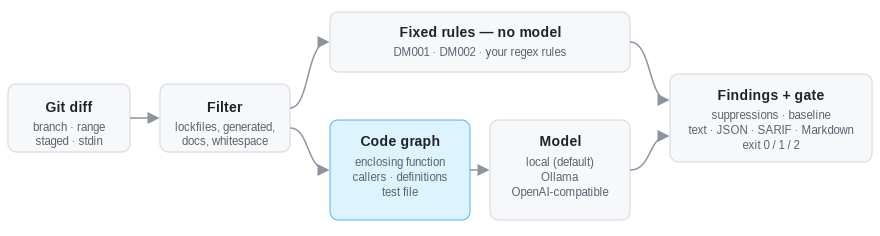
DM001, DM002 and your rules.toml
regex rules.The graph matches symbols by name, not by full type resolution, and labels ambiguous matches as "possible". Languages without a parser are still reviewed, just without callers. Details: How Diffmind works.
| Provider | Status | Code leaves your machine? |
|---|---|---|
| Built-in local model (Qwen2.5-Coder, 0.5B–32B) | Default | No (one-time model download from Hugging Face) |
| Ollama | Supported | Only if the server is remote |
| OpenAI-compatible server (vLLM, LM Studio, llama.cpp, LiteLLM, …) | Supported protocol; specific servers not tested by the project | Only if the server is remote |
| Hosted APIs (Anthropic, OpenAI, …) | No built-in backend yet (roadmap) |
diffmind --backend ollama --backend-model qwen2.5-coder:14b
Remote backends receive the diff and its context, and a committed
config.toml can select one, so check it in repositories you do not trust.
API keys come only from an environment variable (DIFFMIND_API_KEY by
default), and are refused over plain http:// to a non-local host. There is no OAuth. Bigger models give better
findings and run slower. Only the built-in backend uses constrained decoding,
and its output is repeatable on the same machine. Setup, credentials and
trade-offs: Models and providers.
permissions:
  contents: read
  security-events: write          # for SARIF upload

steps:
  - uses: actions/checkout@v4
  - uses: thinkgrid-labs/diffmind@v0.9.3
    with:
      version: v0.9.3             # pin the binary too; the default is "latest"
      fail-on: high
The action caches the model, reviews the pull request under the base branch's
.diffmind/ configuration, and uploads SARIF so findings appear inline on the
diff. It needs no secret beyond the workflow's built-in token. Set
format: markdown and comment: true for a PR comment instead.
Anywhere else:
git diff origin/main...HEAD | diffmind --stdin --format sarif --output diffmind.sarif --fail-on high
| Exit | Meaning |
|---|---|
0 |
Review complete; nothing at or above --fail-on |
1 |
Review complete; findings at or above --fail-on |
2 |
Diffmind failed, or part of the diff was not reviewed (fails by default in CI) |
Git hooks: diffmind install-hooks --hook pre-push, or the
pre-commit hook id: diffmind. Inputs, permissions,
fork behaviour and the limits of the config protection:
CI, GitHub Actions and git hooks.
stats, team rules, configuration and every flagWhat it does today: review any text diff; add code-graph context for 13 languages; run deterministic checks and your regex rules; apply team rule sets written in Markdown; report as text, JSON, SARIF 2.1.0 or Markdown; gate CI with exit codes and a completeness check; keep findings quiet with suppressions and a baseline; record verdicts and measure accept/wrong rates; run locally, through Ollama or through an OpenAI-compatible server.
What to keep in mind:
--fail-on is a severity threshold for all findings. It cannot yet be
limited to deterministic findings. If model false positives block your
builds, use a higher threshold or a larger model, or in the GitHub Action
set fail-on: none and treat the review as advisory.--triage off to review every file..diffmind/config.toml can select a remote backend and the environment
variable used as its API key. Read it before running Diffmind, or its git
hooks, in an untrusted clone. (The GitHub Action pins the local backend.)merge_group or push events unless you set base, and it
does not cover generated-file markers. See CI.Full plan, with what is already shipped: ROADMAP.md.
Issues and pull requests are welcome. Before opening a pull request:
cargo test --workspace --all-targets
cargo clippy --workspace --all-targets -- -D warnings
cargo fmt --all
Adding a code-graph language is a good first contribution: a tree-sitter
grammar crate plus one entry in the LANGUAGES table in
graph/extract.rs.
MIT. See LICENSE.
thinkgrid-labs/diffmind is a public repo on GitHub by thinkgrid-labs. Diffmind — local-first AI code review, in your terminal.
It declares the MIT license on GitHub.
Its maker tagged it for macOS, Windows and Linux, or as Docker or cross-platform. That is declared by the maker; Take My Repo has not tested it.
Open "Take it" on its page: Take My Repo writes an install plan for your machine and hands it to your AI agent (Claude Code, Codex or Cursor), which asks you before each step. Take My Repo has not tested it on any machine.
Secure, fast, efficient, battle-tested at Alibaba's scale. Hybrid architecture code review tool: deterministic pipelines + LLM Agent, precise line-level comments, built-in multi-language ruleset (NPE, thread-safety, XSS, SQL injection), OpenAI & Anthropic compatible.
A list of Free Software network services and web applications which can be hosted on your own servers
Fair-code workflow automation platform with native AI capabilities. Combine visual building with custom code, self-host or cloud, 400+ integrations.
Its last change on GitHub was on 2026-11-22. GitHub counts 0 open issues and pull requests. Take My Repo does not judge from that whether it is maintained.
Nobody has reviewed it on Take My Repo yet, which says nothing about its quality.
Take My Repo cannot say: it does not audit code and has not run diffmind. What is known comes from GitHub. It declares the MIT license on GitHub. Its last change was on 2026-11-22. It has 4 stars, which measure popularity, not safety. Nobody has reviewed it on Take My Repo yet, which says nothing about its quality. Read the source before you run it. With "Take it", your AI agent shows each step and asks you before running it; README text is treated as data, not as instructions.




