cdc2net
USB-host CDC to raw-TCP bridge on ESP32-S3 (ser2net-style) for the CUL/TUL/EUL line — and the network-attached Zigbee gateway for the ESP32-S3 + ESP32-H2 board
- 5
- GPL-2.0
- 3 d ago
Repo tostmann/cdc2net, read from GitHub 21 h ago. tostmann has not joined Take My Repo.
In short
tostmann/cdc2net is a public repo on GitHub by tostmann. USB-host CDC to raw-TCP bridge on ESP32-S3 (ser2net-style) for the CUL/TUL/EUL line — and the network-attached Zigbee gateway for the ESP32-S3 + ESP32-H2 board. It declares the GPL-2.0 license on GitHub. It is written mainly in C, has 5 stars and last changed on 2026-11-22. Nobody has reviewed it on Take My Repo yet, which says nothing about its quality. Read from GitHub on 2026-11-23.

CDC2NET
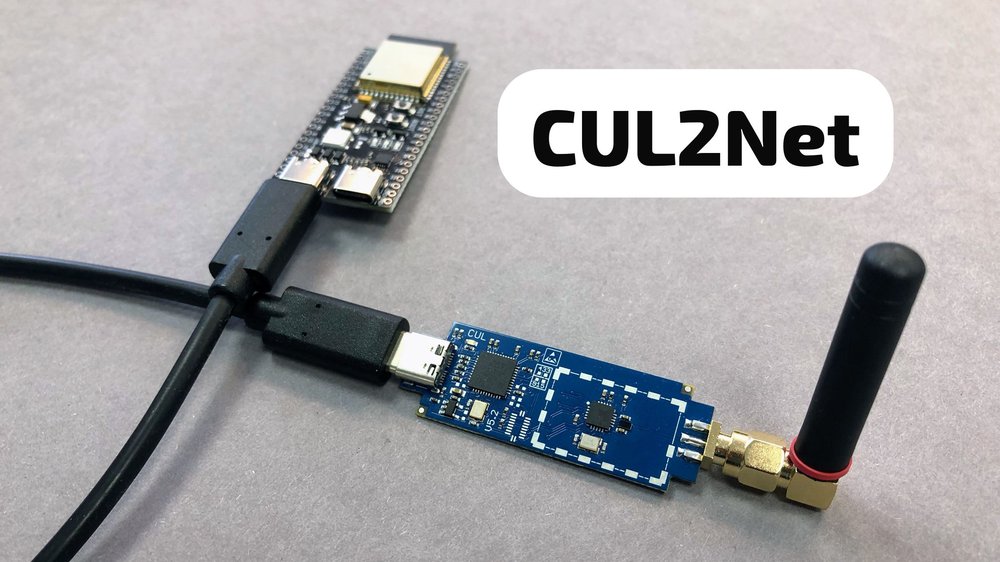
Transparent USB-Host-CDC → network bridge for the ESP32-S3 — a ser2net-style gateway that puts an unmodified USB serial stick onto the network (WiFi, or wired Ethernet where the board has it) without touching the stick's firmware.
Built for the CUL / TUL / EUL line, but it bridges any common USB serial stick:
- native CDC-ACM — legacy CUL (LUFA / ATmega32U4) and the USB-Serial-JTAG of modern ESP32-C3/C6 devices
- USB-serial bridge chips — FTDI (FT2xx), WCH CH340 / CH341, and Silicon Labs CP210x, opened through their vendor (VCP) drivers so the chip wire framing is handled and the UART baud is actually set
The S3 is the USB host: it opens the stick and fans its raw byte stream out to
TCP clients (multi-client). Raw clients get a plain socket — no framing — so
FHEM and friends talk to it exactly like a local CUL, just over host:port;
clients that need to set the line rate at runtime can use RFC2217 on the
same port.
Features
- Transparent raw-TCP pipe — default port
2329, multiple clients fan-out. - USB host, multi-chip — native CDC-ACM (CUL/TUL/EUL, C3/C6 USB-Serial-JTAG) plus the common USB-serial bridge chips — FTDI FT2xx, WCH CH340/CH341, Silicon Labs CP210x — via their VCP drivers; shows the stick's USB vendor/product strings.
- Per-port serial config — baud / data bits / parity / stop bits per device, set in the web UI and persisted in NVS (keyed by the stick's USB serial, else its VID:PID). Native CDC sticks (culfw) are baud-agnostic; real-UART bridges get the wire rate set.
- RFC2217 — optional dynamic serial config (telnet COM-PORT-OPTION) over the raw-TCP port. Raw clients stay byte-transparent; a single controlling connection owns the line parameters.
- WiFi onboarding — Improv-Serial right after flashing, or a captive portal. Static-IP or DHCP, configurable TCP port, a connectivity watchdog.
- Wired Ethernet (W5500) — on carrier boards that have one: picked up by DHCP at boot, takes precedence over WiFi, and the fallback access point stays off while the link is up.
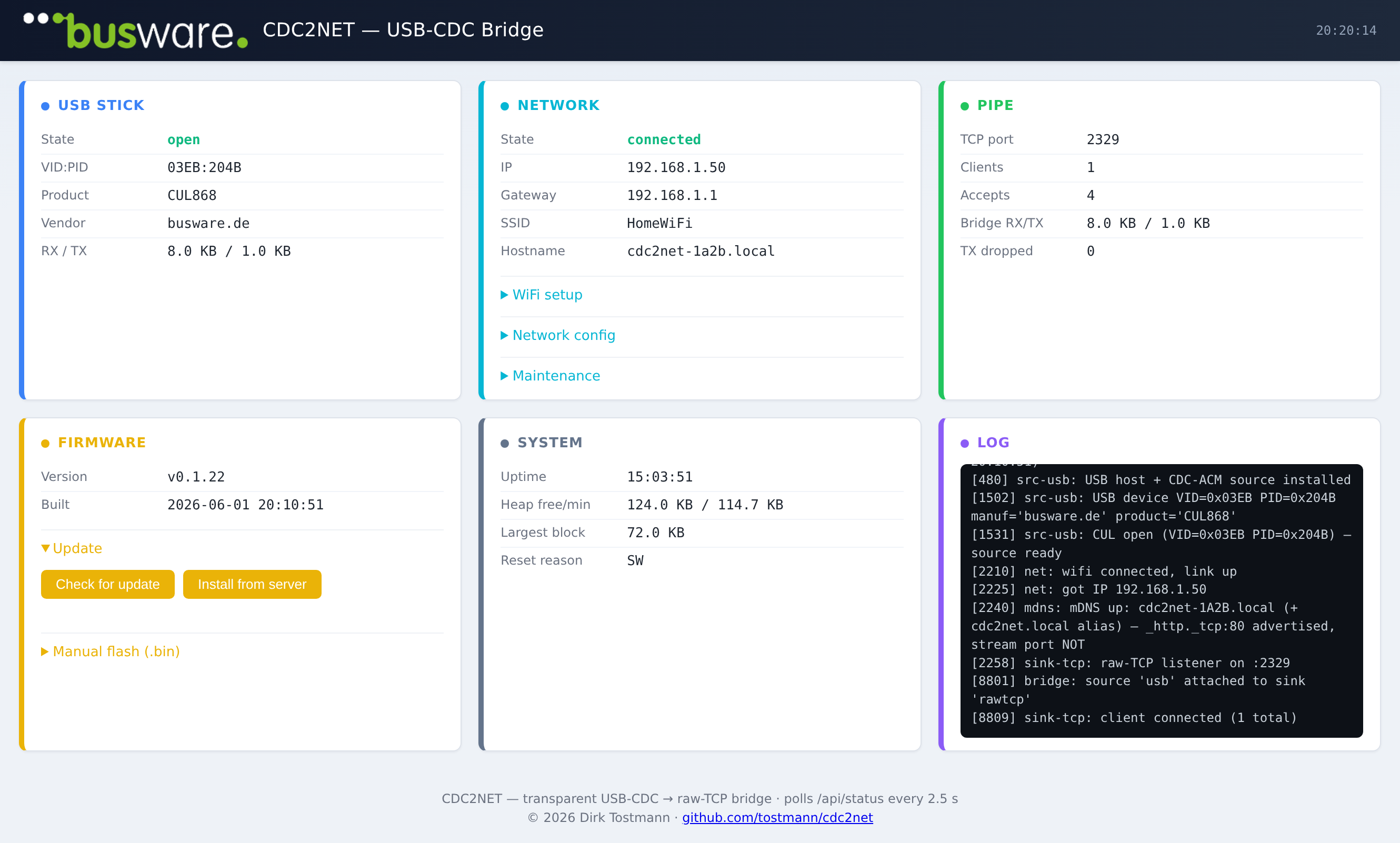
- Web UI on port 80 — status, configuration, logs, and OTA.
- OTA updates — upload a
.binfrom the browser, or pull a release straight from the update server. - mDNS — reachable as
cdc2net.local(plus a uniquecdc2net-XXXX.local); advertises_http._tcpfor the web UI. The stream port is deliberately not advertised — what's on the host port is module-dependent. - Reflash the attached CUL — USB-source builds can push a new firmware
into an attached ATmega32U4 stick through its DFU bootloader, from the web
API, no PC and no cable change; see
docs/cul-dfu.md. - One-click web flasher — install over Web Serial from the browser.
Why the S3
Only the ESP32-S2/S3/P4 have a USB-OTG host peripheral — a C3/C6 cannot be the host.
The network layer is link-abstracted: WiFi is the uplink on a plain S3 dev
board, while builds whose carrier board carries a W5500 get wired Ethernet
as well (firmware/main/net_eth.c, enabled on the gateway build and the C6
stick builds). An absent W5500 is detected and skipped, so the same code runs
on boards without one.
Install
Web flasher (easiest)
Open https://install.busware.de/cdc2net/ in a Chromium-based desktop browser (Chrome / Edge / Opera / Brave — Web Serial isn't available in Safari, Firefox, or on mobile), plug the S3 board into USB, and click Install. The browser detects the chip and writes the factory image; WiFi is handed over via Improv right after flashing.
The flasher programs the ESP32-S3 bridge board — not the CUL/TUL/EUL stick. Your sticks keep their own firmware (culfw / a-culfw); CDC2NET only carries their serial line over the network.
Manual flash
Grab factory_cdc2net_esp32s3.bin from the flasher directory and write it
with esptool:
esptool.py --chip esp32s3 -p /dev/ttyACM0 write_flash 0x0 factory_cdc2net_esp32s3.bin
firmware.bin next to it is the app-only image used by the in-device OTA.
Zigbee gateway variant (ESP32-S3 + ESP32-H2 board)
A second build targets Espressif's ESP Thread Border Router / Zigbee Gateway
board and turns it into a network-attached Zigbee coordinator: the
on-board ESP32-H2 runs the
esp-coordinator ZBOSS NCP
firmware, and CDC2NET on the S3 bridges its frame stream to :2329 over
Ethernet or WiFi. Zigbee2MQTT connects with adapter: zboss and
port: tcp://<gateway-ip>:2329.
https://install.busware.de/cdc2net/zbgw/ — one click writes both chips:
the S3 image carries the H2's firmware in a dedicated radio_fw partition and
flashes it over the inter-chip UART on first boot (MD5-verified). Later boots
verify the radio's application against the staged image (MD5) and rewrite only
on a mismatch, so a gateway update leaves a matching radio untouched, and an
erased or half-written H2 is repaired automatically.
Flash the socket marked
USB2— that is the ESP32-S3. The board's other USB-C (USB1) goes to the ESP32-H2 and cannot write this image.
This overwrites Espressif's factory firmware on both chips; the way back to a Thread border router (Espressif's esp-thread-br firmware) is untested here.
Design notes — radio-flash policy, partition layout, board wiring, the 8 MB
flash decision and the PSRAM finding — are in docs/zbgw.md.
Use
After flashing and WiFi onboarding, the device comes up as cdc2net.local.
Plug a stick into the host port and point your software at the raw-TCP port
(default 2329). In FHEM:
define CUL_0 CUL cdc2net.local:2329 1234
Power the host port. The stick draws its 5 V from the S3's USB-OTG host port, so that port has to actually supply VBUS. On dev boards with a passive VBUS path (no on-board 5 V switch) the host port only passes through what the board is fed — feed the board from a solid 5 V source. If a stick doesn't enumerate, check VBUS at the host connector first: it should sit near 5 V (a sagging ~4.5 V already causes flaky or failed enumeration).
Open http://cdc2net.local/ for live status, WiFi/network/port
configuration, logs, and firmware updates.
Build from source
PlatformIO with the ESP-IDF framework (IDF 5.5.x via espressif32@6.13.0):
cd firmware
pio run                       # build (pre-build hook bumps version + git-snapshots)
pio run -t upload             # flash over USB (set upload_port first)
pio device monitor            # 115200 baud, console on UART0
Release artifacts for the web flasher are produced by firmware/scripts/release.sh.
Build note (ESP-IDF #15079): on the S3 the USB-OTG and USB-Serial-JTAG controllers share one USB PHY. Bringing up the WiFi PHY disables the USB PHY unless
CONFIG_ESP_PHY_ENABLE_USB=yis set — which it is, infirmware/sdkconfig.defaults. Without it, the host stops enumerating once WiFi associates.
Layout
firmware/            ESP-IDF (PlatformIO) project — the device firmware
firmware/web/        web UI sources (gzipped + embedded into the firmware)
firmware/scripts/    version bump + web-asset embed + release packaging
webflasher/          ESP Web Tools manifest + landing page (release artifacts)
images/              screenshots / assets for this README
docs/                design notes, per-variant and per-feature documentation
License
CDC2NET is licensed under the GNU General Public License v2.0 or later
(GPL-2.0-or-later) — see LICENSE for the full text. Every source
file carries an SPDX-License-Identifier: GPL-2.0-or-later header.
© 2026 Dirk Tostmann. The vendored ESP-IDF components under
firmware/components/ retain their own upstream licenses (Apache-2.0 / MIT).
CDC2NET · © 2026 Dirk Tostmann · https://github.com/tostmann/cdc2net · hosted at busware.de
Questions
What is cdc2net?
tostmann/cdc2net is a public repo on GitHub by tostmann. USB-host CDC to raw-TCP bridge on ESP32-S3 (ser2net-style) for the CUL/TUL/EUL line — and the network-attached Zigbee gateway for the ESP32-S3 + ESP32-H2 board.
Is cdc2net open source?
It declares the GPL-2.0 license on GitHub.
Does cdc2net run on macOS, Windows or Linux?
Its maker has not tagged a system, so it is unknown here. Its README says what it needs.
How do I install cdc2net?
Open "Take it" on its page: Take My Repo writes an install plan for your machine and hands it to your AI agent (Claude Code, Codex or Cursor), which asks you before each step. Take My Repo has not tested it on any machine.