
awesome-decision-tree-papers
A collection of research papers on decision, classification and regression trees with implementations.
- 2.5k
- Python
- CC0-1.0
- 11 mo ago
Regular Expression Counts of Terms and Substrings
Repo trinker/termco, read from GitHub 1 min ago. trinker has not joined Take My Repo.
trinker/termco is a public repo on GitHub by trinker. Regular Expression Counts of Terms and Substrings. It declares no license on GitHub. Public does not mean open source: without a license, nobody is granted the right to reuse it. It is written mainly in R, has 26 stars and last changed on 2022-01-05. Nobody has reviewed it on Take My Repo yet, which says nothing about its quality. Read from GitHub on 2026-11-25.
A collection of research papers on decision, classification and regression trees with implementations.

termco is a suite of functions used to count and find terms and substrings in strings. The tools can be used to build an expert rules, regular expression based text classification model. The package wraps the data.table and stringi packages to create fast data frame counts of regular expression terms and substrings.
The main function of termco is term_count. It is used to extract
regex term counts by grouping variable(s) as well as to generate
classification models.
Most of the functions count, search, plot terms, and covert
between output types, while a few remaining functions are used to train,
test and interpret models. Additionally, the probe_ family of
function generate lists of function calls or plots for given search
terms. The table below describes the functions, category of use, and
their description:
| Function | Use Category | Description |
|---|---|---|
term_count |
count | Count regex term occurrence; modeling |
token_count |
count | Count fixed token occurrence; modeling |
frequent_terms/all_words |
count | Frequent terms |
important_terms |
count | Important terms |
hierarchical_coverage_term |
count | Unique coverage of a text vector by terms |
hierarchical_coverage_regex |
count | Unique coverage of a text vector by regex |
frequent_ngrams |
count | Weighted frequent ngram (2 & 3) collocations |
word_count |
count | Count words |
term_before/term_after |
count | Frequency of words before/after a regex term |
term_first |
count | Frequency of words at the begining of strings |
colo |
search | Regex output to find term collocations |
search_term |
search | Search for regex terms |
match_word |
search | Extract words from a text matching a regular expression |
search_term_collocations |
search | Wrapper for search_term + frequent_terms |
classification_project |
modeling | Make a classification modeling project template |
classification_template |
modeling | Make a classification analysis script template |
as_dtm/as_tdm |
modeling | Coerce term_count object into tm::DocumentTermMatrix/tm::TermDocumentMatrix |
split_data |
modeling | Split data into train & test sets |
evaluate |
modeling | Check accuracy of model against human coder |
classify |
modeling | Assign n tags to text from a model |
get_text |
modeling | Get the original text for model tags |
coverage |
modeling | Coverage for term_count or search_term object |
uncovered/get_uncovered |
modeling | Get the uncovered text from a model |
mutate_counts |
modeling | Apply normalizing function to term count columns |
select_counts |
modeling | Select columns without stripping count classes |
tag_co_occurrence |
modeling | Explore co-occurrence of tags from a model |
validate_model/assign_validation_task |
modeling | Human validation of a term_count model |
read_term_list |
read/write | Read a term list from an external file |
write_term_list |
read/write | Write a term list to an external file |
term_list_template |
read/write | Write a term list template to an external file |
as_count |
convert | Strip pretty printing from term_count object |
as_terms |
convert | Convert a count matrix to list of term vectors |
as_term_list |
convert | Convert a vector of terms into a named term list |
weight |
convert | Weight a term_count object proportion/percent |
plot_ca |
plot | Plot term_count object as 3-D correspondence analysis map |
plot_counts |
plot | Horizontal bar plot of group counts |
plot_freq |
plot | Vertical bar plot of frequencies of counts |
plot_cum_percent |
plot | Plot frequent_terms object as cumulative percent |
probe_list |
probe | Generate list of search_term function calls |
probe_colo_list |
probe | Generate list of search_term_collocations function calls |
probe_colo_plot_list |
probe | Generate list of search_term_collocationss + plot function calls |
probe_colo_plot |
probe | Plot probe_colo_plot_list directly |
To download the development version of termco:
Download the zip
ball or tar
ball, decompress and
run R CMD INSTALL on it, or use the pacman package to install the
development version:
if (!require("pacman")) install.packages("pacman")
pacman::p_load_gh(
    "trinker/gofastr",
    "trinker/termco"
)
You are welcome to:
The following examples demonstrate some of the functionality of termco.
if (!require("pacman")) install.packages("pacman")
pacman::p_load(dplyr, ggplot2, termco)

data(presidential_debates_2012)
discoure_markers <- list(
    response_cries = c("\\boh", "\\bah", "aha", "ouch", "yuk"),
    back_channels = c("uh[- ]huh", "uhuh", "yeah"),
    summons = "hey",
    justification = "because"
)

counts <- presidential_debates_2012 %>%
    with(term_count(dialogue, grouping.var = list(person, time), discoure_markers))

counts

## Coverage: 100%
## # A tibble: 10 x 7
##    person  time  n.words response_cries back_channels summons justification
##    <fct>   <fct>   <int> <chr>          <chr>         <chr>   <chr>
##  1 OBAMA   time~    3599 3(.08%)        0             43(1.1~ 26(.72%)
##  2 OBAMA   time~    7477 2(.03%)        0             42(.56~ 29(.39%)
##  3 OBAMA   time~    7243 1(.01%)        1(.01%)       58(.80~ 33(.46%)
##  4 ROMNEY  time~    4085 0              0             27(.66~ 8(.20%)
##  5 ROMNEY  time~    7536 1(.01%)        3(.04%)       49(.65~ 20(.27%)
##  6 ROMNEY  time~    8303 5(.06%)        0             84(1.0~ 19(.23%)
##  7 CROWLEY time~    1672 2(.12%)        0             4(.24%) 12(.72%)
##  8 LEHRER  time~     765 3(.39%)        3(.39%)       0       0
##  9 QUESTI~ time~     583 2(.34%)        0             0       2(.34%)
## 10 SCHIEF~ time~    1445 0              0             2(.14%) 6(.42%)
print(counts, pretty = FALSE)

## Coverage: 100%
## # A tibble: 10 x 7
##    person  time  n.words response_cries back_channels summons justification
##    <fct>   <fct>   <int>          <int>         <int>   <int>         <int>
##  1 OBAMA   time~    3599              3             0      43            26
##  2 OBAMA   time~    7477              2             0      42            29
##  3 OBAMA   time~    7243              1             1      58            33
##  4 ROMNEY  time~    4085              0             0      27             8
##  5 ROMNEY  time~    7536              1             3      49            20
##  6 ROMNEY  time~    8303              5             0      84            19
##  7 CROWLEY time~    1672              2             0       4            12
##  8 LEHRER  time~     765              3             3       0             0
##  9 QUESTI~ time~     583              2             0       0             2
## 10 SCHIEF~ time~    1445              0             0       2             6

print(counts, zero.replace = "_")

## Coverage: 100%
## # A tibble: 10 x 7
##    person  time  n.words response_cries back_channels summons justification
##    <fct>   <fct>   <int> <chr>          <chr>         <chr>   <chr>
##  1 OBAMA   time~    3599 3(.08%)        _             43(1.1~ 26(.72%)
##  2 OBAMA   time~    7477 2(.03%)        _             42(.56~ 29(.39%)
##  3 OBAMA   time~    7243 1(.01%)        1(.01%)       58(.80~ 33(.46%)
##  4 ROMNEY  time~    4085 _              _             27(.66~ 8(.20%)
##  5 ROMNEY  time~    7536 1(.01%)        3(.04%)       49(.65~ 20(.27%)
##  6 ROMNEY  time~    8303 5(.06%)        _             84(1.0~ 19(.23%)
##  7 CROWLEY time~    1672 2(.12%)        _             4(.24%) 12(.72%)
##  8 LEHRER  time~     765 3(.39%)        3(.39%)       _       _
##  9 QUESTI~ time~     583 2(.34%)        _             _       2(.34%)
## 10 SCHIEF~ time~    1445 _              _             2(.14%) 6(.42%)
plot(counts)

plot(counts, labels=TRUE)

plot_ca(counts, FALSE)

termco wraps the quanteda
package to examine important ngram collocations. quanteda’s
collocation function provides measures of: "lambda", "z", and
"frequency" to examine the strength of relationship between ngrams.
termco adds stopword removal, min/max character filtering, and
stemming to quanteda’s collocation as well as a generic plot
method.
trinker/termco is a public repo on GitHub by trinker. Regular Expression Counts of Terms and Substrings.
It declares no license on GitHub. Public does not mean open source: without a license, nobody is granted the right to reuse it.
Its maker has not tagged a system, so it is unknown here. Its README says what it needs.
Open "Take it" on its page: Take My Repo writes an install plan for your machine and hands it to your AI agent (Claude Code, Codex or Cursor), which asks you before each step. Take My Repo has not tested it on any machine.
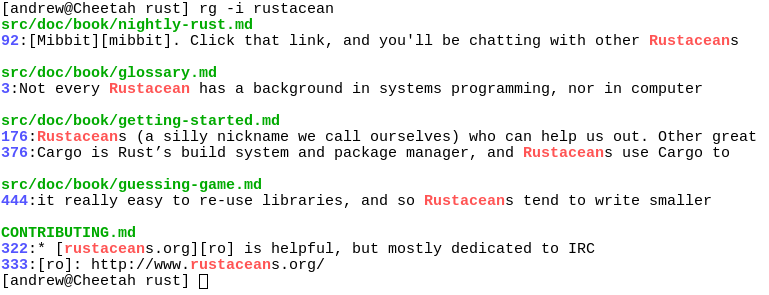
ripgrep recursively searches directories for a regex pattern while respecting your gitignore
:fire: Android developers should collect the following utils(updating).
Its last change on GitHub was on 2022-01-05. GitHub counts 15 open issues and pull requests. Take My Repo does not judge from that whether it is maintained.
Nobody has reviewed it on Take My Repo yet, which says nothing about its quality.
Take My Repo cannot say: it does not audit code and has not run termco. What is known comes from GitHub. It declares no license on GitHub. Public does not mean open source: without a license, nobody is granted the right to reuse it. Its last change was on 2022-01-05. It has 26 stars, which measure popularity, not safety. Nobody has reviewed it on Take My Repo yet, which says nothing about its quality. Read the source before you run it. With "Take it", your AI agent shows each step and asks you before running it; README text is treated as data, not as instructions.