dify
Build Agentic workflows, RAG pipelines, with rich AI model and tool support on one collaborative workspace. Deploy on cloud, VPC, or self-hosted, so teams move from prototype to production without rebuilding the stack.
- 162k
- Python
- 3 h ago
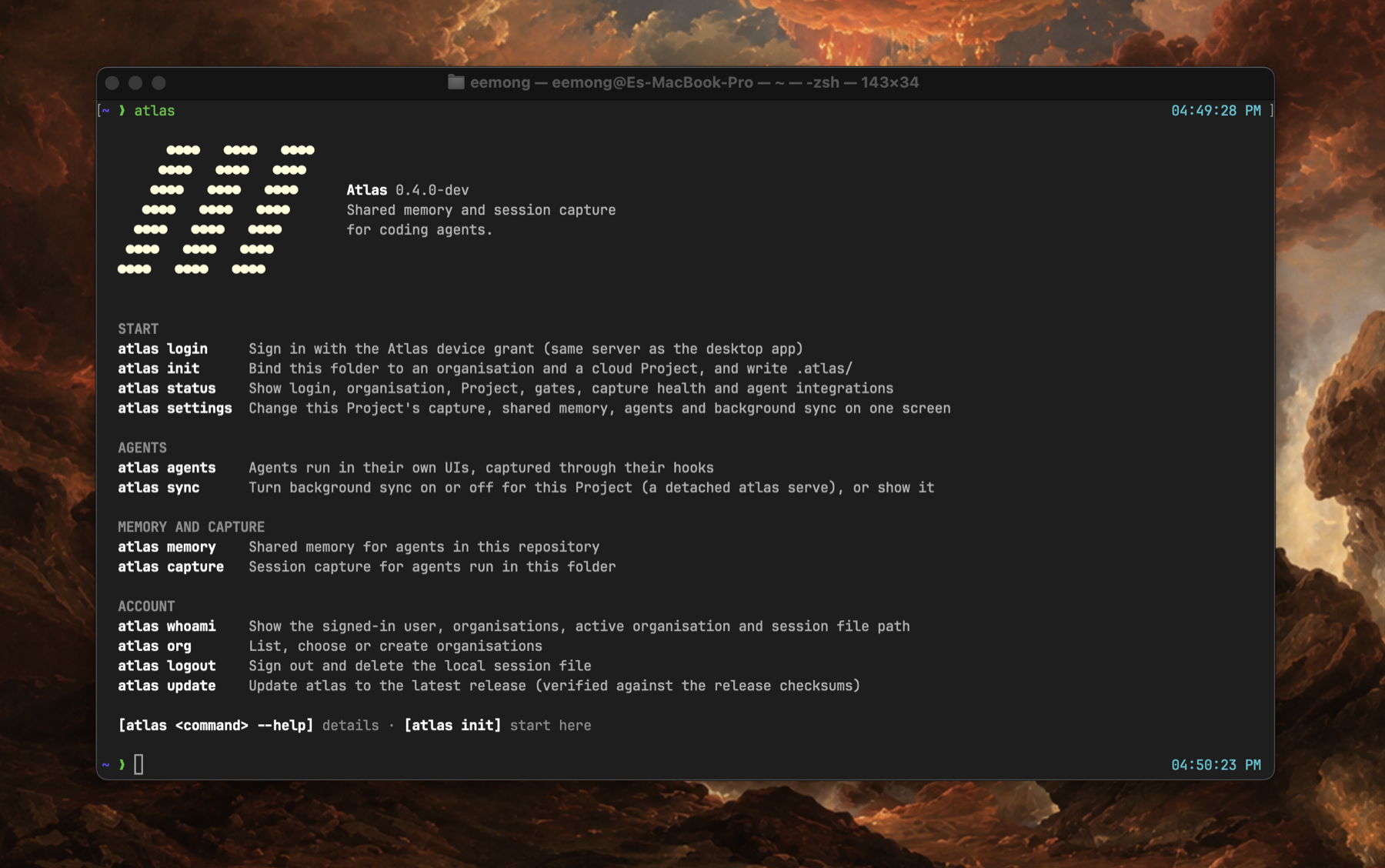
Atlas CLI is the command-line version of Atlas. It hooks into the coding agents you already use, such as Claude Code, Codex, Cursor, and captures every session live to the cloud. It also gives every agent one shared project memory that they search by meaning, using a model that runs locally.
Repo tryatlas/cli, read from GitHub 51 min ago. tryatlas has not joined Take My Repo.
tryatlas/cli is a public repo on GitHub by tryatlas. Atlas CLI is the command-line version of Atlas. It hooks into the coding agents you already use, such as Claude Code, Codex, Cursor, and captures every session live to the cloud. It also gives every agent one shared project memory that they search by meaning, using a model that runs locally. It declares the Apache-2.0 license on GitHub. It is written mainly in Go, has 5 stars and last changed on 2026-11-23. Nobody has reviewed it on Take My Repo yet, which says nothing about its quality. Read from GitHub on 2026-11-24.
Build Agentic workflows, RAG pipelines, with rich AI model and tool support on one collaborative workspace. Deploy on cloud, VPC, or self-hosted, so teams move from prototype to production without rebuilding the stack.
Reverse engineer anything with agents, from app behavior down to native binaries.
Shared memory and session capture for coding agents, from the terminal.
Claude Code, Codex, Cursor, Copilot, OpenCode, Droid, Antigravity and Pi keep their own UIs;
Atlas records every session and gives every agent the same memory of the project.
Install · Quick start · Shared memory · Session capture · Agents · Commands
Atlas CLI is the headless Atlas: one Go binary that signs in like the Atlas
desktop app, binds a folder to an organisation and a cloud Project, and plugs
into the hooks of the agents you already use. It writes the same files the app
writes, byte for byte, so a folder works the same whether it is open in the app,
in a terminal on a server, or both.
macOS (Apple silicon, Intel) and Linux (amd64, arm64):
curl -fsSL https://github.com/tryatlas/cli/releases/latest/download/install.sh | sh
The installer verifies the archive's sha256 and puts atlas-cli in ~/.local/bin
(ATLAS_INSTALL_DIR changes it, ATLAS_VERSION=v0.4.0 pins it). Later,
atlas-cli update does the same in place. From source: make build (pure Go, no
cgo).
Coming from a release up to v0.4.0, where the command was atlas: atlas update (or the installer) brings the new version, which renames itself to
atlas-cli the first time you run it. Then run atlas-cli agents add --all in
each Project to point the agents' hooks at the new name.
To remove it: atlas-cli uninstall takes Atlas's hooks and memory entries out
of every Project, stops the listeners, and deletes the CLI's state and binary.
Each Project's .atlas/ and your sign-in stay for the desktop app (atlas-cli logout first to sign out too).
atlas-cli login      # sign in (the same account as the desktop app)
cd ~/work/backend
atlas-cli init       # organisation → Project → agents → background sync
claude               # …or codex, cursor-agent, opencode, copilot: work as usual
atlas-cli status     # what was captured, what synced, what agents remember
atlas-cli init is a guided flow on a terminal:
| step | asks |
|---|---|
| 1 · Organisation | which organisation the folder belongs to (skipped when you have one) |
| 2 · Project | the cloud Project: the one matching this repository first, the others, or a new one |
| 3 · Agents | which agents found on this machine to hook, with an All agents row |
| 4 · Background sync | keep a listener running so every event reaches the cloud at once |
| 5 · Memory search | download the local search model (87 MB, once) when it is missing |
--local binds without a cloud. In scripts, flags answer instead: --org,
--project | --create, --agents claude-code,codex | --all-agents,
--sync on|off.
atlas-cli settings changes any of it later on one screen: account, capture and
memory, each agent, background sync, the local model, updates.
When a project is a folder of repositories, each with its own git:
acme-shop/        ← atlas-cli init here, once
├── frontend/     (git)
└── backend/      (git)
run atlas-cli init --workspace in acme-shop/. On a terminal, plain
atlas-cli init asks, with "This folder only" pre-selected; a folder already
bound alone becomes a workspace with atlas-cli workspace on. Agents started
in frontend/ or backend/ then record into the one Project and share one
memory, and the agent hooks are installed in every repository. A workspace is
never made by default: it captures every repository below it. A repository
cloned in later is part of the workspace at once; atlas-cli workspace sync
hooks it. A repository with its own atlas-cli init is split off as its own
Project.
| command | does |
|---|---|
atlas-cli workspace |
lists the workspace's folders and which agents are hooked in each |
atlas-cli workspace sync |
hooks folders added since, with the agents the workspace folder uses |
atlas-cli workspace on / off |
turns an already bound folder into a workspace, or back |
atlas-cli workspace add <folder> / remove <folder> |
a folder without git (or a repository deeper down) joins or leaves |
Every agent in the project reads and writes one memory, through the
atlas_memory MCP server that atlas-cli agents add registers in the agent's own
config. Nothing is ever injected into a prompt: agents pull what they need.
| tool | what an agent gets |
|---|---|
memory_briefing |
at session start: the active plan, recent file changes, decisions, facts, failures, architecture, conventions, and the previous session's handoff |
memory_search |
memories ranked by meaning and words, plus the project's documents (CLAUDE.md, AGENTS.md, notes, captured sessions) |
memory_remember |
save a decision, fact, failure, architecture note or preference; near-duplicates merge |
memory_changes |
what other sessions recorded since this one last looked |
memory_get · memory_history · memory_why |
one memory, its earlier wordings, and the sessions behind a file or commit |
memory_forget · memory_feedback · memory_list |
remove, rate and list |
TodoWrite, update_plan, todowrite, Claude's tasks and plan mode, …),
it becomes the project's plan, and the next session, or another agent, sees
it in its briefing..atlas/memory/ holds the app's exact files:
memory.sqlite (with its vectors), corpus.sqlite, memory.snapshot.sqlite
(a daily backup, restored automatically if the record is damaged) and
extract-state/.atlas-cli memory browse # entries by kind, search, history
atlas-cli memory index # embed every memory, index the project's documents
atlas-cli memory compute # how this machine embeds: auto, off, cpu, ollama or a URL
atlas-cli memory compute … |
for |
|---|---|
auto (default) |
the CPU; keywords only on a small machine; a local Ollama with all-minilm when found |
off |
keywords only: the model is never loaded |
cpu [--threads N] |
the CPU whatever the machine, on at most N cores |
ollama |
Ollama here (ollama pull all-minilm) |
http://gpu-box:8080/v1 |
an OpenAI-compatible server on a GPU |
ATLAS_EMBED, ATLAS_EMBED_MODEL and ATLAS_EMBED_THREADS override the
setting for one environment (CI, a container).
Capture happens per event, as the agent works:
post-commit hook
links each commit to the session and turn that wrote it.Every event reaches the cloud Project within seconds: the hook writes the store
and syncs, or hands the event to atlas-cli serve, or spools it while the desktop
app has the folder open. A hook never fails the agent; problems go to
atlas-cli status.
atlas-cli sync on     # a background listener your agents' hooks keep alive
atlas-cli serve       # the same in the foreground, with a live feed of hook events
atlas-cli agents add <agent> writes the hook and the memory server into the
agent's own config in the project; atlas-cli agents remove takes them out.
Nothing is wrapped and no environment variable changes.
| agent | hook written to | memory server written to |
|---|---|---|
claude-code Claude Code |
.claude/settings.local.json |
.mcp.json, approved in the local settings |
codex Codex |
.codex/hooks.json: choose Trust all and continue once |
.codex/config.toml |
cursor Cursor CLI and IDE |
.cursor/hooks.json |
.cursor/mcp.json, approved once in Cursor |
copilot GitHub Copilot CLI |
.github/hooks/atlas.json, once the folder is trusted |
.github/mcp.json |
opencode OpenCode |
.opencode/plugins/atlas.ts |
opencode.json |
droid Factory Droid |
.factory/settings.json |
.factory/mcp.json |
antigravity Antigravity (agy) |
.agents/hooks.json |
.agents/mcp_config.json |
pi Pi |
.pi/extensions/atlas/index.ts, once the project is trusted |
.pi/mcp.json |
Keep atlas-cli current on PATH, including ~/.local/bin, which some agents put
first.
Every command draws its own screen on a terminal (the Atlas palette: monochrome, colour only for status) and prints plain text to pipes and scripts.
| command | what |
|---|---|
atlas-cli |
the overview: logo, commands by group |
atlas-cli login · logout · whoami |
sign in with the device grant; the session file is the only secret kept (mode 0600) |
atlas-cli org list | use | create |
organisations |
atlas-cli init |
bind the folder, hook the agents, choose background sync and memory search |
atlas-cli settings |
everything on one screen |
atlas-cli status |
sign-in, Project, capture health, commits linked, sync, memory, agents |
atlas-cli agents add | remove | list | sessions |
the hooks and memory entry per agent; the sessions seen |
atlas-cli sync [on | off] |
background sync |
atlas-cli serve |
the Project's listener: memory server, sync drain, receiver of hook events |
atlas-cli memory browse | list | index | verify | export | import |
shared memory |
atlas-cli memory compute [auto | off | cpu | ollama | <url>] |
how memory search embeds on this machine |
atlas-cli memory enable | disable |
the shared-memory gate for this repository |
atlas-cli capture enable | disable | sync | retry | link |
the capture gate; sync now, retry failed rows, link commits |
atlas-cli update [--check] [--version vX.Y.Z] |
replace this binary with a release, checksum verified |
atlas-cli uninstall [--yes] [--keep-binary] |
remove Atlas's hooks from every Project, stop the listeners, delete the CLI's state and the binary; .atlas/ and the sign-in stay |
| path | what |
|---|---|
.atlas/ |
the app's per-project files only: sessions.db, blobs/, memory/, project.json |
~/.local/state/atlas-cli/projects/<hash>/ |
the CLI's own: hook state, hooks.log, the listener's run file, preferences |
~/.local/state/atlas-cli/compute.json |
this machine's memory compute setting, and endpoint verdicts beside it |
~/Library/Application Support/dev.atlas.ide/models/ |
the local search model, shared with the app (~/.local/share/… on Linux) |
make build    # ./bin/atlas
make test     # go test ./...
make lint     # golangci-lint
| doc | what |
|---|---|
docs/progress.md |
what was built, what was verified live, what was not |
docs/adr/ |
decisions; 0013 is capture through agents' hooks |
docs/research/entire-cli.md |
the per-agent hook facts the integrations follow |
tryatlas/cli is a public repo on GitHub by tryatlas. Atlas CLI is the command-line version of Atlas. It hooks into the coding agents you already use, such as Claude Code, Codex, Cursor, and captures every session live to the cloud. It also gives every agent one shared project memory that they search by meaning, using a model that runs locally.
It declares the Apache-2.0 license on GitHub.
Its maker has not tagged a system, so it is unknown here. Its README says what it needs.
The agent harness performance optimization system. Skills, instincts, memory, security, and research-first development for Claude Code, Codex, Opencode, Cursor and beyond.
Fair-code workflow automation platform with native AI capabilities. Combine visual building with custom code, self-host or cloud, 400+ integrations.
Open "Take it" on its page: Take My Repo writes an install plan for your machine and hands it to your AI agent (Claude Code, Codex or Cursor), which asks you before each step. Take My Repo has not tested it on any machine.
Its last change on GitHub was on 2026-11-23. Take My Repo does not judge from that whether it is maintained.
Nobody has reviewed it on Take My Repo yet, which says nothing about its quality.
Take My Repo cannot say: it does not audit code and has not run cli. What is known comes from GitHub. It declares the Apache-2.0 license on GitHub. Its last change was on 2026-11-23. It has 5 stars, which measure popularity, not safety. Nobody has reviewed it on Take My Repo yet, which says nothing about its quality. Read the source before you run it. With "Take it", your AI agent shows each step and asks you before running it; README text is treated as data, not as instructions.