dify
Build Agentic workflows, RAG pipelines, with rich AI model and tool support on one collaborative workspace. Deploy on cloud, VPC, or self-hosted, so teams move from prototype to production without rebuilding the stack.
- 162k
- Python
- 46 min ago
The agent loop for Rust — stream from 7 LLM protocols, run tools, loop until done. From a laptop to a Cloudflare Worker.
Repo yologdev/yoagent, read from GitHub 1 min ago. yologdev has not joined Take My Repo.
yologdev/yoagent is a public repo on GitHub by yologdev. The agent loop for Rust — stream from 7 LLM protocols, run tools, loop until done. From a laptop to a Cloudflare Worker. It declares the MIT license on GitHub. It is written mainly in Rust, has 379 stars and last changed on 2026-11-15. Nobody has reviewed it on Take My Repo yet, which says nothing about its quality. Read from GitHub on 2026-11-22.
Getting started · Design philosophy · Docs · API · Changelog · 中文
The agent loop for Rust. Stream from any LLM protocol, run tools and extensions, loop until done.
A loop library, not an agent: it powers yoyo, a coding agent evolving its own source since March 2026. Your agent ships as one native binary, or builds for wasm32 to run in a Cloudflare Worker.
git clone https://github.com/yologdev/yoagent && cd yoagent
ollama serve &
ollama pull llama3.1:8b                           # or pass --model <any pulled model>
cargo run --example cli -- --provider ollama
That's a working coding agent in your terminal — file read/write/edit, shell, ripgrep search, streaming output, skills. No signup, no key, nothing to configure.
  yoagent cli — mini coding agent
  Type /quit to exit, /clear to reset

  model: llama3.1:8b
  cwd:   /home/user/my-project

> find all TODO comments in src/

  ▶ search 'TODO' ✓

Found 3 TODOs:
  src/main.rs:42: // TODO: handle edge case
  src/lib.rs:15:  // TODO: add tests
  src/utils.rs:8: // TODO: optimize this

  tokens: 1250 in / 89 out
Point it at a hosted model instead by swapping the flag:
ANTHROPIC_API_KEY=sk-... cargo run --example cli
GROQ_API_KEY=...        cargo run --example cli -- --provider groq --model openai/gpt-oss-120b
cargo run --example cli -- --api-url http://localhost:1234/v1 --model my-model # LM Studio, llama.cpp, vLLM[dependencies] yoagent = "0.27" tokio = { version = "1", features = ["full"] }
Building for wasm32? Use default-features = false (see
WebAssembly & Cloudflare Workers).
On a native target keep the default native feature: without it reqwest has no TLS, and every
HTTPS provider call fails at runtime.
An agent that actually uses a tool — the thing the crate exists for:
use yoagent::provider::ModelConfig;
use yoagent::{tools, Agent, AgentEvent, StreamDelta};

#[tokio::main]
async fn main() {
    // The provider is selected from the config's protocol and the key is read
    // from ANTHROPIC_API_KEY. Call `.with_api_key(k)` to pass one explicitly.
    let mut agent = Agent::from_config(ModelConfig::claude_sonnet_5())
        .with_system_prompt("You are a coding assistant.")
        .with_tools(tools::default_tools());

    let mut events = agent.prompt("Find every TODO in src/ and summarise them").await;

    while let Some(event) = events.recv().await {
        match event {
            AgentEvent::MessageUpdate { delta: StreamDelta::Text { delta }, .. } => print!("{delta}"),
            AgentEvent::ToolExecutionStart { tool_name, .. } => println!("\n▶ {tool_name}"),
            AgentEvent::AgentEnd { .. } => break,
            _ => {}
        }
    }
    agent.finish().await;
}
Swap the model by swapping the config — the provider follows, and the key is read from that provider's conventional env var:
Agent::from_config(ModelConfig::groq("openai/gpt-oss-120b", "GPT-OSS 120B"));    // GROQ_API_KEY
Agent::from_config(ModelConfig::gemini_3_8_flash());                              // GEMINI_API_KEY
Agent::from_config(ModelConfig::ollama("http://localhost:11434/v1", "llama3.1:8b")); // no key
Every agent runs the same loop, and almost every hand-written one gets the same things wrong: streams that end badly, tools that panic or hang, context that runs out, runs that never stop, spend nobody can account for. yoagent writes that loop once, with each guarantee pinned by a test, and keeps one rule for what goes in: does every agent need it, the same way? Anything else is an extension, a feature or a companion crate (design philosophy).
So it ships no vector stores, embedding pipelines, or task-graph layer — if your problem is retrieval or orchestration, one of these is the better fit:
| If you need | Look at |
|---|---|
| RAG pipelines, vector stores, embeddings, transcription and image generation | rig — "Build modular and scalable LLM Applications in Rust" |
| Typed task graphs and streaming RAG indexing alongside agents | swiftide — "Composable LLM agents and harness, typed task graphs, and streaming RAG pipelines in Rust" |
| A tool-calling loop you host, gate, steer, branch, and record | yoagent |
What that focus bought:
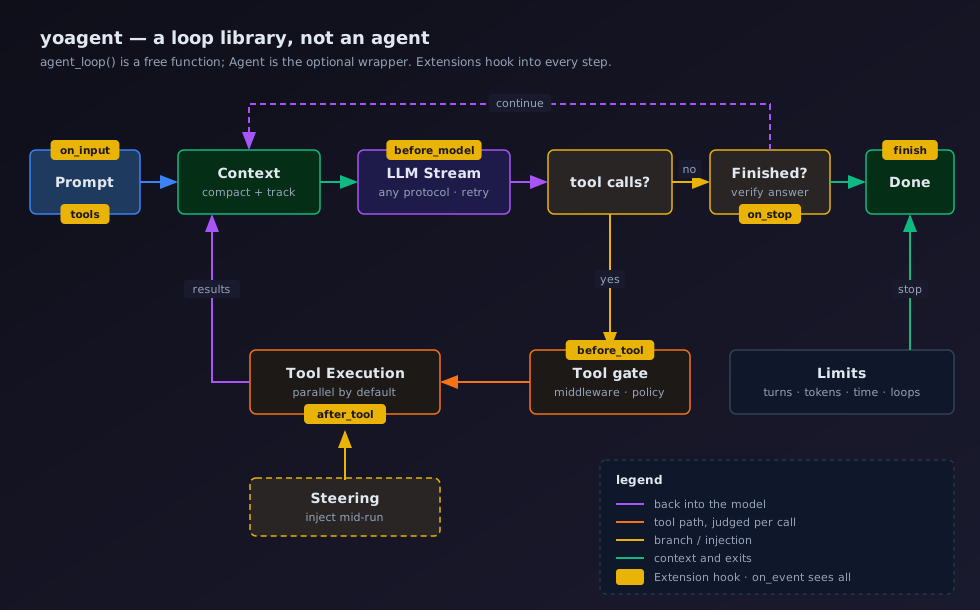
agent_loop() is stateless and takes
everything it needs as arguments. Agent is an optional wrapper that adds history and queues.
You can drive the loop yourself without adopting our state model.Extension can add tools, check input, allow,
modify or deny each tool call, redact results, and check the final answer, with state
that starts fresh each run. Install it as host policy and it governs every sub-agent too.
Hooks that guard a call fail closed: a policy that cannot run denies, an input check rejects,
a redaction that fails withholds.Session forks, checkpoints, and seeks.
Edit an earlier turn and re-run it without destroying the original branch.features = ["gasp"], a run becomes an append-only semantic
event log in a git repo — restore is clone + replay. Conformance-checked in CI.MockProvider scripts multi-turn tool-calling
conversations and honours cancellation, so abort and steering paths are testable with no
network or key.Everything that changes what the loop does goes through one contract, Extension: its run's
RunHooks see on_input, before_model, before_tool, after_tool, on_stop, every event,
and finish. A tool policy is a few lines:
use yoagent::extension::{ClonedHooks, RunHooks};
use yoagent::{ToolCallRequest, ToolDecision};

#[derive(Clone)]
struct NoForcePush;

#[async_trait::async_trait] // the `async-trait` crate
impl RunHooks for NoForcePush {
    async fn before_tool(&self, call: &ToolCallRequest<'_>) -> ToolDecision {
        let command = call.args["command"].as_str().unwrap_or_default();
        if command.contains("push --force") {
            ToolDecision::Deny("force-push is not allowed here".into())
        } else {
            ToolDecision::Allow
        }
    }
}

let agent = agent.with_extension(ClonedHooks::new("no-force-push", NoForcePush));
yoagent's own budget, tool gate and input guard are built the same way. Six runnable
extension_* examples cover policies, redaction, verifiers, budgets, sub-agent policy and
audit logs (guide).
Plugins and other ecosystems. yoagent-rutis turns
rutis plugins — Rust, TypeScript (Node or Bun), Python or Go, loaded,
reloaded and unloaded at runtime — into one Extension. Through small adapters it also runs many
pi extensions and DeepSeek harness (DSH) tool plugins unchanged, with no
change to yoagent's core: tools, tool policies, input checks, prompt additions and images cross
over; commands and UI don't. An extension that hooks something the adapter can't enforce is
refused, not half-run. How the 20 most-downloaded packages of each ecosystem fare (by monthly
downloads, among npm's first 1000 search results per keyword), measured:
plugin compatibility.
Agents built this way — a coding agent with pi and DSH plugins in your browser, a handoff agent
that asks without waiting and reports back — live in yobuild.
The same loop builds natively and for wasm32-unknown-unknown. In yoyo's Cloudflare Worker we
measured about 4 ms to start and a median of ~45 ms of CPU per agent run — an agent
spends most of a run waiting on the model, which Workers do not bill as CPU. A minimal Worker
(one provider via Agent::from_provider, one tool, no decision model) is about 330 KiB gzipped. HTTP MCP works over the host's fetch;
yoagent-workers turns the Workers AI binding into a decision
model. See WebAssembly & Cloudflare Workers.
yoyo-evolve — a coding
agent that evolves its own source in public. It began as 200 lines of Rust; every commit since has
been agent-written and gated on tests. It runs on this loop with the openapi feature enabled.
Also built on yoagent:
| Project | What it is |
|---|---|
rab |
A lightweight, extensible Rust coding agent |
greatsage |
"Rimuru's Unique Skill, you know the one" |
yoclaw |
OpenClaw reborn in Rust — a single-binary agent that remembers you |
Built something on yoagent? Open a PR and add it here — we'd like to see it.
| The loop | Full event stream; parallel, sequential or batched tools; steering and follow-ups; execution limits; retry with backoff and jitter; unanswered tool calls closed | Agent loop · Events · Retry |
| Extensions | One plug-in contract for the run; on_stop sees cut-off answers too; Budget; the older hooks (ToolMiddleware, input filters, TurnHook, callbacks) still work |
Extensions · Callbacks |
| Providers | 7 native protocols reaching 20+ providers, or your own StreamProvider; thinking controls; prompt-cache hints; one context-overflow classifier; images sent the way each protocol takes them, or a text note with image_input off |
Providers · Prompt caching |
| Tools | bash, file read/write/edit, list_files, search; custom tools via one trait; MCP over stdio or HTTP; OpenAPI specs; ToolSources (refreshed mid-run, MCP list_changed included); per-file locking, images checked before sending, no overwrite after a partial read (ReadLog, on in default_tools()) |
Tools · MCP · OpenAPI |
| Sub-agents | Child loops with their own model and tools; large artifacts passed by reference; spend rolled up | Sub-agents |
| Context | Usage-calibrated tracking, tiered compaction, optional LlmCompaction, loop detection |
Context management |
| Sessions, skills, structured output | Branching session trees with JSONL; AgentSkills SKILL.md; typed prompt_structured::<T>() |
Sessions · Skills · Structured outputs |
Decision models (decision) |
Typed yes/no, one-of-N and score judgments in a few hundred ms (Jev, Clef, OpenAI Decisions, any logprobs server); a tool gate and an input guard | Decision models |
| Cost and telemetry | Opt-in pricing (nothing priced by default); model limits from the same table, applied even with pricing off; SessionStats per run incl. sub-agents; tracing spans with tokens and cost |
Pricing · Telemetry |
Recording (gasp) |
serde on every core type; runs recorded into a GASP repo, plugin logs too (opt-in) | Persistence · GASP |
| WebAssembly | --no-default-features for wasm32-unknown-unknown, e.g. Cloudflare Workers |
WebAssembly & Workers |
Seventeen of the 22 runnable examples in examples/ are below; ten need no API key at all (eleven counting cli with a local model). The rest are live-provider harnesses and offline evaluation sweeps.
| Example | What it shows | Key needed |
|---|---|---|
cli |
A ~400-line coding agent — all tools, skills, streaming, colored output. Like a baby Claude Code | optional¹ |
rlm |
An LLM that explores a codebase on its own by spawning sub-agents | yes |
code_review |
Three sub-agents reviewing a diff in parallel, results merged | yes |
shared_state |
Passing a large artifact between sub-agents by reference | yes |
sub_agent |
Delegation basics with a per-sub-agent model | yes |
basic |
The smallest possible agent | yes |
callbacks |
Lifecycle hooks and a custom tool | no |
persistence |
Save and restore a session | no |
telemetry |
tracing spans with token and cost fields |
no |
gasp_emit |
Recording a run into a GASP repo | no |
decision |
Decision-model questions in one line, and attaching a model to an agent (feature decision) |
yes |
extension_policy, _redact, _verifier, _budget, _tree, _audit |
Extensions: a tool policy, redaction, a verifier, budgets, policy over sub-agents, an audit log (guide) | no² |
¹ --provider ollama or --api-url needs no key; hosted providers read their conventional env var.
² Scripted offline by default; -- --live uses DEEPSEEK_API_KEY or ANTHROPIC_API_KEY.
The companion crates have their own: language_plugins, pi_extensions and dsh_tools
(TypeScript, Python, pi and DSH plugins) and a Clef tool-gate Worker.
MockProvider scripts a whole multi-turn tool-calling conversation with no network, and honours
cancellation, so abort and steering paths are testable too. See
Testing Your Agent; how the crate itself is tested and what CI runs is
in CONTRIBUTING.
SKILL.md; also in the published crate) — and llms.txt, a map of every docs pageMSRV is 1.86, enforced in CI. Raising it is a minor-version change.
Bug reports, ideas and PRs are welcome — open an issue or pick one labelled help wanted. CONTRIBUTING covers building, the checks CI runs, and the PR checklist. Report security issues privately as described in SECURITY.
rutis, the plugin runtime behind yoagent-rutis, and the
contributors who send fixes and ideas — including the ones who suggest them on X.
MIT — see LICENSE.
yologdev/yoagent is a public repo on GitHub by yologdev. The agent loop for Rust — stream from 7 LLM protocols, run tools, loop until done. From a laptop to a Cloudflare Worker.
It declares the MIT license on GitHub.
Its maker has not tagged a system, so it is unknown here. Its README says what it needs.
Open "Take it" on its page: Take My Repo writes an install plan for your machine and hands it to your AI agent (Claude Code, Codex or Cursor), which asks you before each step. Take My Repo has not tested it on any machine.
Its last change on GitHub was on 2026-11-15. GitHub counts 6 open issues and pull requests. Take My Repo does not judge from that whether it is maintained.
Nobody has reviewed it on Take My Repo yet, which says nothing about its quality.
Build Agentic workflows, RAG pipelines, with rich AI model and tool support on one collaborative workspace. Deploy on cloud, VPC, or self-hosted, so teams move from prototype to production without rebuilding the stack.
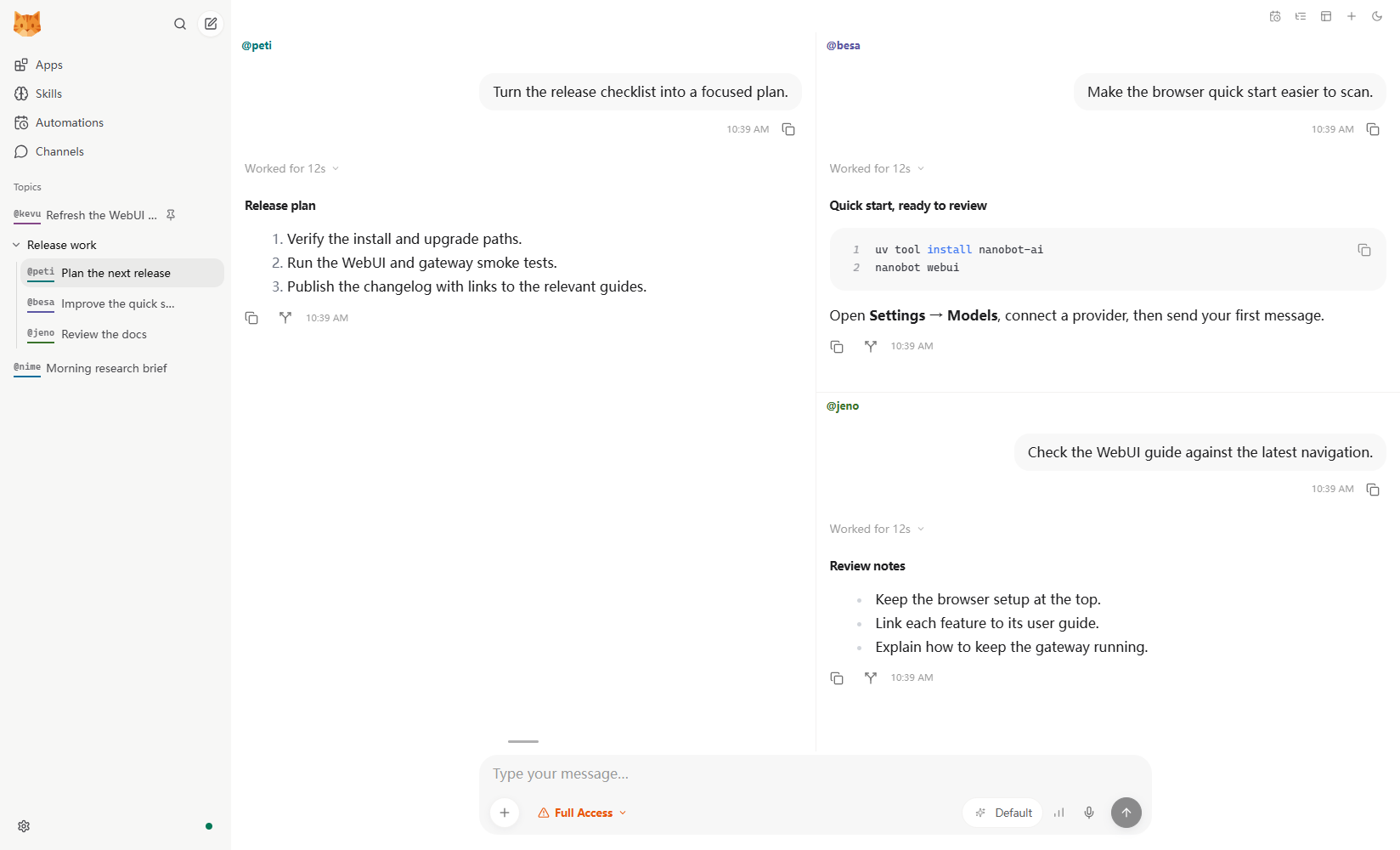
Your lightweight open-source personal agent.
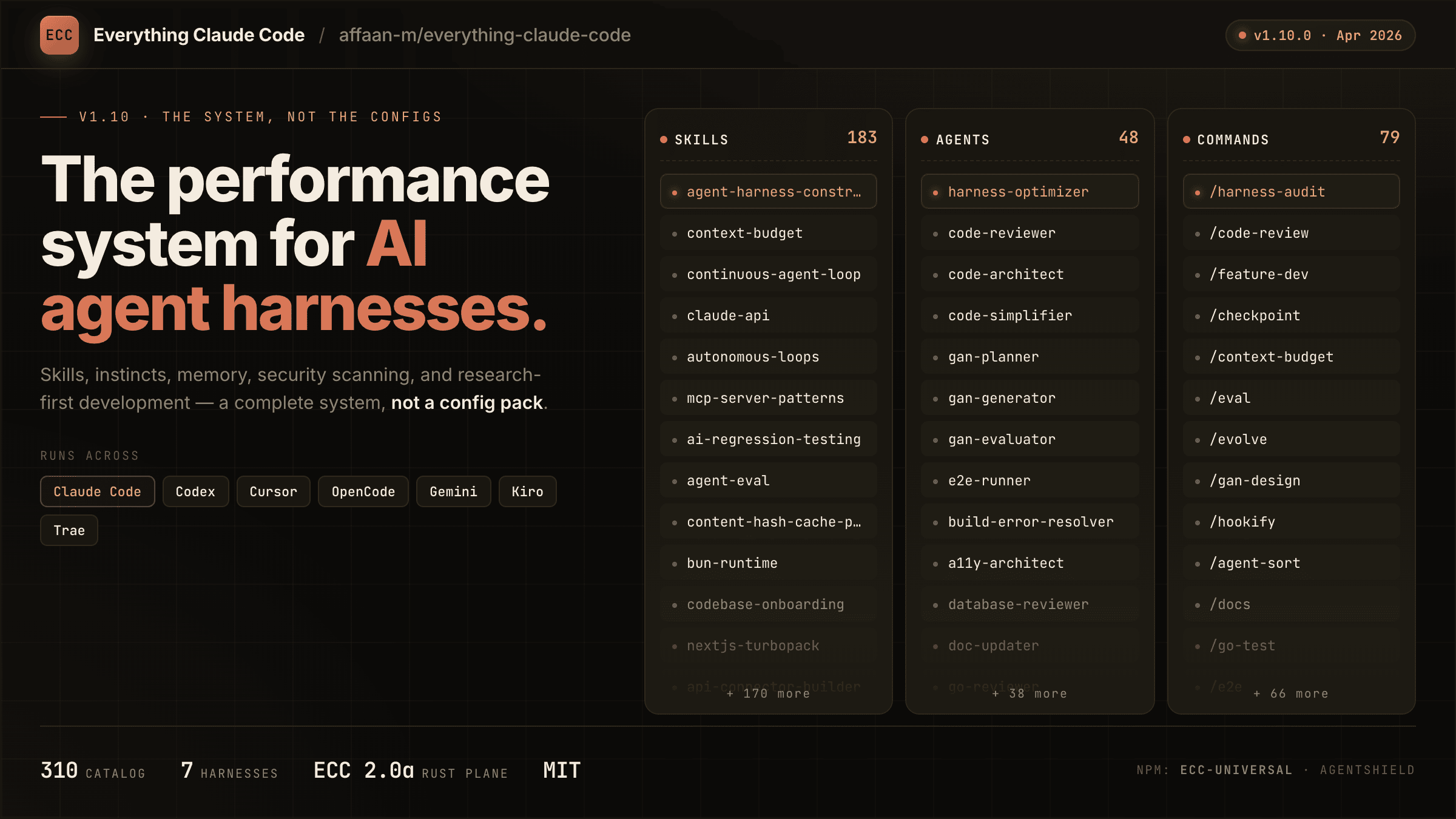
The agent harness performance optimization system. Skills, instincts, memory, security, and research-first development for Claude Code, Codex, Opencode, Cursor and beyond.
Reverse engineer anything with agents, from app behavior down to native binaries.
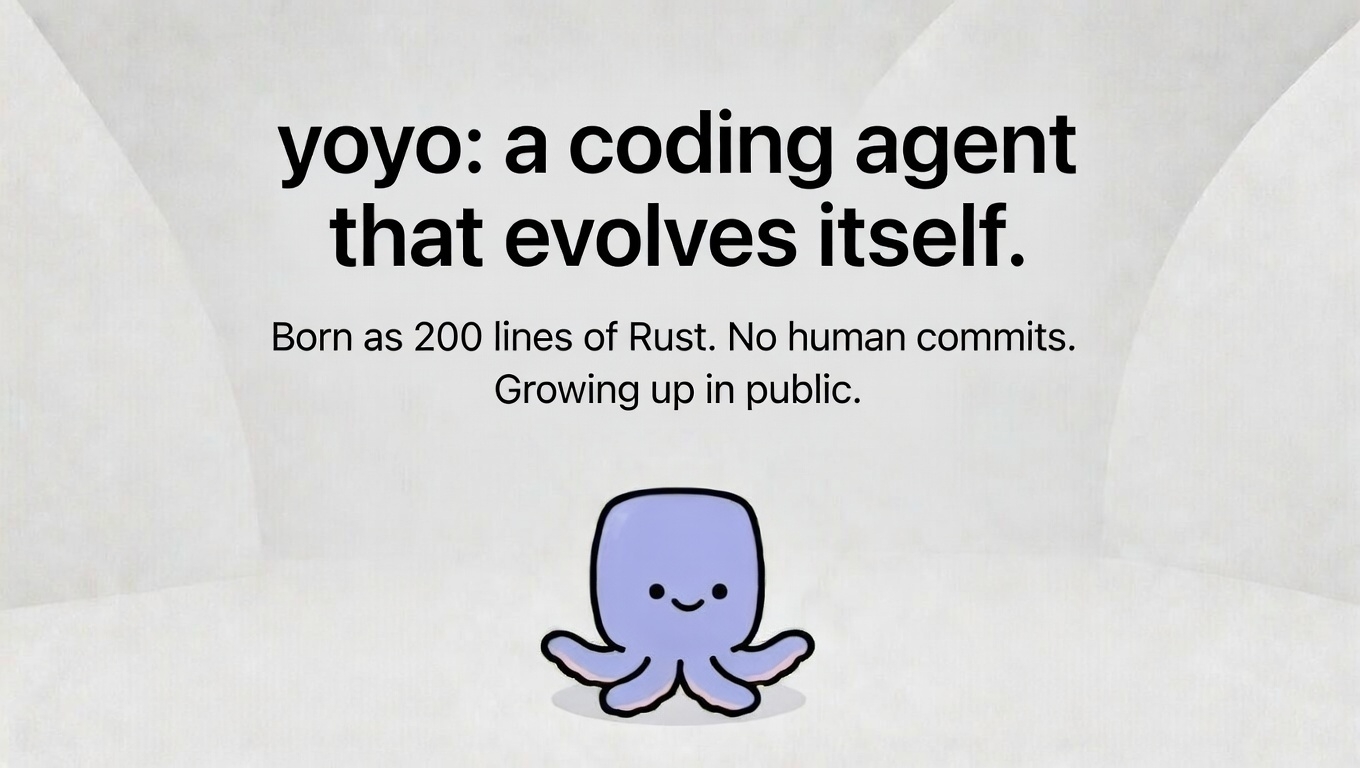
A coding agent that evolves its own source, in public — 200 lines of Rust on day one, every commit since agent-written and tests-gated.
This repo IS yoyo 🐙 — the self-evolving agent's portable state per GASP: identity, skills, memory, and the append-only event log of its life. Clone + fold = yoyo, restored.
GASP — the Git Agent State Protocol: a standard for portable agent state. The repo is the agent.