Market-Basket-Analysis
Association rule mining is a technique to identify underlying relations between different items.
- 71
- Jupyter Notebook
- 7 y ago
Association rule mining is a technique to identify underlying relations between different items.
Unsupervised ML algorithm for predictive modeling and time-series analysis
All codes, both created and optimized for best results from the SuperDataScience Course
Comparison of Apriori and FP-Growth Algorithm in accuracy metrics, execution time and memory usage for a prediction system of dengue.
This repository is created to represent the processing and the analysis that has been done on this online retail dataset.
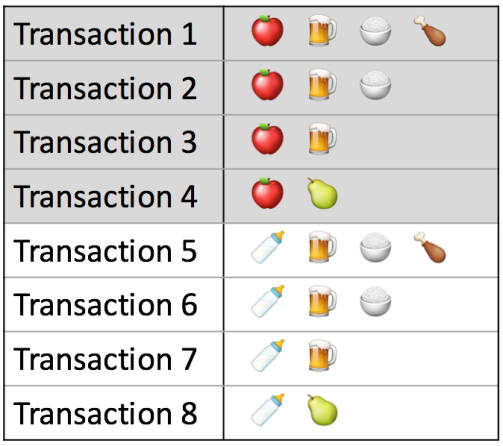
Market Basket Analysis What is it? Market Basket Analysis is a modelling technique based upon the theory that if you buy a certain group of items, you are more (or less) likely to buy another group of items. For example, if you are in an English pub and you buy a pint of beer and don't buy a bar meal, you are more likely to buy crisps (US. chips) at the same time than somebody who didn't buy beer.
Implementation scripts of Machine Learning algorithms on Scikit-learn and Keras for complete novice..
This repository contains the three-part capstone project made for the DTU Data Science course 02450: Introduction to Machine Learning and Data Mining
Finding Association Rules between Location, Crime Type and Crime Outcome of Crime in England
The purpose of this project is to recommend personalized products for segments by finding product associations.
Used association ruling to find out which products were frequently bought together. Aim is to drive higher sales volume and customer retention.
🚀 A hands-on AI/ML playground 🤖📊 — from NumPy, Pandas & Matplotlib basics to Supervised ML (Regression, Classification, SVM, Random Forest) and Unsupervised ML (Clustering, Dim. Reduction, Association Rules). Real-world projects 🛒📈 with rich visual outputs 🎨 — AI made practical.
Market Basket Analysis is one of the key techniques used by large retailers to uncover associations between items. It works by looking for combinations of items that occur together frequently in transactions. To put it another way, it allows retailers to identify relationships between the items that people buy.