leedl-tutorial
《李宏毅深度学习教程》(李宏毅老师推荐👍,苹果书🍎),PDF下载地址:https://github.com/datawhalechina/leedl-tutorial/releases
- 17k
- Jupyter Notebook
- 4 wk ago
A benchmark of different approaches on the task of Intent Classification
Repo AlexandreSajus/Intent-Classification, read from GitHub 11 min ago. AlexandreSajus has not joined Take My Repo.
AlexandreSajus/Intent-Classification is a public repo on GitHub by AlexandreSajus. A benchmark of different approaches on the task of Intent Classification. It declares the GPL-3.0 license on GitHub. It is written mainly in Jupyter Notebook, has 5 stars and last changed on 2023-04-04. Nobody has reviewed it on Take My Repo yet, which says nothing about its quality. Read from GitHub on 2026-11-22.
A benchmark of different approaches on the task of Intent Classification on the Hugging Face Silicone Maptask dataset:
| Approach | Model | Performance (Test Accuracy) | Pros | Cons |
|---|---|---|---|---|
| Human | Manual Labelling | 54.1% | Generally correct | Takes time |
| Training from Scratch | LSTM | 61.0% | Low resource cost | Not the best model |
| Fine-Tuning | BERT | 63.4% | Best model | High resource cost |
| Prompting | GPT-4 | 43.3% | Automated with no training required | Expensive, Low perfomance |
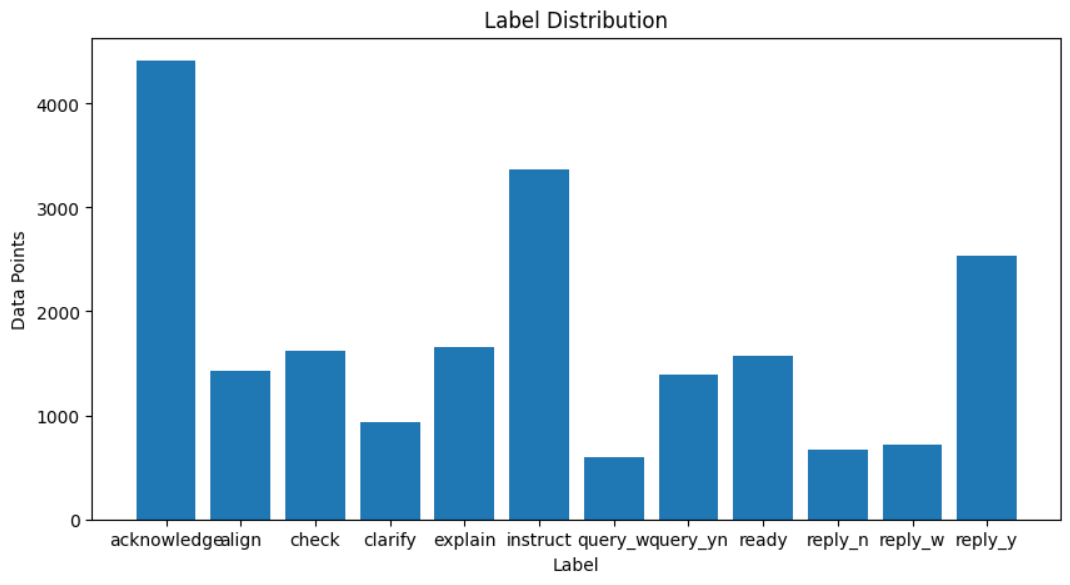
The dataset has 12 labels:
| Label | Example |
|---|---|
| acknowledge | uh-huh |
| align | okay |
| check | on the right-hand side roughly just |
| clarify | right beside it |
| explain | i've got a gallows to the left like d-- below the left |
| instruct | okay the start part is at the top left-hand corner |
| query_w | how far underneath the diamond mine |
| query_yn | do you have a diamond mine there |
| ready | well |
| reply_n | no |
| reply_w | no i haven't got that |
| reply_y | uh-huh |
The label distribution is not too imbalanced which means that accuracy is still a useful metric to use. We will also use confusion matrixes to make sure that some labels are not forgotten by our models.
The human accuracy is at 54.1% (13/24 examples correct)
Measuring this metric was done by guessing 24 labels for 24 utterances by only using for reference 3 labelled examples per label.
The logs of the expermiment are available at human_level_perf.txt
This sets a baseline performance and highlights challenges when predicting these labels: some labels are very similar
In this part we train a simple LSTM model on the task:
_________________________________________________________________
Layer (type)                 Output Shape              Param #
=================================================================
embedding (Embedding)        (None, None, 128)         3906816
_________________________________________________________________
bidirectional (Bidirectional (None, None, 512)         788480
_________________________________________________________________
dropout (Dropout)            (None, None, 512)         0
_________________________________________________________________
bidirectional_1 (Bidirection (None, 512)               1574912
_________________________________________________________________
dropout_1 (Dropout)          (None, 512)               0
_________________________________________________________________
dense (Dense)                (None, 256)               131328
_________________________________________________________________
dropout_2 (Dropout)          (None, 256)               0
_________________________________________________________________
dense_1 (Dense)              (None, 12)                3084
=================================================================
Total params: 6,404,620
Trainable params: 6,404,620
Non-trainable params: 0
_________________________________________________________________
Training for 20 epochs results in the following accuracy plot:
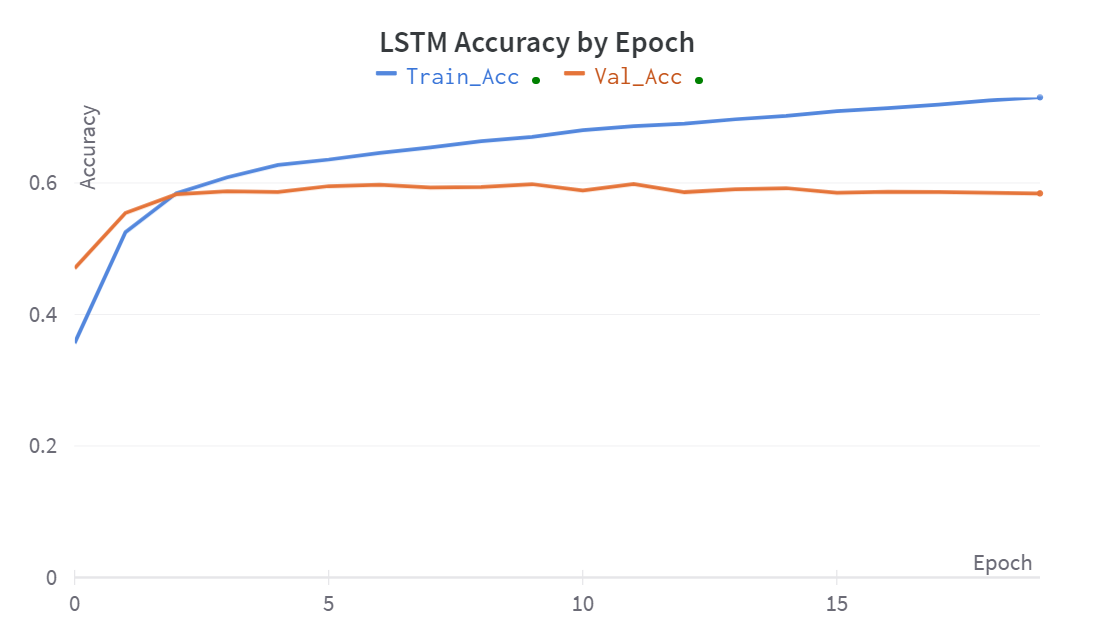
We see that even with Dropout, the model suffers from overfitting.
The best LSTM model results in a 61.0% test accuracy
Which beats the human baseline and has the following confusion matrix:
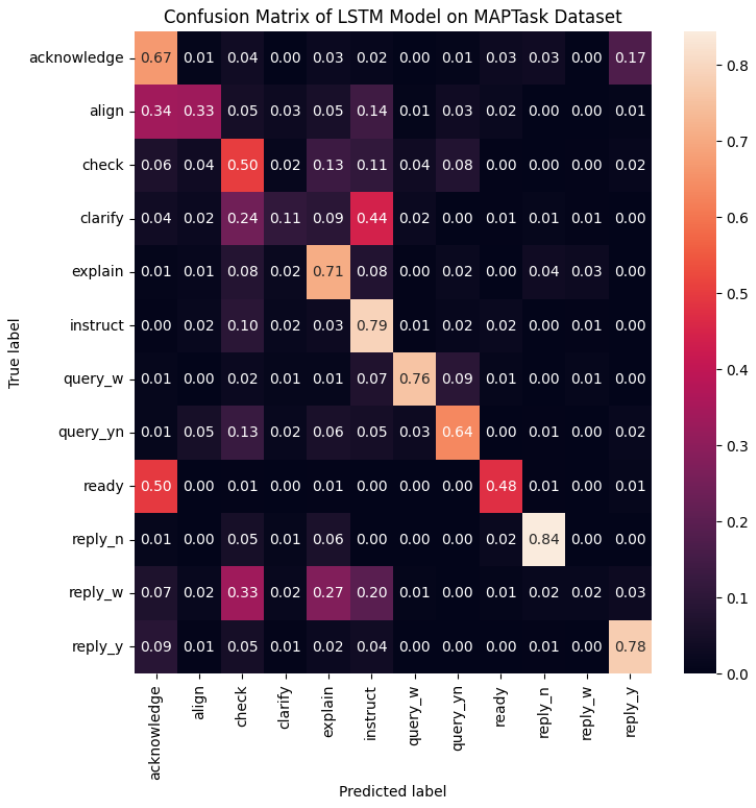
As expected from the HLP experiment, the model makes most of its mistakes on labels that are very similar even for a human:
ready and acknowledgecheck and clarifyIn this part, we fine-tune a BERT model on this classification task:
__________________________________________________________________________________________________
 Layer (type)                   Output Shape         Param #     Connected to
==================================================================================================
 input_ids (InputLayer)         [(None, 124)]        0           []

 attention_mask (InputLayer)    [(None, 124)]        0           []

 tf_bert_model (TFBertModel)    TFBaseModelOutputWi  108310272   ['input_ids[0][0]',
                                thPoolingAndCrossAt               'attention_mask[0][0]']
                                tentions(last_hidde
                                n_state=(None, 124,
                                 768),
                                 pooler_output=(Non
                                e, 768),
                                 past_key_values=No
                                ne, hidden_states=N
                                one, attentions=Non
                                e, cross_attentions
                                =None)

 global_max_pooling1d (GlobalMa  (None, 768)         0           ['tf_bert_model[0][0]']
 xPooling1D)

 dense (Dense)                  (None, 256)          196864      ['global_max_pooling1d[0][0]']

 dropout_37 (Dropout)           (None, 256)          0           ['dense[0][0]']

 dense_1 (Dense)                (None, 12)           3084        ['dropout_37[0][0]']

==================================================================================================
Total params: 108,510,220
Trainable params: 108,510,220
Non-trainable params: 0
__________________________________________________________________________________________________
The model takes much longer to train and takes a lot of GPU memory, but results converge at only 5 epochs.
The best BERT model results in a 63.4% test accuracy
Which is better than both the human baseline and the LSTM model. The confusion matrix is as follows:
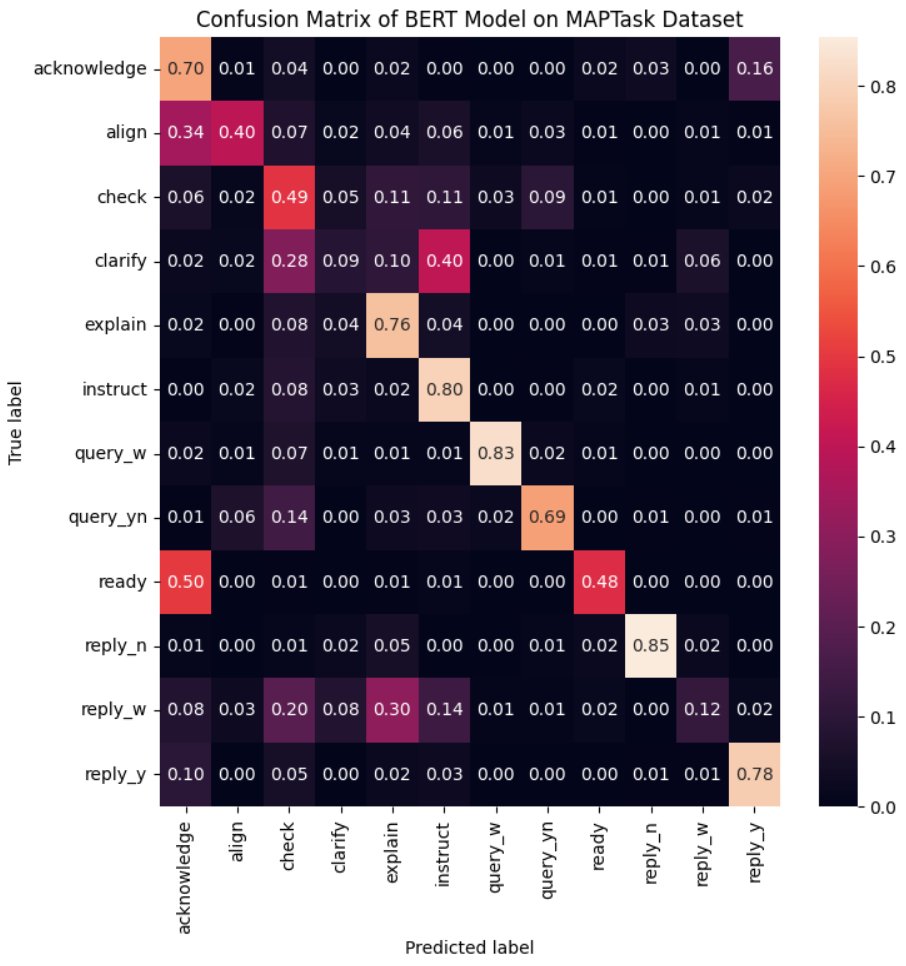
Here we see very similar results to the LSTM model, with the same mistakes being made.
In this part we take a completely different approach and simply prompt GPT-4 on the task by giving him a few labelled examples and asking him to annotate a batch of test data.
We do this by giving him this first prompt with 5 example sentences per label so it understands the task at hand:
Your job is to classify sentences according to 12 categories:
acknowledge, align, check, clarify, explain, instruct, query_w, query_yn, ready, reply_n, reply_w, reply_y

Here are some examples for each label:
acknowledge: uh-huh
align: okay
check: on the right-hand side roughly just
clarify: right beside it
explain: i've got a gallows to the left like d-- below the left
...
We then ask him to classify a batch of test sentences and gather its predictions:
Now classify the following sentences:
0. start at the extinct volcano
1. go down around the tribal settlement and then
2. whereabouts is the tribal settlement
3. it's at the bottom it's to the left of the e-- extinct volcano
4. right
5. how far
6. ehm at the opposite side
7. to the opposite side
Prompting GPT-4 results in a 43.3% test accuracy
This underperforms all of our previous models but is still impressive considering:
The predictions have the following confusion matrix:
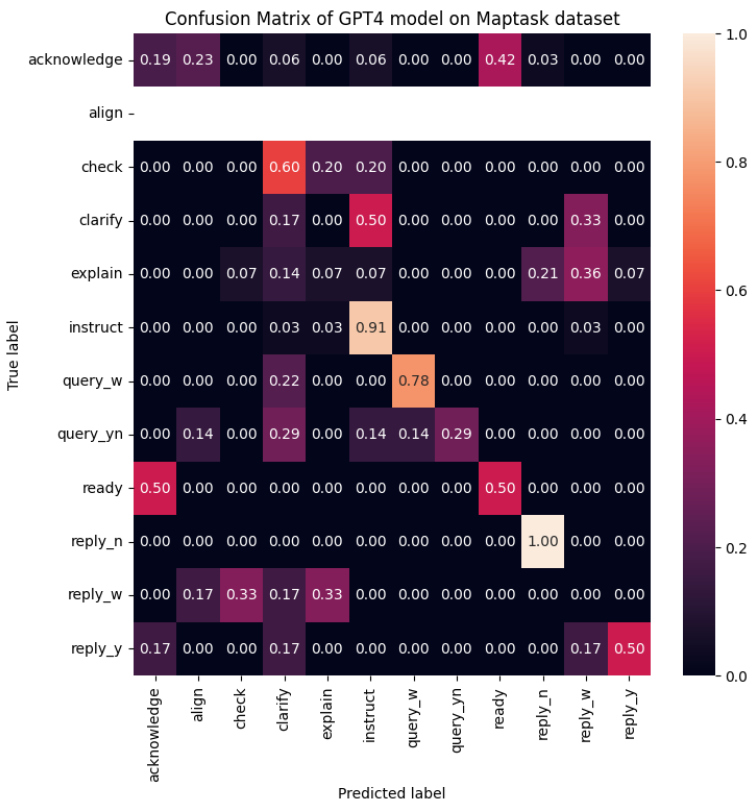
GPT-4 does expected mistakes like confusing ready and acknowledge but also unexpected ones like failing to annotate reply_w sentences.
Note: align was not present in the test dataset since we sampled only 120 test sentences for budget purposes (this experiment cost about 0.50$)
AlexandreSajus/Intent-Classification is a public repo on GitHub by AlexandreSajus. A benchmark of different approaches on the task of Intent Classification.
It declares the GPL-3.0 license on GitHub.
Its maker has not tagged a system, so it is unknown here. Its README says what it needs.
Open "Take it" on its page: Take My Repo writes an install plan for your machine and hands it to your AI agent (Claude Code, Codex or Cursor), which asks you before each step. Take My Repo has not tested it on any machine.
Its last change on GitHub was on 2023-04-04. Take My Repo does not judge from that whether it is maintained.
Nobody has reviewed it on Take My Repo yet, which says nothing about its quality.
《李宏毅深度学习教程》(李宏毅老师推荐👍,苹果书🍎),PDF下载地址:https://github.com/datawhalechina/leedl-tutorial/releases
Local UI to run and train LLMs and diffusion models. Supports GGUF, MLX, Qwen3.8, DeepSeek-V4.1, MiniMax-H3, Gemma 4, FLUX and more.
f.k.a. Awesome ChatGPT Prompts. Share, discover, and collect prompts from the community. Free and open source — self-host for your organization with complete privacy.
An open source library for deep learning end-to-end dialog systems and chatbots.
🤗 Transformers: the model-definition framework for state-of-the-art machine learning models in text, vision, audio, and multimodal models, for both inference and training.
Your own personal voice assistant: Voice to Text to LLM to Speech, displayed in a web interface
Controlling a Rigidbody Quadcopter using Control Theory and Reinforcement Learning
A 2D Python Implementation of Smoothed Particle Hydrodynamics
An Implementation of Smoothed Particle Hydrodynamics in Unity
A simple discrete ecosystem model in Python illustrating prey-predator systems and natural selection