playwright
Playwright is a framework for Web Testing and Automation. It allows testing Chromium, Firefox and WebKit with a single API.
- 101k
- TypeScript
- Apache-2.0
- 1 d ago
🧩 Plugins and extractors that ArchiveBox + abx-dl use: chrome, ytdlp, wget, singlefile, readability, forum-dl, gallery-dl, papers-dl, and more...
Repo ArchiveBox/abx-plugins, read from GitHub 1 min ago. ArchiveBox has not joined Take My Repo.
ArchiveBox/abx-plugins is a public repo on GitHub by ArchiveBox. 🧩 Plugins and extractors that ArchiveBox + abx-dl use: chrome, ytdlp, wget, singlefile, readability, forum-dl, gallery-dl, papers-dl, and more... It declares the MIT license on GitHub. It is written mainly in Python, has 20 stars and last changed on 2026-11-22. Nobody has reviewed it on Take My Repo yet, which says nothing about its quality. Read from GitHub on 2026-11-22.
ArchiveBox-compatible plugin suite (hooks and config schemas).
This package contains standalone plugin hook scripts and config schemas. A hook
can be run directly as a CLI; runners such as abx-dl
and archivebox add orchestration,
environment setup, and cache projection around the same scripts.

Tools like abx-dl and ArchiveBox can discover plugins from this package
without symlinks or environment-variable tricks.
Each plugin lives under plugins/<name>/ and may include:
config.json config schemaconfig.json > screenshot points to a plugin-owned JSON recipe, such as "screenshot": "screenshot.json"config.json: category, display_order, hidden, and x-auto-run (set false for hooks that require explicit host selection)snapshot_thumbnail_cards declarations in config.json identify ArchiveResult names whose existing card.html may represent a snapshot in list and grid views, with an explicit ordersnapshot_output_group, snapshot_output_order, snapshot_display_name, archive_result_aliases, default_output_path, icon_hidden, card_hidden, card_interactive, output_extension_preference, presentation_module, and boolean snapshot_<role> declarations such as snapshot_list_icon, snapshot_primary_preview, and snapshot_title_source; hosts consume these declarations generically while plugin templates and presentation modules retain the rendering behaviorchrome/navigation.json artifact to select the recorded final navigation for the requested URL. Missing, malformed, unrelated, or unrecorded navigation metadata preserves selection from the WACZ page index alone.ARCHIVEWEBPAGE_STRIP_COOKIES=true: the native recorder cookie policy omits request Cookie and its x-wabac-preset-cookie replay copy. A guarded pinned-extension correction removes Cookie from the actual serialized header dictionary. Policy is snapshot-local, including inherited child recorders; concurrent captures cannot change each other through global extension settings. Set it to false only to intentionally retain cookies. In ArchiveBox, choose this setting in the persona editor’s ArchiveWeb.page plugin settings; the stored Persona.config override is {"ARCHIVEWEBPAGE_STRIP_COOKIES": false}. Persona-owned plugin overrides remain live unless a crawl or snapshot explicitly overrides them. Standalone abx-dl accepts the same setting through its normal runtime config/environment; selecting a persona directory alone does not load ArchiveBox’s persona database settings. Live authentication and persona cookies are unchanged. This is not general secret sanitization: response Set-Cookie, Authorization, URLs, bodies and browser storage may still contain secrets. It does not clean existing archives.Object.prototype.__proto__ accessor. Only served worker bytes change; installed extension and archive bytes remain intact. Updating that dependency requires reviewing the worker hash and the three exact prototype-lookup replacements in presentation.py, then passing native replay Storage tests.responses/index.jsonl when native MHTML omits them. Native MIME parts take precedence; missing/malformed metadata or different font bodies for one URL leave the native preview unchanged. Downloaded MHTML bytes are never rewritten.Retry-After (seconds or HTTP date), or a 60-second cooldown when that hint is absent or invalid. The existing CHROME_TIMEOUT still bounds the entire navigation: a cooldown that cannot fit is never shortened and the response is reported as failed. POST responses, access challenges, and other HTTP errors are not retried. Browser identity remains unchanged. chrome/navigation.json preserves the HTTP status, attempt count, and failure reason; completed HTTP error pages are not reported as successful navigation.UseLevelDbForNewStores rollout stage. Chromium's SQLite key-path encoding turns one-element array key paths into strings after a browser restart, corrupting both object-store and index schemas. New origin databases use LevelDB; existing SQLite databases remain accessible. Disabling the rollout entirely would hide existing SQLite state in Chrome 157. This setting does not repair metadata already persisted incorrectly.config.json > required_binaries binary dependency declarations (optional)on_CrawlSetup__... crawl setup hook scripts (optional) - shared setup/process startup, emit no stdout JSONL recordson_Snapshot__... per-snapshot hooks - emit ArchiveResult and may also emit Snapshot / TagArchiveBox templates that need sibling output manifests should bind
{% snapshot_results snapshot 'responses,wget' as captures %} after
{% load core_tags %}, then reuse captures across their loops. The host selects
only the named plugins' manifests or reuses already-prefetched results; it does
not load every result's fields and files for each loop. This works in live cards
and static exports.
Hooks run with:
.).)SNAP_DIR/<plugin>/...CRAWL_DIR/<plugin>/...../<other-plugin>/... from your own output dirGit captures acquire a fresh shallow repository, all branch tips, and recursive
submodules in TMP_DIR/git/<hash of SNAP_DIR>/repo before replacing the saved
checkout. A failed acquisition preserves previous output. A local OS lock is
inherited by Git processes so an interrupted hook cannot leave a live child whose
scratch is deleted by another attempt. The next attempt discards only its own
abandoned scratch; it does not repair saved Git locks or resume a transaction.
This temporarily needs space for one additional repository/checkout. Publication
preserves runner sidecars, removes obsolete repository files, and reports copy
failures as failures. The saved layout remains git/.
Plugins may depend on other plugins through required_plugins. Plugin code must
not import or require archivebox or abx-dl.
config.json key |
Contract |
|---|---|
commands |
Command name → [relative executable, ...arguments]; JSON input/output follows the command's contract. |
output_str_type |
"path" (default) or "text"; text results never identify output files. default_output_path identifies their saved artifact. |
default_output_path |
Saved filename relative to the plugin output directory. |
archive_result_aliases |
List of historical ArchiveResult plugin names owned by this plugin. |
snapshot_output_group, snapshot_output_order, snapshot_display_name |
Card group (html, article_text, images, embedded_media, metadata, other), integer order, and label. |
snapshot_thumbnail_cards |
List of {archive_result_name, order} entries selecting existing card templates for list/grid previews. |
icon_hidden, card_hidden, card_interactive |
Hide icons, hide cards, or allow interactive cards respectively; booleans default to false. |
output_extension_preference |
Ordered lists of equivalent file extensions, e.g. [[".html", ".htm"], [".txt"]]. |
snapshot_<role> / snapshot_<role>_order |
Boolean participation and integer priority (default 0, lower first, then plugin name). Roles include list_icon, primary_preview, title_source, html_replay, live_preview, file_inventory. |
snapshot_live_preview_route |
Registered Django URL name accepting snapshot_id. |
replay_assets |
Format → relative asset paths; an export uses one provider's complete bundle. |
replay_document_patterns |
MIME type → snapshot-relative path globs handled by rewrite_replay_document. |
search_order, search_fallback, search_scan |
Integer priority (default 1000), fallback eligibility, filesystem-scan flag (both default false). |
presentation_module |
Importable module providing the presentation functions below. |
app_module |
Importable app.py providing optional native application functions below; import must not require Django setup. |
agent_tools |
{scope, binaries, environment?}; environment is module:function(endpoint, binaries) -> dict[str, str]. |
agent_skills |
Section name → relative Markdown file, selected by agent_tools.scope. |
Presentation metadata is validated when ArchiveBox loads the plugin catalog. Presentation functions are optional:
template_context(slot, context) -> dict: additional template context. Snapshot details supply plain url, title, output_dir, output_files, and ordered primary_preview_plugins.extra_snapshot_output_cards(outputs) -> list[dict]: output records include output_files metadata, without model instances.serve_replay_asset_response(path, config, response_factory) -> response | None.render_full_response(filename, output_path, *, source_path=None, replay_base, fallback_url="", last_modified="", etag="", cache_control="", content_encoding="") -> (body, content_type, headers) | None. A source etag enables persistent replay payload caching and reuse of parsed WACZ metadata; changing it invalidates both. It must not be returned as the generated viewer HTML's ETag.rewrite_replay_document(text, *, snapshot_root, rel_path, content_type, page_url=None, replay_url=None, source_text=None) -> (text, replacement_count).replay_roots(snapshot_root, url) -> list[str] | tuple[str, ...]: relative directories inside the snapshot.Application functions are optional. host implements
base.host.Host; it supplies configuration,
authorized records, request handling, and collection CLI command arguments.
host.capture_context(request, *, snapshot_id=None, crawl_id=None) requires
exactly one ID and checks access before returning output_dirs and tmp_dir.
Snapshot context also includes id, url, title, crawl_id, and tags.
| Function | Return value |
|---|---|
get_urlpatterns(host) |
Native Django URL patterns. |
get_websocket_views(host) |
URL name → ASGI callable (scope, receive, send). |
get_api_routers(host) |
(prefix, ninja.Router) pairs. |
get_cli_commands(host) |
Native Click commands mounted at archivebox plugin <plugin> <command>. |
get_services(host, config) |
Service dictionaries described below. |
read_snapshot_inventory(snapshot_dir, *, verify=False) |
None when absent, otherwise {path: {size, hash, is_dir}}; invalid inventories raise ValueError. |
app.py may export AppConfig, a native Django AppConfig subclass with a unique
label. The host installs it at startup; models, migrations, management commands,
and ready() use standard Django behavior. Register signals and logging filters
there. App registration is independent of hook enable flags.
Call abx_plugins.plugins.base.django.register_webhooks(model, *, events=None, status_events=None)
from AppConfig.ready() to register CRUD webhooks. events maps event names to
options (label, icon, color, section, blocking);
status_events maps saved status values to declared events. These use the model's
webhook_events and webhook_status_events attributes. Emit an explicit event with
webhook_event.send(sender=Model, instance=instance, event="READY", **metadata) from the same module.
Payloads use the existing serializer and optional model.webhook_data() method.
Services require name, label, and prepare() -> supervisor_worker_dict.
Optional fields: ready() -> bool, bind: (host, port), process_name,
identity: list[str], and contexts: list[str] (default
["server", "runner", "command"]). The prepared worker keeps the declared name.
templates/<slot>.html contributes UI through {% plugin_ui slot %};
{% plugin_ui plugin slot %} selects one plugin. Collection slots: navigation,
add, importers_actions, importer_sessions, snapshot_head.
Output slots: icon, card, full. Static assets stay inside the plugin.
Templates and template_context receive the existing context, including Django
models and request when supplied by the view.
ArchiveBox renders the existing config.json properties as searchable plugin
settings on /add/ and Persona admin. No extra manifest is needed. A field can
replace its presentation through templates/config/<EXACT_CONFIG_KEY>.html:
{% extends "plugins/config_field.html" %}
{% block label %}Image size{% endblock %}
{% block widget %}{% include "plugins/config_resolution.html" %}{% endblock %}
{% block help %}Choose a preset or enter width,height in pixels.{% endblock %}
The template receives plugin and field (key, input_name, value, label,
description, minimum, maximum, options). Without an override, the shared renderer
handles booleans, enums, numbers, strings, secrets, and JSON. Keep the canonical
control's name="{{ field.input_name }}", id="id_{{ field.input_name }}",
class="plugin-config-input", and data-config-key="{{ field.key }}" so existing
validation, Persona defaults, and saving continue to work. Presentation templates
do not change the schema or persisted key/value shapes.
Shared controls include plugins/config_range.html (pass unit, low, high,
and step), plugins/config_resolution.html, and plugins/config_editor.html.
The editor extends the field template with language and snippets blocks;
buttons with data-config-insert insert text at the cursor. Add
data-config-position="start" for a guard before existing code, or use
data-config-wrap with an __SCRIPT__ placeholder to wrap the existing script.
data-config-source reads a sibling field into an __VALUE__ placeholder as a
quoted string (useful for routing prompts by domain). See Puppeteer's script
and Autosummary's prompt templates for working examples. Editors submit ordinary
strings; snippets are inserted only when selected.
Command contracts:
browser-open: stdin {config, persona_dir, name?, headless?, collection_dir?}; emits a JSON readiness record with ready and browser_pid.browser-export-state: stdin {config, user_data_dir?, cdp_url?, profile_dir?, browser_binary?, cookies_output_file?, auth_output_file?}; exports selected browser state.browser-profile: stdin {action: "copy" | "import", source_dir, destination_dir, profile_dir?} or {action: "prepare", persona_dir, source_dir?, name?, browser_binary?}; stdout {path}. Paths are absolute; import requires profile_dir and normalizes it to Default.configure-gallery: stdin {model, config, data_dir}; stdout {configured: bool}.recover: stdin {config, paths}; stdout {processes_orphaned: nonnegative int}. Recovery uses installed tools and preserves live owners.deduplicate: stdin {root, files: [{path, hash, size}]}; emits {type: "DeduplicateResult", schema_version: 1, supported_platform, attempted_files, extent_bytes_verified, failed_files, error?}.Plugins need no screenshot registration. ArchiveBox captures the selectable outputs
of its default example snapshot at desktop, tablet, and mobile sizes. The marketplace
automatically uses snapshot-view-<plugin-name>-<profile>.png (underscores become
hyphens). Enabled plugins with visible output templates must appear in the gallery.
For a plugin that needs a different source, add "screenshot": "screenshot.json"
to its config.json and keep the recipe beside it:
{
  "url": "https://news.ycombinator.com/item?id=41860909",
  "wait_for_text": "ArchiveBox is evolving: the future of self-hosted internet archives"
}
url overrides the default snapshot source. Every source runs the full capture
pipeline. config_overrides supplies plugin settings for that capture, such as a
script or agent prompt. output_plugin selects the saved output to photograph
(default: the recipe's plugin); preparation plugins can show the normal screenshot
output after their work. wait_for_text waits
inside that output's preview before taking the screenshots. Recipes sharing a URL
reuse one snapshot. An optional view selects an existing application gallery
view instead, such as "AI agent". With "config": true, view names a dedicated
screenshot of the plugin's expanded settings on Add URLs (see mobilesize).
Set "enabled": true to include an optional plugin in the default capture.
Ordinary plugins need no recipe.
The yt-dlp example uses a public HTML video demo so its gallery does not depend on YouTube allowing anonymous CI downloads. TLSNotary uses the small Example Domain response so the gallery can show a complete verified proof within its normal response-size budget. Both still require real successful captures.
Recipes travel in the plugin package. Neither website needs a plugin allowlist, and adding an example requires no workflow changes or separate screenshot job.
EXTRA_CONTEXT is an opaque JSON object used only by shared output emitters to
reflect correlation fields unchanged into JSONL records. Hooks must never read,
branch on, or extract values from it, including IDs. Required inputs belong in
explicit CLI arguments (e.g. --snapshot-id, --depth, --url) or filesystem
data. Unbounded archived content such as titles and tags belongs in files, not
environment variables or shell commands. Sonic reads snapshot metadata from
SNAP_DIR/index.jsonl; archived title text is available in title/title.txt.
SQLite and Sonic first index saved plain text/Markdown (including LiteParse/OCR),
extracted article HTML from Readability, Defuddle, Mercury and Trafilatura, and
native HTML document exports published under files/ with downloads.json.
Data URLs and long ASCII encoded blobs are stripped in bounded streaming reads
before any size thresholds are applied. Extracted text has a 5 MiB total budget.
If it supplies less than 10 KiB, raw HTML with less than 100 KiB of cleaned source
is used as a fallback, adding at most 256 KiB of text. HTML parsing itself is
bounded to 16 MiB of cleaned input per source and 64 MiB per snapshot. Sonic
snapshot metadata also has a 16 MiB cleaned-input bound before JSON decoding.
Search limits never modify the saved capture files.
LiteParse uses sharepoint-to-text for native Office, OpenDocument, CSV/TSV,
and RTF text extraction. Rendering those documents to temporary PDFs required
an entire office suite, even for plain CSV data. The small native extractor runs
under the existing per-document deadline and preserves real document units,
tables, and annotations in JSON; it does not fabricate PDF page geometry.
PDF/image parsing and ZIP-embedded image OCR continue through LiteParse.
Original files are unchanged. Legacy binary Office images are not rendered or
OCRed through this text-only path; modern ZIP-contained images retain the
existing independent OCR path.
SNAP_DIR - base snapshot directory (default: .)CRAWL_DIR - base crawl directory (default: .)TMP_DIR - local runtime storage for disposable files (defaults to the host runtime's temporary directory); live screencast frames stay here, with each snapshot isolated by its SNAP_DIR, and only explicitly retained frames saved under SNAP_DIR/chrome_screencast on shutdownABXPKG_LIB_DIR - binaries/tools root (default: ~/.config/abx/lib)PERSONAS_DIR - persona profiles root (default: ~/.config/abx/personas)ACTIVE_PERSONA - persona name (default: Default)Lifecycle:
config.json > required_binaries declares plugin dependencies.*_BINARY values from env, known local paths, and abxpkg provider state so hooks can run as standalone CLIs.abx-dl and ArchiveBox use abxpkg services/cache backends to prepare env/DB state, but hooks must not depend on those services being active.Optional min_version and max_version are inclusive bounds on acceptable
installed binaries. Set both to the same version for an exact requirement;
provider install_args alone select what to install and do not reject a
different binary already present on the host.
config.json declaration:
[
  {
    "name": "{YTDLP_BINARY}",
    "binproviders": "env,uv,brew,apt",
    "min_version": null,
    "overrides": {
      "uv": {
        "install_args": ["yt-dlp[default]"]
      }
    }
  }
]
Runners may project resolved binary metadata internally as BinaryEvent records shaped like:
{"type":"Binary","name":"yt-dlp","abspath":"/abs/path","version":"2025.01.01","sha256":"<optional>","binprovider":"pip","machine_id":"<recommended>","binary_id":"<recommended>"}Notes:
config.json > required_binaries.abxpkg.abxpkg owns the provider cache under ABXPKG_LIB_DIR; ArchiveBox may additionally project resolved binary events into DB machine_binary rows. Plugins and abx-dl stay unaware of both persistence layers.State/OS:
CRAWL_DIR/<plugin>/ABXPKG_LIB_DIR (e.g. npm prefix, pip venv, puppeteer cache)apt (Debian/Ubuntu), brew (macOS/Linux), and language/runtime-specific installers; many hooks currently assume POSIX paths
Lifecycle:
on_CrawlSetup__* runs before snapshot extraction; background setup hooks use their first stdout line as readiness and emit no stdout JSONL recordsCRAWL_DIR/chrome/extensions/<name>.extension.json with name, matching installed version, and a prepared unpacked_path. Chrome uses that copy only when the installed extension is selected and enabled; setup must leave the shared package cache unchanged.x-chrome-extension-load: on-demand in config.json. Chrome keeps the installed extension available and enables CDP extension loading, but the hook loads and unloads it around each capture.on_Snapshot__* runs once per snapshot; background hooks use their first stdout line as readiness and then may emit ArchiveResult, Snapshot, and Tag records onlywait_for_background_cleanup: true to flush and stop snapshot monitors before reading their outputs. Place these hooks after all capture hooks. Direct callers must finish and clean up producers before invoking them.State:
SNAP_DIR/<plugin>/../<plugin>/...Output records:
on_Snapshot__* should finish with an ArchiveResult record:{"type":"ArchiveResult","status":"succeeded|noresults|skipped|failed","output_str":"path-or-message"}Snapshot and Tag records may appear before the final ArchiveResultSemantics:
stdout: for background hooks, the first line is the readiness boundary; hook JSONL records may followstderr: diagnostics/logging0: succeeded, noresults, or skippedRules:
on_CrawlSetup__* hooks should communicate only through side effects such as files, sockets, long-lived processes, or the background readiness stdout line, not stdout JSONL recordson_Snapshot__* hooks should not emit Machine, Process, or Binary recordsThe base/ plugin provides shared Python and JS helpers that all other plugins import:
Python (base/utils.py):
from abx_plugins.plugins.base.utils import (
    load_config,
    emit_archive_result_record,
    emit_snapshot_record,
)
load_config() — load plugin config.json with env var + alias + fallback resolution, merged with shared base/common runtime vars like SNAP_DIR, CRAWL_DIR, ABXPKG_LIB_DIR, PERSONAS_DIR, EXTRA_CONTEXT, TIMEOUT, and USER_AGENTemit_archive_result_record(status, output_str) — print {"type":"ArchiveResult",...} JSONL to stdoutemit_snapshot_record(record) — emit {"type":"Snapshot",...} JSONL to stdoutwrite_text_atomic(path, content) — write file atomically (temp + rename)find_html_source(snap_dir, ...) — locate HTML from sibling pluginshas_staticfile_output(staticfile_dir="../staticfile") / hasStaticFileOutput() — check for a successful staticfile download; pending or failed downloads do not suppress other extractorsis_non_html_document(navigation_path="../chrome/navigation.json") / isNonHtmlDocument() — let HTML-only hooks skip a known non-HTML browser document. Chrome navigation records document.contentType before post-navigation hooks run; HTML and XHTML remain eligible. Missing, failed, or older navigation records leave extraction enabled. This does not depend on staticfile completion.enforce_lib_permissions() — lock down ABXPKG_LIB_DIR so snapshot hooks can read/execute but not writeJS (base/utils.js):
const { loadConfig, getEnv, getEnvBool, getEnvInt, getEnvArray, emitArchiveResultRecord, emitSnapshotRecord } = require('../base/utils.js');
loadConfig() — load plugin config.json merged with shared base/common runtime vars using env var + alias + fallback resolutionemitArchiveResultRecord(status, outputStr) — emit ArchiveResult JSONL to stdoutemitSnapshotRecord(record) — emit Snapshot JSONL to stdoutTest helpers (base/test_utils.py):
CI discovers every test_*.py automatically. Linux tests can use hosted or ugNAS
capacity by default. Genuine runner requirements belong in the first five lines
of the test file: # ci-runner: hosted keeps its normal OS assignment, while
# ci-runner: hosted-linux requires a hosted Linux runner (for example, Docker
integration tests). Add a comment explaining the requirement beside the header.
from abx_plugins.plugins.base.testing import (
    get_hook_script,
    parse_jsonl_output,
    run_hook,
)
parse_jsonl_output(stdout) — extract first matching JSONL record from hook stdoutrun_hook(hook_script, url, snapshot_id=None) — run a hook subprocess with explicit URL and optional snapshot ID argumentsget_hook_script(plugin_dir, pattern) — find hook script by glob patternNote: Use
sys.path.append()(notinsert(0, ...)) because thessl/plugin directory would shadow Python's stdlibsslmodule.
succeeded if they ran and produced outputnoresults if they ran but produced no meaningful output due to an expected runtime condition (e.g. git on a non-github url, ytdlp on a site with no media, paperdl on a site with no pdfs, or unavailable provider authentication/export permission)skipped only if config prevented execution (e.g. YTDLP_ENABLED=False)failed if any hard dependencies are missing/invalid (e.g. chrome), if the process exited non-0 / raised an unexpected exception, or for navigation, missing-control and invalid-content errorsoutput_str e.g. the page title, mimetype, return status code, or the relative path of the primary output file produced like output.pdf or 0 modals closed or The Page Title Verbatim or favicon.io or Not a git URLbg vs fg as the only programmatic hook distinction; words like daemon and finite in hook filenames are human hints onlyHooks emit plain JSONL records to stdout. The current hook families and records are:
on_CrawlSetup__* → background readiness line only, no stdout JSONL recordson_Snapshot__* → background readiness line when applicable, then ArchiveResult, Snapshot, Tagabx-dl and ArchiveBox map those records into their own internal event systems. Binary request events are produced from plugin config and handled by abxpkg, not by plugin hook scripts. Plugins do not need to know or emit any bus envelope format.
Parallel Tests remains the required release/cascade gate. Live authenticated
Canva, Figma, Miro and Substack acceptance runs independently in Live Provider Tests, scheduled every eight hours or started manually on main. Missing or
expired sessions and failed exports fail that workflow normally; they do not
turn into passing tests or block deterministic release checks.
Public iWork (Keynote, Pages and Numbers) acceptance also runs in that workflow,
in a separate hosted job with no provider credentials. Other public and local
plugin tests remain in Parallel Tests. Test files declare ci-environment: provider-capture or ci-environment: provider-public in their first five lines;
the matrix verifies that every discovered test file is assigned exactly once.
Authenticated jobs retain the protected provider-capture environment and
required runner placement. Documentation checks remain their existing separate
scheduled/manual workflow.
Article/text extractors can reuse archivewebpage/archivewebpage.wacz when no
DOM, SingleFile, or Wget HTML is available. This is offline HTTP response HTML,
not a reconstructed JavaScript DOM. Selection requires the requested URL's latest
indexed GET response, follows only recorded HTTP redirects (at most four), and
never substitutes an incidental page or iframe. Original captures are unchanged.
The bounded reader currently supports indexes/index.cdx or concatenated-gzip index.cdx.gz, ZIP-stored gzip
WARC members, and SHA-256 recordDigest entries. It checks selected-record digest,
gzip CRC, WARC integrity, HTTP status and HTML MIME type. Revisit records, encoded HTTP bodies, missing matching responses and unsupported/corrupt captures yield no
input, without fetching the live site. Limits: 256 MiB archive, 1024 ZIP members,
8 MiB index, 16 MiB compressed record/individual ZIP metadata read, 32 MiB expanded
record/decoded HTML, with a cooperative 10-second processing deadline. Extractors
retain their existing overall timeouts. A consumer-local hidden input file avoids
races between extractors and does not modify the archived WACZ.
ArchiveBox/abx-plugins is a public repo on GitHub by ArchiveBox. 🧩 Plugins and extractors that ArchiveBox + abx-dl use: chrome, ytdlp, wget, singlefile, readability, forum-dl, gallery-dl, papers-dl, and more...
It declares the MIT license on GitHub.
Its maker tagged it for macOS, Windows and Linux, or as Docker or cross-platform. That is declared by the maker; Take My Repo has not tested it.
Open "Take it" on its page: Take My Repo writes an install plan for your machine and hands it to your AI agent (Claude Code, Codex or Cursor), which asks you before each step. Take My Repo has not tested it on any machine.
Its last change on GitHub was on 2026-11-22. GitHub counts 20 open issues and pull requests. Take My Repo does not judge from that whether it is maintained.
Playwright is a framework for Web Testing and Automation. It allows testing Chromium, Firefox and WebKit with a single API.
Nobody has reviewed it on Take My Repo yet, which says nothing about its quality.
12 weeks, 26 lessons, 52 quizzes, classic Machine Learning for all
Bring data to life with SVG, Canvas and HTML. :bar_chart::chart_with_upwards_trend::tada:
📢 Fast multi-language Event Bus library for Python/TS/Golang/Rust with support for advanced concurrency control features, nested event tracking, type enforcement, bridges to other backends, and more...
🗃 Open source self-hosted web archiving. Takes URLs/browser history/bookmarks/Pocket/Pinboard/etc., saves HTML, JS, PDFs, media, and more...
🖥️ Official ArchiveBox browser extension: automatically/manually preserve your browsing history using ArchiveBox.
😇 A Docker Compose bundle to run on servers with spare CPU, RAM, disk, and bandwidth to help the world. Includes Tor, ArchiveWarrior, BOINC, and more...
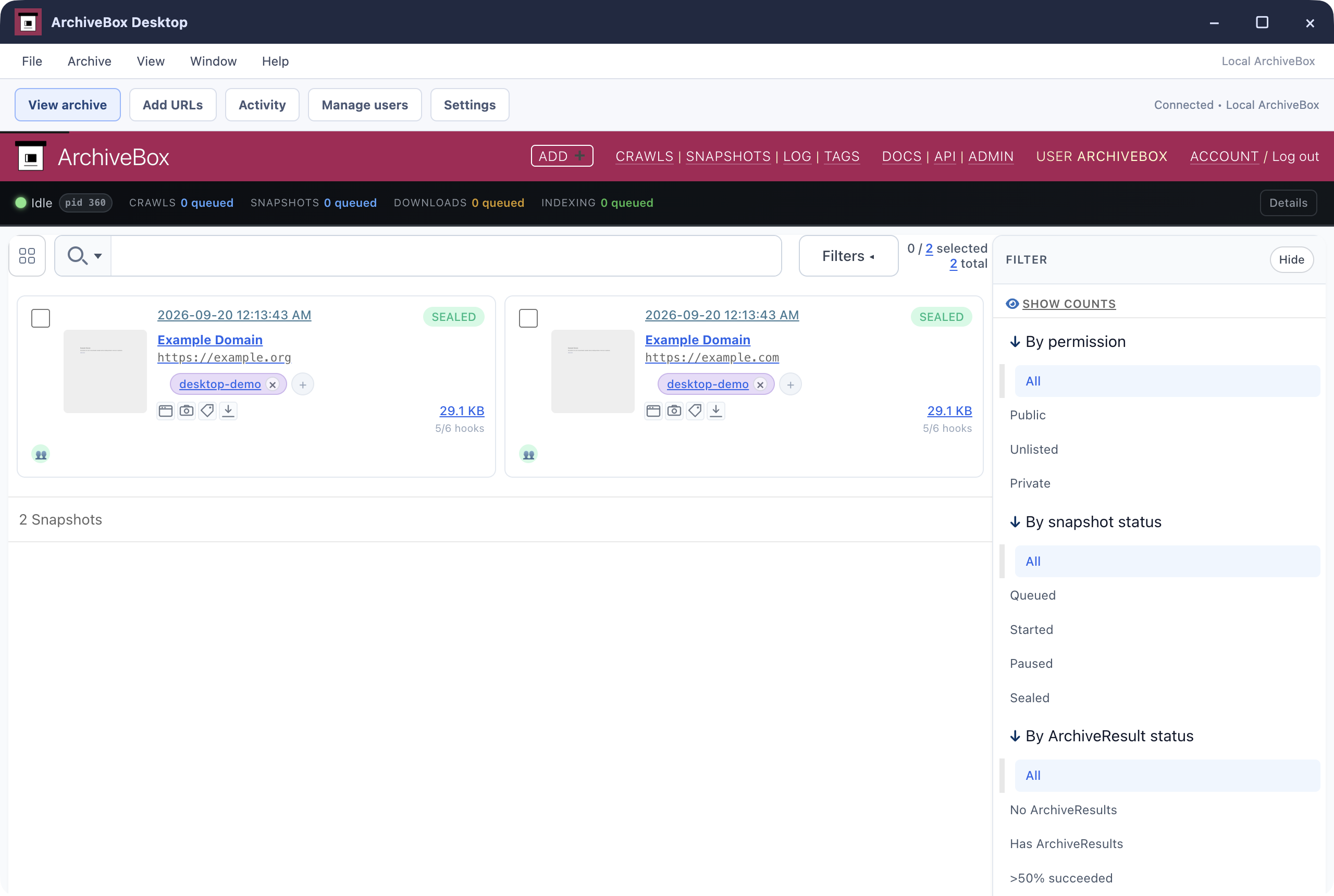
⚛️ Windows & Linux ArchiveBox Desktop App (powered by Electron + Docker Desktop).
⬇️ A simple all-in-one CLI tool to download EVERYTHING from a URL (like youtube-dl/yt-dlp, forum-dl, gallery-dl, simpler ArchiveBox). 🎭 Uses headless Chrome to get HTML, JS, CSS, images/video/audio/subtitles, PDFs, screenshots, article text, git repos, and more...