ComfyUI
The most powerful and modular diffusion model GUI, api and backend with a graph/nodes interface. The fastest local inference engine in the world.
- 148k
- Python
- GPL-3.0
- 2 h ago
Documentation for ComfyUI
Repo Comfy-Org/docs, read from GitHub 10 h ago. Comfy-Org has not joined Take My Repo.
Comfy-Org/docs is a public repo on GitHub by Comfy-Org. Documentation for ComfyUI. It declares the GPL-3.0 license on GitHub. It is written mainly in MDX, has 325 stars and last changed on 2026-11-22. Nobody has reviewed it on Take My Repo yet, which says nothing about its quality. Read from GitHub on 2026-11-23.
To preview documentation changes locally, first install dependencies and then start the development server:
npm i
npm run dev
To sync translations after editing English docs, see Automated translation below (npm run translate).
Create a PR. Once it is accepted Vercel will deploy the change to https://docs.comfy.org/
Can either use an OpenAPI file or URL containing the file:
cd registry/api-reference # Keep API files separated by products.
npx @mintlify/scraping@latest openapi-file <path-to-openapi-file>
This will only generate the MDX files for each endpoint. You need to add a link to these files in docs.json, and the up-to-date API spec will be shown on that doc page.
redirects list in the docs.jsonA GitHub Action will check for redirects and fail the PR if they are missing. Redirects should follow this format:
"redirects": [
  {
    "source": "/path/to/old-file",
    "destination": "/path/to/new-file"
  }
]
Don't forget to include the corresponding translation files under
zh/,ja/,ko/, etc.!
You can also refer to the Mintlify doc to learn how to add and match a wildcard path.
ComfyUI now has a built-in node help menu for both built-in nodes and custom nodes. All built-in node documentation will now be maintained in this repo.
We will regularly sync updated documentation from the corresponding repository to docs.comfy.org weekly to ensure content synchronization and updates. If you would like to contribute to the documentation, please submit PRs and updates to this repo.
For node documentation, we will use a single-level directory structure under the built-in-node folder for the following reasons:
docs.json file, so we can make unified changes in that fileDue to historical updates, some existing documents use different folder hierarchies. We will no longer adjust these files, but new files will use a single-level directory
Please just create a PR and we will review it within a few days.
Or talk to us on our discord
The documentation is built with Mintlify, please refer to Mintlify documentation to learn how to use it.
Some files in this repository are written by the Comfy API v2 specification sync and rewritten from upstream sources every time it runs. Editing them here publishes the change until the next sync, which then silently reverts it. Do not edit these files in a PR:
| File | Where the edit belongs |
|---|---|
openapi-v2.yaml |
The API contract upstream. This file is a vendored projection of it. |
router-openapi.yaml |
The API contract upstream. This file is a vendored Router-only projection of it. |
development/comfy-router/reference.mdx |
The API contract upstream. This page is generated from it. |
development/comfy-router/quickstart.mdx |
The upstream quickstart.mdx, which is published here verbatim. |
development/comfy-router/limitations.mdx |
The upstream limitations.mdx, which is published here verbatim. |
development/comfy-router/higgsfield-byok.mdx |
The upstream higgsfield-byok.mdx, which is published here verbatim. |
development/comfy-router/litellm.mdx |
The upstream litellm.mdx, which is published here verbatim. |
development/comfy-router/realtime.mdx |
The upstream realtime.mdx, which is published here verbatim. |
router-schemas/** |
The API contract upstream. The whole directory is re-mirrored on every sync. |
development/comfy-router/models.mdx |
A model's code.yaml, or the upstream contract. Regenerate with bun run code-pages:gen. |
development/comfy-router/providers.mdx |
The upstream alt-provider contract. Regenerate with bun run code-pages:gen. |
development/comfy-router/models/**/code.mdx |
The sibling code.yaml, or the upstream contract. Regenerate with bun run code-pages:gen. |
Two things inside that tree stay editable: docs.json (the sync rewrites only the Models nav group and the model-page redirects) and the hand-curated development/comfy-router/models/**/code.yaml generator inputs, which are where a change to a generated model page belongs. development/comfy-router/pricing.mdx is not in that tree: it is a hand-written page that points readers at router.comfy.org for Router prices, so edit it (and its ja, zh, ko and es copies) directly.
The Sync-Owned Files Check workflow fails a PR that touches any of the guarded paths and prints, per file, where the edit belongs. The last three rows are generator output, so they are judged on freshness instead: committing pages that match bun run code-pages:gen is a regeneration and passes, while a page that does not match is a hand-edit and fails. The sync's own PR is exempt. Localized copies under zh/, ja/ and ko/ are maintained by the i18n sync and are not covered by this check. When an English change introduces or increases a gap on these pages, Structure Parity reports a warning naming the i18n sync. The changed-file report omits unchanged missing-only gaps; use --all to see the backlog. A localized-direction gap still fails.
English MDX at the repo root is the source of truth. Translations mirror the same relative paths under language directories (for example zh/get_started/introduction.mdx, ja/get_started/introduction.mdx, ko/get_started/introduction.mdx). Reusable fragments live in snippets/ with per-language copies under snippets/zh/, snippets/ja/, snippets/ko/, and so on.
Contributing guides in other languages: readme/ (中文, 日本語, 한국어).
Translation policy
Supported locales are maintained through automated translation from English. When English docs change, translations are updated in batch via npm run translate — contributors do not need to hand-translate every page.
Request a new language
Want docs in another language? Open an issue with the locale you need (for example French, German, or Brazilian Portuguese). A maintainer will add the language to translation-config.json and docs.json, then run a full batch translation of all content. You only need to submit the request; no translated MDX PR is required to get started.
Specifications for editing MDX can be found in the Writing Content section of the Mintlify document.
Note:
built-in-nodes/is maintained in embedded-docs and is skipped by the translation script. Do not run bulk translation against that folder.
This repo includes a hash-based translation script. It compares each English file against translationSourceHash stored in the translated file; when the English source changes, the file is fully re-translated.
Prerequisites
cp .env.local.example .env.local
# Set TRANSLATE_API_KEY (OpenAI-compatible: DashScope Qwen-MT, OpenRouter, DeepSeek, etc.)
npm scripts
| Command | Description |
|---|---|
npm run translate |
Translate all languages listed in translation-config.json |
npm run translate:dry-run |
List pending files without calling the API |
npm run translate:force |
Re-translate everything, ignoring stored hashes |
npm run translate:snippets |
Translate snippets/ only |
npm run translate:snippets:dry-run |
Preview pending snippet translations |
npm run translate:check-truncation |
Scan for likely truncated translations |
npm run translate:repair-truncated |
Re-translate files listed in the truncation log |
npm run glossary:sync |
Rebuild the terminology glossary from the ComfyUI frontend (see Terminology consistency) |
npm run translate:review |
Score existing translations with an AI judge (see Quality review) |
Pass extra flags after --:
npm run translate -- --lang zh,ja
npm run translate:dry-run -- --lang ja
npm run translate -- installation/manual_install.mdx
npm run translate:check-truncation -- --lang ko
npm run translate:repair-truncated -- --lang ko
Truncated translations
Long files can occasionally be cut off mid-translation (e.g. unclosed code fences). After a batch run, the script scans newly translated files and writes a repair list to .github/i18n-logs/translate/truncation-issues.json and truncation-issues.txt (gitignored). To scan everything for a language, or to repair:
npm run translate:check-truncation -- --lang ko
npm run translate:repair-truncated -- --lang ko
repair-truncated reads the JSON log and force re-translates only the flagged files.
How it works
zh/, ja/, ko/, etc., with refreshed translationSourceHash in frontmatter (snippets use an HTML comment for the hash)=== MISMATCHES ===, they go to .github/i18n-logs/translate/mismatches.json and mismatches.txt (gitignored), not into MDX. Only produced during npm run translate, not by the truncation scanner..github/i18n-logs/translate/truncation-issues.json — see Truncated translations above.built-in-nodes/ (configured in translation-config.json → skip_paths)changelog/index.mdx is handled by <Update label="v0.x.x"> version labels. The script compares EN vs target labels, translates only missing versions, and inserts them in EN order. Old blocks are never re-translated unless you use --force.mkdir by handScript location: .github/scripts/i18n/ (see translate-i18n.ts, translation-config.json, and the i18n README for full details)
To keep the same English term rendered the same way across pages (e.g. avoid "custom node" drifting between two different Korean translations), three complementary mechanisms feed the translator. Each handles a different kind of term:
| Mechanism | Effect | Example | Maintained |
|---|---|---|---|
preserve_terms (in translation-config.json) |
keep the term in English | checkpoint, LoRA, scheduler |
by hand |
glossary/frontend/{lang}.json |
use the frontend's translation | workflow → 워크플로 |
machine-synced |
glossary/overrides/{lang}.json |
correct / extend the frontend | custom node → 커스텀 노드 |
by hand, wins |
The ComfyUI frontend (ComfyUI_frontend/src/locales) is the authoritative source of term translations. npm run glossary:sync mirrors its locale terms into glossary/frontend/{lang}.json (rebuilt wholesale each run — never hand-edit). Hand-maintained corrections live in glossary/overrides/{lang}.json, which wins over the mirror and is the place to record a term decision or drop a noisy frontend term:
// glossary/overrides/ko.json
{
  "terms":  { "custom node": "커스텀 노드" },   // remap or add (wins over frontend)
  "ignore": ["title", "additional", "work"]      // drop a noisy frontend term
}
At translation time, only terms that actually appear in a document are selected and injected as preferred (not mandatory) hints, so the model keeps natural phrasing when a literal substitution would read awkwardly. ComfyUI proper nouns with no settled translation (model names, checkpoint, …) instead go in preserve_terms to stay in English. See the i18n README for the full design and curation guidance.
npm run glossary:sync                 # rebuild the frontend mirror, all languages
npm run glossary:sync -- --lang ko    # one language
npm run glossary:sync:dry-run         # report counts without writing
The frontend locales source resolves in order:
frontend_locales_url in translation-config.json (GitHub raw main branch). Override with FRONTEND_LOCALES_URL or --frontend-url <url>.--frontend <path> or FRONTEND_LOCALES_PATH when you need an offline or forked checkout.npm run translate:review scores existing translations with an independent (and typically cheaper) AI model — an LLM-as-a-judge — on four axes: accuracy, completeness, terminology (checked against the glossary), and fluency. It is separate from the translation model's own === MISMATCHES === self-notes; here a different model acts as judge.
Results are advisory: the detailed scores and issue list are written to .github/i18n-logs/review/ (quality-report.json / .txt, gitignored) and never block a PR. The reviewed hash is recorded as reviewSourceHash in the translated file's frontmatter (committed to git), so review state is shared across the team and visible per file — mirroring translationSourceHash. By default only translations that are up to date with English and not yet reviewed at that hash are checked.
npm run translate:review                     # pending reviews, all languages
npm run translate:review -- --lang ko        # one language
npm run translate:review -- --all            # re-review everything
npm run translate:review -- --sample 20      # N pending files per language
npm run translate:review -- --min-score 4    # report files scoring below 4/5
Configure a dedicated cheap judge model via REVIEW_API_KEY / REVIEW_API_BASE_URL / REVIEW_API_MODEL in .env.local (falls back to the TRANSLATE_* model when unset). Use a fast model — evaluation is lighter than translation; reasoning-heavy models are slow under concurrency, so lower REVIEW_CONCURRENCY if you see connection errors.
See Request a new language above — please open an issue rather than adding a language in a PR yourself.
Maintainers: add one entry under languages in .github/scripts/i18n/translation-config.json (code, name, dir, snippets_dir). Path exclusion, link localization, and English-file scanning are derived automatically by i18n-config.mjs in the same folder — no per-language edits in translate scripts when adding a locale. Then add navigation in docs.json (see Mintlify Localization), and batch-translate:
npm run glossary:sync -- --lang fr        # build the terminology glossary for the new locale
npm run translate:dry-run -- --lang fr
npm run translate -- --lang fr
npm run translate:snippets -- --lang fr
The glossary is extended automatically: once the language is in translation-config.json, npm run glossary:sync generates glossary/frontend/{lang}.json from the ComfyUI frontend locale (provided the frontend ships that locale). An glossary/overrides/{lang}.json file is optional — add it later only to correct or pin specific terms. See Terminology consistency.
You can still translate by hand instead of using the script:
import paths (/snippets/... → /snippets/zh/...) and internal links (/path → /zh/path).docs.json.When English MDX changes, the i18n-sync-check workflow warns if matching translation files were not updated in the same PR, and posts a reminder comment tagging @comfyui-wiki. Update translations manually or re-run npm run translate.
When adding workflow examples to the documentation, please:
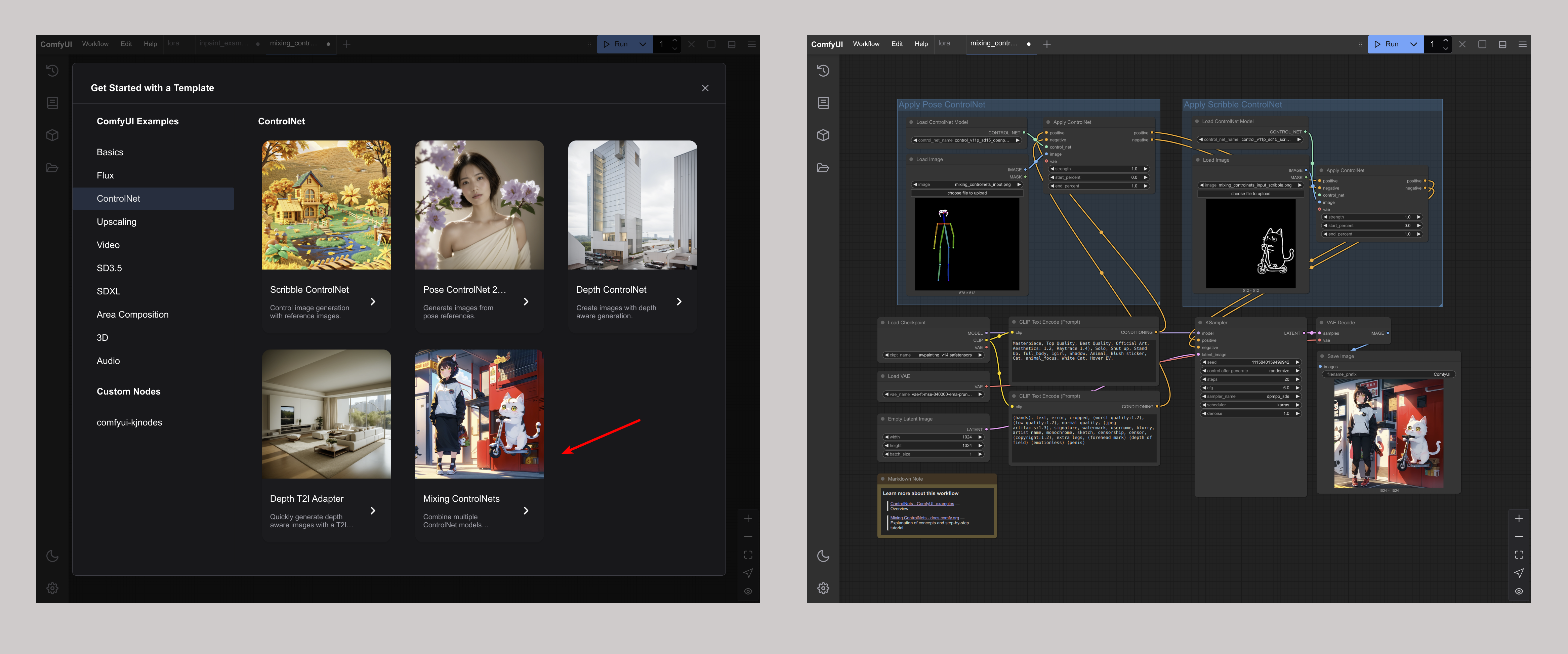
Upload your workflow JSON and preview image to the example_workflows repository
Use the raw GitHub content URL in your documentation. To convert a GitHub file URL to a raw content URL:
https://github.com/Comfy-Org/example_workflows/blob/main/your-workflow.json
https://raw.githubusercontent.com/Comfy-Org/example_workflows/main/your-workflow.json
You can also click the "Raw" button on the GitHub file page and copy the URL directly.
This ensures the workflow metadata is preserved in the docs site when dragging it into ComfyUI.
Comfy-Org/docs is a public repo on GitHub by Comfy-Org. Documentation for ComfyUI.
It declares the GPL-3.0 license on GitHub.
Its maker has not tagged a system, so it is unknown here. Its README says what it needs.
Open "Take it" on its page: Take My Repo writes an install plan for your machine and hands it to your AI agent (Claude Code, Codex or Cursor), which asks you before each step. Take My Repo has not tested it on any machine.
Its last change on GitHub was on 2026-11-22. Take My Repo does not judge from that whether it is maintained.
Nobody has reviewed it on Take My Repo yet, which says nothing about its quality.
The most powerful and modular diffusion model GUI, api and backend with a graph/nodes interface. The fastest local inference engine in the world.
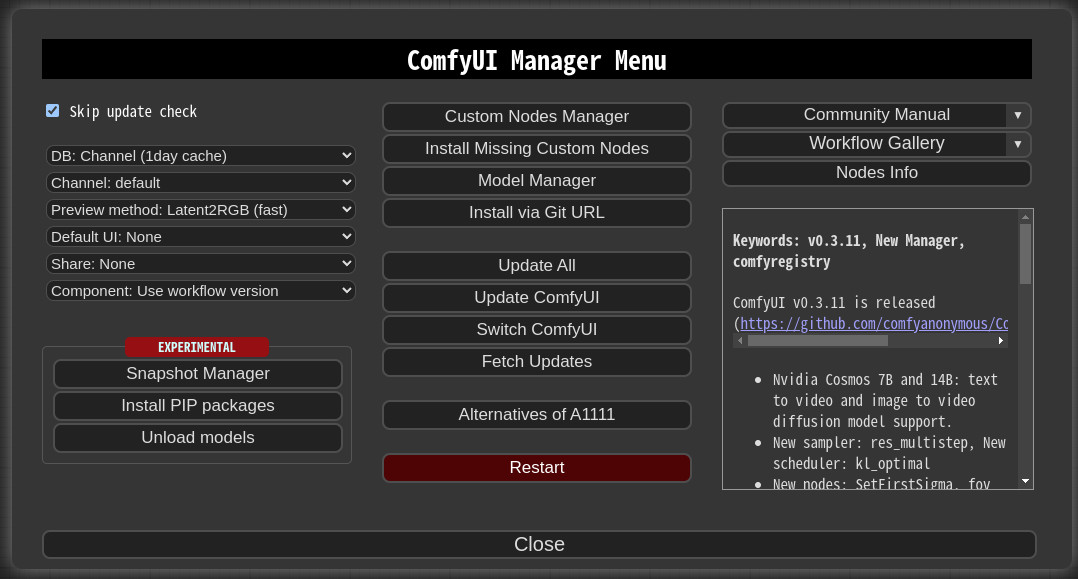
ComfyUI-Manager is an extension designed to enhance the usability of ComfyUI. It offers management functions to install, remove, disable, and enable various custom nodes of ComfyUI. Furthermore, this extension provides a hub feature and convenience functions to access a wide range of information within ComfyUI.
[ARCHIVED] Superseded by https://github.com/Comfy-Org/Comfy-Desktop