rea
Reverse engineer anything with agents, from app behavior down to native binaries.
- 477k
- TypeScript
- MIT
- 44 min ago
Auto AI improver. Cost and token burn reducer, turn saver, and focus keeper for Claude Code, Codex, Copilot, Gemini, and more: surgical read hints, PDF/Office/CSV/md file interception, 255+ filter & interception rules, compact manifest injection, image shrinking, cache and compact skills, cache MCPs, prompt injection protection, and much more.
Repo DFKHelper/token-goat, read from GitHub 1 min ago. DFKHelper has not joined Take My Repo.
DFKHelper/token-goat is a public repo on GitHub by DFKHelper. Auto AI improver. Cost and token burn reducer, turn saver, and focus keeper for Claude Code, Codex, Copilot, Gemini, and more: surgical read hints, PDF/Office/CSV/md file interception, 255+ filter & interception rules, compact manifest injection, image shrinking, cache and compact skills, cache MCPs, prompt injection protection, and much more. It declares no license on GitHub. Public does not mean open source: without a license, nobody is granted the right to reuse it. It is written mainly in TypeScript, has 148 stars and last changed on 2026-11-24. Nobody has reviewed it on Take My Repo yet, which says nothing about its quality. Read from GitHub on 2026-11-24.
Reverse engineer anything with agents, from app behavior down to native binaries.
Give the model what it needs, not everything you have.
85% smaller reads · 49% of first-read bytes withheld · 97.4% image compression · leaner prompt cache · 255+ filter & interception rules · 94–99% skill overhead cut · compaction memory · prompt injection guard · 3.7 GB never reached the model · 1.1 Gt tokens saved
Saves AI turns, context and tokens, and improves its focus. Fully automated, always online.
Also defends against prompt injection. Every fetched page, tool result, and extracted document is wrapped in an untrusted-content fence before hitting the model, whether or not it matched an attack pattern, and the scan only decides what the label says. One config line to disable.
Your AI re-reads the same file three times. Every whole-file dump is paid for again on every turn after it. Every compaction causes amnesia. Every build log buries the one line that matters. You pay for all of it. Token-Goat fixes all of it — automatically.
Token-Goat sits silently between your AI and your tools. Re-read a file? It gets a one-line hint and a narrow-slice suggestion instead of the full file again. Grab a screenshot? A 100 KB copy reaches the model instead of 10 MB. Run pytest, npm install, docker build, or cargo? The thousands of progress bars and passing-test names are stripped to the failures before the output even reaches the context window. Open a PDF, a large Markdown doc, or a CSV? The hook intercepts it — heading tree, page count, or column preview — so the model never pays for the full file. Run gh run watch or next dev a second time? Prior output is recalled rather than re-run. Compact a long session? It gets a clean structured manifest of edited files and key symbols so nothing important is forgotten. Sessions drop 40–90%+ in cost. You change nothing about how you work.
Each of these also costs a turn. A model that pages a file ten lines at a time, or runs the same command again to see output it already has, spends round trips as well as tokens. Token-Goat aims to answer the next question as well as the current one. These features save turns today:
token-goat brief "file::symbol" returns the symbol body, its callers and its containing doc section in one call.token-goat answer "<question>" answers a plain-English question from the index alone, or refuses with a reason.token-goat read "file::symbol" returns one function in place of paging through the file.token-goat bash-output <id> and token-goat web-output <id> recall captured output instead of running the command or fetch again.The symbol index also understands native Nginx, Caddyfile, and Apache HTTP Server configuration blocks, so token-goat read "file::symbol" can jump directly to them.
Works with Claude Code, Gemini CLI, Qwen Code, Codex CLI, Aider, Cursor, Cline, Windsurf, Copilot CLI, VS Code (Copilot agent), Visual Studio (Copilot agent, MCP tools and instructions only), Zed (MCP tools only), Kimi Code, Grok CLI (xAI Grok Build), Antigravity CLI (agy), and OpenCode, plus pi (pi-coding-agent).
Ask your AI to install it fully (give it this GitHub link), or install in one command:
npm install -g token-goat && token-goat install
Restart your AI sessions. Run token-goat stats a couple of minutes after your next session to see the massive savings. It also doubles as a great tracker of your work. Welcome to token efficiency.
Built and continually improved, free, by one person. If it saves you tokens, drop a ⭐️ at the top of this page. One click. Makes my day. Also, if you'd like anything added, drop me a line.
Install · CLI · Architecture Q&A · What gets installed? · Stats · Security & uninstall
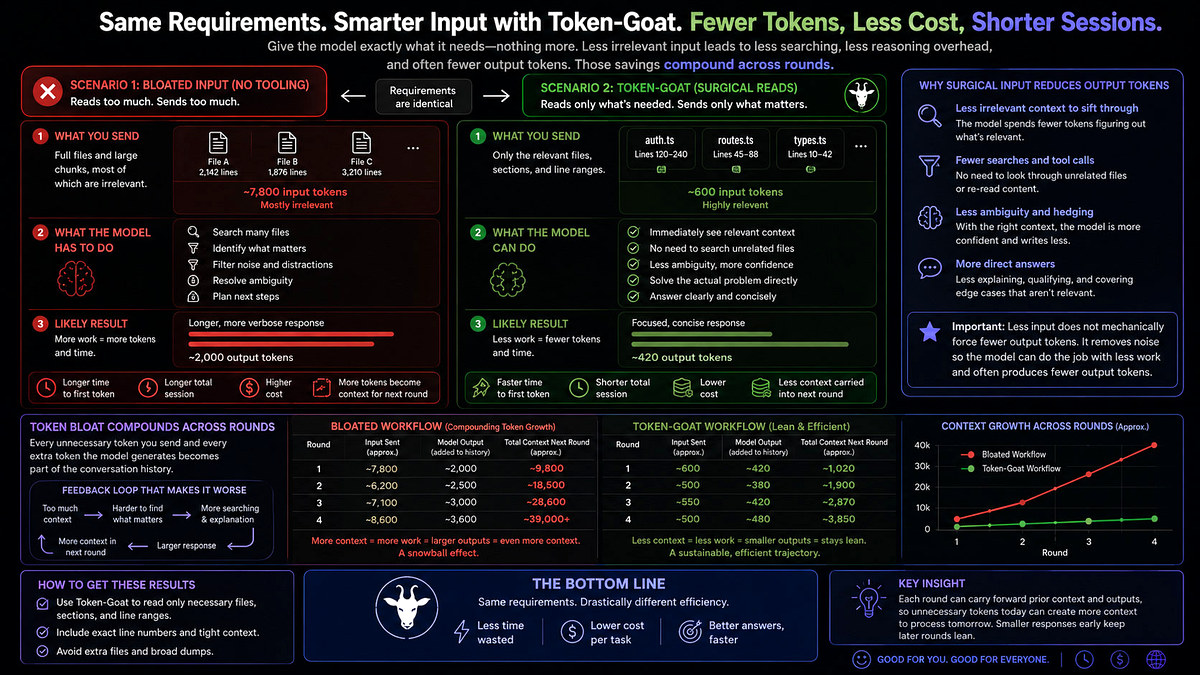
Same requirements, smarter input: fewer input tokens, shorter answers, and context that stops compounding across rounds
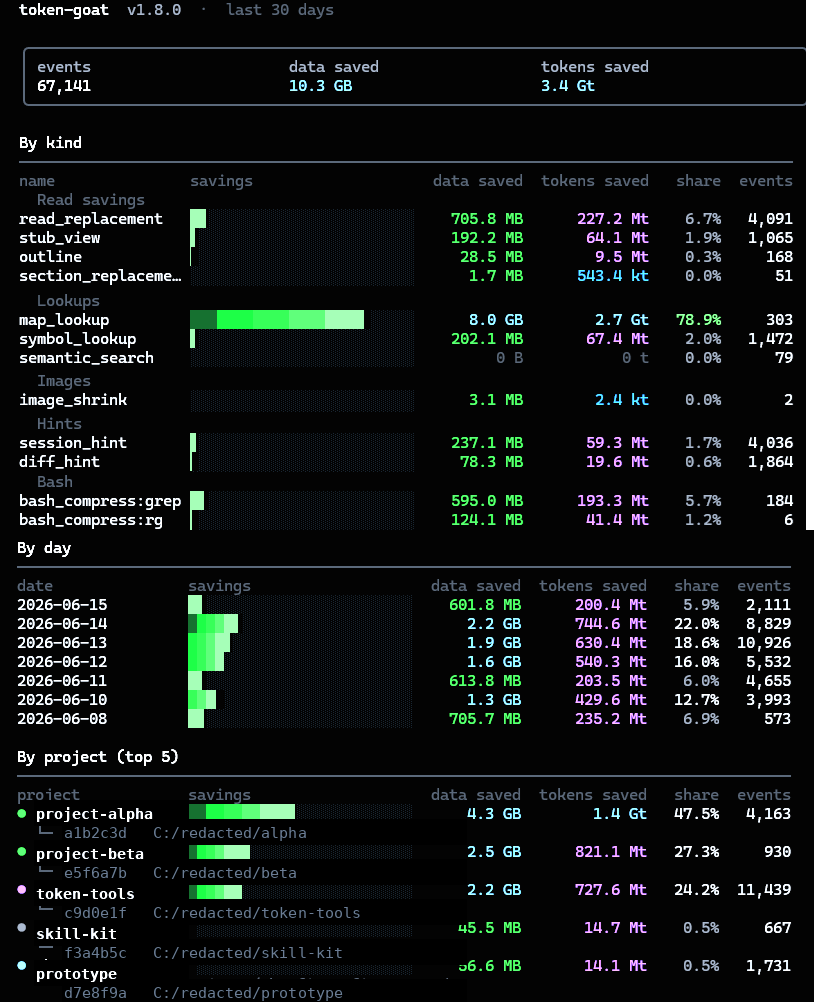
Stats display — gradient bars, sparklines, and a calendar heatmap in 24-bit color
AIs read auth.py. Then reads it again. And again. Then a third time after compaction wipes the session. Then it can't find what it wanted and searches other lines and files. You pay for every token and most of it is waste.
Long sessions accumulate waste six ways. Screenshots cross the model at full resolution. A single PNG can land at 10+ MB. The agent re-reads files it already parsed earlier in the same conversation. When a session compacts, the summary LLM doesn't know which files were edited or which symbols mattered, so it preserves the wrong things. Every pytest, npm install, docker build, or git log dumps thousands of lines of progress bars, deprecation warnings, and passing-test names that bury the one line that actually matters.
The fifth waste is skills. A single large skill injects 10k–65k tokens every time. Run a five-iteration /improve loop and you've paid for five full copies of the same rules. Token-Goat now blocks repeat skill loads before they happen: a PreToolUse hook intercepts the second invocation, serves the cached compact (~400 tokens) instead, and only allows a reload when compaction may have evicted the skill from context. It also intercepts direct reads of skill files and ensures the compaction manifest carries the full skill index — so nothing is forgotten and the full body never re-enters context unnecessarily.
The sixth waste is what a large read costs after the turn it lands in. The prompt cache makes it cheaper, not free: Anthropic bills the first cache write at 1.25x the base input price (2x for the one-hour cache), then about 0.1x for every later turn that reads it back, until the session compacts. A 2,000-line file read to check a three-line helper is carried, and paid for, on every one of those turns. It also brings compaction closer, and the turn after a compaction writes the new prefix at the write price. Token-Goat's surgical reads add only the requested symbol or slice, so every later turn carries less.
The fastest way to reduce AI token costs is fixing these six, not writing shorter prompts. Each one is preventable. Token-Goat intercepts all six, automatically.
| Without Token-Goat | With Token-Goat |
|---|---|
| A full-file read is written to the prompt cache once, then read back on every later turn until compaction | Surgical reads add only the lines asked for, so every later turn reads back less and compaction comes later |
| 3.3 MB screenshot lands in model context | 84 KB compressed copy, 97.4% smaller |
| Agent re-reads files from earlier in the session | "Already read this" reminder with narrow slice suggestion |
| Read tool asks for lines the session was already given | Answered with a pointer at the copy already delivered instead of the file, when the text this read would return matches the text already served for it whole line for whole line. Proof rather than a read count, so it also covers a file inside the recent-read protection window; a changed file, a wider range, and reread_deny = false all pass through |
Same unchanged file read again through the shell (cat, head, tail, sed -n '1,40p') |
Byte-identical repeat replaced with a one-line pointer instead of the whole body: 4,031 bytes to 189 on this project. A later read wholly inside an earlier one collapses the same way |
A shell read of a file overlaps an earlier one without sitting inside it (sed -n '100,140p' after sed -n '120,160p') |
Only the already-shown stretch is withheld, replaced in place by one line naming its line numbers and the command that returns it; every line not shown before arrives untouched. 56% of the second read on a real pair over this project's README. Line numbers come from the command's own ranges, so a tail, whose start the command does not state, is left alone. Full text stays available via token-goat bash-output <id> |
Part of a file re-read under a different command (head -40 F then sed -n '1,30p' F) |
Repeat replaced with a pointer when every line coming back was already served for that same file this session. Matched on the text, on whole-line boundaries, so a read that adds any new lines is left whole; the record is dropped when the file is edited or the conversation is compacted. A file read with the Read tool counts as served too, limited to the lines that read actually handed over, and a read that came back truncated counts for nothing |
| Read tool asks for a range that overlaps one already delivered | Only the overlapping stretch is withheld, replaced by one line naming the line numbers and the recall command; the new lines come through with their own numbers and spacing, byte for byte. A stretch is kept whenever dropping it would save less than the line replacing it costs, and a result carrying anything the redactor would strip, a truncated result, or a file changed on disk all pass through whole. Set elide_served_lines = false to disable |
Shell command run with colour on (git, npm, npx, token-goat) |
Terminal escape sequences removed, leaving byte-for-byte the same output with colour off: 13.2% smaller on a real git diff here, and about a quarter of the bytes on the calls it fires for. Nothing is summarized or withheld, so there is no recall pointer; it runs on failed commands too, and only when the escapes are worth a rewrite |
| Agent re-reads a file edited mid-session | Unified diff injected as a hint — full Read avoided when the diff covers the change. Docs and source/style/data files (.md/.ts/.css/.json/…) by default; set serve_diff_on_reread = false to disable source diffs |
| Compaction forgets which files were edited | Structured session manifest injected before compact |
Same files re-read from scratch after /compact |
Recovery hint at SessionStart lists cached snapshot + bash + WebFetch IDs |
| Loaded skill body summarized away by compaction | ### Active Skills manifest section + **Skills**: recovery block list every loaded skill; full body recoverable via token-goat skill-body <name> without re-invoking |
| Large skill bodies re-injected each turn (6 active skills = 65k+ tokens) | <!-- COMPACT_END --> marker: everything above the marker is the compact form; token-goat detects it on load, caches the compact slice, and injects only that — typically ~400 tokens vs. 10k+ |
| Model reads a skill SKILL.md file directly mid-session (burning the full 10k–65k tokens again) | Pre-Read hook intercepts */.claude/skills/<name>/SKILL.md paths; if the skill is already cached this session it emits a token-goat skill-body <name> hint instead |
| Same large skill invoked twice in a session | PreToolUse hook blocks the reload; serves cached compact (~400 tokens) via additionalContext instead of the full 40–65k body. Allows the reload if compaction fired since the last load |
Skill invoked with first_load_compact=true and <!-- COMPACT_END --> present |
First load also blocked; only the curated compact section is served. Full body available via token-goat skill-body <name> on demand |
| Same docs URL fetched twice in a session with the same question | Re-fetch blocked at any context pressure; cached body available via token-goat web-output <id>. Keyed on the URL and the prompt together, since a WebFetch answer is specific to the question asked, so the same page fetched with a different question is left alone |
cat src/auth.py or Get-Content module.py run via Bash |
Pre-Bash hook detects whole-file reads of indexed source files and suggests token-goat read "file::Symbol", skeleton, or section — covers cat, bat, type, PowerShell Get-Content/gc |
DFKHelper/token-goat is a public repo on GitHub by DFKHelper. Auto AI improver. Cost and token burn reducer, turn saver, and focus keeper for Claude Code, Codex, Copilot, Gemini, and more: surgical read hints, PDF/Office/CSV/md file interception, 255+ filter & interception rules, compact manifest injection, image shrinking, cache and compact skills, cache MCPs, prompt injection protection, and much more.
3,000+ reusable AI agent skills for Claude Code, Codex, Cursor and Gemini CLI. AAS Core adds local catalog discovery, agent-owned selection and plan preview. CLI, MCP and plugins.
Compress tool outputs, logs, files, and RAG chunks before they reach the LLM. 20% fewer tokens for coding agents, 60-95% fewer tokens for JSON, same answers. Library, proxy, MCP server.
The agent harness performance optimization system. Skills, instincts, memory, security, and research-first development for Claude Code, Codex, Opencode, Cursor and beyond.
It declares no license on GitHub. Public does not mean open source: without a license, nobody is granted the right to reuse it.
Its maker tagged it for Windows and Linux. That is declared by the maker; Take My Repo has not tested it.
Open "Take it" on its page: Take My Repo writes an install plan for your machine and hands it to your AI agent (Claude Code, Codex or Cursor), which asks you before each step. Take My Repo has not tested it on any machine.
Its last change on GitHub was on 2026-11-24. Take My Repo does not judge from that whether it is maintained.
Nobody has reviewed it on Take My Repo yet, which says nothing about its quality.
Take My Repo cannot say: it does not audit code and has not run token-goat. What is known comes from GitHub. It declares no license on GitHub. Public does not mean open source: without a license, nobody is granted the right to reuse it. Its last change was on 2026-11-24. It has 148 stars, which measure popularity, not safety. Nobody has reviewed it on Take My Repo yet, which says nothing about its quality. Read the source before you run it. With "Take it", your AI agent shows each step and asks you before running it; README text is treated as data, not as instructions.