
EXCISE
EXCISE: query-side exclusion for late-interaction retrieval
- 0
- MIT
- 6 d ago
Repo DataScienceUIBK/EXCISE, read from GitHub 20 h ago. DataScienceUIBK has not joined Take My Repo.
In short
DataScienceUIBK/EXCISE is a public repo on GitHub by DataScienceUIBK. EXCISE: query-side exclusion for late-interaction retrieval. It declares the MIT license on GitHub. It is written mainly in Python, has 0 stars and last changed on 2026-11-16. Nobody has reviewed it on Take My Repo yet, which says nothing about its quality. Read from GitHub on 2026-11-22.
AI models this project points to
EXCISE: Query-Side Exclusion for Late-Interaction Retrieval
Overview · Benchmark · Results · Installation · Quick start · Training · Baselines · Data · Citation
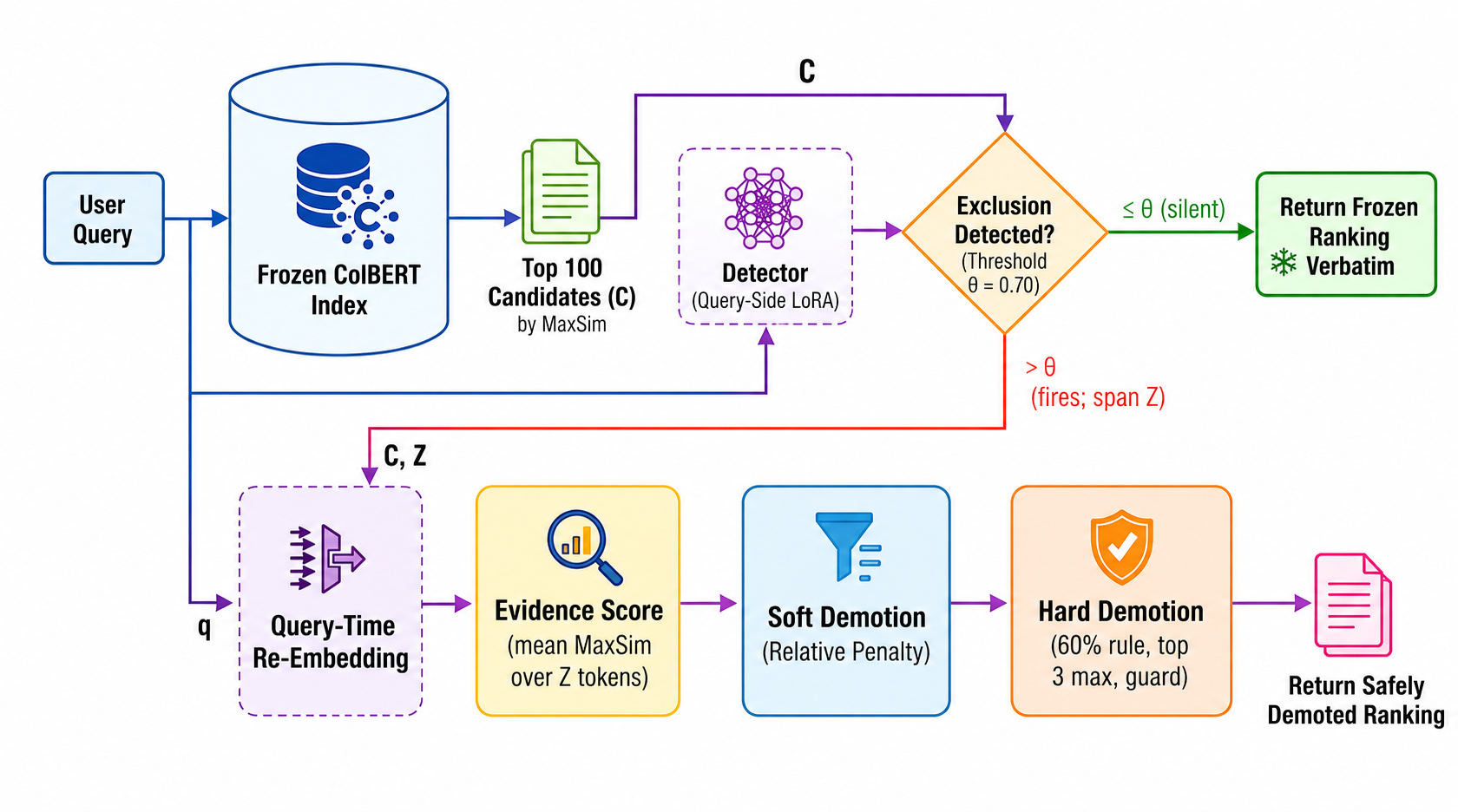
TL;DR. When a user asks a late-interaction retriever for "X but not Z", the additive MaxSim score rewards the tokens that name Z, so documents about Z are promoted rather than suppressed. EXCISE leaves the index frozen: two query-side modules of 1.5M parameters identify the excluded topic and re-embed a 100-document shortlist, and a parameter-free rule demotes the candidates that match it. We also release X-BENCH, 1,860 exclusion queries over six collections. On Reason-ModernColBERT, EXCISE raises pooled exclusion success@10 from 0.201 to 0.773.
Overview
A detector reads the query. If it finds no exclusion, the frozen ranking is returned unchanged. If it does, EXCISE re-embeds the top 100 candidates, measures how strongly each one covers Z, lowers the score of the strong matches and moves at most three of them to the bottom. The constants are the same on all three backbones and are set in excise/config.py.
The X-BENCH benchmark
Each query asks for a topic X while ruling out one or two topics Z, and comes with a gold document and one excluded document per Z. A query counts as a success@10 only when the gold document is in the top ten and no excluded document is. ExcluIR (554 test queries) and FiQA (208) have training splits; TREC-COVID (343), ESGenius (206), EDGAR (353) and EUR-Lex (196) are zero-shot.
| Tier | The query | Test |
|---|---|---|
| T1 explicit | states the exclusion with a cue such as not, without or excluding | 693 |
| T2 implicit | has no cue; the exclusion is carried by framing, e.g. "with the European heavyweight title already covered" | 569 |
| T3 compound | rules out two topics | 598 |
Training and test data share no query and no document.
Results
Pooled exclusion success@10 over the 1,860 test queries (Table 1 of the paper). Reason-ModernColBERT indexes 10,000 words per document, GTE-ModernColBERT-v1 and ColBERTv2.0 index 1,000.
| System | Re-index? | Reason-ModernColBERT | GTE-ModernColBERT-v1 | ColBERTv2.0 |
|---|---|---|---|---|
| Frozen ColBERT | no | 0.2011 | 0.1608 | 0.2301 |
| LoRA fine-tune | yes | 0.5774 | 0.5823 | 0.5489 |
| Full fine-tune | yes | 0.5323 | 0.5263 | 0.5317 |
| Query-only fine-tune | no | 0.5806 | 0.5016 | 0.4608 |
| EXCISE | no | 0.7731 | 0.7403 | 0.6995 |
Installation
git clone https://github.com/DataScienceUIBK/EXCISE && cd EXCISE
pip install -r requirements.txt
python scripts/download.py --what corpora         # the six collections, 3.2 GB, checked against their sha256  -> data/datasets/
python scripts/download.py --what checkpoints     # the detectors and adapters, 25 MB  -> model/checkpoints/
The corpora and checkpoints come from mohammed933/EXCISE-corpora and mohammed933/EXCISE-checkpoints. --tier baselines and --tier externals add the checkpoints of the baselines and of the external systems. The backbones and the BEIR datasets are downloaded into HF_HOME on first use.
Quick start
Every run uses one GPU, with two exceptions: the Reason-ModernColBERT indexes of EUR-Lex and EDGAR do not fit on a single 94 GB GPU. The index is spread over all visible GPUs automatically; EUR-Lex ran with two GPUs visible and EDGAR with four.
python -m excise.run --list                                                     # backbones, collections, systems
python -m excise.run --backbone reason --dataset excluir --system excise --dry  # print the exact command
for D in excluir fiqa trec-covid esgenius edgar eurlex; do
  python -m excise.run --backbone reason --dataset $D --system excise           # success@10, nDCG@10 and leak, overall and per tier
done
The backbones are reason, gte and colbertv2. excise.run uses each backbone's document settings from the paper (for ColBERTv2 it sets EXCISE_DOC_LEN=300; export that variable yourself when you call excise.evaluate, excise.evaluate_beir or a trainer directly), and any extra flag (for example --dump-orders FILE) is passed to the evaluator. excise.evaluate_beir scores ordinary retrieval on SciFact, NFCorpus and ArguAna, and excise.significance compares two runs with a paired bootstrap.
Training
The released checkpoints are the ones the paper reports. To train a detector and an adapter for Reason-ModernColBERT:
export EXCISE_BACKBONE=lightonai/Reason-ModernColBERT EXCISE_QUERY_LEN=128
python -m excise.train_detector --data data/benchmark/train/detector.jsonl --out model/checkpoints/my_detector --epochs 3 --bs 32 --lr 1e-3 --lora-r 8 --pos-weight 8 --tap proj128 --xz --iob
python -m excise.label_z --triples data/benchmark/train/adapter_triples_unlabelled.jsonl --finder model/checkpoints/my_detector/deepfinder.pt --thr 0.70 --out my_adapter_triples.jsonl
python -m excise.train_adapter --triples my_adapter_triples.jsonl --out model/checkpoints/my_adapter --lr 1e-3 --epochs 3 --lora-r 8 --z-margin 0.10 --z-weight 5.0
For ColBERTv2 the detector uses --lr 5e-4 and the adapter --z-weight 2.0; excise/adopted.json records every released checkpoint's arguments.
Baselines
The ColBERT baselines (frozen, loraft, fullft, qonly) run through excise.run --system <name>. The external retrievers and rerankers (BGE-large, E5-large, GTE-Qwen2, Promptriever, and the BGE and MiniLM rerankers) run through competitors/:
python -m competitors.evaluate_external --model bge-rerank --ft model/checkpoints/bge-rerank --records 'data/benchmark/test/excluir/*.jsonl' --max-doc-words 10000 --window-words 350
python -m competitors.train_external --model bge-rerank --out model/checkpoints/my_bge-rerank   # fine-tune on the same 1,900 retrieval triples
The first command scores the released fine-tuned checkpoint (scripts/download.py --what checkpoints --tier all); pass the directory given to --out as --ft to score your own. Each released external checkpoint records its learning rate in SELECTION.json; pass it with --lr to retrain that model.
Test-time interventions
scripts/nine_interventions.py scores the nine test-time interventions of Appendix A.3, and the plain MaxSim(Z) rule they replace, on the frozen Reason-ModernColBERT index. The excluded topic comes from the record, or from the released detector with --detector-z.
python scripts/nine_interventions.py --source excluir                # oracle Z
python scripts/nine_interventions.py --source fiqa --detector-z      # the detector's Z
Two further scripts reproduce the analyses of Appendices A.3 and B.4. scripts/zcond_shift.py measures how prepending the excluded topic to a document changes its match to that topic, for the gold and for the excluded document. scripts/verbatim_overlap.py splits the test queries by whether the excluded document names the excluded topic verbatim, and reports success@10 for each group from saved per-query outcomes:
python scripts/zcond_shift.py --sources excluir fiqa
for D in excluir fiqa; do
  python scripts/nine_interventions.py --source $D --detector-z --dump-perquery nine_$D.jsonl
  python -m excise.run --backbone reason --dataset $D --system excise --dump-orders excise_$D.jsonl
done
python scripts/verbatim_overlap.py --sources excluir fiqa --perquery nine_excluir.jsonl nine_fiqa.jsonl \
    --arms maxsimz bm25z --orders EXCISE=excise_excluir.jsonl EXCISE=excise_fiqa.jsonl
Data
| File | Rows | What it is |
|---|---|---|
data/benchmark/test/<collection>/*.jsonl |
1,860 | the test queries, one file per tier and length |
data/benchmark/train/excluir.jsonl, fiqa.jsonl |
1,100 | the training queries |
data/benchmark/train/retrieval_triples.jsonl |
1,900 | the triples every trainable system trains on |
data/benchmark/train/adapter_triples.jsonl |
2,627 | EXCISE's adapter data: the 1,900 triples plus 727 demotion triples, with Z labelled |
data/benchmark/train/detector.jsonl |
12,871 | the detector's queries |
Every test and training record has the same nine fields: id, source (the collection), tier, length, query, X (the wanted topic), Z (a list, one entry per excluded topic), pos_id (the gold document) and neg_ids (one excluded document per entry of Z). Documents are linked by id; their text is in the collection's corpus. data/benchmark/CORPUS_REQUIRED.json pins each corpus by sha256.
Repository layout
excise/                 the system
  run.py                runs one system on one collection
  exclusion.py          the operator: re-embedding, evidence, soft penalty, hard demotion
  detector.py           the detector
  evaluate.py           evaluation on X-BENCH (evaluate_beir.py: on BEIR)
  train_detector.py     trains the detector (train_adapter.py: the adapter and the ColBERT baselines)
  config.py             paths and constants; the other files are the encoder, MaxSim, metrics and data loading
competitors/            the external systems: training and evaluation
data/benchmark/         X-BENCH
scripts/                download.py, nine_interventions.py, zcond_shift.py, verbatim_overlap.py, slurm_example.sh
Citation
@article{ali2026excise,
  title   = {EXCISE: Query-Side Exclusion for Late-Interaction Retrieval},
  author  = {Ali, Mohammed and Abdallah, Abdelrahman and Jatowt, Adam},
  year    = {2026}
}
MIT license for the code and the benchmark records; the corpora remain under their sources' terms.
Questions
What is EXCISE?
DataScienceUIBK/EXCISE is a public repo on GitHub by DataScienceUIBK. EXCISE: query-side exclusion for late-interaction retrieval.
Is EXCISE open source?
It declares the MIT license on GitHub.
Does EXCISE run on macOS, Windows or Linux?
Its maker has not tagged a system, so it is unknown here. Its README says what it needs.
How do I install EXCISE?
Open "Take it" on its page: Take My Repo writes an install plan for your machine and hands it to your AI agent (Claude Code, Codex or Cursor), which asks you before each step. Take My Repo has not tested it on any machine.
Is EXCISE still maintained?
Its last change on GitHub was on 2026-11-16. Take My Repo does not judge from that whether it is maintained.
What do people who ran EXCISE say?
Nobody has reviewed it on Take My Repo yet, which says nothing about its quality.