
MemRevise
MemRevise: a revisable memory for conversational search, with the ConvRevise benchmark
- 0
- MIT
- 5 wk ago
Repo DataScienceUIBK/MemRevise, read from GitHub 23 h ago. DataScienceUIBK has not joined Take My Repo.
In short
DataScienceUIBK/MemRevise is a public repo on GitHub by DataScienceUIBK. MemRevise: a revisable memory for conversational search, with the ConvRevise benchmark. It declares the MIT license on GitHub. It is written mainly in Python, has 0 stars and last changed on 2026-10-18. Nobody has reviewed it on Take My Repo yet, which says nothing about its quality. Read from GitHub on 2026-11-23.


MemRevise: A Revisable Memory for Conversational Search
Overview · Benchmark · Results · Installation · Quick start · Competitors · Citation
TL;DR. In conversational search, users correct misunderstandings, revise their requests and return to earlier topics, so part of the history no longer reflects what they want. We introduce ConvRevise, a benchmark that isolates such turns, and MemRevise, a memory of the conversation that a 3B writer revises one turn at a time, so the search query always targets the topic the user means now. With a frozen retriever, MemRevise reaches a mean MRR@10 of 0.701, against 0.589 for the best competitor.
Overview
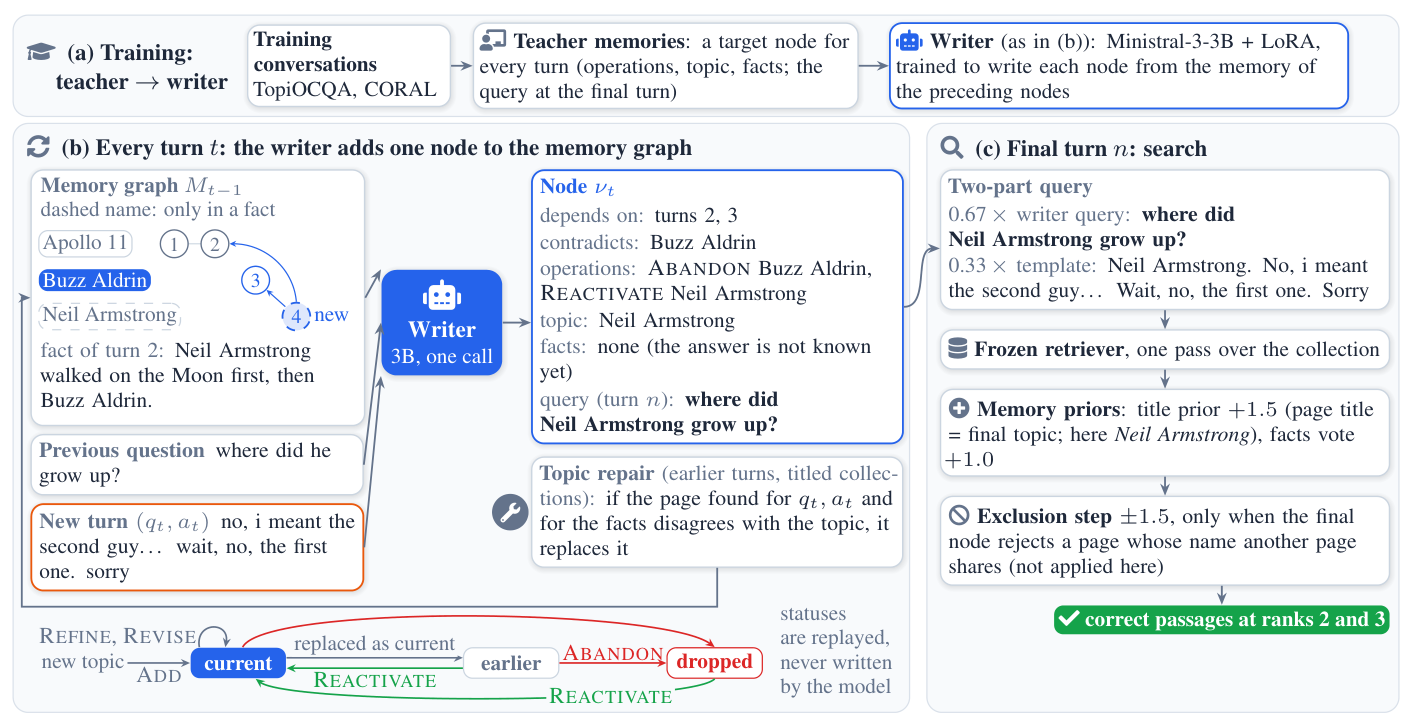
A 3B writer, distilled from teacher-written memories, adds one node per turn to a memory graph (topic, facts and operations); at the final turn its query is combined with evidence from the memory and searched with a frozen Reason-ModernColBERT retriever.
| Operation | Meaning | Status of the topic |
|---|---|---|
ADD |
introduces a new topic | becomes current; the previous one becomes earlier |
REFINE |
continues the current topic: the turn asks more about the topic already being discussed | stays current |
REVISE |
changes an established value, e.g. the War of 1812 → the one in 1863 | becomes current |
ABANDON |
drops a topic, e.g. after "no, not that one" | dropped, its facts kept |
REACTIVATE |
restores an earlier topic when the user returns to it | current again |
The ConvRevise benchmark
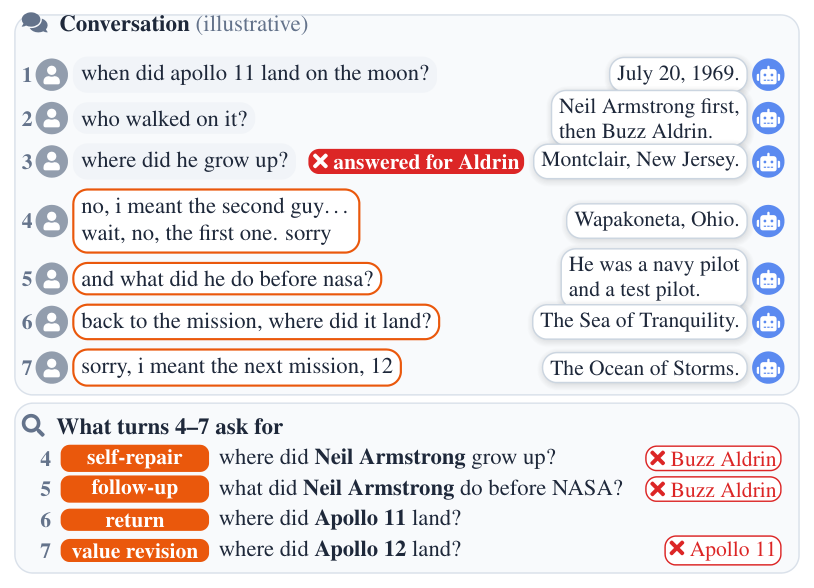
Each question is the last turn of a conversation in which the user corrects, revises or returns to a topic; a system must retrieve the passages for the topic the user means now. The benchmark and its passage collections are on Hugging Face.
| Tier | The question | Test |
|---|---|---|
| Return-1 | resumes the topic discussed just before the current one | 1,233 |
| Return-2+ | returns to a topic at least two topics earlier | 815 |
| Correction | rejects one or more topics and names the intended one | 1,239 |
| Follow-up | is a short question that depends on a preceding correction | 300 |
| Self-repair | corrects and re-corrects within the same turn | 608 |
| Value revision | changes a value in the topic's name | 234 |
Results
MRR@10 on the test sets with the frozen retriever (Table 2 of the paper); MemRevise is the mean of three training seeds.
| Method | Size | TopiOCQA | CORAL | OR-QuAC | Mean |
|---|---|---|---|---|---|
| Original Query | – | 0.074 | 0.360 | 0.263 | 0.232 |
| T5QR | 0.2B | 0.243 | 0.460 | 0.353 | 0.352 |
| T5QR-FT | 0.2B | 0.342 | 0.469 | 0.302 | 0.371 |
| ConvGQR† | 0.2B | 0.288 | 0.404 | 0.470 | 0.387 |
| ConvSearch-R1 | 3B | 0.591 | 0.546 | 0.572 | 0.570 |
| ConvSearch-R1-FT | 3B | 0.611 | 0.570 | 0.588 | 0.589 |
| LLM-Rewrite | 32B | 0.499 | 0.609 | 0.581 | 0.563 |
| CHIQ-AD | 32B | 0.436 | 0.617 | 0.594 | 0.549 |
| CMT-RAG‡ | 32B | 0.283 | 0.507 | 0.440 | 0.410 |
| ChatRetriever | 7B | 0.448 | 0.433 | 0.468 | 0.450 |
| ChatRetriever-FT | 7B | 0.620 | 0.524 | 0.548 | 0.564 |
| MemRevise (mean of 3 seeds) | 3B | 0.686 | 0.634 | 0.783 | 0.701 |
| MemRevise, released writer (seed 1) | 3B | 0.689 | 0.633 | 0.788 | 0.703 |
-FT: continued on our training data; †: trained on our data, no released model; ‡: our re-implementation. ChatRetriever rows use their own retriever.
Installation
git clone https://github.com/DataScienceUIBK/MemRevise && cd MemRevise
python -m venv .venv-writer      # the writer, and the LLM competitors
.venv-writer/bin/pip install torch==2.11.0 transformers==5.11.0 peft==0.19.1 accelerate==1.13.0 huggingface_hub==1.18.0 vllm==0.22.1
python -m venv .venv-retriever   # retrieval, evaluation, and the T5, ConvGQR and ChatRetriever competitors
.venv-retriever/bin/pip install torch==2.10.0 transformers==4.51.0 huggingface_hub==0.36.2 safetensors==0.7.0 numpy \
                                peft==0.18.1 sentencepiece tiktoken einops transformers_stream_generator
export MEMREVISE_RETRIEVER_PYTHON=$PWD/.venv-retriever/bin/python
bash scripts/download.sh         # the collections -> corpus/, the writer and its base model -> models/ (about 7.5 GB)
Quick start
R=.venv-retriever/bin/python; W=.venv-writer/bin/python
for C in topiocqa coral orquac; do $R -m memrevise.encode_corpus --corpus $C; done     # once -> encoded/
for S in test_topiocqa test_coral test_orquac; do
  $W -m memrevise.write_memory --set $S      # memory and final query -> outputs/writer/$S/
  $R -m memrevise.search --set $S            # rankings
done
$R -m memrevise.evaluate --sets test_topiocqa test_coral test_orquac
memrevise.evaluate reports MRR@10, NDCG@3, Recall@10/100 and the stale-win rate per set and tier. --shard i/n splits any command over n GPUs. A small first run: --set dev_orquac_value_revisions (84 questions). Training the writer: .venv-writer/bin/torchrun --nproc_per_node=4 -m memrevise.train.
Competitors
Each competitor writes its queries, competitors.score_queries ranks them with the frozen retriever, and memrevise.evaluate scores them:
source .venv-writer/bin/activate            # vLLM needs the environment on its path
$W -m competitors.llm_rewrite --set test_coral                  # also chiq_ad, cmt_rag, convsearch_r1
$R -m competitors.t5qr --set test_coral                         # also original_query
$R -m competitors.score_queries --set test_coral --names llm_rewrite t5qr
$R -m competitors.score_queries --set test_coral --names cmt_rag --prior after
$R -m memrevise.evaluate --sets test_coral --names llm_rewrite           # one row; --compare t5qr adds the paired difference
ChatRetriever encodes and ranks with its own model: $R -m competitors.chatretriever --encode coral --shard i/8 (one GPU per part), then --set test_coral. The trained rows are trained first, with competitors.train_t5qr, train_convgqr --decode oracle and --decode answer, train_chatretriever and competitors/convsearch_r1_ft/train.sh; ConvGQR then runs as competitors.convgqr, the others with --model models/<row> --name <row>.
Note. Reruns of the LLM-based competitors may differ slightly from the reported scores, owing to sampling and non-deterministic GPU computation.
Repository layout
memrevise/                  the system
  write_memory.py           the writer reads each turn once and adds a node to the memory; at the final turn it writes the query
  prompt.py                 builds the writer's prompt from the memory (the same for training and inference)
  writer_prompt.txt         the writer's instructions: the node format and the operations
  schema.py                 the memory: nodes, operations, and the topic statuses they give
  locate_server.py          retrieval process for topic repair, started by write_memory
  search.py                 ranks the passages for the final question from the memory and the query
  colbert.py                the frozen Reason-ModernColBERT retriever
  encode_corpus.py          encodes a passage collection for search
  evaluate.py               the metrics, seed means and paired intervals
  train.py                  trains the writer (LoRA on Ministral-3-3B)
  config.py                 paths, evaluation sets and per-collection settings
  corpus.py                 reads the passage collections
competitors/                the competitors of Table 2: one module per method, train_*.py for the fine-tuned rows,
                            score_queries.py (ranks any queries with the frozen retriever), common.py (shared input and output)
data/
  benchmark/                the ConvRevise questions: train, dev and test
  writer_training/          the writer's training and held-out rows
  competitor_training/      the fine-tuned competitors' targets: rewrites, answers, positives and negatives
scripts/                    download.sh (Hugging Face), slurm_example.sh (one set on a 4-GPU node)
assets/                     logo and figures
corpus/  models/            the collections and the models (download.sh)
encoded/  outputs/          the encoded collections; memories, queries and rankings (written by the commands)
Licence
The code is under the MIT licence. The ConvRevise benchmark is under CC BY-NC-SA 4.0, as its source datasets require, and the MemRevise models follow the Apache 2.0 licence of their base model.
Citation
The BibTeX entry will be added when the paper is published.
Questions
What is MemRevise?
DataScienceUIBK/MemRevise is a public repo on GitHub by DataScienceUIBK. MemRevise: a revisable memory for conversational search, with the ConvRevise benchmark.
Is MemRevise open source?
It declares the MIT license on GitHub.
Does MemRevise run on macOS, Windows or Linux?
Its maker has not tagged a system, so it is unknown here. Its README says what it needs.
How do I install MemRevise?
Open "Take it" on its page: Take My Repo writes an install plan for your machine and hands it to your AI agent (Claude Code, Codex or Cursor), which asks you before each step. Take My Repo has not tested it on any machine.