t3code
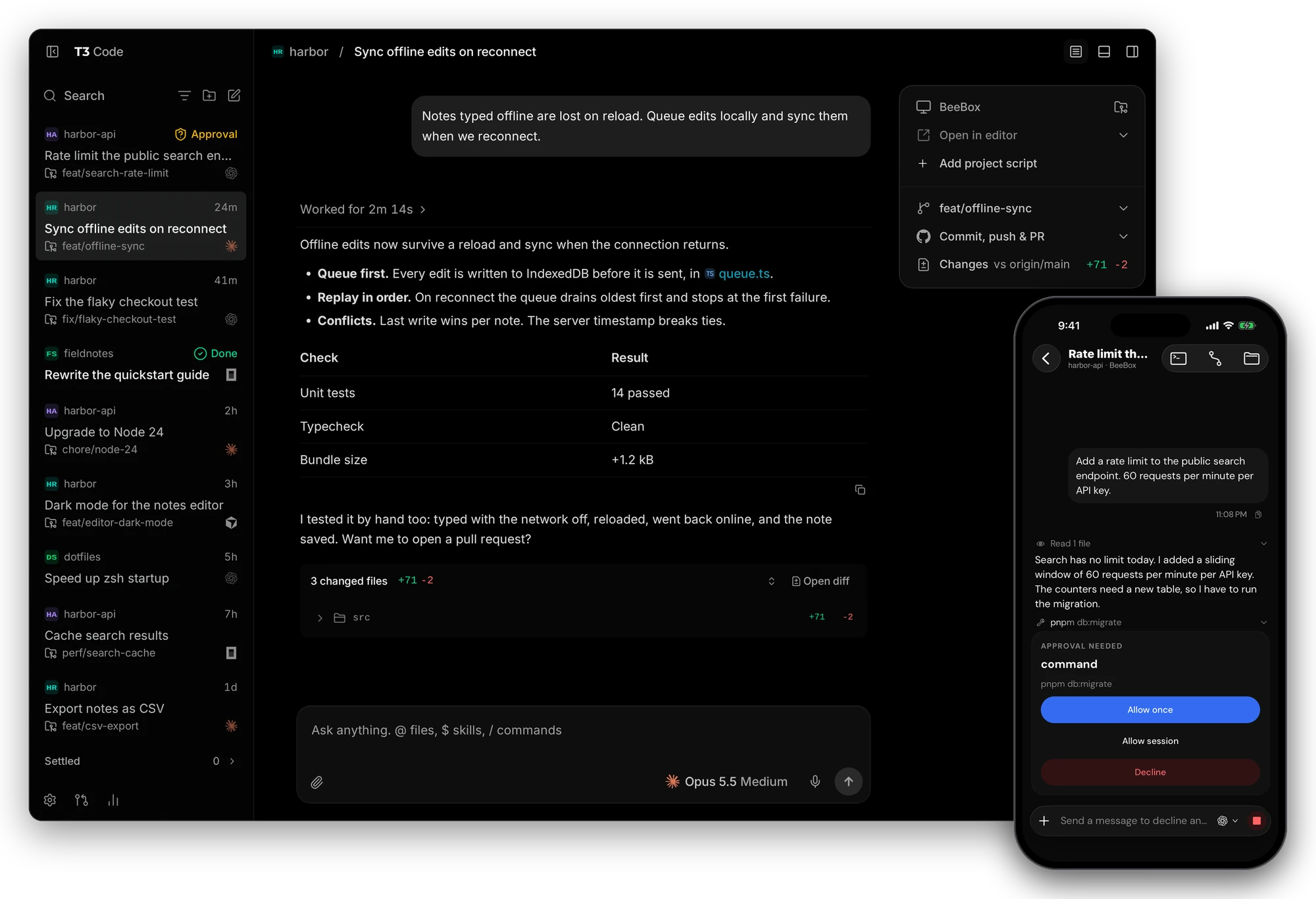
The best way to control Claude Code, Codex and more from any computer or phone
- 77k
- TypeScript
- MIT
- 13 h ago
Risk-Aware AI Code Review for Business-Critical Systems
Repo HexmosTech/LiveReview, read from GitHub 6 h ago. HexmosTech has not joined Take My Repo.
HexmosTech/LiveReview is a public repo on GitHub by HexmosTech. Risk-Aware AI Code Review for Business-Critical Systems. It declares no license on GitHub. Public does not mean open source: without a license, nobody is granted the right to reuse it. It is written mainly in Go, has 164 stars and last changed on 2026-11-24. Nobody has reviewed it on Take My Repo yet, which says nothing about its quality. Read from GitHub on 2026-11-25.
The best way to control Claude Code, Codex and more from any computer or phone
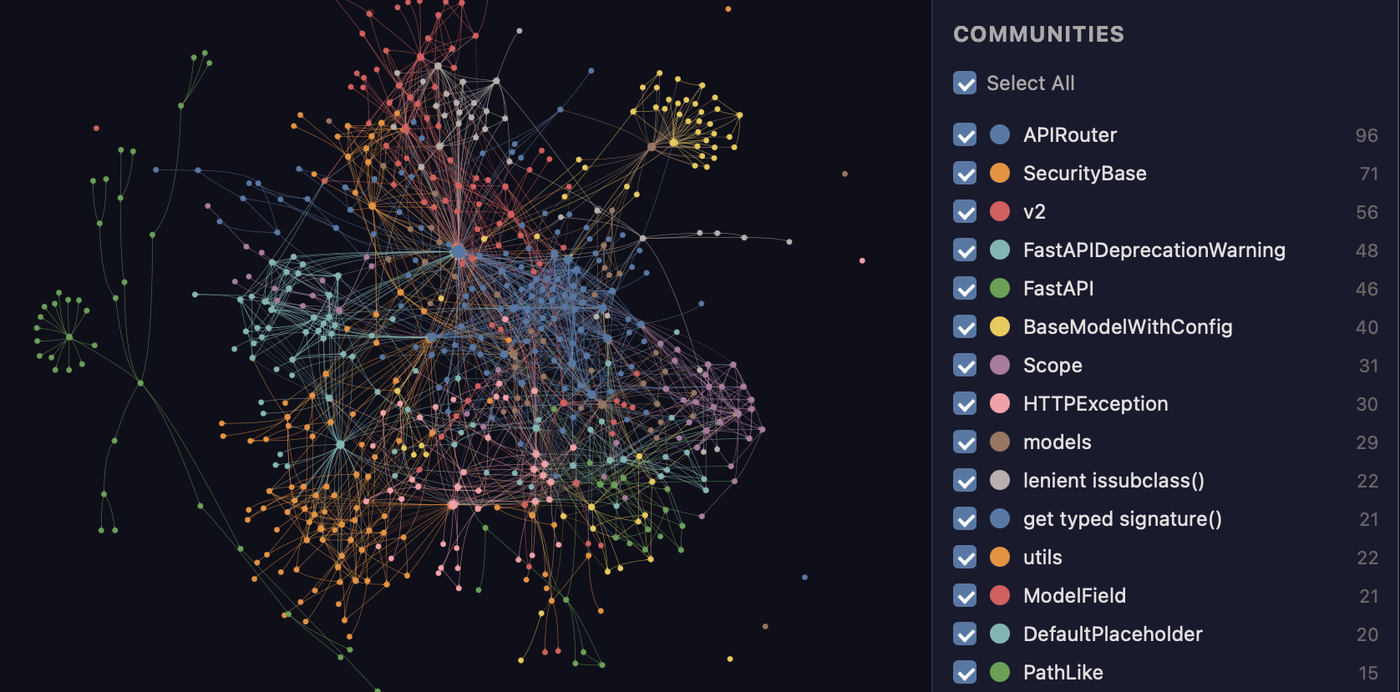
Turn any codebase, with its docs, SQL schemas, configs, and PDFs, into a queryable knowledge graph. A /graphify skill for Claude Code, Cursor, Codex, and Gemini CLI: local deterministic AST parsing, every edge explained, no vector store.

|
LiveReview Try it on cloud → |

LiveReview is built for engineering teams that ship often, but also care about keeping production stable for customers. It approves some 40-50% of low-risk changes automatically, and it gives your team the tools to handle the rest:
Auto-Approve Upto 50% of Your Pull Requests, Safely. Risk scoring decides which MRs/PRs are safe enough to ship without a human, so your team only spends review time on risky and critical changes.
https://github.com/user-attachments/assets/7ebae4b8-22ed-4572-bcfe-d938a8d13ca7
LiveReview auto-approving a low-risk change while routing a risky change to a human reviewer. Click to play.
The risk score blends three signals:
Inspired by Meta's RADAR paper: 50x fewer production incidents, 3x fewer rollbacks, 35% faster reviews.
How it works:
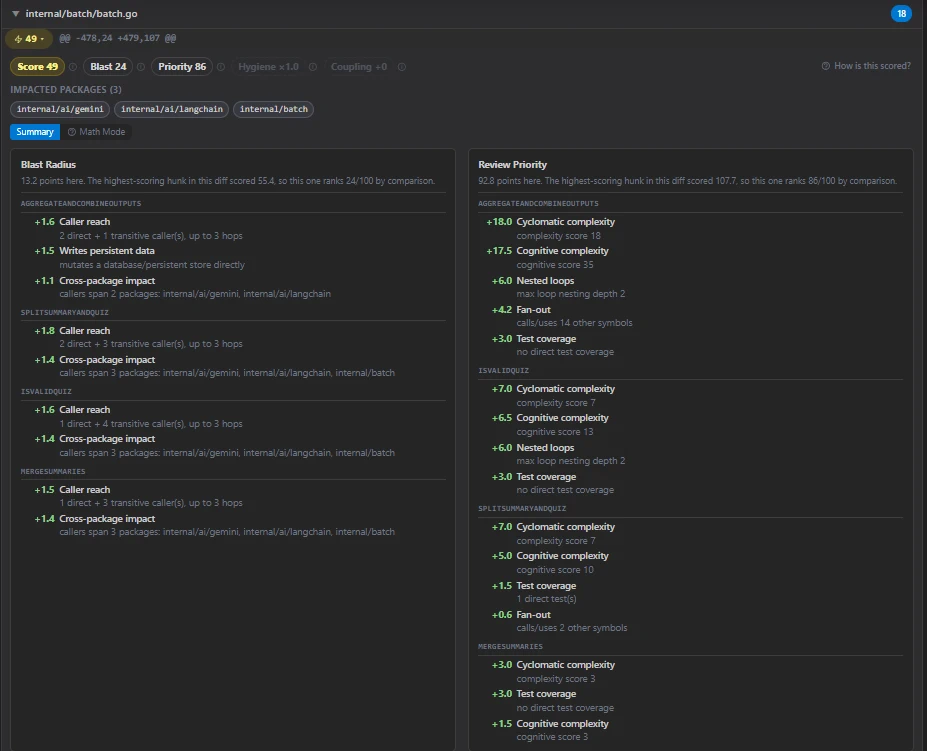
For everything that still goes to a human, LiveReview scores every hunk of a diff by blast radius: how far a change reaches through your call graph, how much persistent state it touches, and how well-tested it is. A 3-line change to a shared auth check can outrank a 300-line UI tweak. Your team's attention goes to the highest-risk code first, not spread evenly across every diff.
https://github.com/user-attachments/assets/b7663ad5-e792-4d24-8452-18bbb9b958a0
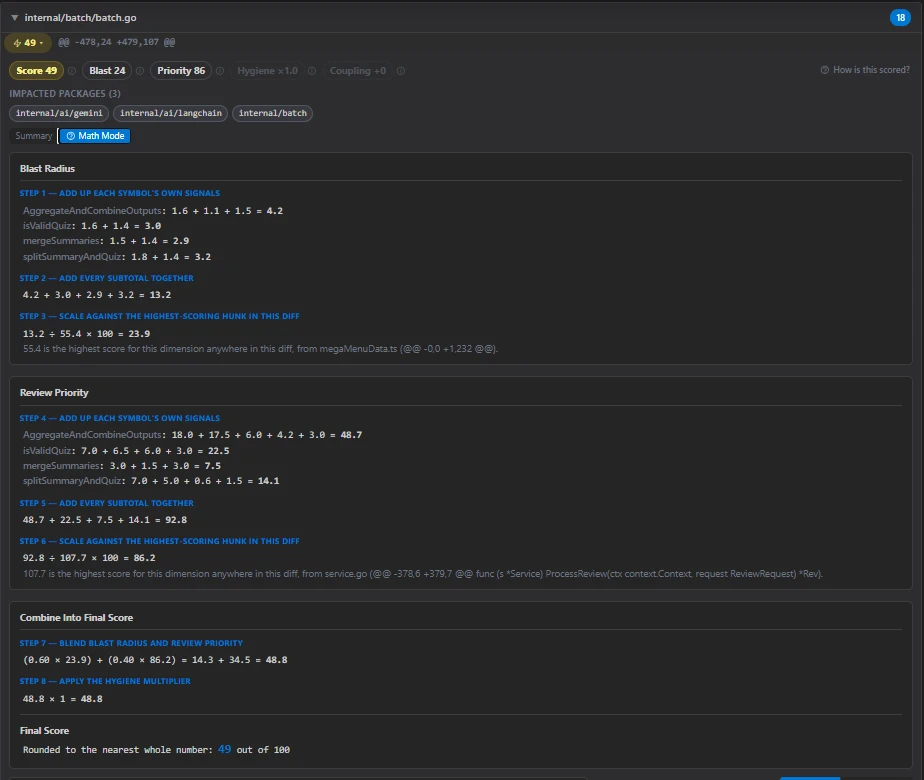
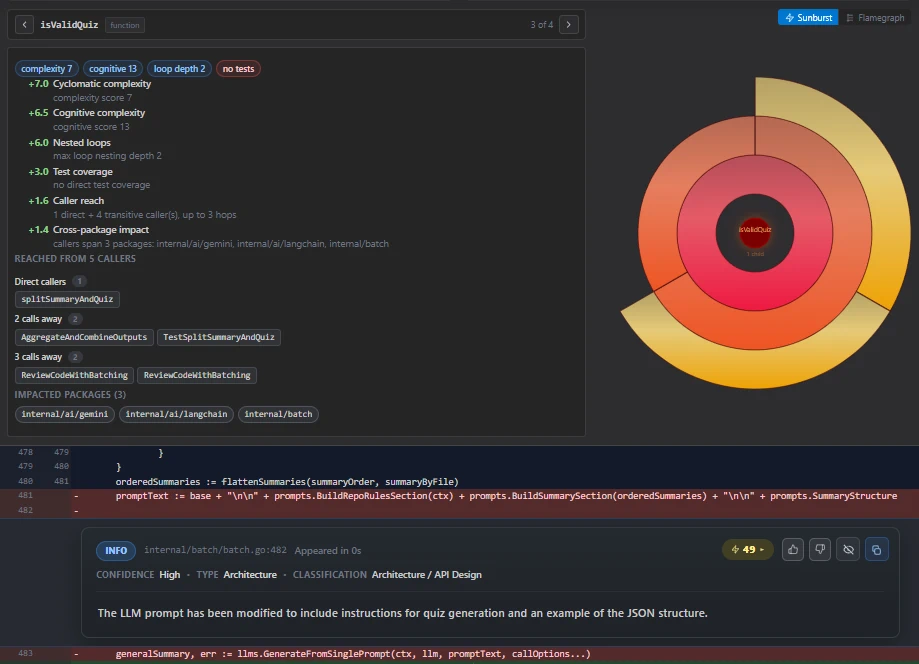
LiveReview's Blast Radius & Review Priority scoring, live in the diff viewer.
| The exact math, not a black box | Visualize blast radius at a glance | Every factor that feeds the score |
|---|---|---|
 |
 |
 |
Here's the goal:
To get there, LiveReview gives each hunk two scores, then combines them into one and ranks every hunk in the diff by it.
LiveReview may add new signals over time. The two questions behind them stay the same: how far, and how much scrutiny.
Self-Host for Free: Get Started in 5 Minutes
Want a guided rollout? Join the 14-Day Transformation Program
LiveReview runs as an independent inspection layer on top of whatever writes your code: Claude, Copilot, Cursor, or anything else. AI can generate code far faster than any human can review it by hand — the leverage comes from an inspection layer that runs at the same speed AI writes, not from slowing the writing down. That independence is what turns engineering competence into business leverage: fewer regressions, less downtime, and fewer quality, performance, and security surprises.
LiveReview organizes around five capabilities, each answering a question your team already asks. Improve feeds straight back into Review: the loop below runs continuously on every commit, not once at setup.
| Pillar | Question it answers | What it covers |
|---|---|---|
| Review | Can we get both speed and quality? | Multi-level review checkpoints (commit, push, MR/PR, CI/CD, scheduled), Auto-Approve, Adaptive Reviews |
| Understand | Can an engineer quickly understand what changed and what it means? | Summary decks, Issue Navigator, PR summaries, Cognitive Coverage / PR Quizzes |
| Enforce | Can we make our engineering standards and review policies actually happen? | Repository Rules, CI/CD Gates, custom prompts, scheduled reviews |
| Improve | How are we doing, and where should engineering improve? | Impact Report, Livi / Data-Backed Decisions |
| Connect | Can we adopt this without disrupting how the team already works? | MCP server & REST API, git-lrc / claude-lrc CLI, IDE extensions |
The result: engineering becomes a business advantage. You stay ahead, your engineers build deep systems understanding, standards get enforced where the work actually happens, and you get speed and quality together.
🚀 Get Started
| I want to... | Go to |
|---|---|
| Try LiveReview free in under 5 minutes | Quick Start |
| Auto-approve low-risk pull requests safely | Auto-Approve |
| Understand Blast-Radius scoring | Within-Diff Prioritization |
| Review a diff with awareness of other connected repos (microservices) | Multi-Repo Context |
| Enforce checks at commit / push / PR / CI | Org-Wide Harness |
| Write a precise, custom rule for blocking a merge | CI/CD Gates |
📊 See the Product In Action
| I want to... | Go to |
|---|---|
| See what risks LiveReview actually catches | Prevent Outages, Breaches & Technical Debt |
| See what LiveReview's analytics can tell my team | Data-Backed Decisions |
| Keep engineers accountable for AI-generated code they didn't write themselves | Cognitive Coverage / PR Quizzes |
| Understand how LiveReview differs from other tools | Why LiveReview |
| See the full feature set | Features |
🔌 Integrate LiveReview
| I want to... | Go to |
|---|---|
| Wire reviews into every commit | Git-Native CLI (git-lrc) |
| Review from inside Claude Code | Git-Native CLI (claude-lrc) |
| Review code without leaving my editor | IDE Extensions |
| Connect LiveReview to Claude, Cursor, or Windsurf | MCP Server |
| Automate LiveReview in CI/CD, scripts, or bots | REST API |
| Enforce my team's own coding standards | Repository Rules |
| Cut AI review costs in half | Adaptive Reviews |
💰 Pricing & Trust
| I want to... | Go to |
|---|---|
| Compare pricing plans | Pricing & Enterprise |
| See how LiveReview stacks up vs Copilot / CodeRabbit / SonarQube / Claude Code | Comparisons |
| Understand LiveReview's security posture | Security |
| Read the full setup and API docs | Full Documentation |
🤝 Get Hands-On Help
| I want to... | Go to |
|---|---|
| Get hands-on help rolling this out to my team | 14-Day Transformation Program |
Get LiveReview running in under 5 minutes. Self-hosting starts free, with the same 30k LOC/month, bring-your-own-key plan available on the cloud. You can scale up from there. See Pricing & Enterprise for the full breakdown.
# Quick demo setup (localhost only, no webhooks)
curl -fsSL https://raw.githubusercontent.com/HexmosTech/LiveReview/master/lrops.sh | sudo bash -s -- setup-demo
Requirements:
bash shell (zsh/fish not officially supported)docker-compose or docker compose)jqAccess your installation:
For teams needing external access and webhooks, follow the Productionization Guide.
| Feature | Demo Mode | Production Mode |
|---|---|---|
| Access | localhost only | External via reverse proxy |
| Webhooks | Disabled (manual triggers) | Enabled (automatic triggers) |
| Configuration | Zero config required | Reverse proxy setup needed |
| Perfect for | Development, testing, demos | Teams, production deployments |
Some tools give you speed and sacrifice quality, or the reverse. Multi-level review checkpoints let you set policy per team and repo, at different gradations, so you get both.
AI writes code faster than any human can review it by hand. LiveReview gives you a checkpoint at every stage where that code could reach production. Turn on the stages that matter to you, per repository.
| Stage | What happens |
|---|---|
| Commit | git lrc review checks your staged changes before the commit happens, right in your terminal. No context switch. |
| Before Push | LiveReview catches issues one last time before code leaves your machine. Skips are explicit (git lrc review --skip) and stay in the git log, so nothing slips through silently. |
HexmosTech/LiveReview is a public repo on GitHub by HexmosTech. Risk-Aware AI Code Review for Business-Critical Systems.
It declares no license on GitHub. Public does not mean open source: without a license, nobody is granted the right to reuse it.
Its maker has not tagged a system, so it is unknown here. Its README says what it needs.
Open "Take it" on its page: Take My Repo writes an install plan for your machine and hands it to your AI agent (Claude Code, Codex or Cursor), which asks you before each step. Take My Repo has not tested it on any machine.
Open-source AI penetration testing tool to find and fix your app’s vulnerabilities.
Secure, fast, efficient, battle-tested at Alibaba's scale. Hybrid architecture code review tool: deterministic pipelines + LLM Agent, precise line-level comments, built-in multi-language ruleset (NPE, thread-safety, XSS, SQL injection), OpenAI & Anthropic compatible.
Local code intelligence for developers and AI agents. Connect code, docs and infrastructure in a persistent graph, with CBM Lens, MCP tools, agent integrations and change-aware test selection.
Its last change on GitHub was on 2026-11-24. Take My Repo does not judge from that whether it is maintained.
Nobody has reviewed it on Take My Repo yet, which says nothing about its quality.
Take My Repo cannot say: it does not audit code and has not run LiveReview. What is known comes from GitHub. It declares no license on GitHub. Public does not mean open source: without a license, nobody is granted the right to reuse it. Its last change was on 2026-11-24. It has 164 stars, which measure popularity, not safety. Nobody has reviewed it on Take My Repo yet, which says nothing about its quality. Read the source before you run it. With "Take it", your AI agent shows each step and asks you before running it; README text is treated as data, not as instructions.