Nightward

Nightward finds AI-tool risks before you sync: MCP risk, local-only state, secret exposure, and reviewable fix plans, all locally.
It scans common Codex, Claude, Cursor, Windsurf, VS Code, Raycast, JetBrains, Zed, Continue, Cline/Roo, Aider, OpenCode, Goose, LM Studio, Ollama/Open WebUI, Neovim, MCP config locations, and repo/workspace AI config; classifies what is portable versus local-only or secret; highlights MCP security findings; and produces redacted analysis signals, fix plans, SARIF policy output, snapshot plans, and dry-run backup plans.
Public docs and the fixture TUI walkthrough live at https://nightward.aethereal.dev/.
Nightward is read-only by default, but it can run explicit, confirmation-gated local actions such as provider installation, provider enable/disable, scheduled scan install/remove, portable config snapshots, policy ignores, and Nightward-owned report/cache cleanup.
[!IMPORTANT]
Nightward is local-first by design: no telemetry, no default network calls, and no cloud dashboard. Write-capable actions are beta operator tools. Users must review previews, confirmations, backups, package-manager behavior, and third-party provider behavior before applying changes. Nightward is provided without warranty, and maintainers are not liable for broken configs, lost data, exposed secrets, or third-party tool side effects.
TUI Preview
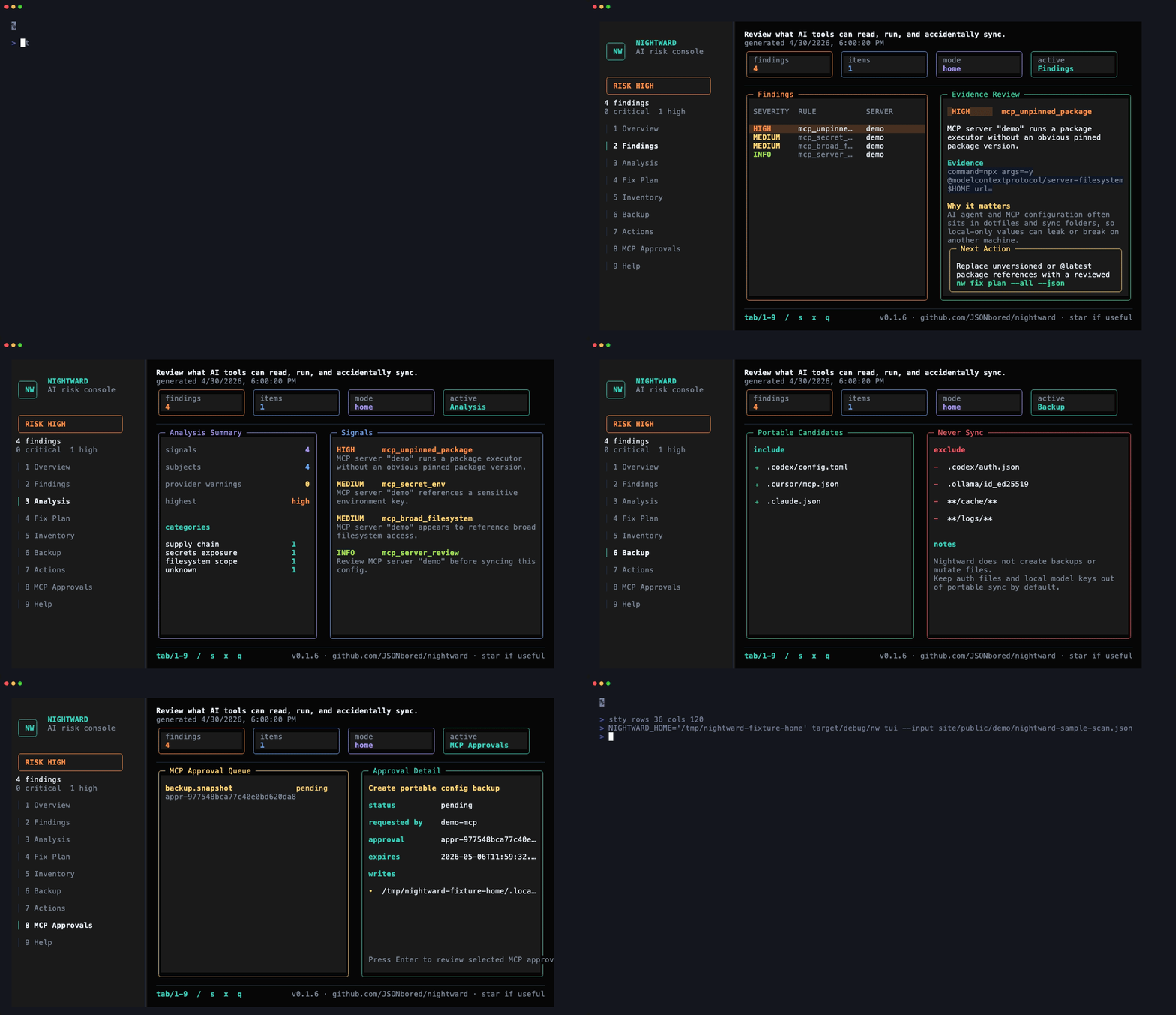
The README uses a GIF so the preview renders directly on GitHub. The docs homepage uses the lighter WebM loop, and the TUI guide keeps the full section gallery.
At A Glance
| Surface |
What it does |
Default write behavior |
| TUI |
Dashboard, inventory, findings, analysis, fix plan, backup preview, action queue |
Read-only until a confirmed action is applied |
| CLI |
Scriptable scan, doctor, policy, SARIF, snapshot, schedule, backup, and action commands |
Read-only unless explicit output/export paths or --confirm actions are requested |
| MCP server |
Stdio tools/resources/prompts for AI clients |
Can request local action approvals; applies only the locally approved action once |
| Raycast |
macOS companion commands plus confirmed Nightward Actions |
Clipboard/report-folder actions plus confirmation-gated writes |
| GitHub Action |
Workspace policy and SARIF checks |
Writes only requested CI outputs |
| Trunk plugin |
Local workspace policy/analyze linters |
Emits SARIF to stdout |
Sample Output
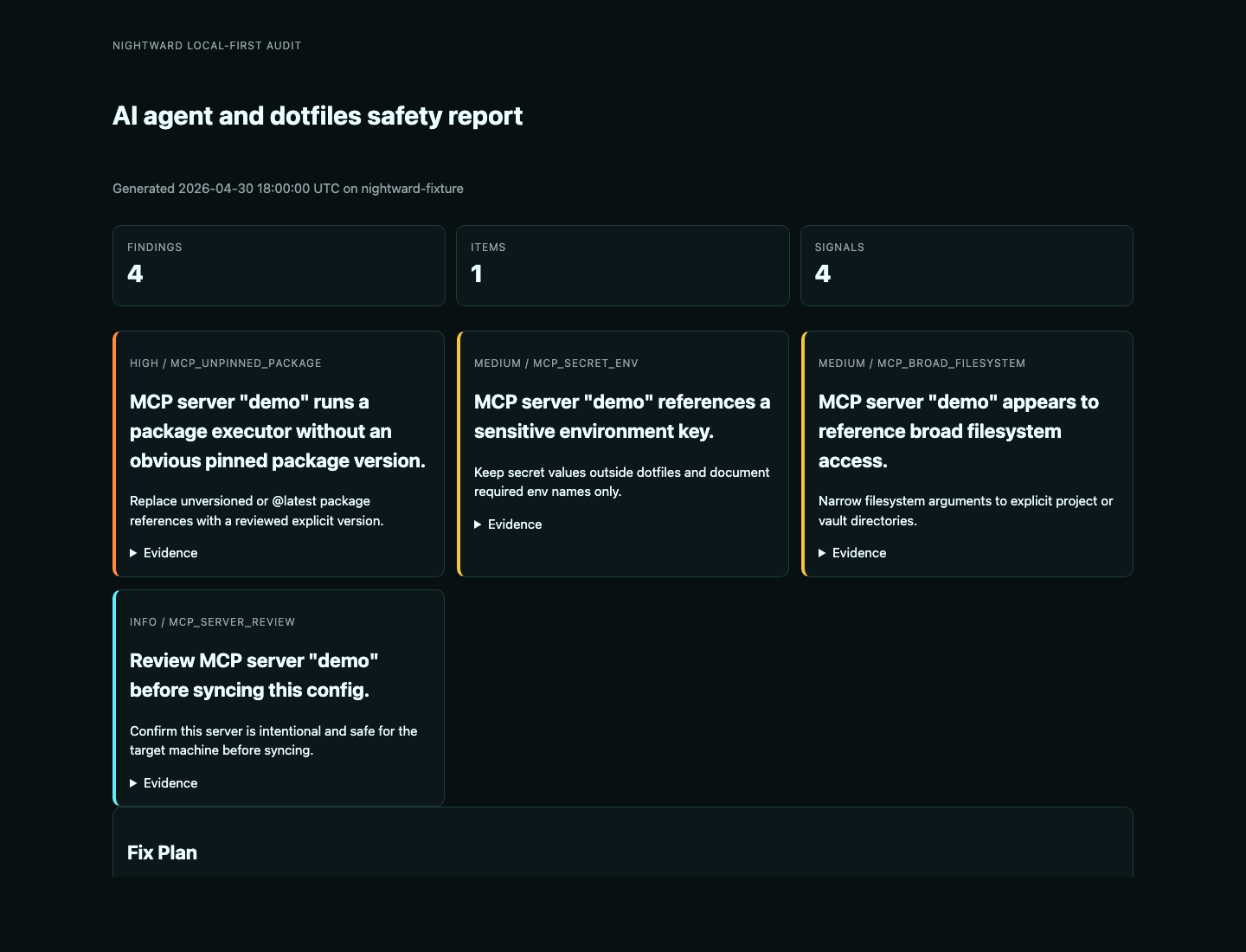
The sample below is generated from the committed fixture home at testdata/homes/policy. Hostname, HOME, local paths, timestamps, and secret-looking fixture values are scrubbed before the JSON, report, or screenshot is committed.
flowchart LR
  configs["AI agent/devtool config"] --> scan["nw scan"]
  scan --> classify["classify paths"]
  scan --> mcp["review MCP trust boundaries"]
  classify --> tui["TUI"]
  classify --> json["redacted JSON"]
  mcp --> findings["findings + analysis signals"]
  findings --> fix["fix exports + action queue"]
  findings --> sarif["policy SARIF"]
  classify --> backup["backup plan + confirmed snapshot"]
Why
AI coding tools scatter useful state across config files, MCP server definitions, skills, rules, commands, extension settings, credentials, caches, and app-owned databases. Blindly syncing all of it is fragile and unsafe.
Nightward answers the practical questions first:
- What exists on this machine?
- What is portable enough for a private dotfiles repo?
- What is machine-local, app-owned, runtime cache, or credential material?
- Which MCP configs deserve security review?
- What exact remediation plan should I consider before syncing?
- What would a backup plan include, review, or exclude before it writes anything?
Highlights
- OpenTUI-powered interactive app with dashboard, findings, analysis, fix plan, inventory, backup preview, action queue, and help sections.
nightward canonical command plus nw short alias.- Redacted JSON for automation and CI.
- HOME scanning for local machines and
--workspace scanning for CI, Trunk, and dotfiles repos.
- MCP findings for unpinned package execution, package-name impersonation risk, remote package sources, shell wrappers, Docker/socket exposure, sensitive env keys, sensitive headers, local/private endpoints, broad filesystem access, token paths, stale configs, app-owned state, parse failures, and unknown server shapes.
- Offline analysis signals for supply-chain, secret exposure, filesystem scope, network exposure, execution risk, machine-local, and app-owned state review.
- Optional provider framework for Gitleaks, TruffleHog, Semgrep, Trivy, OSV-Scanner, Grype, Syft, OpenSSF Scorecard, and Socket; provider installs and online-capable execution stay confirmation/opt-in gated.
- Scan summaries separate inventory buckets from finding buckets: item classification/risk/tool counts are distinct from finding severity/rule/tool counts.
- Remediation metadata: fix kind, confidence, risk, review requirement, impact, steps, and bounded action specs where Nightward can safely preview writes.
- SARIF output for GitHub code scanning.
- Importable Trunk plugin definition for
nightward-policy and nightward-analyze from pinned release tags.
- Optional
.nightward.yml policy config with reason-required ignores.
- Redacted plan-only remediation exports for parseable MCP config findings.
- Read-only snapshot plans plus confirmed portable config snapshot creation.
- Reusable GitHub Action for scan, policy, and SARIF modes.
- Raycast extension for Dashboard, Findings, Analysis, Provider Doctor, Nightward Actions, Explain Finding/Signal, Fix Plan/Analysis export, and report-folder access.
- Stdio MCP server for AI clients that need local scan, analysis, finding, rule, provider, policy, report, prompt, fix-plan, and bounded action context.
- User-level nightly scan scheduling for macOS launchd and Linux systemd user timers.
- No telemetry, no cloud dashboard, and no default network calls from Nightward runtime.
- OpenSSF-oriented project hygiene: DCO, governance docs, threat model, coverage gate, pinned CI actions, release snapshot checks, signed release configuration, and security reporting policy.
[!TIP]
A practical first pass is nw, then nw scan --json, then nw doctor --json.
Install
Try the release-gated npm launcher:
npx @jsonbored/nightward scan
npm install -g @jsonbored/nightward
nw
This installs one Nightward CLI distribution with two command names:
nightward: canonical project commandnw: short alias for frequent terminal/TUI use
For local development from this checkout:
make install-local
The npm package is intentionally a thin launcher for GitHub Release binaries. It does not run a postinstall script; on first execution it downloads the matching release archive, verifies the archive SHA-256 from checksums.txt, rejects unsafe archive entries before extraction, caches the binaries locally, and then runs nightward or nw. Strict environments can set NIGHTWARD_NPM_REQUIRE_SIGSTORE=1 to require Cosign verification of checksums.txt.sigstore.json before trusting the checksum file.
Quick Start
Open the TUI:
nw
Review a saved scan in the same TUI:
nw tui --input scan.json
Scan local HOME state and emit redacted JSON:
nw scan --json
Scan a repo/workspace instead of HOME:
nw scan --workspace . --json
Check local assumptions:
nw doctor --json
Accept the beta responsibility disclosure before write-capable actions:
nw disclosure accept
List and explain findings:
nw findings list
nw findings explain mcp_unpinned_package-abc123
Generate a plan-only fix report:
nw fix plan --json
nw fix plan --rule mcp_secret_env
nw fix export --format markdown
Run offline analysis and provider checks:
nw analyze --json
nw analyze --workspace . --json
nw analyze package npm:@modelcontextprotocol/server-filesystem --json
nw analyze finding mcp_unpinned_package-abc123 --json
nw providers list --json
nw providers doctor --with syft,gitleaks --json
nw rules list --json
nw rules explain mcp_secret_header --json
Online-capable providers remain blocked until explicitly allowed:
nw providers doctor --with trivy,grype,scorecard,socket --online --json
nw analyze --workspace . --with trivy,osv-scanner,grype,scorecard,socket --online --json
Create or explain policy config:
nw policy init
nw policy explain
nw policy check --config .nightward.yml --strict --json
nw actions apply policy.ignore --finding mcp_server_review-abc123 --reason "reviewed locally" --confirm
Generate a dry-run backup plan:
nw plan backup
Generate a read-only snapshot plan:
nw snapshot plan --output ~/nightward-snapshots --json
Render a local static HTML report from redacted scan JSON:
nw scan --json --output /tmp/nightward-scan.json
nw report html --input /tmp/nightward-scan.json --output /tmp/nightward-report.html
nw report diff --from /tmp/previous-scan.json --to /tmp/nightward-scan.json
nw report html --from /tmp/previous-scan.json --to /tmp/nightward-scan.json --output /tmp/nightward-report.html
nw tui --from /tmp/previous-scan.json --to /tmp/nightward-scan.json
nw report html
nw report history
nw report latest
Run policy checks or generate SARIF:
nw policy check --strict --json
nw policy sarif --output nightward.sarif
nw policy check --workspace . --include-analysis --strict --json
nw policy sarif --workspace . --include-analysis --output -
nw policy badge --workspace . --include-analysis --sarif-url https://example.invalid/nightward.sarif --output nightward-badge.json
Expose Nightward to MCP-capable AI clients:
nw mcp serve
Preview scheduled nightly scans:
nw schedule plan --preset nightly
nw schedule install --preset nightly --dry-run
nw schedule remove --dry-run
Classification Model
Nightward classifies discovered state as:
portable: usually safe to sync after reviewmachine-local: tied to local paths, identities, or machine assumptionssecret-auth: credentials or auth material; excluded by defaultruntime-cache: generated runtime data; excluded by defaultapp-owned: databases, extension binaries, encrypted app state, or caches owned by another appunknown: found state Nightward cannot classify confidently
Backup plans include portable items, mark machine-local/unknown items for review, and exclude secret/auth, runtime-cache, and app-owned state by default.
flowchart TD
  found["Discovered path"] --> bucket{"Classification"}
  bucket -->|portable| include["include in private backup plan"]
  bucket -->|machine-local or unknown| review["review before syncing"]
  bucket -->|secret-auth| excludeSecret["exclude by default"]
  bucket -->|runtime-cache| excludeCache["exclude by default"]
  bucket -->|app-owned| export["prefer app-supported export"]
[!WARNING]
Do not blindly sync secret-auth, runtime-cache, or app-owned paths. Nightward excludes them by default because those files often contain credentials, generated state, or app-private databases.
Fix Plan Model
Nightward separates review guidance from apply-capable actions. Fix plans remain structured review material for high-risk MCP edits, while the shared action layer can apply bounded local operations when Nightward knows the exact write surface:
pin-package: pin npx, uvx, or pipx package execution when the package name is parseableexternalize-secret: move inline secret values out of agent config and keep only env key names or setup docsreplace-shell-wrapper