ECC
The agent harness performance optimization system. Skills, instincts, memory, security, and research-first development for Claude Code, Codex, Opencode, Cursor and beyond.
- 310k
- JavaScript
- MIT
- 22 h ago
Compile organizational policy into verifiable decision training data.
Repo Juneo-Lab/decision-forge, read from GitHub 1 min ago. Juneo-Lab has not joined Take My Repo.
Juneo-Lab/decision-forge is a public repo on GitHub by Juneo-Lab. Compile organizational policy into verifiable decision training data. It declares the Apache-2.0 license on GitHub. It is written mainly in Python, has 352 stars and last changed on 2026-11-22. Nobody has reviewed it on Take My Repo yet, which says nothing about its quality. Read from GitHub on 2026-11-24.
The agent harness performance optimization system. Skills, instincts, memory, security, and research-first development for Claude Code, Codex, Opencode, Cursor and beyond.

Compile organizational policy into verifiable decision training data.
Every organization's judgment, turned into the data that makes AI agents trustworthy.
Why Decision Forge · See it in action · Quickstart · How it works · Documentation · Roadmap · Contributing · Changelog
English · 简体中文

For three hundred years, every organization was built from people. The next ones will be built from people and agents — and the agents will outnumber the people.
A second workforce has arrived. Agents now carry a task for hours without supervision, take on work that once went to a colleague, and call one another across tools and companies. For the first time, the supply of labor is no longer bounded by the number of people. Yet this abundance of intelligence has not become an abundance of capability. Agents wait in pilots because they are trusted with too little, or act in production while trusted with too much.
What is missing is trust. Over centuries, organizations learned to hand their work to thousands of strangers. People foresee what their actions will do, act within their authority, and answer for the results. Agents have been connected to every tool and to each other, but given none of this. The pipes are built. The trust layer is empty.
Trust begins with foresight. To trust an action is to know what it will do before it happens. Language models learned to speak from the world's text; world models are learning physics from its video. No public dataset records what happens inside an organization when an agent reassigns a client, shares a file, or approves a payment. That knowledge lives only within the organization, in three forms:
| What foresight requires | Where it lives | What Decision Forge does with it |
|---|---|---|
| Decision context: the state, roles, and options at the moment of action | Workflows, tickets, CRM records | Reconstructs each decision moment with explicit candidate actions, grouped into families |
| Judgment standard: what this organization allows, forbids, or escalates | Handbooks, SOPs, approval rules, permission tables | Compiles rules with verified source quotations, puts them through business review, and replays them to label every example |
| Execution receipts: what actually happened after the action | Approvals, outcomes, runtime logs | Ingests runtime events and reviewed outcomes as feedback for the next dataset version |
Every organization has its own sense of right. What one firm encourages, another forbids. That judgment cannot be downloaded from a general model. It has to be learned inside each organization, and it has to belong to that organization.
Decision Forge turns that judgment into data. It compiles an organization's own documents into verified decision training data: every label traces back to a rule, every rule back to its source, and the core runs inside the organization's own walls. It is the foundation of the stack we are building at Juneo Lab:
| Layer | Role | Status |
|---|---|---|
| AI-native organizations | People and agents allocate work, share information, act, and accept results together; their execution receipts flow back into the data | Built with partner organizations |
| Laplace | A causal-interventional decision model. It foresees the consequence of each candidate before an agent acts, and makes the four decisions an organization delegates | Open weights: Laplace-1-Atlas (27B) and Laplace-1-Vector (4B), trained entirely on Decision Forge data |
| Decision Forge | An organization's documents, turned into verified decision training data | Open source, this repository |
The world we are building. Humans keep the right to decide. Agents earn the right to act, within limits that only narrow as work passes from hand to hand. Every action is foreseen before it happens, and every contribution is measured after it is done. Every organization owns the intelligence that carries its judgment.
We are building the trust layer that lets human organizations keep pace with machine intelligence. Read the full story in Why Decision Forge.
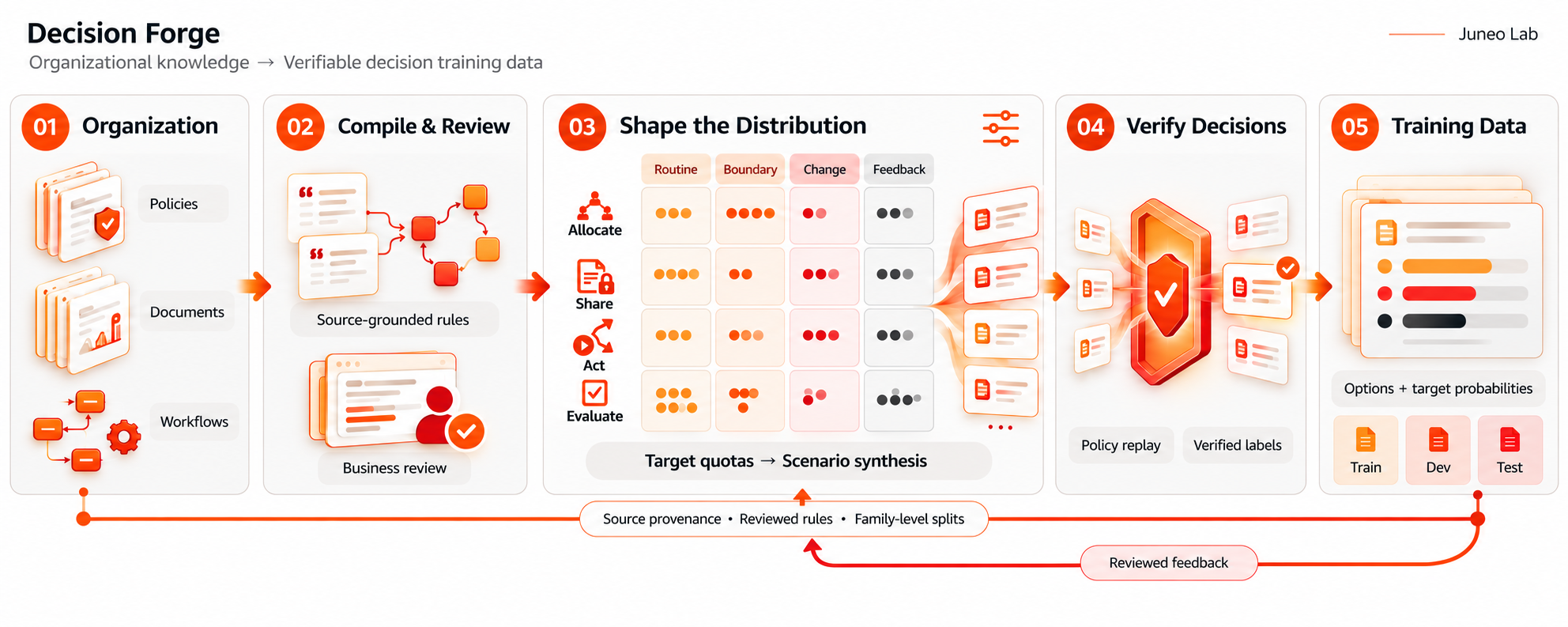
Organizational decisions depend on policies, thresholds, escalation rules, and acceptance criteria recorded in handbooks, SOPs, and workflow definitions. Decision Forge turns that knowledge into reproducible supervision for decision models.
The document compiler proposes a rule specification with source quotations for business review. The data pipeline evaluates scenarios against the approved rules and exports decision examples with verified labels, source provenance, and stable family assignments. The result is training data you can audit, reproduce, and hand to a trainer.
Note
Status: v0.4.0 alpha — organizational decision data pipeline.
Reviewed or authored specifications build into training data locally, without model credentials.
Document compilation and model-assisted synthesis use an explicitly selected model endpoint.
See project status for the current implementation and next milestones.
| Capability | What you get |
|---|---|
| Trains real models | Laplace-1 is trained entirely on Decision Forge data and is best or tied for best on 7 of 9 decision benchmarks (27B) and 7 of 8 (4B) |
| Offline data path | Reviewed rules → scenarios → verified labels → exports, with no API keys or model downloads |
| Policy-verified labels | Recomputed from declared rules by a deterministic interpreter |
| Source provenance | Verified rule quotations and source hashes; corpus compilation adds spans and locators |
| Leak-resistant splits | Related variants share a family split; cross-split duplicates are reported and dropped |
| Training-ready exports | Four formats, including the candidate-readout decision contract |
| Broad ingestion | Text, Markdown, JSON/YAML, PDF, DOCX/XLSX/PPTX, HTML, CSV/TSV, and local OCR |
| Validated | 371 tests, 91.28% statement coverage in the full optional-adapter environment |
| Continuous checks | 10 CI jobs across Linux and macOS, including adapter, OCR, and Harbor controls; CodeQL and OpenSSF Scorecard scans |
Two fictional organizations, a speed-first startup and a clinic network, deploy agents that attempt the same actions. Each writes its own policy, and Decision Forge compiles each into verified decisions:
| Agent action | Lumen Labs | Halcyon Health |
|---|---|---|
| Refund 400 to a verified customer | proceed: “Agents may issue refunds of up to 1000 dollars to verified customers without approval.” | hand back: “Every other refund for a verified patient goes to a person in patient accounts.” |
| Send a health record to an internal team | send in full: “Agents may share full customer records with internal teams.” | send a summary: “Health information may reach internal teams only as a minimum-necessary summary.” |
| Delegate more authority than the agent holds | block: “An agent must never delegate more authority than it holds.” | block: “An agent must never delegate more authority than it holds.” |
Of 17 situations, 8 are decided differently, and every decision cites the sentence that governs it. Run the agent delegation example offline in one command.
compile-corpus drafts rules from organization sources through an explicitly selected model endpoint;
business review accepts them, or an authored specification skips both steps. Everything after review
runs offline: scenario families and quotas, label replay through the policy interpreter, deduplication
with family split isolation, and training exports.
The pipeline organizes workflow decision points into the four kinds of decisions an organization delegates to people and agents:
| Surface | Question the model learns to answer |
|---|---|
| Allocate work | Which person or agent should own this task? |
| Share information | Which recipient may receive which information? |
Act (select_actions) |
Should the workflow execute, adjust, or request authorization? |
| Evaluate outcomes | Does the deliverable meet the acceptance criteria? |
Requires Python 3.11+ and uv. No API keys, no model downloads. New here? The five-minute tutorial goes from a written policy to training data, and the notebook version runs in Colab.
git clone https://github.com/Juneo-Lab/decision-forge
cd decision-forge
uv sync --group dev

uv run decision-forge validate examples/customer_support/project.yaml
uv run decision-forge build    examples/customer_support/project.yaml --output runs/demo
uv run decision-forge export   runs/demo --output runs/demo-decision --format decision
The fictional Northstar Support example is deliberately small (one handbook, ~1.2 KB of policy) and
produces a complete, verified dataset:
| Output | Value |
|---|---|
| Accepted episodes | 336 (requested 336, realized 336) |
| By surface | 96 allocate · 96 share · 96 act · 48 evaluate |
| By split | 196 train · 84 development · 56 test, assigned per family |
| Rejected for having no permitted choice | 0 |
| Model calls | 0 |
Artifacts in runs/demo/: episodes.jsonl, rejected.jsonl, distribution.json, dedup.json,
report.json, report.md, a hash-bound project.snapshot.json, and an integrity-checked
manifest.json. Rebuilding reuses content-addressed scenario caches; changing an input is detected
and refused rather than silently mixed into the old run.
The example's committed project.splits.lock.json records every family's split, so adding scenario
families later never moves an existing family between training and held-out data.
Each published scenario label is recomputed by the policy interpreter. Source checks and review records connect the declared rules to the organization's documents.
| Property | How it is enforced |
|---|
Juneo-Lab/decision-forge is a public repo on GitHub by Juneo-Lab. Compile organizational policy into verifiable decision training data.
It declares the Apache-2.0 license on GitHub.
Its maker tagged it for macOS, Windows and Linux, or as Docker or cross-platform. That is declared by the maker; Take My Repo has not tested it.
Open "Take it" on its page: Take My Repo writes an install plan for your machine and hands it to your AI agent (Claude Code, Codex or Cursor), which asks you before each step. Take My Repo has not tested it on any machine.
The official repository for the AiiDA code
Local UI to run and train LLMs and diffusion models. Supports GGUF, MLX, Qwen3.8, DeepSeek-V4.1, MiniMax-H3, Gemma 4, FLUX and more.
Its last change on GitHub was on 2026-11-22. GitHub counts 22 open issues and pull requests. Take My Repo does not judge from that whether it is maintained.
Nobody has reviewed it on Take My Repo yet, which says nothing about its quality.
Take My Repo cannot say: it does not audit code and has not run decision-forge. What is known comes from GitHub. It declares the Apache-2.0 license on GitHub. Its last change was on 2026-11-22. It has 352 stars, which measure popularity, not safety. Nobody has reviewed it on Take My Repo yet, which says nothing about its quality. Read the source before you run it. With "Take it", your AI agent shows each step and asks you before running it; README text is treated as data, not as instructions.