VoiceStudio
VoiceStudio is the open-source, fully-local ElevenLabs alternative — voice cloning, voice design, video dubbing, dictation, transcription & audiobook creation in 646 languages.
- 118k
- Python
- AGPL-3.0
- 14 h ago
Easy, fast, and memory-efficient structure prediction inference
Repo NVIDIA-BioNeMo/BioNeMo-Inference-Runtime, read from GitHub 11 h ago. NVIDIA-BioNeMo has not joined Take My Repo.
NVIDIA-BioNeMo/BioNeMo-Inference-Runtime is a public repo on GitHub by NVIDIA-BioNeMo. Easy, fast, and memory-efficient structure prediction inference. It declares the Apache-2.0 license on GitHub. It is written mainly in Python, has 85 stars and last changed on 2026-11-19. Nobody has reviewed it on Take My Repo yet, which says nothing about its quality. Read from GitHub on 2026-11-24.
VoiceStudio is the open-source, fully-local ElevenLabs alternative — voice cloning, voice design, video dubbing, dictation, transcription & audiobook creation in 646 languages.
Easy, fast, and memory-efficient structure prediction inference
GPU-accelerated inference for protein, nucleic-acid, and ligand structure prediction models — from FASTA/MSA to PDB/mmCIF.
BioNeMo Inference Runtime (BioIR) is NVIDIA's library for structure-prediction
inference. A five-stage GPU pipeline turns AlphaFold-lineage and all-atom models
into PDB/mmCIF with confidence scores. Models stay ordinary nn.Modules — no
TensorRT engine build.
BioIR is in a Beta state, may not be fully functional, may contain errors or design flaws, and may be changed at any time without notice. We appreciate your feedback to improve and iterate on our products.
The notice and disclaimer applies to separately downloaded dependencies, model checkpoints, and metadata.
manylinux_2_34, so the host needs glibc 2.34 or newer — Ubuntu 22.04, RHEL 9
or later.cp312-abi3 stable ABI and supports all three versions.PyTorch and the CUDA math libraries arrive as wheel dependencies, or in
nvcr.io/nvidia/pytorch:26.09-py3 when you use the container. Building the
extension from source outside a container needs a C++17 compiler and CUDA
headers as well — docs/dev.md.
BioIR runs on the Ampere, Ada Lovelace, Hopper, and Blackwell GPUs listed in the support matrix. The doc also shows which fused kernels apply to each architecture. Benchmarks page shows detailed speedup, memory, and accuracy for these GPUs: H200, H100, A100, L40S, GB200, and GB300.
BioIR is published on PyPI, one wheel per CPU architecture:
pip install bionemo-ir
The wheel ships the kernels precompiled. It needs the driver's libcuda.so.1,
but no local CUDA Toolkit or NGC image. pip installs PyTorch, CUDA libraries,
and other dependencies separately. Some dependencies build from source, and
Triton needs a C compiler and Python headers on first use. See
docs/install.md for the full requirements. The container
below is for working on BioIR itself.
Configure SSH authentication with GitHub, then clone the repository and fetch its submodules and LFS objects.
git lfs install &&
  GIT_LFS_SKIP_SMUDGE=0 \
    git clone --recurse-submodules \
    git@github.com:NVIDIA-BioNeMo/BioNeMo-Inference-Runtime.git &&
  cd BioNeMo-Inference-Runtime
On a host with the required compiler and CUDA headers, uv provisions the pinned Python and exact dependency set, builds the editable extension, and runs tools inside that environment:
uv sync --locked
uv run --locked scripts/fetch_weights.sh --model boltz-2
uv run --locked python examples/folding/run_demo.py --output-dir output
The supported container workflow remains available when the host is not configured:
docker/dev.sh
Then run inside its shell:
uv lock --check
uv pip install --no-deps -e .
scripts/fetch_weights.sh --model boltz-2
python examples/folding/run_demo.py --output-dir output
Checkpoints come from their upstream publishers and need no NVIDIA credentials;
anything that cannot be fetched is skipped, and the tests needing it skip too.
Running uv run --locked scripts/run_tests.sh on the host, or
scripts/run_tests.sh in the container, stages weights and runs the suite the
way CI does.
See docs/dev.md
for the host prerequisites, environment details and wheel build.
docs/ref/docker-images.md covers the images and
what docker/dev.sh mounts.
BioIR documentation lives under docs/ and is published with Fern:
build_processorbuild_processor, model constructors,
inputs/outputsBaseConfig tree and
pipeline stage configsbuild_processor
demoFolding benchmarks over a bench set the shipped
rebuild_dataset.py builds from RCSB
and NVIDIA's MSA Search NIM — there is no dataset release to download.
Template-bearing samples included: both sides load every bundled MSA and attach
every listed template.
model.forward(). Featurization, transfers,
postprocessing, writing, and scoring stay outside the window.torch.compile when it
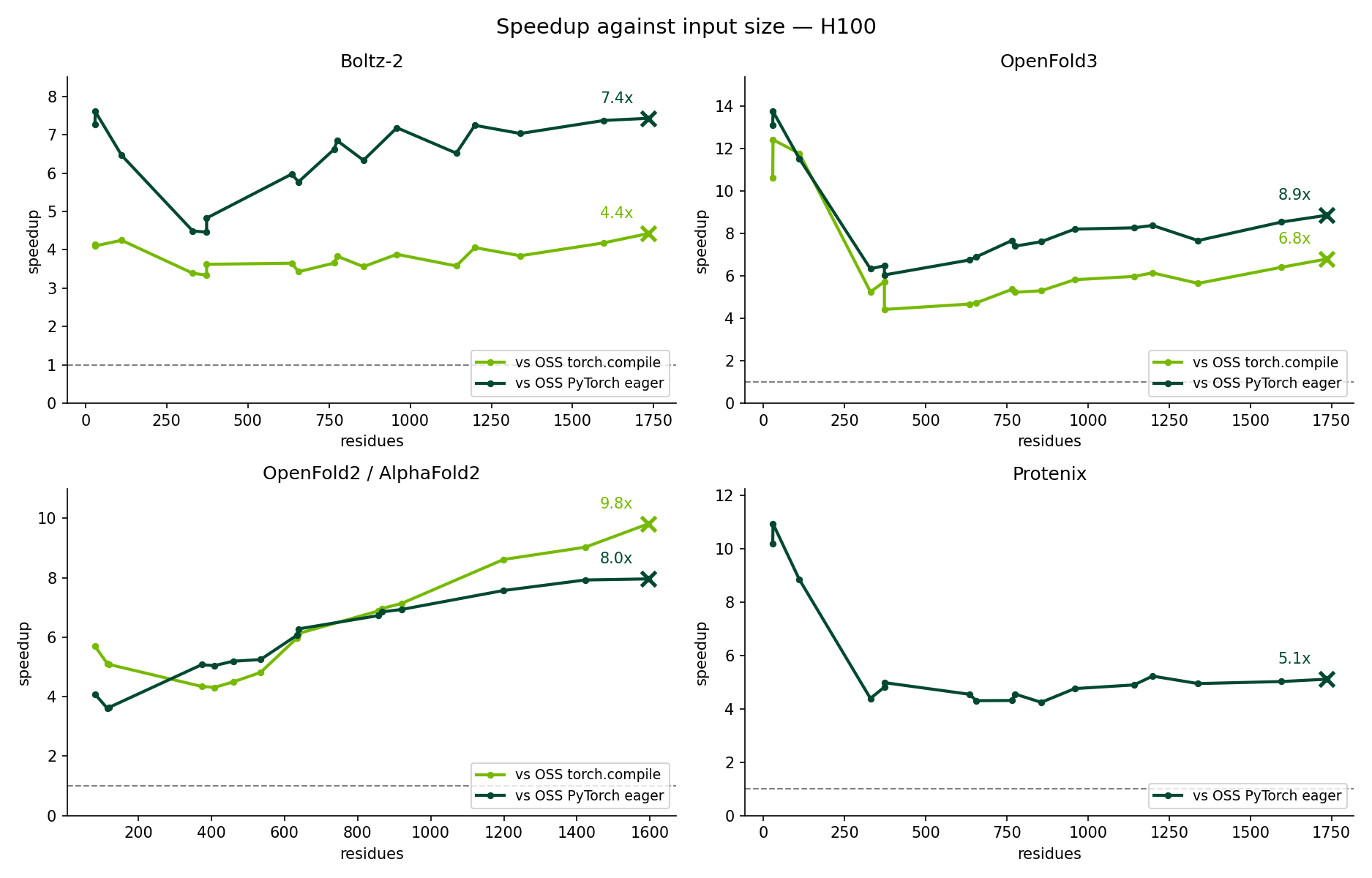
passes a dynamic-shape probe.OSS forward / BioIR forward; above 1 favors BioIR.| Model | H100 | H200 |
|---|---|---|
| Boltz-2 | 3.81x / 6.35x | 4.33x / 6.19x |
| OpenFold3 | 6.27x / 8.20x | 5.63x / 7.93x |
| OpenFold2 / AlphaFold2 monomer | 6.08x / 5.70x | 5.98x / 6.02x |
| OpenFold2 / AlphaFold2 multimer | 5.27x / 6.03x | 5.25x / 6.09x |
| Protenix | — / 5.37x | — / 5.03x |
Geomean speedup, vs OSS torch.compile / vs OSS PyTorch eager; above 1 favours
BioIR. Protenix has no torch.compile path. Twelve GPUs, per-model accuracy
and peak memory, and how to reproduce any of it:
docs/ref/benchmark.md.
The bench-perf-oss agent skill has
the full gates, environment isolation, result schema, and charting protocol.
We welcome contributions. See contributing.md for
policy and docs/dev.md for the development workflow.
If you use BioIR in your research, please cite it via
CITATION.cff.
SECURITY.md — do not
file a public issueNVIDIA-authored BioIR code is licensed under the Apache License 2.0. Distribution compliance material is available here:
NVIDIA-BioNeMo/BioNeMo-Inference-Runtime is a public repo on GitHub by NVIDIA-BioNeMo. Easy, fast, and memory-efficient structure prediction inference.
It declares the Apache-2.0 license on GitHub.
Its maker has not tagged a system, so it is unknown here. Its README says what it needs.
Open "Take it" on its page: Take My Repo writes an install plan for your machine and hands it to your AI agent (Claude Code, Codex or Cursor), which asks you before each step. Take My Repo has not tested it on any machine.
Turn any AI agent into an AI Scientist. The #1 Agent Skills library for science, used by 250,000+ scientists worldwide. 177 ready-to-use validated skills plus 100+ scientific databases covering biology, chemistry, medicine, and drug discovery. Compatible with Cursor, Claude Code, Codex, Pi, Antigravity, and the open Agent Skills standard.
Tensors and Dynamic neural networks in Python with strong GPU acceleration
List of papers about Proteins Design using Deep Learning
A high-throughput and memory-efficient inference and serving engine for LLMs
State-of-the-Art Deep Learning scripts organized by models - easy to train and deploy with reproducible accuracy and performance on enterprise-grade infrastructure.
Its last change on GitHub was on 2026-11-19. Take My Repo does not judge from that whether it is maintained.
Nobody has reviewed it on Take My Repo yet, which says nothing about its quality.
Take My Repo cannot say: it does not audit code and has not run BioNeMo-Inference-Runtime. What is known comes from GitHub. It declares the Apache-2.0 license on GitHub. Its last change was on 2026-11-19. It has 85 stars, which measure popularity, not safety. Nobody has reviewed it on Take My Repo yet, which says nothing about its quality. Read the source before you run it. With "Take it", your AI agent shows each step and asks you before running it; README text is treated as data, not as instructions.