VoiceStudio
VoiceStudio is the open-source, fully-local ElevenLabs alternative — voice cloning, voice design, video dubbing, dictation, transcription & audiobook creation in 646 languages.
- 117k
- Python
- AGPL-3.0
- 4 h ago

CUDA Templates and Python DSLs for High-Performance Linear Algebra
Repo NVIDIA/cutlass, read from GitHub 7 h ago. NVIDIA has not joined Take My Repo.
NVIDIA/cutlass is a public repo on GitHub by NVIDIA. CUDA Templates and Python DSLs for High-Performance Linear Algebra. It declares no license on GitHub. Public does not mean open source: without a license, nobody is granted the right to reuse it. It is written mainly in C++, has 10,757 stars and last changed on 2026-11-23. Nobody has reviewed it on Take My Repo yet, which says nothing about its quality. Read from GitHub on 2026-11-23.
CUTLASS 4.9.0 - Nov. 2026
CUTLASS is a collection of abstractions for implementing high-performance matrix-matrix multiplication (GEMM) and related computations at all levels and scales within CUDA. It incorporates strategies for hierarchical decomposition and data movement. CUTLASS decomposes these "moving parts" into reusable, modular software components and abstractions.
Primitives for different levels of a conceptual parallelization hierarchy can be specialized and tuned via custom tiling sizes, data types, and other algorithmic policy. The resulting flexibility simplifies their use as building blocks within custom kernels and applications.
CUTLASS has been providing CUDA C++ template abstractions for high-performance linear algebra since 2017 and these abstractions provide extensive support for a wide range of computations including mixed-precision computations, specialized data-movement (async copy) and multiply-accumulate abstractions for FP64, FP32, TF32, FP16, BF16, FP32 emulation via tensor core instruction, 8b floating point types (e5m2 and e4m3), block scaled data types (NVIDIA NVFP4 and OCP standard MXFP4, MXFP6, MXFP8), narrow integer types (4 and 8b signed and unsigned integers), and binary 1b data types (where architectures allow for the native support of such data types) across NVIDIA's Volta, Turing, Ampere, Ada, Hopper, and Blackwell architectures.
To this rich ecosystem of C++ based kernel programming abstractions, CUTLASS 4 adds CUTLASS DSLs. These are Python native interfaces for writing high-performance CUDA kernels based on core CUTLASS and CuTe concepts without any performance compromises. This allows for a much smoother learning curve, orders of magnitude faster compile times, native integration with DL frameworks without writing glue code, and much more intuitive metaprogramming that does not require deep C++ expertise.
Overall, we envision CUTLASS DSLs as a family of domain-specific languages (DSLs). With the release of 4.0, we released the first of these in CuTe DSL. This is a low-level programming model that is fully consistent with CuTe C++ abstractions - exposing core concepts such as layouts, tensors, hardware atoms, and full control over the hardware thread and data hierarchy.
CuTe DSL demonstrates optimal matrix multiply and other linear algebra operations targeting the programmable, high-throughput Tensor Cores implemented by NVIDIA's Ampere, Hopper, and Blackwell architectures.
We believe it will become an indispensable tool for students, researchers, and performance engineers alike - flattening the learning curve of GPU programming, rapidly prototyping kernel designs, and bringing optimized solutions into production.
CuTe DSL is currently in public beta and will graduate out of beta by end of summer 2026.
To get started quickly - please refer :
New features:
@cute.jit, @cute.kernel, and cute.compile without an opt-in flag. Programs that do not require extension APIs can select the previous compiler path with CUTE_DSL_USE_EXTENSION_COMPILER=0 or, per compilation, cute.compile[cute.DisableCuteExtCompile](...).jax.vmap with with cutlass_calloptions="--divmod-semantics=python" to select Python floor-division and modulo semantics, or options="--divmod-semantics=legacy" to retain the previous behavior. Legacy semantics remain the default, with migration warnings for potentially affected code. We will make Python semantics the default in a future release.examples/python/CuTeDSL/helpers/efc:efc_config.accum_split(num_parts) splits the accumulator into N-interleaved parts, and swiglu(), geglu(), reglu() and gated(name) compute up * activation(gate) from a two-way split. The output is num_parts times narrower along N than the accumulator and is stored through TMA.DenseGemmEFCBlockScaled: fp8 A/B with E8M0 scale factors per 32 K elements, Float32 accumulator, tile N of 64, 128, 192 or 256.DenseGemmEFCSm107 (fp8 with the K=64 MMA and B collector reuse) and DenseGemmEFCBlockScaledSm107.DenseGemmEFC takes swizzle_size and raster_along for the persistent tile scheduler; the EFC examples expose them as --swizzle_size and --raster_order.tensor.load() / tensor.store() (TMA, direct global-memory access since 4.6, cp.async load since 4.7) and reductions with tensor.reduce(value, op=...) (scalar since 4.6, per-row and per-column since 4.7).New example kernels added:
Bug fixes and improvements:
cute_ext grouped GEMM and pointer-array GEMM kernels by requiring explicit updates for device-dynamic TMA tensors. Affected 4.8 kernels must now call tensor = cute_ext.tma_update(tensor) after construction and after reconstruction with changed pointer, shape, or strides. Execute the update on the warp issuing the consuming TMA operations and use the returned tensor; implicit updates could execute on multiple warps. The affected examples have been updated in 4.9.epilogue_tma_store no longer drains the TMA-store pipeline on return, allowing stores to overlap across persistent tiles. Callers must call tail() after their final store-producing epilogue invocation.import cutlass.cute is about 25% faster. Import is most of the time it takes to get a first compiled kernel. NumPy is now lazily imported when a dense elements attribute (F64/I32/I64/IndexElementsAttr) is built from Python values.tensormap_replace now keeps device-side TMA descriptor updates safe when a descriptor is shrunk below its original extent (e.g. grouped GEMM) and fixes a possible illegal memory access on Blackwell/Rubin. This behavior can be opted out by specifying keep_oob_fetch_window=True. See https://docs.nvidia.com/datacenter/tesla/tesla-release-notes-595-91-07/index.html#known-issues for more details on the known cuTensorMapEncodeTiled bug.gelu now uses the erf form and matches torch.nn.functional.gelu; it previously used the tanh approximation. silu and gelu evaluate narrow inputs in Float32 and round once, which fixes inaccurate float16 results.Documentation updates:
silent, warn once, warn once per call site, warn every call, and then removed, so its warning gets louder as removal approaches. A deprecation that does not warn yet starts its four-release window in the release that turns its warning on.DeprecationWarning only for code in __main__. Each warning is a cutlass.DSLDeprecationWarning, a subclass of DeprecationWarning, and names the line in your code that uses the deprecated API.Installation changes:
run-iket) is now optional and provided by the separate nvidia-cutlass-dsl-tools package.pip install nvidia-cutlass-dsl included IKET.pip install "nvidia-cutlass-dsl[tools]" installs the DSL and matching IKET tools.pip install "nvidia-cutlass-dsl[cu13,tools]".
Existing run-iket usage is unchanged. Users who do not need IKET can continue installing nvidia-cutlass-dsl without the tools extra.Known issues:
sub.rn.e4m3x4.e4m3x4 or sub.rn.e5m2x4.e5m2x4, as incorrect code generation can produce wrong results.add_packed_f16x2_f32x2_f32x2, add_packed_bf16x2_f32x2_f32x2, mul_packed_f16x2_f32x2_f32x2, mul_packed_bf16x2_f32x2_f32x2, sub_packed_f16x2_f32x2_f32x2, sub_packed_bf16x2_f32x2_f32x2
mul_packed_bf16x2_bf16x2_f16x2, mul_packed_f16x2_f16x2_bf16x2x = prims.mul_packed_bf16x2_bf16x2_f16x2(2.0, b) # x is wrong
x = prims.mul_packed_f16x2_f16x2_bf16x2(2.0, b) # x is wrong
cute.tile_to_shape and similar layout algebra may have dynamic strides folded to 0 when the shape is 1 within device code and not within host code. Previously this kind of folding behaviour was default in the CuTe extensions compiler, but did not occur in CuTe programs. Users should avoid relying on strides of modes whos extents could fold in this way or opt out of the CuTe extension compiler for effected programs with compiled = cute.compile[cute.DisableCuteExtCompile](launch_fn, *args) or CUTE_DSL_USE_EXTENSION_COMPILER=0 python your_program.py see the known issues document for more information.compiled = cute.compile[cute.DisableCuteExtCompile](launch_fn, *args) or CUTE_DSL_USE_EXTENSION_COMPILER=0 python your_program.py. The team is actively working towards a fix by 4.9.0.This release has been tested against the following packages:
cutlass_profiler is now available for CUTLASS Python.
nvidia-cutlass-operators, as well as custom
operators you register for GEMM and grouped GEMM. See the
profiler README <https://github.com/NVIDIA/cutlass/blob/main/operators/cutlass/profiler/README.md>_
to get started.Expanded Blackwell grouped GEMM support.
offsets_value_divisibility guarantee, which allows finding more
optimized operators when data offsets are divisible by 128 or 64.block-scaled MoE grouped GEMM example <https://github.com/NVIDIA/cutlass/blob/main/operators/examples/010_moe_grouped_gemm.ipynb>_
demonstrates forward and weight-gradient workloads, scale-factor layouts,
workspace allocation, and per-expert NVFP4 scales.Universal tile schedulers. Supported Blackwell and Rubin GEMMs offer combinations of non-persistent, static-persistent, and dynamic-persistent scheduling; rasterization order and swizzle size; and split-K reduction.
Programmatic Dependent Launch and data-driven synchronization.
PDL example <https://github.com/NVIDIA/cutlass/blob/main/operators/examples/009_programmatic_dependent_launch.ipynb>_
demonstrates same-stream and cross-stream dependent launches.data-driven synchronization example <https://github.com/NVIDIA/cutlass/blob/main/operators/examples/011_data_driven_sync.ipynb>_
demonstrates back-to-back Rubin GEMMs, including PDL and sentinel
initialization.Expanded epilogue support.
swiglu, geglu, or reglu gated
activations into a single GEMM. The existing
fused epilogue example <https://github.com/NVIDIA/cutlass/blob/main/operators/examples/001_gemm_with_fused_epilogue.ipynb>_
has been updated to demonstrate the gated activations.B
interleaves the gate (even N indices) and up (odd N indices) projections,
and out has half of B's N.torch.float32); no
operator is offered for a narrower destination.gelu now uses the erf form, matching torch.nn.functional.gelu, and
silu and gelu evaluate narrow inputs in FP32 and round once, so
results can differ slightly from 0.3.0.Compile without a GPU and control occupancy. Operators now defer compile-time GPU
queries, allowing GPU-free compilation with fake tensors. At
launch, DeviceProperties is added to supply device information and
allow callers to override the maximum active cluster count.
Heuristics. Added support for ranking Blackwell block-scaled GEMMs via
nvMatmulHeuristics. FP6 types are not supported by the heuristic.
Runtime performance controls.
PerformanceControls, which allow
changing an operator's performance options at runtime. This includes
split-K buffer size, rasterization order and swizzle size, PDL, and
data-driven synchronization for supported operators.performance controls example <https://github.com/NVIDIA/cutlass/blob/main/operators/examples/008_performance_controls.ipynb>_
demonstrates requesting settings, finding compatible operators, and using
wildcards and exclusions.Improved Launch Overhead. Optimizations have been made to RuntimeArguments to reduce the critical path before kernel
launch for non-EFC Operators resulting in a ~50% improvement.
Deprecations
Operator._run` now takes a keyword argument for DeviceProperties``. Operator subclasses that do not use this
will continue to work with the older signature. They will be required to change in an upcoming release.get_operators() will
return a lazily evaluated Sequence instead of a list, enabling
faster iteration and lower memory use. This version adds a warning so
callers can prepare.PersistentDenseGemmEFCOperator is renamed
Sm100PersistentDenseGemmEFCOperator. The old name remains importable
from cutlass.operators.providers.cutedsl.gemm.sm100_static_persistent_efc
as a deprecated alias.((ATOM_M, MMA_M), (ATOM_N, MMA_N), ...) keep
the previous unfolded modes and get a DeprecationWarning.static_assert test.nv_mma_throughput pragma at the kernel entry function. The pragma enables compiler optimizations tuned for matrix multiply-accumulate operations. See https://docs.nvidia.com/cuda//cuda-programming-guide/05-appendices/cpp-language-extensions.html#mma-throughput-pragma for more details. This pragma will be required with future CUDA releases to maintain peak performance for the CUTLASS kernels.default_mma_core_sm80.h, default_multistage_mma_complex_core_sm80.h) now use detail::simt_transpose_padding_aligned instead of the fixed kK/32 padding. They also static-assert that elements are at least 32 bits wide.OutputTileOptimalThreadMap now has a static_assert that kAccessWidth divides the warp size. Configurations such as kN=96 with 8 elements per access previously had lanes writing the same coordinates and gave silently wrong results.sm100_gemm_cpasync_warpspecialized.hpp and the mixed TMA+cpasync kernel adjust the CLC consumer arrive count when the epilogue load is needed.sm100_epilogue_nosmem.hpp computes predicates next to their copies to shorten accumulator live ranges.GemmUniversal::Arguments: The batch_stride_* and ld* members are now zero-initialized.TensorEAtomK and TensorEAtomM are now decltype(size<...>), and cosize is no longer wrapped in Int<>.See the CHANGELOG for details of all past releases and updates.
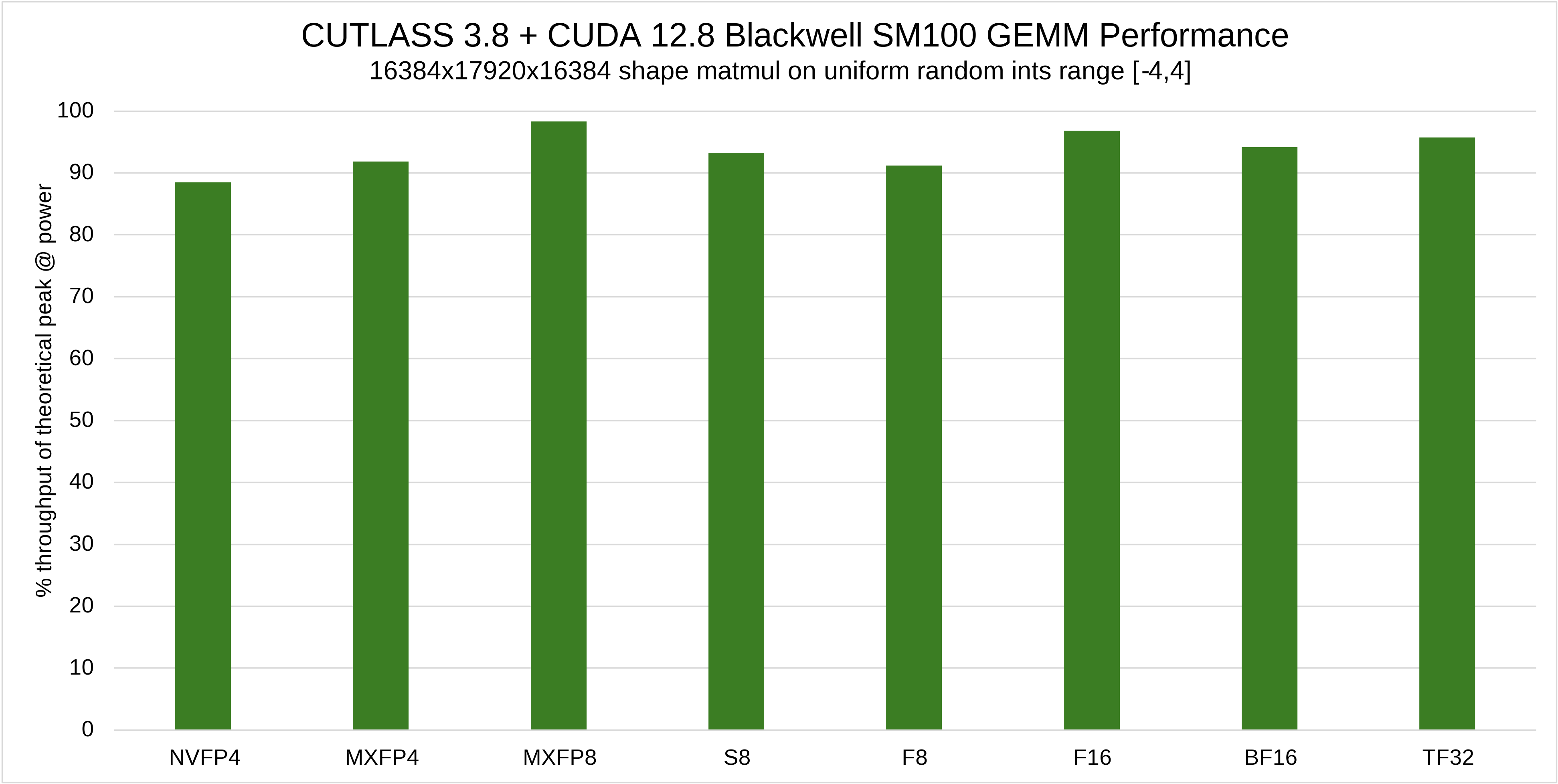
CUTLASS primitives are very efficient. When used to construct device-wide GEMM kernels, they exhibit nearly optimal utilization of peak theoretical throughput. The figure below shows CUTLASS 3.8's performance as a % of theoretical peak utilization on various input and output data types when run on NVIDIA Blackwell SM100 architecture GPU.
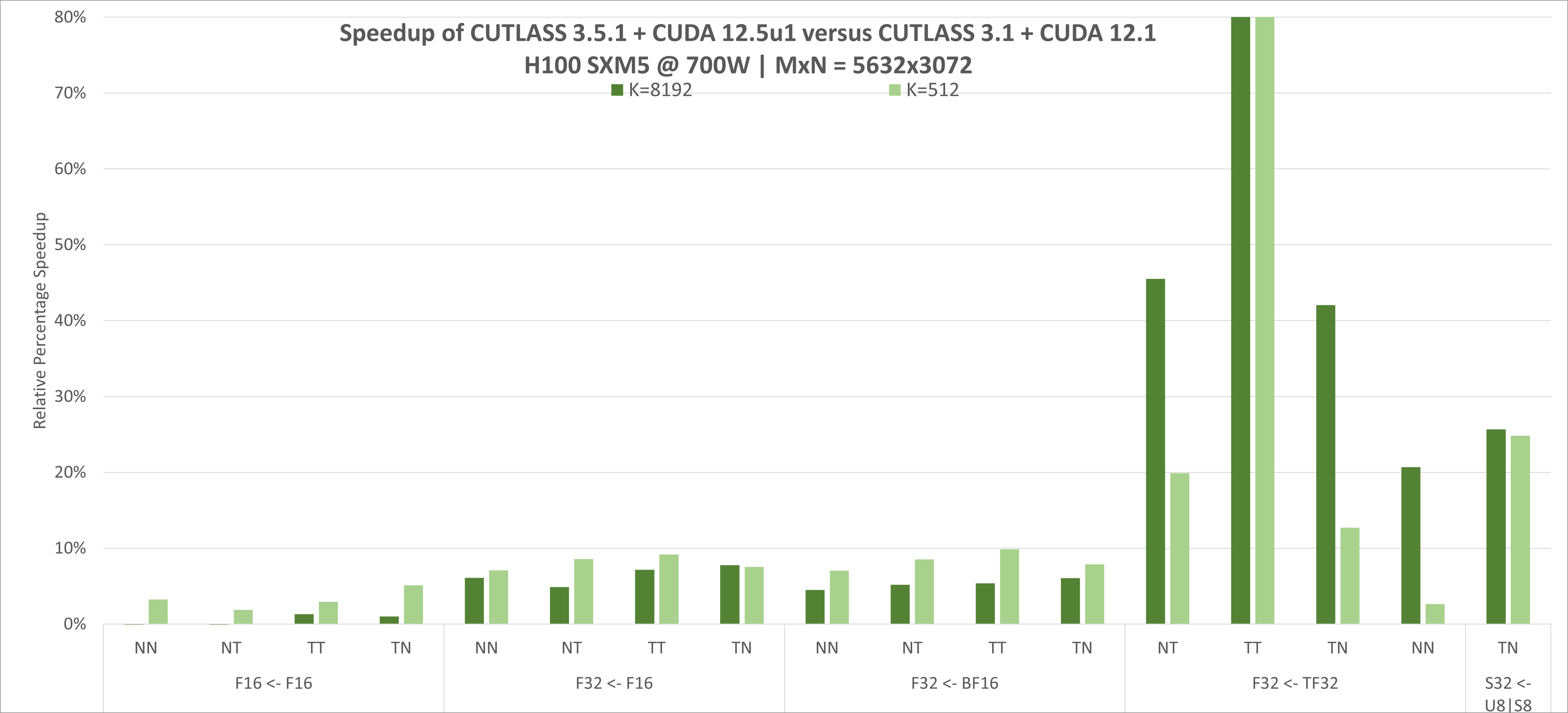
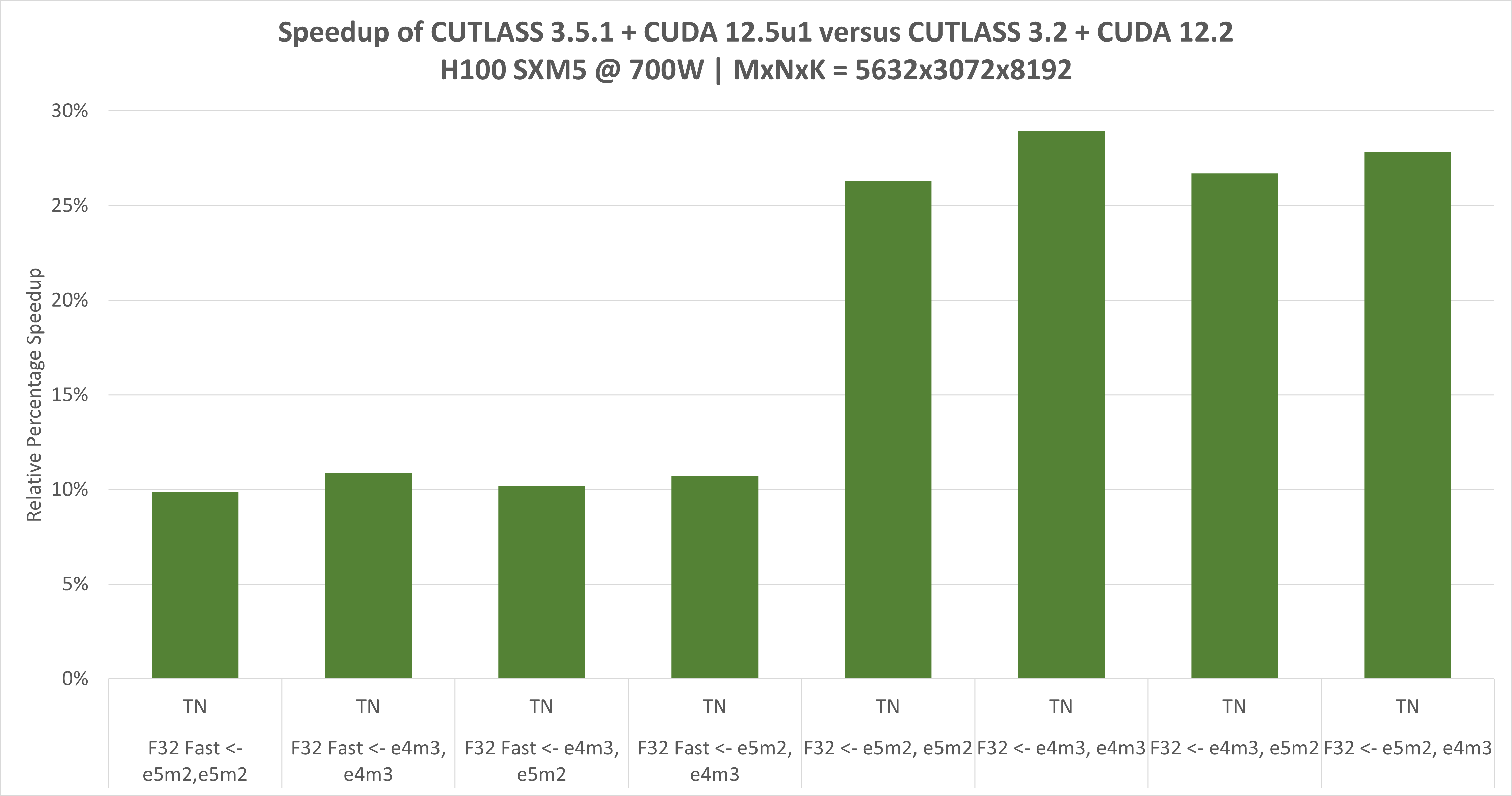
The two figures below show the continual CUTLASS performance improvements on an NVIDIA H100 (NVIDIA Hopper architecture) since CUTLASS 3.1. CUTLASS 3.5.1 was compiled with the CUDA 12.5u1 Toolkit. Tensor Core operations are implemented using CUDA's mma and wgmma instructions.
CUTLASS 3.0 introduced a new core library, CuTe, to describe and manipulate tensors of threads and data.
CuTe is a collection of C++ CUDA template abstractions for
defining and operating on hierarchically multidimensional layouts of threads and data.
CuTe provides Layout and Tensor objects that compactly package the type,
shape, memory space, and layout of data, while performing the complicated indexing for the user.
This lets programmers focus on the logical descriptions of their algorithms while
CuTe does the mechanical bookkeeping for them. With these tools, we can quickly design,
implement, and modify all dense linear algebra operations.
The core abstractions of CuTe are hierarchically multidimensional layouts which can be composed with data arrays to represent tensors. The representation of layouts is powerful enough to represent nearly everything we need to implement efficient dense linear algebra. Layouts can also be combined and manipulated via functional composition, on which we build a large set of common operations such as tiling and partitioning.
CUTLASS 3.0 and beyond adopts CuTe throughout the GEMM hierarchy in its templates. This greatly simplifies the design and improves code composability and readability. More documentation specific to CuTe can be found in its dedicated documentation directory.
Minimum requirements:
CUTLASS requires a C++17 host compiler and performs best when built with the CUDA 12.8 Toolkit. It is also compatible with CUDA 11.4, CUDA 11.5, CUDA 11.6, CUDA 11.7, CUDA 11.8, and all other CUDA 12.x versions.
We have tested the following environments.
| Operating System | Compiler |
|---|---|
| Ubuntu 18.04 | GCC 7.5.0 |
| Ubuntu 20.04 | GCC 10.3.0 |
| Ubuntu 22.04 | GCC 11.2.0 |
Note: GCC 8.5.0 has known regressions regarding fold expressions and overloaded operators. Using GCC 7.5.0 or (preferred) GCC >= 9 is recommended.
Note: CUTLASS 3.x builds are known to be down on Windows platforms for all CUDA toolkits. CUTLASS team is working on a fix.
CUTLASS runs successfully on the following NVIDIA GPUs, and it is expected to be efficient on Volta, Turing, Ampere, Ada, and Hopper architecture based NVIDIA GPUs.
| GPU | CUDA Compute Capability | Minimum CUDA Toolkit Required by CUTLASS-3 |
|---|---|---|
| NVIDIA V100 Tensor Core GPU | 7.0 | 11.4 |
| NVIDIA TitanV | 7.0 | 11.4 |
| NVIDIA GeForce RTX 20x0 series | 7.5 | 11.4 |
| NVIDIA T4 | 7.5 | 11.4 |
| NVIDIA A100 Tensor Core GPU | 8.0 | 11.4 |
| NVIDIA A10 | 8.6 | 11.4 |
| NVIDIA GeForce RTX 30x0 series | 8.6 | 11.4 |
| NVIDIA GeForce RTX 40x0 series | 8.9 | 11.8 |
| NVIDIA L40 | 8.9 | 11.8 |
| NVIDIA H100 Tensor Core GPU | 9.0 | 11.8 |
| NVIDIA H200 Tensor Core GPU | 9.0 | 11.8 |
| NVIDIA B200 Tensor Core GPU | 10.0 | 12.8 |
| NVIDIA B300 Tensor Core GPU | 10.3 | 13.0 |
| NVIDIA DRIVE Thor | 11.0 | 13.0 |
| NVIDIA GeForce RTX 50x0 series | 12.0 | 12.8 |
| NVIDIA DGX Spark | 12.1 | 13.0 |
In general, PTX code generated for one target architecture can be run on future architectures
(i.e., it is forward compatible).
However, CUDA 12.0 introduced the concept of "architecture-accelerated features" whose
PTX does not have forward compatibility guarantees.
Several Hopper and Blackwell PTX instructions fall under this category of
architecture-accelerated features, and thus require a sm_90a or sm100a target architecture
(note the "a" appended). For more details on this and other architecture-accelerated instructions,
please refer to the CUDA Documentation.
The target architecture information is passed on to CUTLASS via the cmake flag
CUTLASS_NVCC_ARCHS. In order to maximize performance on Hopper GH100,
users are required to build CUTLASS with 90a as the target architecture.
If a user accidentally builds a kernel which uses SM90a features
(e.g. Hopper Tensor Core Instructions), using the SM90 target
(note the lack of "a"), with either CUDA Toolkit 12 or 11.8,
the kernel is expected to fail with a runtime error.
cmake .. -DCUTLASS_NVCC_ARCHS="90a"
Or
cmake .. -DCUTLASS_NVCC_ARCHS="100a"
Note: The NVIDIA Blackwell SM100 architecture used in the datacenter
products has a different compute capability than the one underpinning
NVIDIA Blackwell GeForce RTX 50 series GPUs (SM120). As a result, kernels
compiled for Blackwell SM100 architecture with arch conditional features
(using sm100a) are not compatible with RTX 50 series GPUs.
Please refer to the functionality documentation for details on which kernels require which target architectures.
CUTLASS is described in the following documents and the accompanying Doxygen documentation.
We have also described the structure of an efficient GEMM in our talk at the GPU Technology Conference 2018.
CUTLASS is a header-only template library and does not need to be built to be used by other
projects. Client applications should target CUTLASS's include/ directory in their include
paths.
CUTLASS unit tests, examples, and utilities can be build with CMake.
The minimum version of CMake is given in the Quickstart guide.
Make sure the CUDACXX environment variable points to NVCC in the CUDA Toolkit installed
on your system.
$ export CUDACXX=${CUDA_INSTALL_PATH}/bin/nvcc
Create a build directory within the CUTLASS project, then run CMake. By default CUTLASS will build kernels
for CUDA architecture versions 5.0, 6.0, 6.1, 7.0, 7.5, 8.0, 8.6, 8.9, and 9.0.
To reduce compile time you can specify
the architectures to build CUTLASS for by changing the CMake configuration setting
CUTLASS_NVCC_ARCHS.
$ mkdir build && cd build

$ cmake .. -DCUTLASS_NVCC_ARCHS=80               # compiles for NVIDIA's Ampere Architecture
From the build/ directory, compile and run the CUTLASS unit tests by building the target test_unit with make.
The unit tests are organized as several binaries mirroring the top-level namespaces of CUTLASS,
and they may be executed in parallel via make's -j command line argument.
$ make test_unit -j
...
...
...
[----------] Global test environment tear-down
[==========] 946 tests from 57 test cases ran. (10812 ms total)
[  PASSED  ] 946 tests.
All tests should pass on supported platforms, though the exact number of tests may vary over time.
CUTLASS is arranged as a header-only library along with Utilities, Tools, Examples, and unit tests. Doxygen documentation provides a complete list of files, classes, and template concepts defined in the CUTLASS project.
A detailed explanation of the source code organization may be found in the CUTLASS documentation, but several main components are summarized below.
include/                     # client applications should target this directory in their build's include paths

  cutlass/                   # CUDA Templates for Linear Algebra Subroutines and Solvers - headers only

    arch/                    # direct exposure of architecture features (including instruction-level GEMMs)

    conv/                    # code specialized for convolution

    epilogue/                # code specialized for the epilogue of gemm/convolution

    gemm/                    # code specialized for general matrix product computations

    layout/                  # layout definitions for matrices, tensors, and other mathematical objects in memory

    platform/                # CUDA-capable Standard Library components

    reduction/               # bandwidth-limited reduction kernels that do not fit the "gemm" model

    thread/                  # simt code that can be performed within a CUDA thread

    transform/               # code specialized for layout, type, and domain transformations

    *                        # core vocabulary types, containers, and basic numeric operations

  cute/                      # CuTe Layout, layout algebra, MMA/Copy atoms, tiled MMA/Copy

    algorithm/               # Definitions of core operations such as copy, gemm, and operations on cute::tuples

    arch/                    # Bare bones PTX wrapper structs for copy and math instructions

    atom/                    # Meta-information either link to or built from arch/ operators

      mma_atom.hpp           # cute::Mma_Atom and cute::TiledMma

      copy_atom.hpp          # cute::Copy_Atom and cute::TiledCopy

      *sm*.hpp               # Arch specific meta-information for copy and math operations

    *                        # Core library types such as Shape, Stride, Layout, Tensor, and associated operations
CUTLASS SDK examples apply CUTLASS templates to implement basic computations.
tools/
  library/                   # CUTLASS Instance Library - contains instantiations of all supported CUTLASS templates
    include/
      cutlass/
        library/

  profiler/                  # CUTLASS Profiler         - command-line utility for executing operations in the
                             #                            CUTLASS Library

  util/                      # CUTLASS Utilities        - contains numerous helper classes for
    include/                 #                            managing tensors in device memory, reference
      cutlass/               #                            implementations for GEMM, random initialization
        util/                #                            of tensors, and I/O.
The test/unit/ directory consist of unit tests implemented with Google Test that demonstrate
basic usage of Core API components and complete tests of the CUTLASS GEMM computations.
Instructions for building and running the Unit tests are described in the Quickstart guide.
The tools/profiler/ directory contains a command-line utility for launching each of the GEMM kernels.
It can be built as follows:
$ make cutlass_profiler -j16
By default, only one tile size is instantiated for each data type, math instruction, and layout.
To instantiate all, set the following environment variable when running CMake from an empty build/ directory.
Beware, this results in tens of thousands of kernels and long build times.
This would also result in a large binary size and on some platforms linker to fail on building the library.
Therefore, it's highly recommended to generate only a subset of kernels as demonstrated in the sub-section below.
$ cmake .. -DCUTLASS_NVCC_ARCHS=90a -DCUTLASS_LIBRARY_KERNELS=all
...
$ make cutlass_profiler -j16
To compile strictly one kernel or a small set of kernels, a comma-delimited list of kernel names with wildcard characters may be used to reduce the set of kernels. The following examples show building exactly one or a subset of kernels for NVIDIA Ampere and Turing architecture:
To compile a subset of Tensor Core GEMM kernels with FP32 accumulation and FP16 input targeting NVIDIA Ampere and Turing architecture, use the below cmake command line:
$ cmake .. -DCUTLASS_NVCC_ARCHS='75;80' -DCUTLASS_LIBRARY_KERNELS=cutlass_tensorop_s*gemm_f16_*_nt_align8
...
$ make cutlass_profiler -j16
Example command line for profiling a subset of Tensor Core GEMM kernels is as follows:
./tools/profiler/cutlass_profiler --kernels=cutlass_tensorop_s*gemm_f16_*_nt_align8 --m=3456 --n=4096 --k=4096

...
=============================
  Problem ID: 1

        Provider: CUTLASS
   OperationKind: gemm
       Operation: cutlass_tensorop_s1688gemm_f16_256x128_32x2_nt_align8

          Status: Success
    Verification: ON
     Disposition: Passed

reference_device: Passed
          cuBLAS: Passed

       Arguments: --gemm_kind=universal --m=3456 --n=4096 --k=4096 --A=f16:column --B=f16:row --C=f32:column --alpha=1  \
                  --beta=0 --split_k_slices=1 --batch_count=1 --op_class=tensorop --accum=f32 --cta_m=256 --cta_n=128  \
                  --cta_k=32 --stages=2 --warps_m=4 --warps_n=2 --warps_k=1 --inst_m=16 --inst_n=8 --inst_k=8 --min_cc=75  \
                  --max_cc=1024

           Bytes: 118489088  bytes
           FLOPs: 115992428544  flops

         Runtime: 1.55948  ms
          Memory: 70.7616 GiB/s

            Math: 74378.8 GFLOP/s


=============================
...
To compile one SGEMM kernel targeting NVIDIA Ampere and Turing architecture, use the below cmake command line:
$ cmake .. -DCUTLASS_NVCC_ARCHS='75;80' -DCUTLASS_LIBRARY_KERNELS=cutlass_simt_sgemm_128x128_8x2_nn_align1
...
$ make cutlass_profiler -j16
Example command line for profiling single SGEMM CUDA kernel is as follows:
$ ./tools/profiler/cutlass_profiler --kernels=sgemm --m=3456 --n=4096 --k=4096

=============================
  Problem ID: 1

        Provider: CUTLASS
   OperationKind: gemm
       Operation: cutlass_simt_sgemm_128x128_8x2_nn_align1

          Status: Success
    Verification: ON
     Disposition: Passed

          cuBLAS: Passed

       Arguments: --m=3456 --n=4096 --k=4096 --A=f32:column --B=f32:column --C=f32:column --alpha=1 --beta=0 --split_k_slices=1  \
                  --batch_count=1 --op_class=simt --accum=f32 --cta_m=128 --cta_n=128 --cta_k=8 --stages=2 --warps_m=4  \
                  --warps_n=2 --warps_k=1 --inst_m=1 --inst_n=1 --inst_k=1 --min_cc=50 --max_cc=1024

           Bytes: 180355072  bytes
           FLOPs: 115992428544  flops

         Runtime: 6.73655  ms
          Memory: 24.934 GiB/s

            Math: 17218.4 GFLOP/s

=============================
To compile a subset of Tensor core convolution kernels implementing forward propagation (fprop) with FP32 accumulation and FP16 input targeting NVIDIA Ampere and Turing architecture, use the below cmake command line:
$ cmake .. -DCUTLASS_NVCC_ARCHS='75;80' -DCUTLASS_LIBRARY_KERNELS=cutlass_tensorop_s*fprop_optimized_f16
...
$ make cutlass_profiler -j16
Example command line for profiling a subset of Tensor Core convolution kernels is as follows:
$ ./tools/profiler/cutlass_profiler --kernels=cutlass_tensorop_s*fprop_optimized_f16 --n=8 --h=224 --w=224 --c=128 --k=128 --r=3 --s=3

...
=============================
  Problem ID: 1

        Provider: CUTLASS
   OperationKind: conv2d
       Operation: cutlass_tensorop_s16816fprop_optimized_f16_128x128_32x5_nhwc

          Status: Success
    Verification: ON
     Disposition: Passed

reference_device: Passed

       Arguments: --conv_kind=fprop --n=8 --h=224 --w=224 --c=128 --k=128 --r=3 --s=3 --p=224 --q=224 --pad_h=1 --pad_w=1  \
                  --stride_h=1 --stride_w=1 --dilation_h=1 --dilation_w=1 --Activation=f16:nhwc --Filter=f16:nhwc --Output=f32:nhwc  \
                  --conv_mode=cross --iterator_algorithm=optimized --alpha=1 --beta=0 --split_k_mode=serial --split_k_slices=1  \
                  --eq_gemm_provider=none --op_class=tensorop --accum=f32 --cta_m=128 --cta_n=128 --cta_k=32 --stages=5  \
                  --warps_m=2 --warps_n=2 --warps_k=1 --inst_m=16 --inst_n=8 --inst_k=16 --min_cc=80 --max_cc=1024

           Bytes: 1130659840  bytes
           FLOPs: 118482796544  flops

         Runtime: 0.711496  ms
          Memory: 1479.99 GiB/s

            Math: 166526 GFLOP/s

=============================
...
To compile and run one CUDA Core convolution kernel implementing forward propagation (fprop) with F32 accumulation and FP32 input targeting NVIDIA Ampere and Turing architecture, use the below cmake command line:
$ cmake .. -DCUTLASS_NVCC_ARCHS='75;80' -DCUTLASS_LIBRARY_KERNELS=cutlass_simt_sfprop_optimized_128x128_8x2_nhwc
...
$ make cutlass_profiler -j16
Example command line for profiling one CUDA Core convolution kernel:
$ ./tools/profiler/cutlass_profiler --kernels=cutlass_simt_sfprop_optimized_128x128_8x2_nhwc --n=8 --h=224 --w=224 --c=128 --k=128 --r=3 --s=3


=============================
  Problem ID: 1

        Provider: CUTLASS
   OperationKind: conv2d
       Operation: cutlass_simt_sfprop_optimized_128x128_8x2_nhwc

          Status: Success
    Verification: ON
     Disposition: Passed

reference_device: Passed

       Arguments: --conv_kind=fprop --n=8 --h=224 --w=224 --c=128 --k=128 --r=3 --s=3 --p=224 --q=224 --pad_h=1 --pad_w=1  \
                  --stride_h=1 --stride_w=1 --dilation_h=1 --dilation_w=1 --Activation=f32:nhwc --Filter=f32:nhwc --Output=f32:nhwc  \
                  --conv_mode=cross --iterator_algorithm=optimized --alpha=1 --beta=0 --split_k_mode=serial --split_k_slices=1  \
                  --eq_gemm_provider=none --op_class=simt --accum=f32 --cta_m=128 --cta_n=128 --cta_k=8 --stages=2 --warps_m=4  \
                  --warps_n=2 --warps_k=1 --inst_m=1 --inst_n=1 --inst_k=1 --min_cc=50 --max_cc=1024

           Bytes: 2055798784  bytes
           FLOPs: 118482796544  flops

         Runtime: 7.34266  ms
          Memory: 260.752 GiB/s

            Math: 16136.2 GFLOP/s


=============================
CUTLASS is released by NVIDIA Corporation as Open Source software under the 3-clause "New" BSD license.
The official list of CUTLASS developers and contributors is available here: CONTRIBUTORS.
Copyright (c) 2017 - 2026 NVIDIA CORPORATION & AFFILIATES. All rights reserved. SPDX-License-Identifier: BSD-3-Clause
  Redistribution and use in source and binary forms, with or without
  modification, are permitted provided that the following conditions are met:

  1. Redistributions of source code must retain the above copyright notice, this
  list of conditions and the following disclaimer.

  2. Redistributions in binary form must reproduce the above copyright notice,
  this list of conditions and the following disclaimer in the documentation
  and/or other materials provided with the distribution.

  3. Neither the name of the copyright holder nor the names of its
  contributors may be used to endorse or promote products derived from
  this software without specific prior written permission.

  THIS SOFTWARE IS PROVIDED BY THE COPYRIGHT HOLDERS AND CONTRIBUTORS "AS IS"
  AND ANY EXPRESS OR IMPLIED WARRANTIES, INCLUDING, BUT NOT LIMITED TO, THE
  IMPLIED WARRANTIES OF MERCHANTABILITY AND FITNESS FOR A PARTICULAR PURPOSE ARE
  DISCLAIMED. IN NO EVENT SHALL THE COPYRIGHT HOLDER OR CONTRIBUTORS BE LIABLE
  FOR ANY DIRECT, INDIRECT, INCIDENTAL, SPECIAL, EXEMPLARY, OR CONSEQUENTIAL
  DAMAGES (INCLUDING, BUT NOT LIMITED TO, PROCUREMENT OF SUBSTITUTE GOODS OR
  SERVICES; LOSS OF USE, DATA, OR PROFITS; OR BUSINESS INTERRUPTION) HOWEVER
  CAUSED AND ON ANY THEORY OF LIABILITY, WHETHER IN CONTRACT, STRICT LIABILITY,
  OR TORT (INCLUDING NEGLIGENCE OR OTHERWISE) ARISING IN ANY WAY OUT OF THE USE
  OF THIS SOFTWARE, EVEN IF ADVISED OF THE POSSIBILITY OF SUCH DAMAGE.
NVIDIA/cutlass is a public repo on GitHub by NVIDIA. CUDA Templates and Python DSLs for High-Performance Linear Algebra.
It declares no license on GitHub. Public does not mean open source: without a license, nobody is granted the right to reuse it.
Its maker tagged it for Windows and Linux. That is declared by the maker; Take My Repo has not tested it.
Open "Take it" on its page: Take My Repo writes an install plan for your machine and hands it to your AI agent (Claude Code, Codex or Cursor), which asks you before each step. Take My Repo has not tested it on any machine.
Its last change on GitHub was on 2026-11-23. GitHub counts 875 open issues and pull requests. Take My Repo does not judge from that whether it is maintained.
Nobody has reviewed it on Take My Repo yet, which says nothing about its quality.
VoiceStudio is the open-source, fully-local ElevenLabs alternative — voice cloning, voice design, video dubbing, dictation, transcription & audiobook creation in 646 languages.
The Incredible PyTorch: a curated list of tutorials, papers, projects, communities and more relating to PyTorch.
Reverse engineer anything with agents, from app behavior down to native binaries.
A high-throughput and memory-efficient inference and serving engine for LLMs
🤗 Transformers: the model-definition framework for state-of-the-art machine learning models in text, vision, audio, and multimodal models, for both inference and training.
Security scanner for AI agent skills. Detect vulnerabilities, malicious patterns, security risks, prompt injection, data exfiltration, and supply-chain risks in Claude Code, Codex, and MCP skills before you install them.
Run agents like Hermes, LangChain Deep Agents, and OpenClaw more securely inside NVIDIA OpenShell with managed inference
TensorRT LLM provides users with an easy-to-use Python API to define Large Language Models (LLMs) and supports state-of-the-art optimizations to perform inference efficiently on NVIDIA GPUs. TensorRT LLM also contains components to create Python and C++ runtimes that orchestrate the inference execution in a performant way.
State-of-the-Art Deep Learning scripts organized by models - easy to train and deploy with reproducible accuracy and performance on enterprise-grade infrastructure.