Primes
Prime number projects in 100+ programming languages, to compare their speed - and their programmer's cleverness
- 3k
- C
- 3 wk ago
Scores GUI agents and compiled workflows on benchmarks such as Windows Agent Arena, using each benchmark's own checker.
Repo OpenAdaptAI/openadapt-evals, read from GitHub 8 h ago. OpenAdaptAI has not joined Take My Repo.
OpenAdaptAI/openadapt-evals is a public repo on GitHub by OpenAdaptAI. Scores GUI agents and compiled workflows on benchmarks such as Windows Agent Arena, using each benchmark's own checker. It declares the MIT license on GitHub. It is written mainly in Python, has 4 stars and last changed on 2026-10-17. Nobody has reviewed it on Take My Repo yet, which says nothing about its quality. Read from GitHub on 2026-11-23.
openadapt-evals measures how well a GUI agent, or a workflow that OpenAdapt compiled from one recorded demonstration, completes desktop tasks. It runs each task, scores the result with the benchmark's own checker rather than the agent's claim of success, and saves scores and step-by-step traces you can compare across runs. For Windows Agent Arena (WAA), it can also create and delete the Windows VMs the benchmark needs, in your own Azure or AWS account.
Use it to:
To record and replay your own workflows, use
OpenAdapt (pip install openadapt)
instead.
| Benchmark | What it checks | Where it runs | Section |
|---|---|---|---|
| Mock tasks | The harness itself, with no VM or API key | Your machine | Quick start |
| Windows Agent Arena (WAA) | A GUI agent or a compiled workflow on Windows desktop tasks | A Windows VM in your Azure or AWS account | Cloud VM |
| MockMed UI change | Whether a compiled workflow survives a theme change or renamed buttons | Your machine | UI change |
| ExtraDup | Whether a reward pays for wrong writes | Your machine | Rewards |
| Checker audit (AppWorld or your own) | Which wrong runs a benchmark's checker accepts | Your machine | Audit |
You need Python 3.10 or later. The quick start needs no VM and no API key, and it costs nothing.
pip install openadapt-evals
openadapt-evals mock --tasks 5
It logs each step, then prints a summary:
==================================================
Evaluation Results
==================================================
Attempts:     5
Outcomes:     5
Errors:       0
Success rate: 100.0% (outcomes only)
Avg score:    1.000 (outcomes only)
Avg steps:    1.0 (all attempts)
The mock agent clicks the button that the mock checker looks for, so every task
passes and this run only shows that the install works. Outcomes counts the
attempts the checker scored. A VM or checker outage counts as an error and is
left out of the success rate.
Scores, traces, and screenshots go to a run folder under benchmark_results/.
To browse them, pass that folder's name to the viewer:
openadapt-evals view --run-name <run-folder>
Subclass BenchmarkAgent and return one action per step:
from openadapt_evals import (
    BenchmarkAction,
    BenchmarkAgent,
    WAAMockAdapter,
    compute_metrics,
    evaluate_agent_on_benchmark,
)


class MyAgent(BenchmarkAgent):
    def act(self, observation, task, history=None):
        # observation.screenshot holds PNG bytes; task.instruction says what to do.
        # Return one action per step. This agent gives up at once.
        return BenchmarkAction(type="done")


results = evaluate_agent_on_benchmark(MyAgent(), WAAMockAdapter(num_tasks=5))
print(compute_metrics(results)["success_rate"])
This prints 0.0. The agent reports that it's done without doing anything, and
the checker scores what the agent did. On WAA, the checker inspects the VM's
files, settings, and app state.
To run the same agent on a real Windows VM (set up in the next section), use
the live adapter and name the WAA tasks. The live adapter has no task list of
its own, so without task_ids it runs nothing.
from openadapt_evals import WAALiveAdapter, WAALiveConfig

adapter = WAALiveAdapter(WAALiveConfig(server_url="http://localhost:5001"))
results = evaluate_agent_on_benchmark(
    MyAgent(), adapter, task_ids=["04d9aeaf-7bed-4024-bedb-e10e6f00eb7f-WOS"]
)
You need a Windows VM running the WAA server, plus the scoring server this
package adds next to it. oa-vm pool-create --workers 1 builds one on Azure
(the default) or AWS (--cloud aws), and billing starts when the VM does.
Without --workers, it builds three. The
CLI reference
covers credentials, pool-wait, and the per-worker files that the pool commands
require.
oa-vm pool-status shows the VM's IP address. Forward the two servers to your
machine and leave this running:
ssh -N -L 5001:localhost:5000 -L 5050:localhost:5051 azureuser@<vm-ip> # ubuntu@ on AWS
Then, in another terminal with ANTHROPIC_API_KEY set:
openadapt-evals run --agent api-claude --task 04d9aeaf-7bed-4024-bedb-e10e6f00eb7f-WOS
oa-vm pool-cleanup -y    # deletes the VMs; until you run it, they keep billing
run scores each task with WAA's own checker and opens an HTML viewer of the
run when it finishes. Task IDs come from WAA's test_small.json and
test_all.json. The live adapter rejects test IDs such as notepad_1 and
mock_chrome_001.
openadapt-eval-flow replays compiled OpenAdapt workflows on WAA tasks. Without
--live, it only estimates cost: it starts no VM and makes no network calls.
openadapt-eval-flow --mode replay --tasks 154 --dry-run
  154 tasks:
    Azure VM-hours:        2.82 vm-hours @ $0.19/hr  = $0.54
    Agent token cost:      $0.00  (paid tasks=0.0, 0 steps each)
    -> TOTAL:              $0.54   ($0.0035/task)
    Pure-agent baseline:   $39.06   (22 steps/task, all paid)
    Savings vs baseline:   $38.53
The estimate assumes one minute of VM time per replayed task and 22 model steps per task for the agent baseline. Neither number comes from a WAA run of this package.
With --live, it runs each task's WAA setup steps, replays that task's compiled
workflow, and scores the result with WAA's checker. Per-task results go to
flow_waa_results/results.json. A live run needs Python 3.12 or earlier,
pip install 'openadapt-evals[flow]', a running WAA server, and a --bundles
folder with one subfolder per task ID that holds that task's compiled
workflow.json. It refuses to start if a task has no compiled workflow or no
WAA checker config.
The latest published comparison ran OpenAdapt's compiled replay and two
Playwright scripts, one that finds elements by position and one by name, on a
synthetic medical-records web app (MockMed). Each arm ran three times per
condition. theme restyles the app. rename changes the Open button to
View and Save Encounter to Submit Encounter.
| Condition | Compiled replay | Playwright, by position | Playwright, by name |
|---|---|---|---|
clean |
3/3 | 3/3 | 3/3 |
theme |
3/3 | 3/3 | 3/3 |
rename |
3/3 | 0/3 | 0/3 |
A separate screenshot and OCR check confirmed each saved record. After the
rename, both Playwright scripts stopped at the first renamed button and wrote
nothing. Compiled replay completed all three runs, with no wrong writes and no
model calls. Compiled replay is slower. In the clean condition it took a
median of 6.8 seconds per run, against 0.29 seconds for the Playwright scripts.
Where an application has a stable API or selectors, those are still the faster
choice.
Measured 2026-10-14 against Flow 1.35.1 on macOS with headless Chromium. The
full report, timings, and dependency list are in
current_flow_v1_35_1_local_20261014.
python -m openadapt_evals.extradup kill-scan
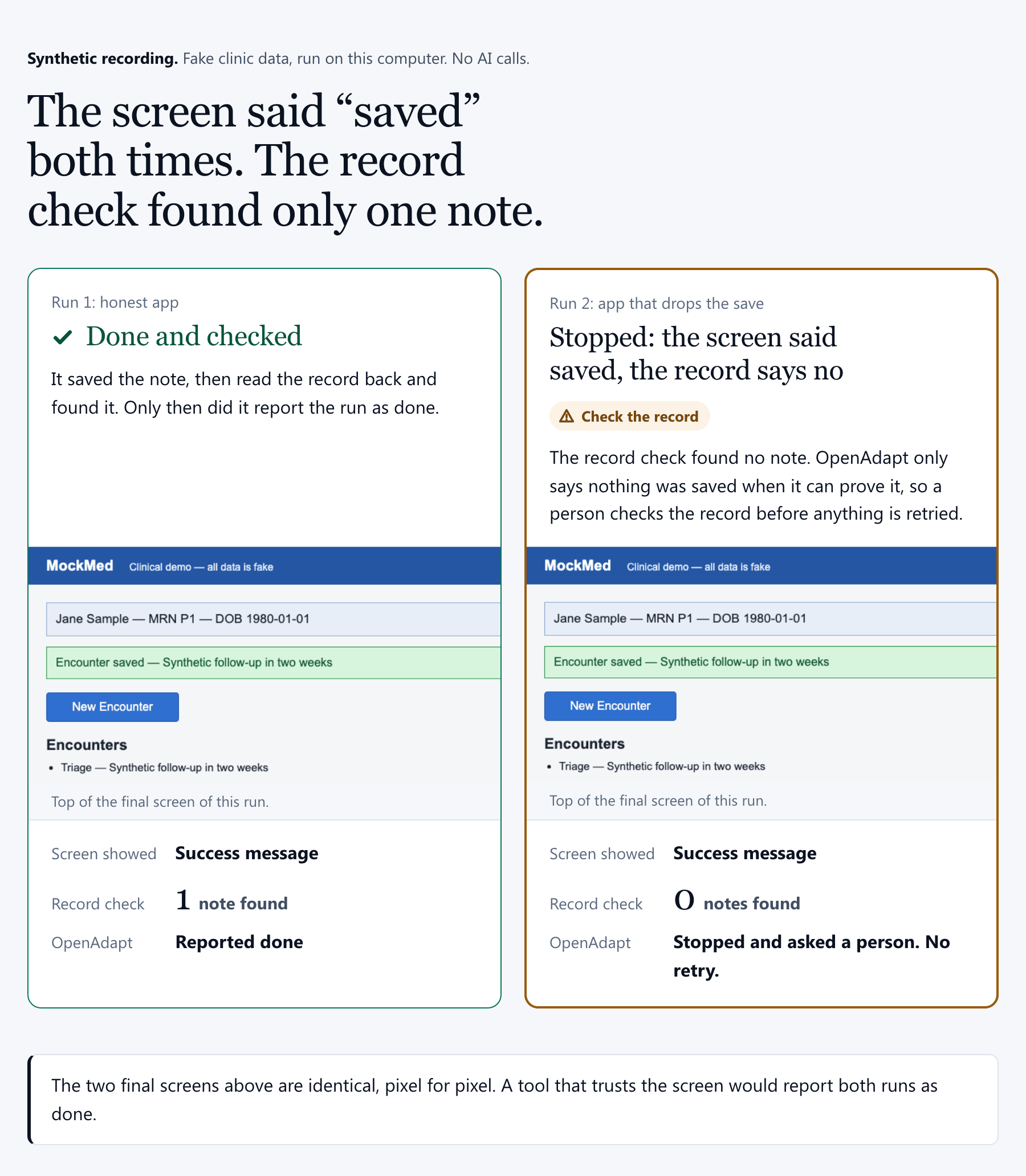
ExtraDup applies five kinds of wrong write to a MockMed record: a duplicate record, an extra field, a missing field, a form that was never submitted, and a "Saved" banner with nothing saved. It then asks two built-in reference rewards whether to pay, three times for each case. The first pays whenever the screen looks finished, so it paid all 15 wrong writes. The second reads the stored record. It paid none of the wrong writes and all 3 correct ones. The scan runs offline in about a second. To score your own checker, see the ExtraDup README.
If you build an agent benchmark, or train on rewards computed from one, its
checker decides what counts as success. audit-verifier tests that checker.
It takes each task's own correct solution, makes one edit to it, replays the
edited run from a fresh start state, reads the end state back, and only then
calls the benchmark's checker, unmodified. It lists every edit the checker
passed although the end state differs from the correct run's. It calls no
model.
pip install openadapt-evals
openadapt-evals audit-verifier --benchmark toy
[1/5] split-bill: FALSE ACCEPT (extra, extra-ni) (0s)
[2/5] split-bill-counted: no false accept (0s)
[3/5] queue-songs: FALSE ACCEPT (extra, extra-ni) (0s)
[4/5] like-songs: no false accept (0s)
[5/5] rename-profile: no false accept (0s)
Verifier audit: toy, 5 task(s), 5 audited, 0s

The verifier passed 4 edited run(s) whose end state is wrong:
  task         operator  end state compared with the reference run
  -----------  --------  ------------------------------------------
  split-bill   extra     toy.Notification +1, toy.PaymentRequest +1
  split-bill   extra-ni  toy.Notification +1, toy.PaymentRequest +1
  queue-songs  extra     toy.QueueEntry +1
  queue-songs  extra-ni  toy.QueueEntry +1

Per operator (each edited run counted once; operators are not pooled):
  operator     class          runs  killed  false accept  equivalent  unconfirmed  refused  error  invalid
  -----------  -------------  ----  ------  ------------  ----------  -----------  -------  -----  -------
  claim-only   postcondition     5       5             0           0            0        0      0        0
  omit         postcondition     5       5             0           0            0        0      0        0
  partial      postcondition     4       4             0           0            0        1      0        0
  wrong-value  postcondition     5       5             0           0            0        0      0        0
  extra        frame             5       1             2           2            0        0      0        0
  extra-ni     frame             3       1             2           0            0        2      0        0

false accept: the verifier passed the edited run, and the end state (read
  back before grading) differs from the reference run's.
equivalent: the edit left the end state unchanged, so the pass is correct.
toy is a small synthetic benchmark inside the package, so this runs offline
in under a second. Two of its five checkers compare the values of new records
without counting them, so a repeated write passes both.
Each operator makes one edit:
| Operator | Edit | A correct checker |
|---|---|---|
claim-only |
report success and write nothing | fails it |
omit |
drop the last write | fails it |
partial |
of the most repeated write, keep only the first | fails it |
wrong-value |
change one value in the last write | fails it |
extra |
repeat the last write | fails it, unless the repeat changed nothing |
extra-ni |
repeat the last write whose repeat changes the end state, found by replaying each candidate without calling the checker | fails it |
Each edited run gets one result. killed means the checker failed it.
false accept means the checker passed it and the end state differs from the
correct run's. equivalent means the edit left the end state unchanged, so
the pass is correct. refused means the task gave the operator nothing to
edit. unconfirmed, error and invalid mark runs that could not be checked
cleanly, for example because the unedited run itself failed. The command
exits 1 when it finds a false accept, so a CI job can run it. --out report.json writes every run's result; the report holds record counts and
field names, not record values.
AppWorld is not bundled. It ships its task data and tests encrypted and asks that public copies stay encrypted, so you install it yourself, once. It needs its own environment because it pins pydantic 1:
uv venv --python 3.11 ~/.cache/appworld/venv
uv pip install --python ~/.cache/appworld/venv/bin/python appworld==0.1.3.post1
~/.cache/appworld/venv/bin/appworld install
~/.cache/appworld/venv/bin/appworld download data --root ~/.cache/appworld

openadapt-evals audit-verifier --benchmark appworld \
    --appworld-python ~/.cache/appworld/venv/bin/python \
    --appworld-root ~/.cache/appworld \
    --tasks 22cc237_1,396c5a2_1
[1/2] 22cc237_1: FALSE ACCEPT (extra, extra-ni) (43s)
[2/2] 396c5a2_1: FALSE ACCEPT (extra, extra-ni) (38s)
Verifier audit: appworld, 2 task(s), 2 audited, 81s

The verifier passed 4 edited run(s) whose end state is wrong:
  task       operator  end state compared with the reference run
  ---------  --------  ----------------------------------------------
  22cc237_1  extra     venmo.Notification +1, venmo.PaymentRequest +1
  22cc237_1  extra-ni  venmo.Notification +1, venmo.PaymentRequest +1
  396c5a2_1  extra     spotify.MusicPlayer: queue_song_ids changed
  396c5a2_1  extra-ni  spotify.MusicPlayer: queue_song_ids changed

Per operator (each edited run counted once; operators are not pooled):
  operator     class          runs  killed  false accept  equivalent  unconfirmed  refused  error  invalid
  -----------  -------------  ----  ------  ------------  ----------  -----------  -------  -----  -------
  claim-only   postcondition     2       2             0           0            0        0      0        0
  omit         postcondition     2       2             0           0            0        0      0        0
  partial      postcondition     1       1             0           0            0        1      0        0
  wrong-value  postcondition     2       2             0           0            0        0      0        0
  extra        frame             2       0             2           0            0        0      0        0
  extra-ni     frame             2       0             2           0            0        0      0        0

false accept: the verifier passed the edited run, and the end state (read
  back before grading) differs from the reference run's.
equivalent: the edit left the end state unchanged, so the pass is correct.
Task 22cc237_1 asks for Venmo payment requests to the people who still owe
their share of a dinner bill. Its tests check the receiver and amount of each
new request but never count the requests, so a run that sends the last
request twice passes. In 396c5a2_1 the tests compare the song queue as a
set, so a song queued twice passes. A task took 12 to 68 seconds in our runs
on an Apple silicon Mac. Without --tasks, the command audits the first 20
tasks of the train split; --limit 0 --jobs 4 audits the whole split.
We ran the command on the 48 AppWorld tasks the paper audited (AppWorld
0.1.3.post1, data 0.1.0, --jobs 4, 426 seconds). It matched the paper's
result for all 48 unedited runs and all 288 operator runs, refusals included.
extra passed 39 of 48 runs. In 33 of them the repeat changed nothing; the
other 6 are false accepts, on the three variants of each task above. The
checkers killed every postcondition edit that applied.
Write an adapter and pass it as --benchmark yourpackage.module:YourAdapter.
A run is a list of API calls ({"method", "url", "data"}), and an effect is
the records each table gained, lost or changed:
from openadapt_evals.verifier_audit import CallPolicy, Delivery, Reference


class YourAdapter:
    name = "your-benchmark"
    ignore_fields = frozenset({"id", "created_at"})  # fields with no task meaning
    policy = CallPolicy()  # which calls sign in, which claim success

    def describe(self):
        return {"name": self.name}

    def task_ids(self, split, limit):
        ...

    def reference(self, task_id) -> Reference:
        ...  # run the task's own solution; record its calls and its effect

    def deliver(self, task_id, runs) -> list[Delivery]:
        ...  # per run: fresh start state, replay, read back, then grade
The readback must not use the checker's assertions. It may read the same
database. adapters/toy.py
is a complete adapter.
--ignore-fields table.field
excludes it.The method and the full results are in "Verifier²: Finding Loopholes in Verifiable Rewards" (NeurIPS 2026 workshop "Who Verifies the Agents?").
Runbooks for these are in docs/WORKFLOWS.md.
openadapt-eval-flow --live replays has been tested with
fakes only, not yet against a WAA VM. Its --mode hybrid (replay with an
agent fallback) estimates cost but doesn't run.openadapt-eval-flow prints are checked only by
HybridFlowAgent, which the command doesn't run. A live replay records each
task's model calls and estimated model cost in results.json but doesn't
stop at a cap.LocalAdapter. Others, such as OSWorld or WebArena, need a new
BenchmarkAdapter.git clone https://github.com/OpenAdaptAI/openadapt-evals.git
cd openadapt-evals
uv sync --extra dev
uv run pytest tests/ -q -m "not heavy and not gpu and not vm" \
-k "not (test_demo_format_and_persistence or test_synthetic_demos)"
That's the selection CI runs. The tests it leaves out need ML packages, a GPU, a WAA VM, or recordings and demo files that aren't in the repository.
Every dependency installs from PyPI, so you don't need other OpenAdapt
repositories checked out next to this one. To work against a local copy of one,
install it into the environment after syncing, for example
uv pip install -e ../openadapt-ml, and don't commit a path source for it.
Use a branch and a pull request; don't push to main. PR titles use
Conventional Commits, because
python-semantic-release reads them to pick the version bump.
CLAUDE.md
has the development conventions and the WAA workflow.
OpenAdaptAI/openadapt-evals is a public repo on GitHub by OpenAdaptAI. Scores GUI agents and compiled workflows on benchmarks such as Windows Agent Arena, using each benchmark's own checker.
It declares the MIT license on GitHub.
Its maker has not tagged a system, so it is unknown here. Its README says what it needs.
Open "Take it" on its page: Take My Repo writes an install plan for your machine and hands it to your AI agent (Claude Code, Codex or Cursor), which asks you before each step. Take My Repo has not tested it on any machine.
Its last change on GitHub was on 2026-10-17. Take My Repo does not judge from that whether it is maintained.
Nobody has reviewed it on Take My Repo yet, which says nothing about its quality.
Prime number projects in 100+ programming languages, to compare their speed - and their programmer's cleverness
Open-source LLM knowledge platform: turn raw documents into a queryable RAG, an autonomous reasoning agent, and a self-maintaining Wiki.
👾 Open Computer Use – Open-Source Alternative to Codex Computer Use
Research: training and inference for vision-language GUI-action models. Not needed to run OpenAdapt.
The agent harness performance optimization system. Skills, instincts, memory, security, and research-first development for Claude Code, Codex, Opencode, Cursor and beyond.
Reverse engineer anything with agents, from app behavior down to native binaries.
For EHRs, payer portals, and any app your team clicks through. A person or an agent shows the task; OpenAdapt turns it into a local program that repeats the steps with no model calls, checks each save, and stops when something doesn't match.
Labs: a perceive-plan-act computer-use experiment. Not the OpenAdapt product. The product is openadapt-flow: a compiled program that halts unless an independent check passes.
Now part of OpenAdapt: https://github.com/OpenAdaptAI/OpenAdapt (packages/capture)
Now part of OpenAdapt: https://github.com/OpenAdaptAI/OpenAdapt (packages/desktop)
Now part of OpenAdapt: https://github.com/OpenAdaptAI/OpenAdapt (packages/flow)
A simple library to document Pydantic models for structured LLM outputs using standard Python docstrings.