dify
Build Agentic workflows, RAG pipelines, with rich AI model and tool support on one collaborative workspace. Deploy on cloud, VPC, or self-hosted, so teams move from prototype to production without rebuilding the stack.
- 162k
- Python
- 6 h ago
A Unified Memory Benchmark Suite for Memory-Augmented Agents
Repo OpenDataBox/MemoryData, read from GitHub 1 min ago. OpenDataBox has not joined Take My Repo.
OpenDataBox/MemoryData is a public repo on GitHub by OpenDataBox. A Unified Memory Benchmark Suite for Memory-Augmented Agents. It declares no license on GitHub. Public does not mean open source: without a license, nobody is granted the right to reuse it. It is written mainly in Python, has 152 stars and last changed on 2026-07-05. Nobody has reviewed it on Take My Repo yet, which says nothing about its quality. Read from GitHub on 2026-11-25.
Build Agentic workflows, RAG pipelines, with rich AI model and tool support on one collaborative workspace. Deploy on cloud, VPC, or self-hosted, so teams move from prototype to production without rebuilding the stack.
The agent harness performance optimization system. Skills, instincts, memory, security, and research-first development for Claude Code, Codex, Opencode, Cursor and beyond.
 MemoryData
A Unified Memory Benchmark Suite for Memory-Augmented Agents
"One pipeline. Four benchmark families. Twenty-two method presets. One consistent execution interface."

📣 Get involved
- 📝 Need a reading list? See Awesome Agent Memory — our companion paper collection.
- 🚧 Actively growing — new methods & benchmark datasets landing continuously.
- ⭐ Stay tuned — Star the repo, open an issue for requests, PRs from community contributions are welcomed!
Memory-augmented agents, structured memory architectures, and retrieval-based baselines are usually evaluated in isolation — each paper ships its own loader, its own runtime adapter, and its own metric harness. Results are hard to compare, and reproducing a single number across two methods often means re-implementing both.
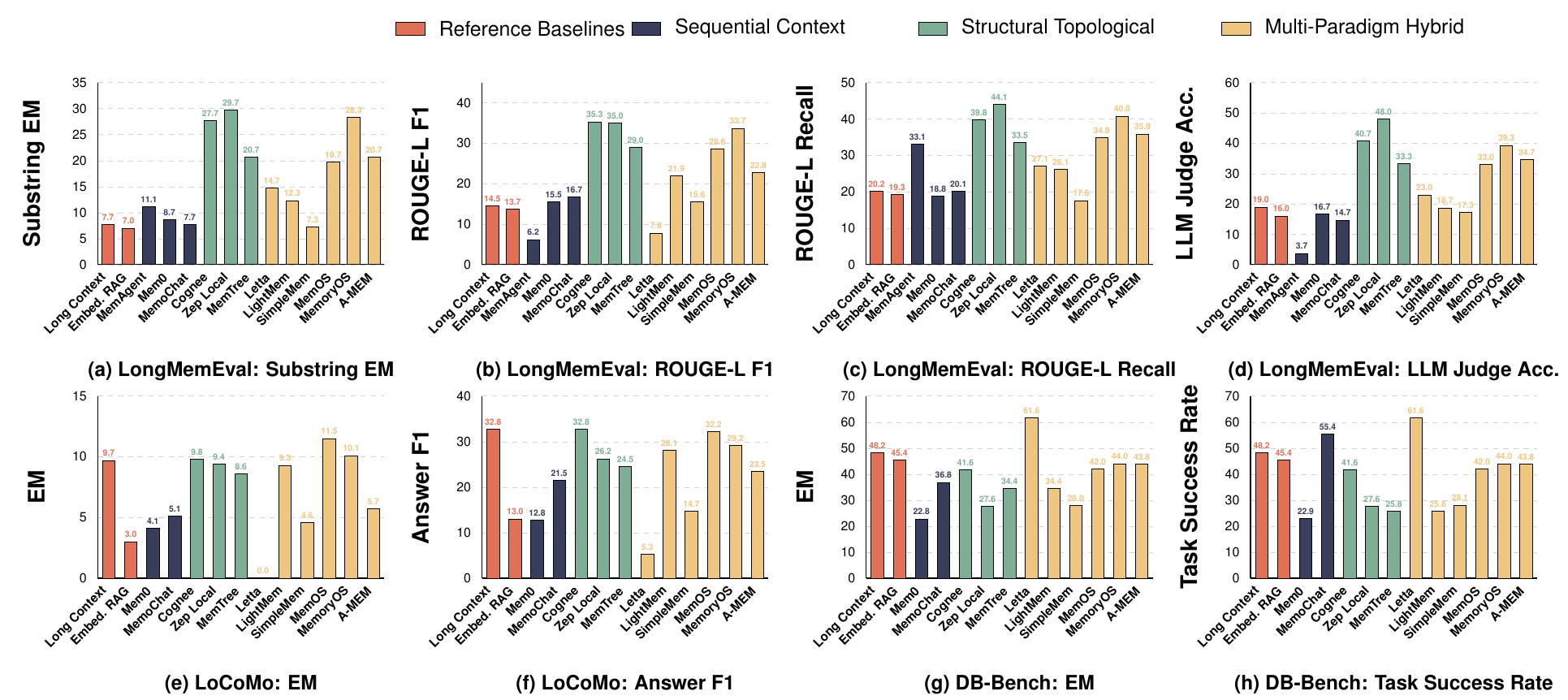
MemoryData closes that gap. It is a research-oriented benchmark suite that unifies four benchmark families (MemoryAgentBench, LoCoMo, LongBench, MemBench), twenty-two method presets, and a shared runtime under a single main.py launcher, so that heterogeneous memory formulations can be compared under one consistent execution interface and one stable artifact layout.
|
🚀 Unified Launcher
|
🧩 22 Method Presets Flattened YAML presets span reference baselines, sequential context, structural topological, and multi-paradigm hybrid architectures — each wired to its vendored runtime. |
|
📊 4 Benchmark Families MemoryAgentBench, LoCoMo, LongBench, and MemBench, each with full and category-specific or slice-specific configs ready to run. |
🗂 Consistent Taxonomy Methods are grouped following the paper's RQ1 effectiveness taxonomy, so presets are discoverable by paradigm instead of by filename. |
|
📦 Structured Artifacts
Every run emits a result JSON, persisted agent state, and optional logs under a stable, override-able |
🖥 Cross-Platform
Separate dependency manifests for Linux/macOS and Windows, with BM25 and long-context reference paths retained under |
Prerequisites: Python 3.11, an OpenAI-compatible model endpoint, and the benchmark datasets placed under datasets/.
conda create -n memory-bench python=3.11
conda activate memory-bench
| Platform | Command |
|---|---|
| Linux / macOS | pip install -r requirements.txt |
| Windows | pip install -r requirements-windows.txt |
Most presets assume OpenAI-compatible serving endpoints. Update the YAML files in config/ so that model, base_url, embedding_base_url, and related provider fields match the model servers available in your environment.
| Variable | Used by | Notes |
|---|---|---|
OPENAI_API_KEY |
Most presets | Default key variable for chat and embedding calls |
OPENAI_API_BASE |
MemOS example environment | Refer to methods/MemOS/config/.env.example when using MemOS-specific setup |
Datasets are not bundled with this repository. Place them under datasets/ according to the loader expectations.
| Benchmark | Default path | Format | Notes |
|---|---|---|---|
| MemoryAgentBench | datasets/MemoryAgentBench/eval_dataset_collection/ |
HuggingFace save_to_disk directory |
Falls back to ai-hyz/MemoryAgentBench if the local copy is absent |
| LoCoMo | datasets/LoCoMo/rq1_4cat_600_dist/locomo_4cat_600_dist.json |
JSON file | Used by the full and category-specific LoCoMo presets |
| LongBench | datasets/longBench_rep150_proportional/datasets |
HuggingFace save_to_disk directory |
Targets the proportional subset |
| MemBench | datasets/MemBench/MemData/FirstAgent/*.json |
JSON files | simple, noisy, knowledge_update, highlevel, RecMultiSession |
Reference layout:
datasets/
├── MemoryAgentBench/
│   └── eval_dataset_collection/          # HuggingFace save_to_disk directory
├── LoCoMo/
│   └── rq1_4cat_600_dist/
│       └── locomo_4cat_600_dist.json
├── longBench_rep150_proportional/
│   └── datasets/                         # HuggingFace save_to_disk directory
└── MemBench/
    └── MemData/FirstAgent/               # simple / noisy / knowledge_update / highlevel / RecMultiSession
Command template:
python main.py --agent_config <agent_yaml> --dataset_config <dataset_yaml>
Representative runs:
| Scenario | Agent config | Dataset config | Extra flags |
|---|---|---|---|
| Default MemoryAgentBench run | config/reference_long_context_agent.yaml |
benchmark/memoryagentbench/Accurate_Retrieval/config/EventQA/Eventqa_full.yaml |
- |
| Small smoke run | config/reference_long_context_agent.yaml |
benchmark/memoryagentbench/Accurate_Retrieval/config/EventQA/Eventqa_full.yaml |
--max_test_queries_ablation 1 |
| LoCoMo evaluation | config/hybrid_simplemem.yaml |
benchmark/locomo/config/Locomo_qa_4cat_600_dist.yaml |
- |
| LongBench evaluation | config/reference_embedding_rag.yaml |
benchmark/longbench/config/LongBench_rep150_proportional.yaml |
- |
| MemBench evaluation | config/sequential_mem0.yaml |
benchmark/membench/config/MemBench_simple.yaml |
- |
Example:
python main.py \
  --agent_config config/reference_long_context_agent.yaml \
  --dataset_config benchmark/memoryagentbench/Accurate_Retrieval/config/EventQA/Eventqa_full.yaml
project-root/
├── main.py                        # unified experiment entry point
├── config/                        # flattened presets: reference, sequential, topological, hybrid
├── benchmark/
│   ├── memoryagentbench/          # MemoryAgentBench loaders and benchmark configs
│   ├── locomo/                    # LoCoMo configs and JSON loader
│   ├── longbench/                 # LongBench proportional-subset support
│   └── membench/                  # MemBench slice configs and loader
├── evaluation/
│   └── longmemeval/               # retained LongMemEval sidecar evaluation helpers
├── methods/                        # method runtimes grouped by the paper taxonomy
│   ├── embedding_rag/              # reference dense-retrieval baseline
│   ├── memagent/  mem0/  memochat/ # sequential context architectures
│   ├── cognee/  graph_rag/  hipporag/  memtree/  raptor/  zep/  zep_local/ # structural topological architectures
│   └── a_mem/  everos/  letta/  lightmem/  memorag/  memoryos/  self_rag/  simplemem/  MemOS/ # multi-paradigm hybrid architectures
├── utils/                          # shared runtime utilities, including long-context and BM25 reference paths
├── requirements.txt               # dependency manifest for Linux/macOS
└── requirements-windows.txt       # dependency manifest for Windows
The taxonomy below follows the grouping used in the main RQ1 effectiveness table of the accompanying paper. Methods retained in the released codebase but not displayed in that specific summary table are assigned to the corresponding taxonomy group for completeness.
| Group | Method | Representative preset | Runtime entry | Notes |
|---|
OpenDataBox/MemoryData is a public repo on GitHub by OpenDataBox. A Unified Memory Benchmark Suite for Memory-Augmented Agents.
It declares no license on GitHub. Public does not mean open source: without a license, nobody is granted the right to reuse it.
Its maker tagged it for macOS, Windows and Linux, or as Docker or cross-platform. That is declared by the maker; Take My Repo has not tested it.
Graphs that teach > graphs that impress. Turn any code into an interactive knowledge graph you can explore, search, and ask questions about. Works with Claude Code, Codex, Cursor, Copilot, Gemini CLI, and more.
Reverse engineer anything with agents, from app behavior down to native binaries.
Open "Take it" on its page: Take My Repo writes an install plan for your machine and hands it to your AI agent (Claude Code, Codex or Cursor), which asks you before each step. Take My Repo has not tested it on any machine.
Its last change on GitHub was on 2026-07-05. GitHub counts 3 open issues and pull requests. Take My Repo does not judge from that whether it is maintained.
Nobody has reviewed it on Take My Repo yet, which says nothing about its quality.
Take My Repo cannot say: it does not audit code and has not run MemoryData. What is known comes from GitHub. It declares no license on GitHub. Public does not mean open source: without a license, nobody is granted the right to reuse it. Its last change was on 2026-07-05. It has 152 stars, which measure popularity, not safety. Nobody has reviewed it on Take My Repo yet, which says nothing about its quality. Read the source before you run it. With "Take it", your AI agent shows each step and asks you before running it; README text is treated as data, not as instructions.