ECC
The agent harness performance optimization system. Skills, instincts, memory, security, and research-first development for Claude Code, Codex, Opencode, Cursor and beyond.
- 309k
- JavaScript
- MIT
- 8 h ago
Toolchain built around the Megatron-LM for Distributed Training
Repo OpenSQZ/MegatronApp, read from GitHub 1 d ago. OpenSQZ has not joined Take My Repo.
OpenSQZ/MegatronApp is a public repo on GitHub by OpenSQZ. Toolchain built around the Megatron-LM for Distributed Training. It declares no license on GitHub. Public does not mean open source: without a license, nobody is granted the right to reuse it. It is written mainly in Python, has 100 stars and last changed on 2026-05-20. Nobody has reviewed it on Take My Repo yet, which says nothing about its quality. Read from GitHub on 2026-11-22.
MegatronApp: Toolchain built around Megatron-LM for Distributed Training
An extension for performance tuning, slow-node detection, and training-process visualization.
MegaScan
MegaScope
MegatronApp is a toolchain built around the Megatron-LM training framework, designed to give practitioners a suite of value-added capabilities such as performance tuning, slow-node detection, and training-process visualization.
The project currently offers four core modules:
The four modules are fully isolated and integrated into the Megatron-LM codebase as plugins; users can flexibly enable or disable any of them at launch via control flags.
The technical report of MegatronApp can be seen here.
📊 Low-Overhead Tracing: Utilizes CUDA Events for high-precision, asynchronous timing of operations with minimal impact on training performance (approx. 10% overhead in tests).
🛠️ Automated Data Pipeline: Automatically aggregates trace files from all distributed ranks, reconstructs communication dependencies, and aligns scattered timelines into a single, globally consistent view.
🧠 Heuristic Detection Algorithm: Implements a multi-stage heuristic algorithm to detect and locate faults like GPU downclocking by comparing peer operations across parallel dimensions and analyzing communication behavior.
🖥️ Rich Visualization: Generates trace files in the Chrome Tracing Format, allowing for intuitive, interactive visualization and analysis of complex distributed training runs using standard tools like chrome://tracing and Perfetto UI.
📊 Real-time generation and visualization: Input any prompt and watch the model generate text token by token, with its internal states displayed in sync.
🛠️ Intermediate result visualization:
🧠 Interactive analysis:
🖥️ Model perturbation injection: To facilitate in-depth research on model robustness, we provide several model perturbation features.
📊 A dynamic pipeline-parallel scheduling algorithm: It selects the next microbatch to compute via a customized greedy rule based on user requirements:
🛠️ An efficient shared-memory based communication library:
For more details, see README_Megatron.md
📊 Instance-Level Decoupled Scheduling: The forward and backward phases are split into two logical processes, each assigned a different rank and bound to separate resources to reduce coupling.
🛠️ Heterogeneous Resource Mapping Optimization: The forward phase can be deployed on lightly loaded devices or CPUs, alleviating GPU pressure.
🧠 Differentiated Parallelism Configuration: Considering factors like activation reuse and communication volume, the forward phase is assigned a lower degree of parallelism to reduce communication overhead.
🖥️ Thread-Level Coordination Mechanism: A communication coordinator ensures necessary data synchronization between forward and backward phases, avoiding deadlocks and redundant communication.
MegatronApp uses a decoupled frontend-backend architecture with WebSockets to enable low-latency, real-time data communication between the model backend and the visualization frontend.
We strongly recommend using the release of PyTorch NGC Container for installation. This container comes with all dependencies pre-installed with compatible versions and optimized configurations for NVIDIA GPUs.
# Run container with mounted directories
docker run --runtime --nvidia --gpus all -it --rm \
  -v /path/to/megatron:/workspace/megatron \
  -v /path/to/dataset:/workspace/dataset \
  -v /path/to/checkpoints:/workspace/checkpoints \
  nvcr.io/nvidia/pytorch:25.04-py3
To install additional required packages, run
pip install -r requirements.txt
We provide a basic repro for you to quickly get started with MegaScan.
Please refer to README_Megatron.md section "Dataset Preparation" and Nvidia's Megatron-LM for more details.
--trace
--trace-dir trace_output
--trace-interval 5 # optional, default is 5 iterations
--continuous-trace-iterations 2 # optional, default is 2 iterations
--trace-granularity full # optional, default is full
--transformer-impl local # currently only supports local transformer implementation
examples/gpt3/train_gpt3_345m_distributed.sh is an example script. You can modify the script to suit your needs.
If you want to train on multiple nodes, change the GPU_PER_NODE, NUM_NODES, MASTER_ADDR, MASTER_PORT, NODE_RANK, WORLD_SIZE in the script accordingly.
Alternatively, you can use elastic training. See torchrun for more details.
benchmark-data-{}-pipeline-{}-tensor-{}.json, where {} is the rank number. Now we should aggregate the trace files into a single trace file:python scripts/aggregate.py --b trace_output --output benchmark.json
chrome://tracing in your browser (or https://ui.perfetto.dev/). Now you can explore the trace data, zoom in on specific events, and analyze the performance characteristics of your distributed training run.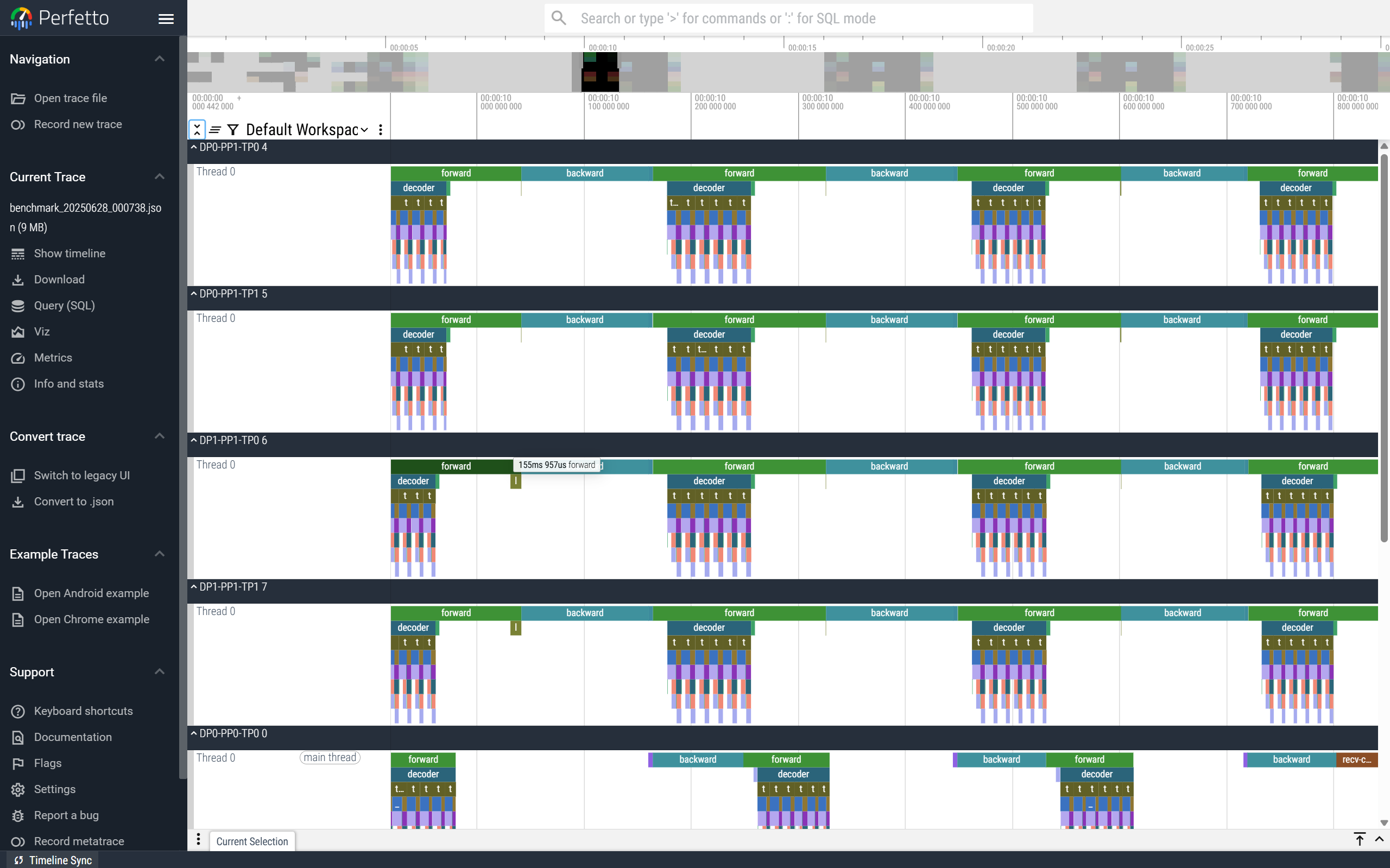
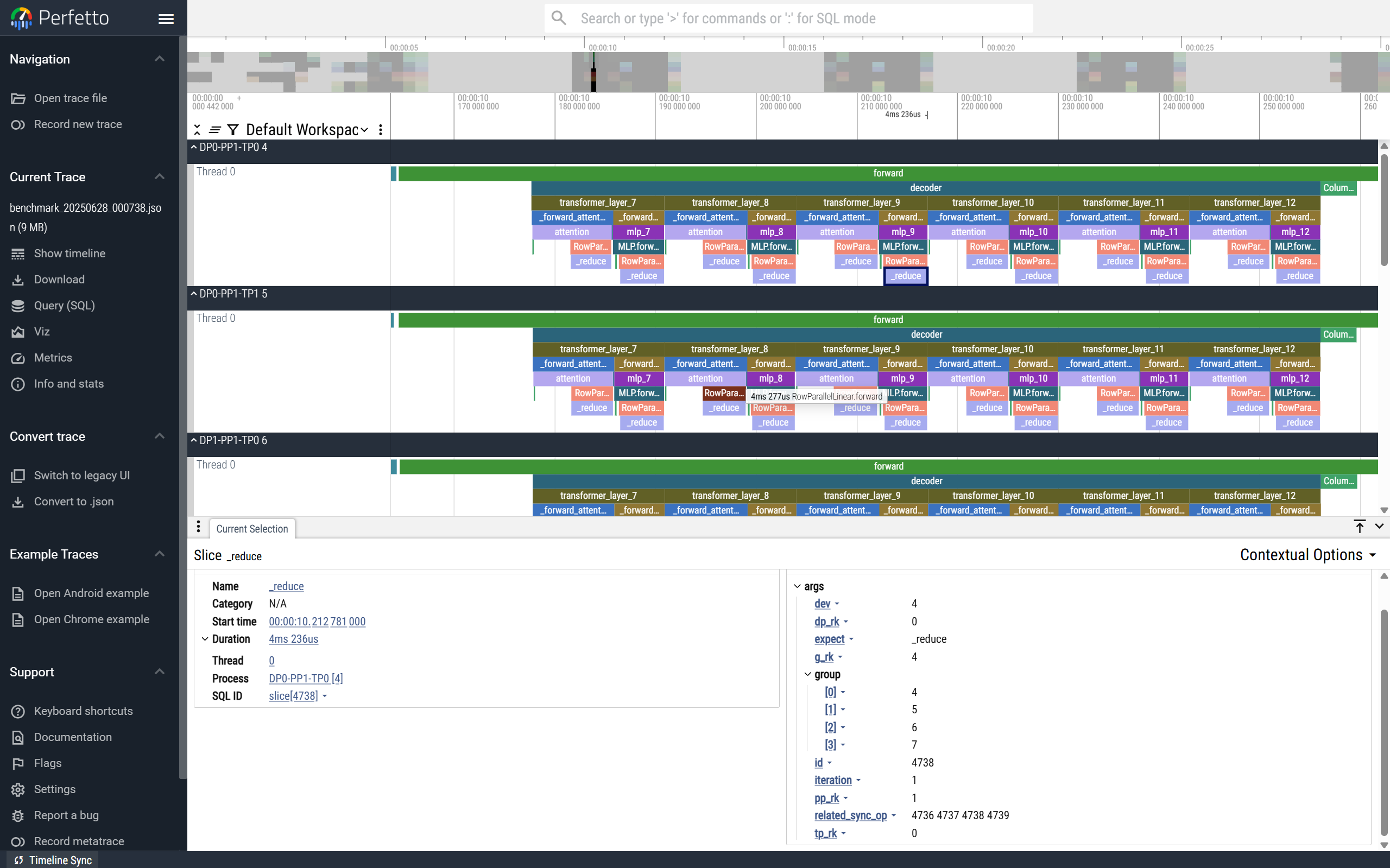
To illustrate the detection algorithm, we can manually inject a fault into the training process. We provide a script scripts/gpu_control.sh to simulate a GPU downclocking.
# Inject a fault into GPU 0, downclocking it to 900MHz
bash scripts/gpu_control.sh limit 0 900
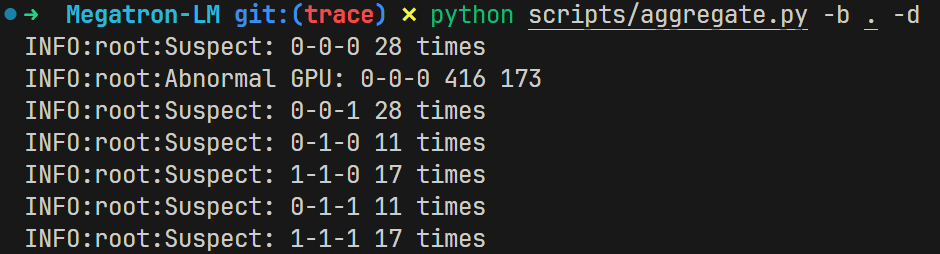
python scripts/aggregate.py \
    -b . \ # Equivalent to --bench-dir
    -d # Enable the detection algorithm, Equivalent to --detect
We can see output indicating that GPU 0 may be abnormal.
First, start the backend and frontend servers.
Backend (Megatron): For inference mode, run the text generation server script, pointing it to your model and tokenizer paths, and make sure to turn on the switch --enable-ws-server in the argument.
bash examples/inference/a_text_generation_server_bash_script.sh /path/to/model /path/to/tokenizer
For example
bash examples/inference/llama_mistral/run_text_generation_llama3.sh /gfshome/llama3-ckpts/Meta-Llama-3-8B-Instruct-megatron-core-v0.12.0-TP1PP1 /root/llama3-ckpts/Meta-Llama-3-8B-Instruct
For training mode, run the training script, and add --training-ws-port XXX (e.g. --training-ws-port 5000) to the argument. A typical command is
bash a_pretrain_script.sh $RANK
For example
bash pretrain_gpt.sh 0
Frontend (Vue): Navigate to the frontend directory and start the development server.
cd transformer-visualize
npm run dev
After launching both, open your browser to the specified address (usually http://localhost:5173). You will see the main interface.
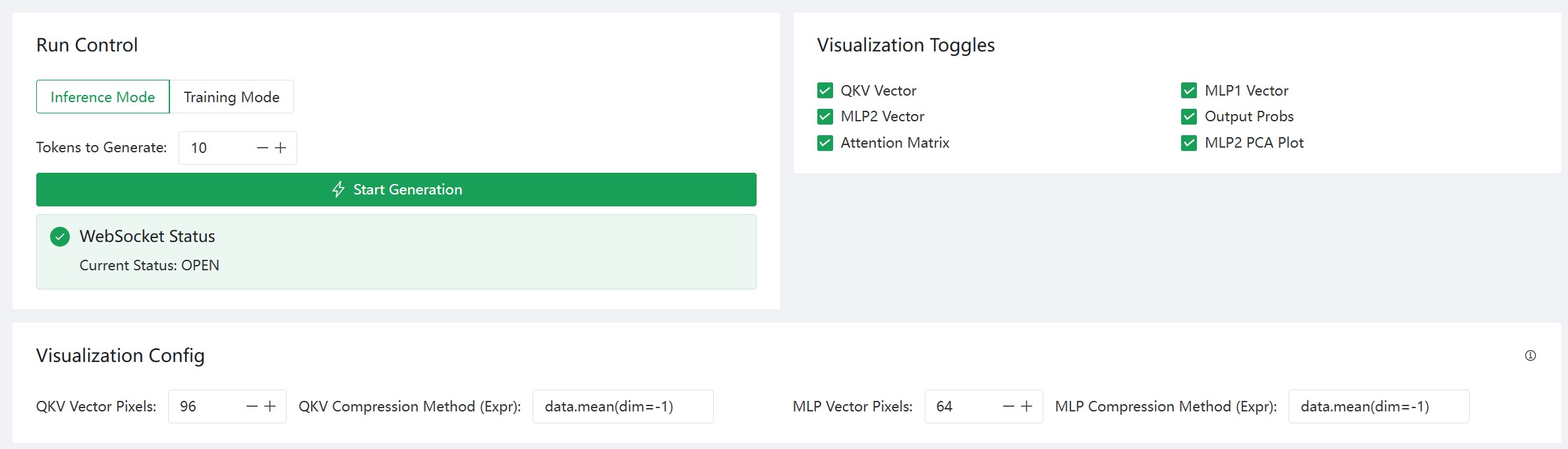
In the input prompts area, enter one or more prompts. Each text box represents a separate batch, allowing for parallel processing and comparison.

In the control panel, set the desired number of tokens to generate. Also enable or disable the real-time display of specific internal states, such as QKV vectors and MLP outputs. This helps manage performance and focus on relevant data. The filter expressions of vectors can be customized by the input box below.
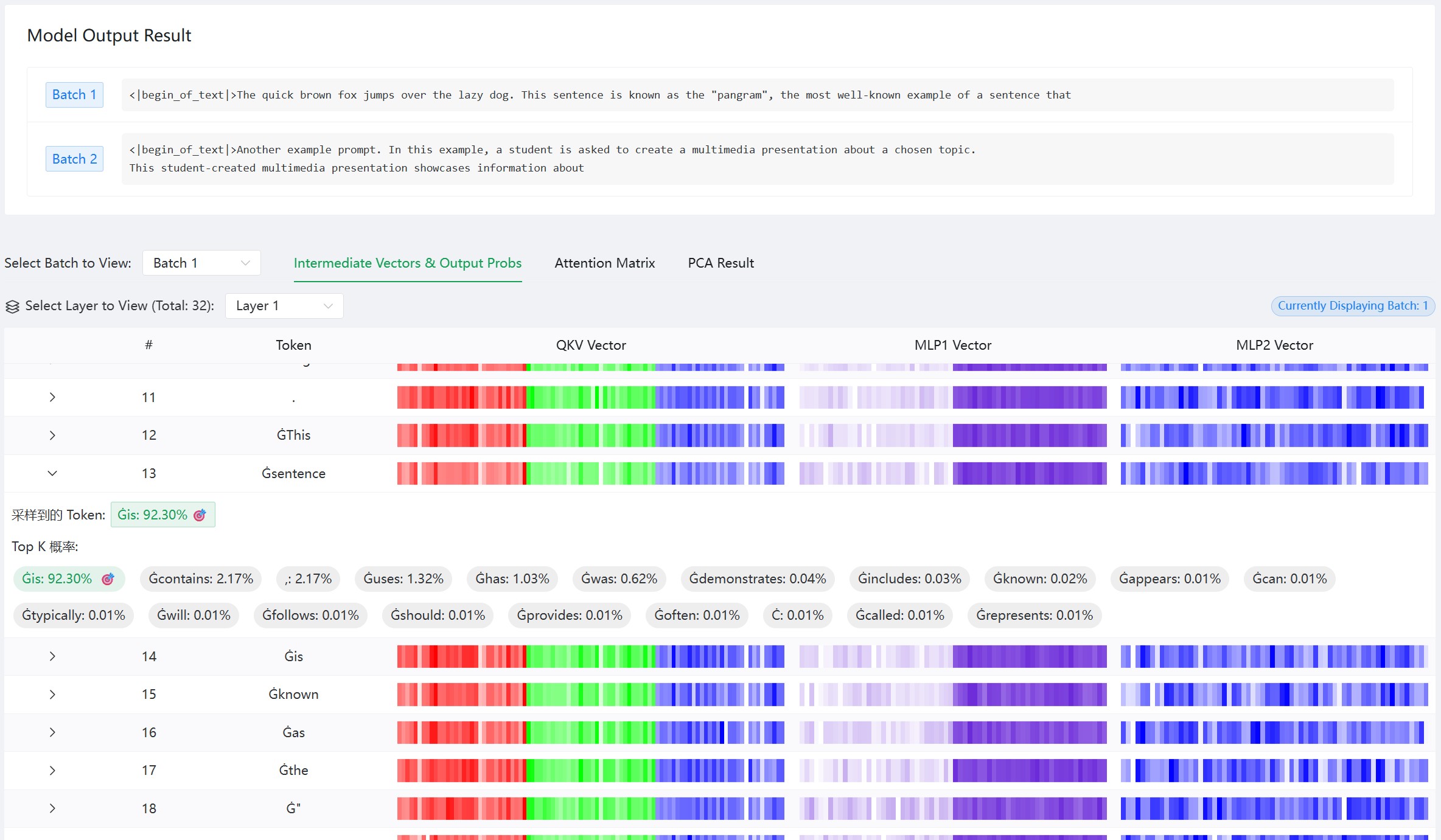
After starting generation, the visualization results will update token-by-token. In the first tab, the intermediate vector heatmaps are displayed and the output probabilities are shown in the expandable sections.
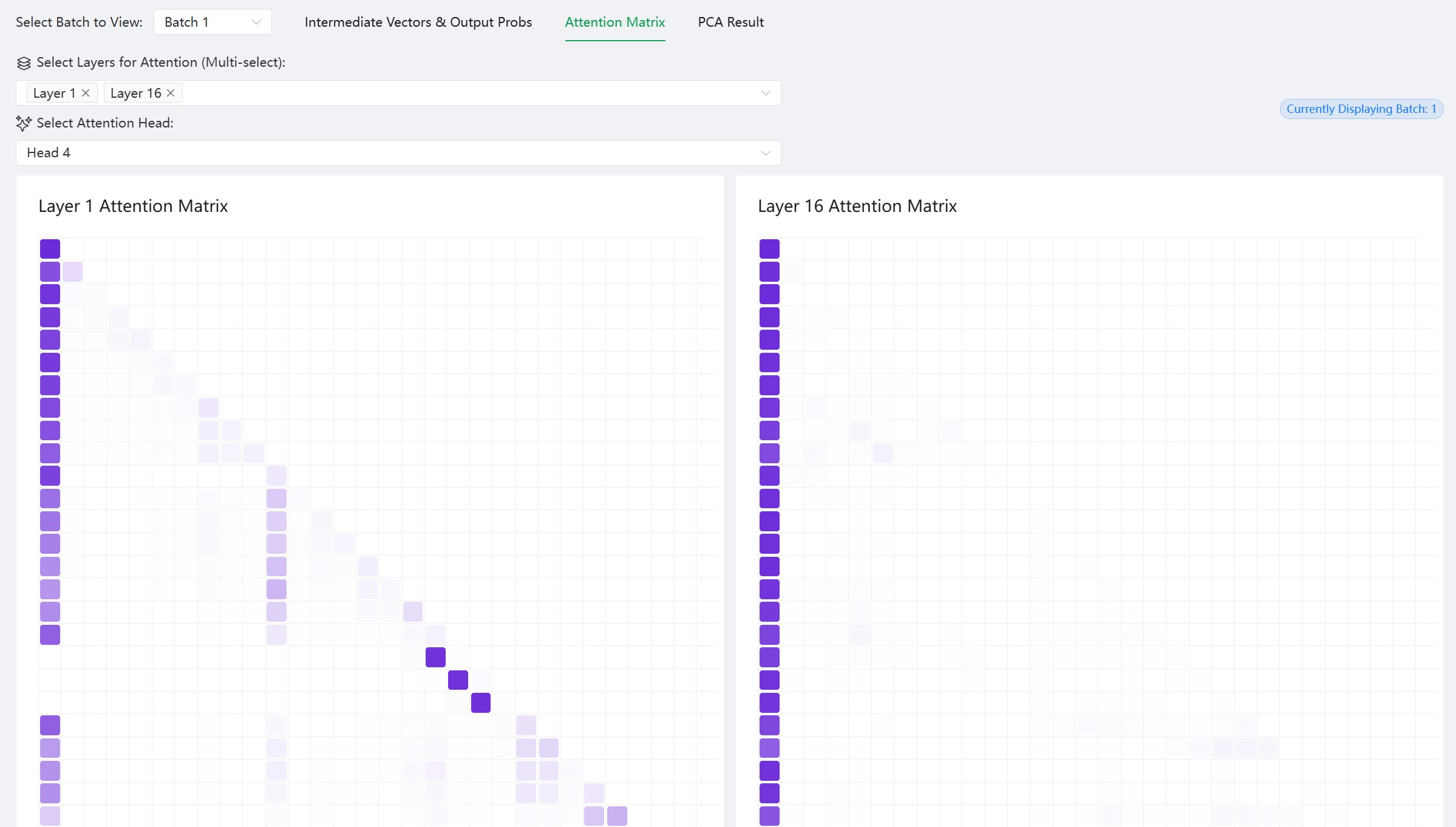
The second tab contains attention matrices. Use the dropdown menus to select the layer and attention head you wish to inspect.
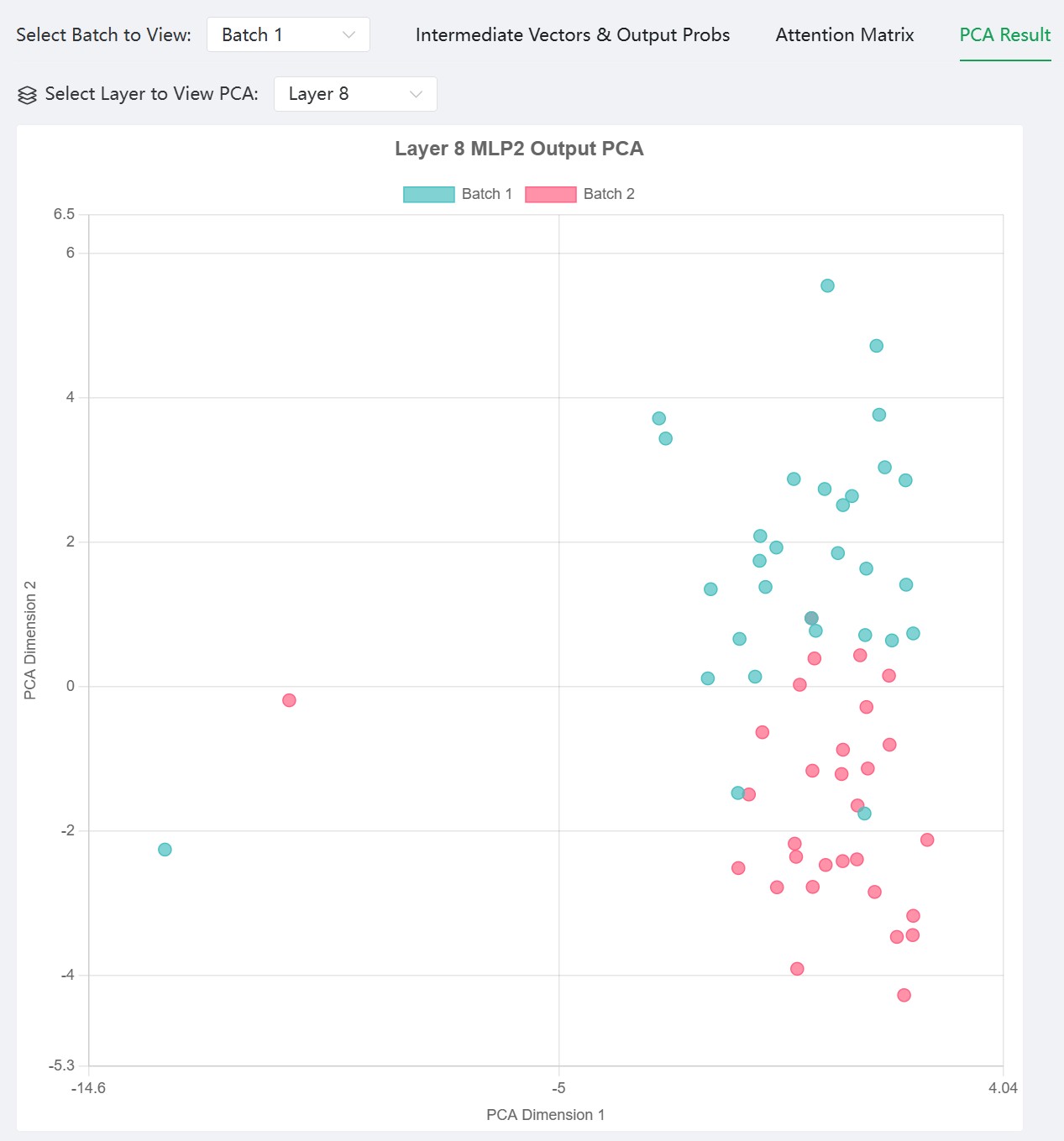
The third tab is the PCA dimensionality reduction feature where you can visually inspect the clustering of tokens and understand how the model groups similar concepts. The displayed layer can also be selected.
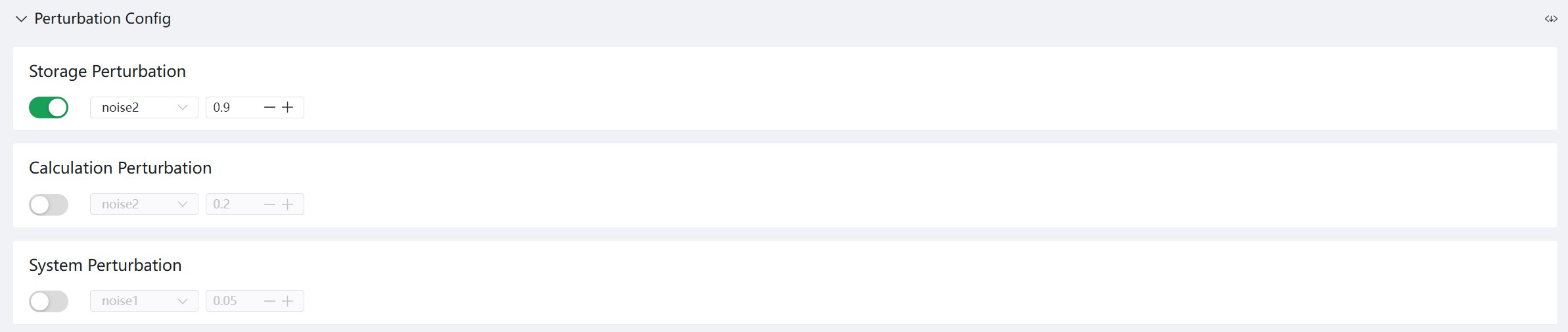
The expandable perturbation control panel can introduce controlled noise into the model's forward pass. Each kind of perturbation has an independent switch, controlling the noise type and intensity.
The currently supported noise types include:
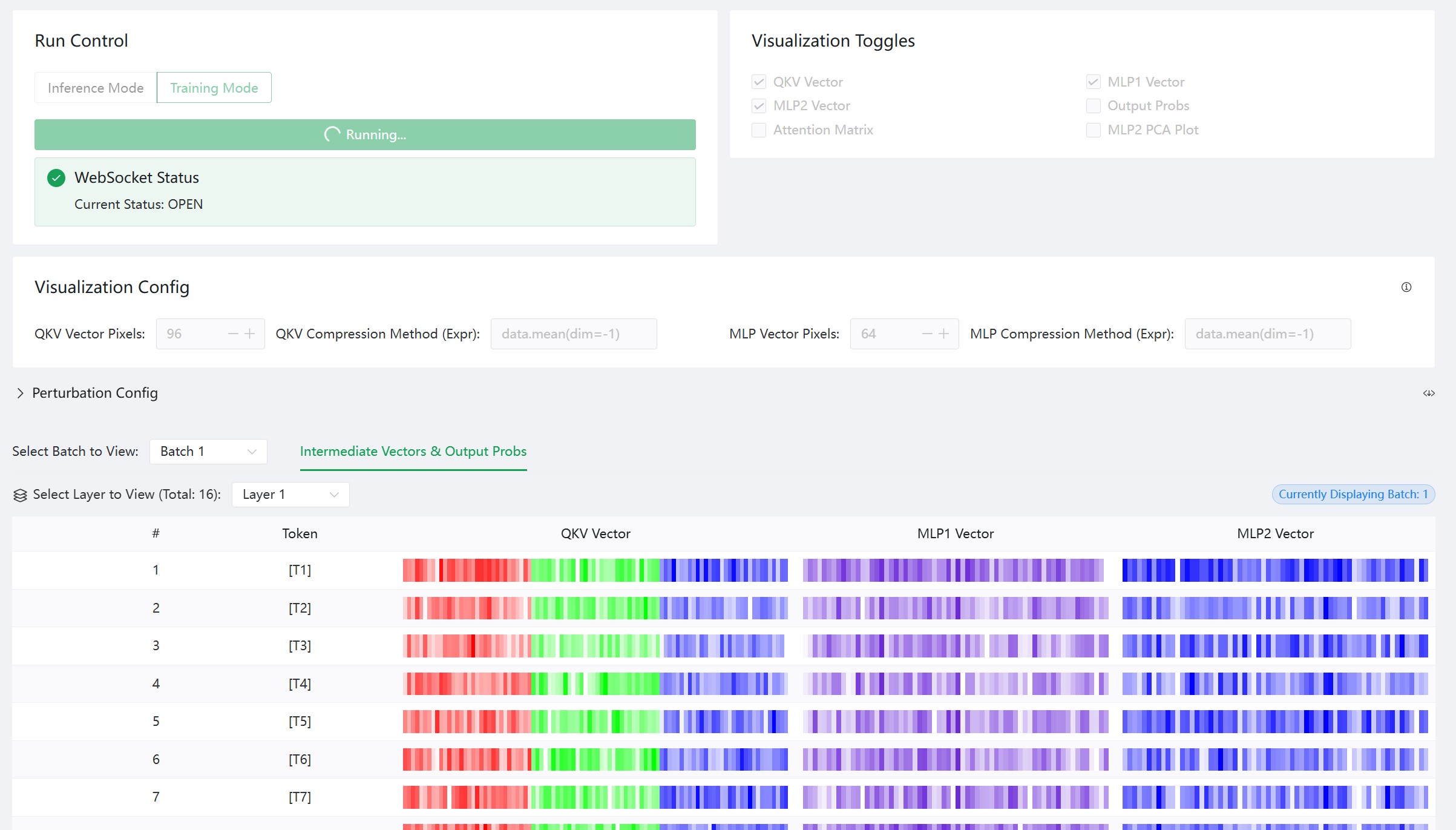
Similar visualization support is provided during the training process. The overall control is the same, and the training process will be controlled on the frontend page. Critical intermediate results and perturbations are supported in training.
ContainerImage: ngc.nju.edu.cn/nvidia/pytorch:25.03-py3
GPU: RTX4090

NVMEStorage: 50G
Limits:
  CPU: 28
  memory: 100Gi
  GPU: 4
UseShm: true
ShmSize: 16Gi

UseIB: true
pip install -r requirements.txt
bash prerequisite.sh
shm_tensor_new_rdma (for multinode) and shm_tensor_new_rdma_pre_alloc modules.cd megatron/shm_tensor_new_rdma
pip install -e .
cd megatron/shm_tensor_new_rdma_pre_alloc
pip install -e .
The dataset preparation step follows largely from the Megatron framework.
First, prepare your dataset in the following .json format with one sample per line
{"src": "bloomberg", "text": "BRIEF-Coach Inc launches tender offer to acquire Kate Spade & Co for $18.50 per share in cash. May 26 (Reuters) - Coach Inc: * Coach Inc launches tender offer to acquire Kate Spade & Company for $18.50 per share in cash * Coach Inc launches tender offer to acquire kate spade & company for $18.50 per share in cash * Coach Inc - tender offer will expire at 11:59 P.M. Edt on June 23, 2017, unless extended * Coach Inc - Chelsea Merger Sub Inc, has commenced a tender offer for all of outstanding shares of common stock, par value $1.00 per share, of Kate Spade & Company Source text for Eikon: Further company coverage: May 26 (Reuters) - Coach Inc: * Coach Inc launches tender offer to acquire Kate Spade & Company for $18.50 per share in cash * Coach Inc launches tender offer to acquire kate spade & company for $18.50 per share in cash * Coach Inc - tender offer will expire at 11:59 P.M. Edt on June 23, 2017, unless extended * Coach Inc - Chelsea Merger Sub Inc, has commenced a tender offer for all of outstanding shares of common stock, par value $1.00 per share, of Kate Spade & Company Source text for Eikon: Further company coverage:", "type": "Eng", "id": "0", "title": "BRIEF-Coach Inc launches tender offer to acquire Kate Spade & Co for $18.50 per share in cash. "}
{"src": "bloomberg", "text": "Var Energi agrees to buy Exxonmobil's Norway assets for $4.5 bln. MILAN, Sept 26 (Reuters) - Var Energi AS, the Norwegian oil and gas group 69.6% owned by Italian major Eni, has agreed to buy the Norwegian upstream assets of ExxonMobil for $4.5 billion. The deal is expected to be completed in the final quarter of this year, Var Energi said on Thursday. Reporting by Stephen Jewkes; editing by Francesca Landini MILAN, Sept 26 (Reuters) - Var Energi AS, the Norwegian oil and gas group 69.6% owned by Italian major Eni, has agreed to buy the Norwegian upstream assets of ExxonMobil for $4.5 billion. The deal is expected to be completed in the final quarter of this year, Var Energi said on Thursday. Reporting by Stephen Jewkes; editing by Francesca Landini", "type": "Eng", "id": "1", "title": "Var Energi agrees to buy Exxonmobil's Norway assets for $4.5 bln. "}
{"src": "bloomberg", "text": "Trump says 'incorrect' he is willing to meet Iran with 'no conditions'. WASHINGTON (Reuters) - U.S. President Donald Trump on Sunday appeared to play down the chances that he might be willing to meet with Iranian officials, saying reports that he would do so without conditions were not accurate. \u201cThe Fake News is saying that I am willing to meet with Iran, \u2018No Conditions.\u2019 That is an incorrect statement (as usual!),\u201d Trump said on Twitter. In fact, as recently as on Sept. 10, U.S. Secretary of State Mike Pompeo said \u201cHe (Trump) is prepared to meet with no preconditions.\u201d Reporting By Arshad Mohammed; Editing by Shri Navaratnam WASHINGTON (Reuters) - U.S. President Donald Trump on Sunday appeared to play down the chances that he might be willing to meet with Iranian officials, saying reports that he would do so without conditions were not accurate. \u201cThe Fake News is saying that I am willing to meet with Iran, \u2018No Conditions.\u2019 That is an incorrect statement (as usual!),\u201d Trump said on Twitter. In fact, as recently as on Sept. 10, U.S. Secretary of State Mike Pompeo said \u201cHe (Trump) is prepared to meet with no preconditions.\u201d Reporting By Arshad Mohammed; Editing by Shri Navaratnam", "type": "Eng", "id": "2", "title": "Trump says 'incorrect' he is willing to meet Iran with 'no conditions'. "}
note that we have provided a sample dataset under datasets_gpt/ and datasets_bert/.
Then, prepare the vocab file (gpt and bert) and the merges file (gpt-only). We have provided it in the respective directories.
For bert, run the following
cd datasets
python ../tools/preprocess_data.py \
       --input ../datasets_bert/dataset.json \
       --output-prefix bert \
       --vocab-file ../datasets_bert/vocab.txt \
       --tokenizer-type BertWordPieceLowerCase \
       --split-sentences \
       --workers $(nproc)
where the paths can be changed according to the location of your files and the place where you want the generated files to be.
For GPT, run the following
cd datasets
python ../tools/preprocess_data.py \
       --input ../datasets_gpt/dataset.json \
       --output-prefix gpt \
       --vocab-file ../datasets_gpt/vocab.json \
       --tokenizer-type GPT2BPETokenizer \
       --merge-file ../datasets_gpt/merges.txt \
       --append-eod \
       --workers $(nproc)
For other models, please refer to nvidia/megatron for the corresponding datasets.
To run distributed training on a single node, go to the project root directory and run
bash run_single_gpt.sh
for GPT and
bash run_single_bert.sh
for bert.
The run_single_<model>.sh files have the following structure:
pipeline_parallel, model_chunks and tensor_parallelvirtual_stage_layer parameter specifies how many layers there are in a single virtual pipeline stage. It is calculated as
$$
\frac{\text{total layer of model}}{\text{pipeline parallel}\times\text{model chunks}}
$$
where total layer is set under examples/ the corresponding model.examples/There are also several critical parameters in examples/gpt3/train_gpt3_175b_distributed.sh (bert model under the corresponding bert/ directory)
--use-dpp switches to DPP algorithm--workload specifies the workload of each single thread, and hence determines the number of threads used in P2P communication--num-gpus specifies the number of GPUs on the current node (single node training)run_single_<model>.sh. It needs to simultaneously modify run_single_<model>.sh if adjusting the layers.For the remaining models, you can either directly run
bash examples/<model>/<train_file>.sh
or write a file similar to run_{single,master,worker}_<model>.sh that sets up configurations and runs the shell under examples/
To run distributed training on multiple nodes, go to the root directory. First run
bash run_master_<model>.sh
and then start another pod and run
bash run_worker_<model>.sh
The run_master_<model>.sh has the following parameters
run_single_<model>.sh, we have pipeline_parallel, model_chunks and tensor_parallelexamples/gpt3/train_gpt3_175b_distributed_master.sh and to train_gpt3_175b_distributed_worker.sh (bert in the corresponding directory)examplesand run_worker_<model>.sh does the following
examplesThe examples/gpt3/train_gpt3_175b_distributed_master.sh and examples/gpt3/train_gpt3_175b_distributed_worker.sh are similar to the single node version, except that the --node-ips is mandatory, which is the infiniband IPs of the pods in the order of their GPU ranks. And also the --multi-node flag should be turned on.
Each run will generate a trace dir in benchmark. Go to the profiling directory and run
python aggregate.py --benchmark_dir benchmark/your-benchmark-dir
in the root dir to produce an aggregated trace file.
Install infiniband prerequisites.
Build the RDMA C++ extension modules: shm_tensor_new_rdma (for multinode) and shm_tensor_new_rdma_pre_alloc module.
Just follow above installation instructions.
$\quad$ To run distributed training on a single node, go to the project root directory and run
bash pretrain_gpt.sh $RANK
Here pretrain_gpt.sh is an example pretraining Bash script.
There are two extra options: --forward-backward-disaggregating and --ignore-forward-tensor-parallel in TRAINING_ARGS.
--forward-backward-disaggregating
Splits each rank into two: one for forward pass and one for backward pass. After doing this, your DP will be halved. Make sure your DP is even before adding this option.
--ignore-forward-tensor-parallel
Enables merging forward ranks within the same TP group. After doing this, your number of ranks will be multiplied by $\frac{TP+1}{2TP}$. Be sure you are using the correct number of ranks.
Currently Context Parallel and Expert parallel are not supported. --transformer-impl should be local.
If you find a security issue with our project, report the vulnerability privately to OpenSQZ. It is critical to avoid public disclosure.
An overview of the vulnerability handling process is:
The reporter reports the vulnerability privately to OpenSQZ.
The appropriate project's security team works privately with the reporter to resolve the vulnerability.
The project creates a new release of the package the vulnerability affects to deliver its fix.
The project publicly announces the vulnerability and describes how to apply the fix.
Contributions and collaborations are welcome and highly appreciated. Check out the Contributor Guide and get involved.
This project is licensed under the Apache 2.0 License, see the LICENSE file for details.
Use WeChat to scan below QR code.

OpenSQZ/MegatronApp is a public repo on GitHub by OpenSQZ. Toolchain built around the Megatron-LM for Distributed Training.
It declares no license on GitHub. Public does not mean open source: without a license, nobody is granted the right to reuse it.
Its maker has not tagged a system, so it is unknown here. Its README says what it needs.
Open "Take it" on its page: Take My Repo writes an install plan for your machine and hands it to your AI agent (Claude Code, Codex or Cursor), which asks you before each step. Take My Repo has not tested it on any machine.
Its last change on GitHub was on 2026-05-20. Take My Repo does not judge from that whether it is maintained.
Nobody has reviewed it on Take My Repo yet, which says nothing about its quality.
The agent harness performance optimization system. Skills, instincts, memory, security, and research-first development for Claude Code, Codex, Opencode, Cursor and beyond.
Give your AI agent eyes to see the entire internet. Read & search Twitter, Reddit, YouTube, GitHub, Bilibili, XiaoHongShu — one CLI, zero API fees.
Cook up amazing AI applications effortlessly with MiniCPM / MiniCPM-V / MiniCPM-o
A system that turns jailbreak papers into runnable attacks and benchmarks — live, as research evolves.
An open research platform for wearable sensing, nearby-device local multimodal inference, and local-first visual assistance.
A machine learning-enhanced automatic theorem prover for the Coq formal proof system