
PySimpleGUI-Photo-Colorizer
Transform black and white images (or your webcam) into beautifully colored images using Deep Learning. Uses OpenCV and Numpy to Colorize your photo or webcam video. GUI provided by PySimpleGUI.
- 178
- Python
psgshortcut- a PySimpleGUI application that will create shortcuts on Windows to your Python, EXE, Batch files... or any other file using a GUI made with PySimpleGUI.
Repo PySimpleGUI/psgshortcut, read from GitHub 1 min ago. PySimpleGUI has not joined Take My Repo.
PySimpleGUI/psgshortcut is a public repo on GitHub by PySimpleGUI. psgshortcut- a PySimpleGUI application that will create shortcuts on Windows to your Python, EXE, Batch files... or any other file using a GUI made with PySimpleGUI. It declares the LGPL-3.0 license on GitHub. It is written mainly in Python, has 10 stars and last changed on 2026-11-02. Nobody has reviewed it on Take My Repo yet, which says nothing about its quality. Read from GitHub on 2026-11-18.
PySimpleGUI Shortcut Tool
Creates Windows shortcuts for Python programs (and anything else) - drop the file on the window, click Create Shortcut.
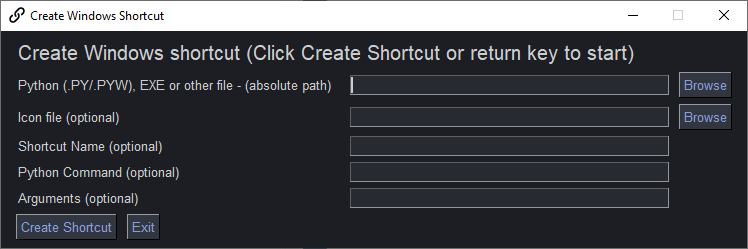
.py, .pyw, .exe or any file anywhere on the windowICON = b'iVBORw0KGgo...') is found, converted to a .ico and used for the shortcut. Programs without an icon get the PySimpleGUI default icon.ico / .png / .gif / .jpg instead if you prefer.pyw files are launched with pythonw.exe (no console window), .py files with python.exeThe latest official release of PySimpleGUI products can be found on PyPI. To pip install the demo applications from PyPI, use this command
python on your computer to invoke Python (Windows):python -m pip install --upgrade psgshortcut
python3 on your computer to invoke Python (Linux, Mac):python3 -m pip install --upgrade psgshortcut
You can also pip install the PySimpleGUI Applications that are in the PySimpleGUI GitHub account. The GitHub versions have bug fixes and new programs/features that have not yet been released to PyPI. To directly pip install from that repo:
python on your computer to invoke Python (Windows):python -m pip install --upgrade https://github.com/PySimpleGUI/psgshortcut/zipball/main
python3 on your computer to invoke Python (Linux, Mac):python3 -m pip install --upgrade https://github.com/PySimpleGUI/psgshortcut/zipball/main
Installed automatically by pip: PySimpleGUI, pywin32 (writes the .lnk files), psgdnd (drag and drop) and pillow (makes the .ico files).
psgshortcut still runs if psgdnd or pillow are missing - you just lose drag and drop, or icon conversion.
Once installed, launch psgshortcut by typing the following in your command line:
psgshortcut
You can also pass a file: psgshortcut my_program.pyw pre-fills the target.
The shortcut is a normal Windows .lnk file - move it anywhere, double-click it, or pin it to the taskbar.
Click Shortcut to this program. The form is filled in with psgshortcut itself (icon included), pick a destination and click Create Shortcut. Put it on your Desktop or in the Start Menu and pin it from there - no command window needed.
You can not only make shortcuts to Python programs, but you can make shortcuts to EXE and other files. Drop the file on the window, click Create Shortcut and you'll find the shortcut in the folder you chose.
Windows will only pin shortcuts whose target is an EXE, which is why Python shortcuts are made with pythonw.exe (or python.exe) as the target and your program as the argument - the Python field shows which one will be used. Put the shortcut in the Start Menu or on the Desktop, then right-click it → Pin to taskbar.
For the running program to group under its pinned icon (instead of opening a second, generic Python icon) the shortcut must carry the same taskbar App ID the program sets. psgshortcut writes the .lnk with IShellLink + IPropertyStore and sets System.AppUserModel.ID to:
PySimpleGUI.App.<md5 of the script path> for programs run with PySimpleGUI 6.3.17 or newer (the ID PySimpleGUI derives from the script path - psgshortcut asks the interpreter in the Python field which version it has)mycompany.myproduct.subproduct.version for programs run with an older PySimpleGUIsg.set_options(win_app_id=...), if it doesThe .ico files made from your programs' embedded icons are saved next to the program (my_program.pyw → my_program.ico). Right-click → Settings can send them to one central folder (%LOCALAPPDATA%\psgshortcut\icons) instead if you prefer to keep program folders clean.
Copyright 2023-2026 PySimpleGUI.
Licensed under LGPL3.
I'm happy to receive issues describing bug reports and feature requests! The project does not accept pull requests.
PySimpleGUI/psgshortcut is a public repo on GitHub by PySimpleGUI. psgshortcut- a PySimpleGUI application that will create shortcuts on Windows to your Python, EXE, Batch files... or any other file using a GUI made with PySimpleGUI.
It declares the LGPL-3.0 license on GitHub.
Its maker has not tagged a system, so it is unknown here. Its README says what it needs.
Open "Take it" on its page: Take My Repo writes an install plan for your machine and hands it to your AI agent (Claude Code, Codex or Cursor), which asks you before each step. Take My Repo has not tested it on any machine.
Its last change on GitHub was on 2026-11-02. Take My Repo does not judge from that whether it is maintained.
Nobody has reviewed it on Take My Repo yet, which says nothing about its quality.
The PySimpleGUI Demo Programs (also in main PySimpleGUI repo) To get: python -m pip install psgdemos
Use a REPL while your program executes. Watch what's happening, change variables, execute code
A System Tray Icon that works with the PySimpleGUI tkinter port. Uses pystray to supply the system tray. Works well under Windows.
A simple, easy to use tool that is a front-end to PyInstaller created with PySimpleGUI to convert your Python programs to executables.