Ribbit Network API
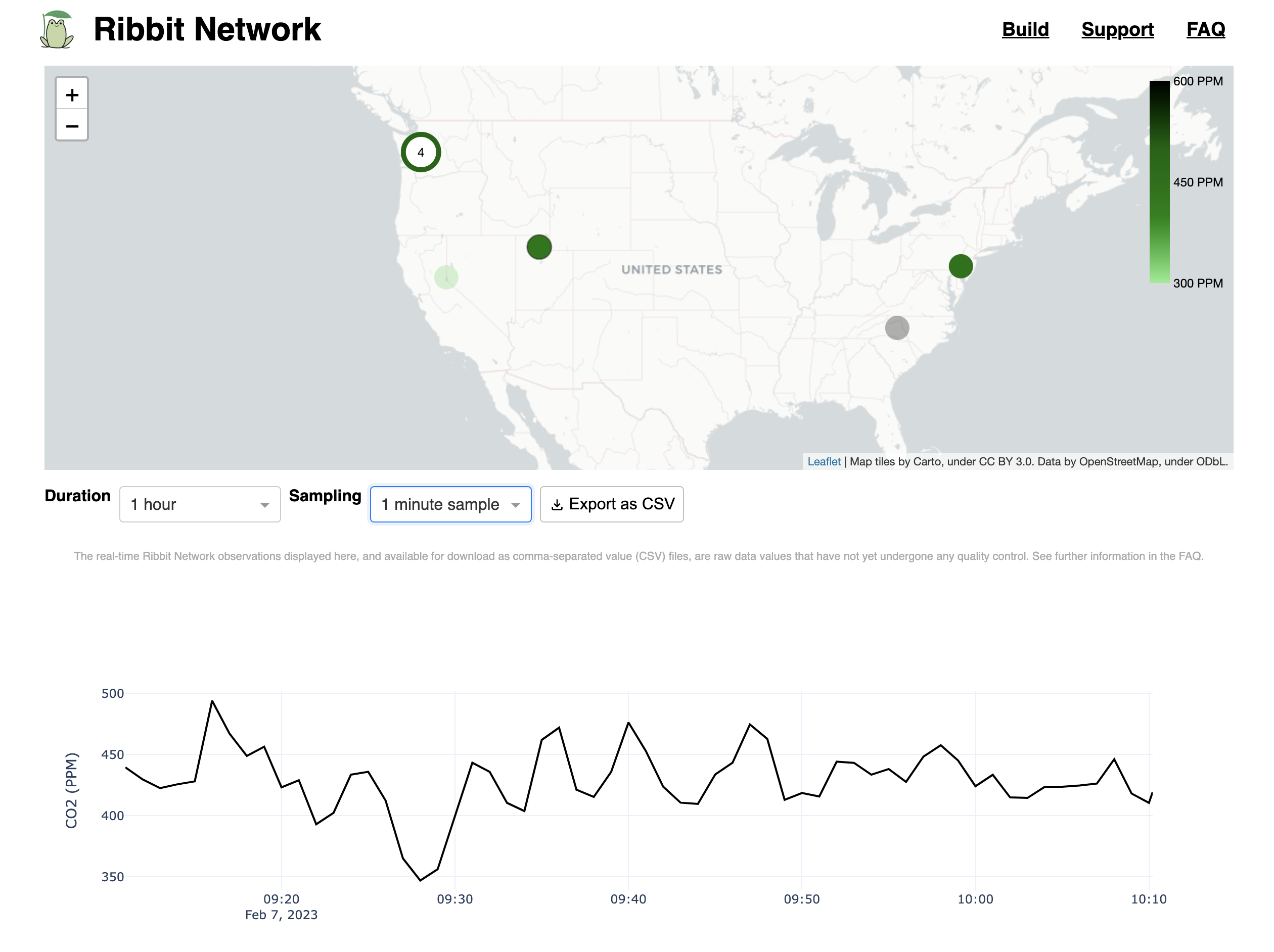
A public API for global CO2 measurements, powered by the Ribbit Network — an open-source network of citizen-operated CO2 sensors.
📖 Documentation
Interactive API reference (try requests in the browser):
api.ribbitnetwork.org/docs
Machine-readable OpenAPI spec:
api.ribbitnetwork.org/openapi.yaml
The spec also lives in this repo at internal/docs/openapi.yaml and is the source of truth — use it to generate client SDKs (openapi-generator, oapi-codegen, etc.) or to import into Postman / Insomnia / Bruno.
Quickstart
No key needed to get started — fetch the last day of CO2 readings on the free tier:
curl "https://api.ribbitnetwork.org/data?start=2024-01-01T00:00:00Z&stop=2024-01-02T00:00:00Z&fields=co2,lat,lon&interval=1h"
An API key is optional and unlocks much higher rate limits — pass it as a header:
curl -H "Authorization: Bearer $RIBBIT_API_KEY" \
  "https://api.ribbitnetwork.org/data?start=2024-01-01T00:00:00Z&stop=2024-01-02T00:00:00Z&fields=co2,lat,lon&interval=1h"
Endpoints at a glance:
| Endpoint |
Auth |
Description |
GET / |
— |
Health banner (🐸) |
GET /healthz |
— |
Liveness check (ok) |
GET /docs |
— |
Interactive API reference |
GET /data |
optional |
Sensor measurements over a time range |
GET /sensors |
optional |
List of known sensor IDs |
See /docs for full parameter, response, and error documentation.
Rate limits
| Tier |
Limited by |
Sustained rate |
Burst |
| Free (no key) |
client IP |
1 request / minute |
5 |
| Keyed |
API key |
1 request / second |
60 |
The free tier is sized for polling a single sensor about once a minute. For more sensors or faster polling. Exceeding the limit returns 429 Too Many Requests with a Retry-After header.
If you would like an API key for faster data access etc, please send an email to hello @ ribbitnetwork.org with a brief description of your usecase and who you are. :)
Running locally
Prerequisites: Go 1.25+
Clone the repo:
git clone https://github.com/Ribbit-Network/api && cd api
Copy the example env file and fill in your InfluxDB credentials:
cp .env.example .env
Run:
go run .
The API will be available at http://localhost:8080, and the interactive docs at http://localhost:8080/docs.
Previewing just the docs
If you only want to render the OpenAPI page (no InfluxDB or API-key store needed), run:
go run . docs
This serves the embedded spec and Scalar reference at http://localhost:8080. Handy when iterating on internal/docs/openapi.yaml.
Environment variables
| Variable |
Description |
PORT |
Port to listen on (e.g. 8080) |
INFLUXDB_SERVER_URL |
InfluxDB Cloud instance URL |
INFLUXDB_AUTH_TOKEN |
InfluxDB API token (use a read-only token in production) |
INFLUXDB_ORG |
InfluxDB organization name or email |
INFLUXDB_BUCKET |
InfluxDB bucket name (frog_fleet) |
API_KEY_DB_PATH |
Path to the SQLite file holding hashed API keys |
SENSORS_CACHE_TTL |
How long the /sensors list is cached (Go duration, e.g. 10m; default 5m) |
API keys
/data and /sensors are open to anonymous callers on the free tier; an API key is optional and raises the rate limit to the keyed tier. A key that is sent but invalid or revoked is rejected with 401 rather than downgraded to the free tier. Keys live in a SQLite file at API_KEY_DB_PATH; only the SHA-256 of each key is stored.
Key management is built into the API binary as a keygen subcommand.
Locally:
# Issue a new key (the raw key is printed once — record it immediately)
go run . keygen issue --owner you@example.com

# List existing keys
go run . keygen list

# Revoke a key by ID
go run . keygen revoke --id 3
In production (on Fly.io), run the same subcommands against the deployed binary over SSH:
fly ssh console -C "/api keygen issue --owner researcher@uni.edu"
fly ssh console -C "/api keygen issue --owner you@example.com"
fly ssh console -C "/api keygen list"
fly ssh console -C "/api keygen revoke --id 7"
Callers pass the key in either header:
curl -H "Authorization: Bearer rbnt_..." "$API_URL/data?start=2024-01-01T00:00:00Z"
curl -H "X-API-Key: rbnt_..."           "$API_URL/data?start=2024-01-01T00:00:00Z"
Updating the docs
The OpenAPI spec at internal/docs/openapi.yaml is embedded into the binary at build time. When you add or change an endpoint:
- Edit the spec to match.
go build ./... to verify it still compiles (the spec is go:embed-ed).- Visit
/docs locally to spot-check the rendered output.
Contributing
Feel free to open an issue or PR! We also have enabled the Github discussion board if you prefer that.