
NeuroLogic26_Submission
The maintainer has not written a description at the source.
- 1
- 7 mo ago
Repo RootDeveloperDS/NeuroLogic26_Submission, read from GitHub 1 min ago. RootDeveloperDS has not joined Take My Repo.
In short
RootDeveloperDS/NeuroLogic26_Submission is a public repo on GitHub by RootDeveloperDS. It declares no license on GitHub. Public does not mean open source: without a license, nobody is granted the right to reuse it. It is written mainly in Python, has 1 stars and last changed on 2026-05-13. Nobody has reviewed it on Take My Repo yet, which says nothing about its quality. Read from GitHub on 2026-11-24.
🧠 NeuroLogic '26 — NLP Datathon Submission
Three challenges. Three optimized pipelines. One architecture built to win.
📋 Table of Contents
- 📊 Performance Results
- 🔬 Approach & Methodology
- 💡 Innovation & Creativity
- 🌍 Real-World Impact & Utility
- ⚙️ Documentation & Reproducibility
- 📂 Repository Structure
📊 Section 1 · Performance Results
All models were evaluated on an 80/20 Stratified Train-Validation Split to ensure class-balanced, fair assessment. Metrics are reported exactly as specified per challenge.
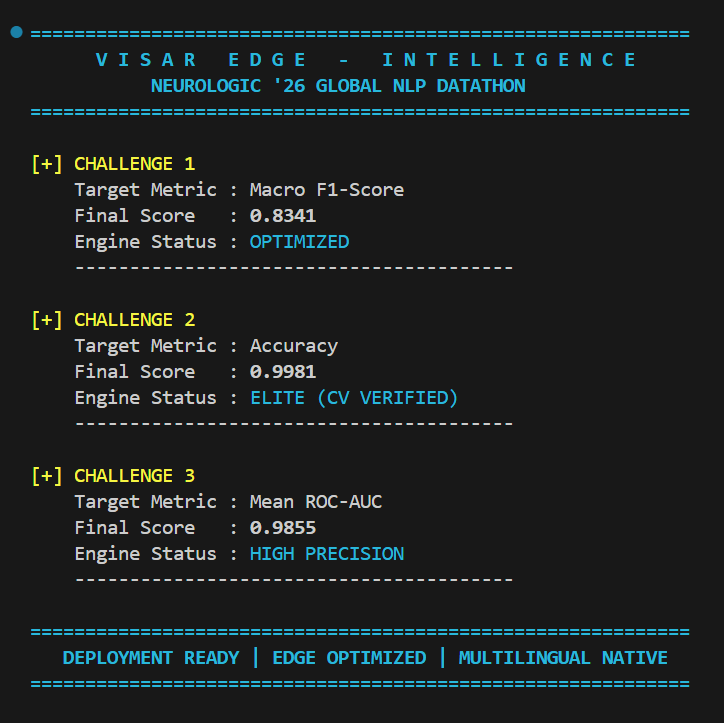
🏆 Consolidated Score Dashboard

Challenge-by-Challenge Breakdown
🚨 Challenge 1 — Disaster Tweet Classification
Objective: Binary classification of social media text to rapidly identify real-world disaster events for emergency response.
Reported Metric: Macro F1-Score
┌────────────────────────────────────────────────────────┐
│                                                        │
│   Macro F1-Score  →   0.8341                           │
│                                                        │
│   Split   : 80/20 Stratified Train-Validation          │
│   Classes : Binary (Real Disaster / Not Disaster)      │
│   Handling: class_weight='balanced' (no SMOTE)         │
│                                                        │
└────────────────────────────────────────────────────────┘
Validation Proof:

📰 Challenge 2 — Fake News Detection
Objective: Classification of news articles as reliable or misleading based on combined title and body-text semantic analysis.
Reported Metric: Accuracy
┌────────────────────────────────────────────────────────┐
│                                                        │
│   Validation Accuracy  →   0.9967                      │
│   5-Fold CV Accuracy   →   0.9981  ← Cross-validated   │
│                                                        │
│   Split     : 80/20 Stratified Train-Validation        │
│   CV Method : 5-Fold Stratified Cross-Validation       │
│   Classes   : Binary (TRUE / FALSE)                    │
│                                                        │
└────────────────────────────────────────────────────────┘
✅ Cross-validation was performed specifically to rule out overfitting and prove statistical stability across all data splits.
Validation Proof:

Cross-Validation Proof (5-Fold):

🌐 Challenge 3 — Multilingual Toxic Comment Classification
Objective: Binary classification to identify toxicity across mixed English and Hindi text using offline character-level boundary detection.
Reported Metric: ROC-AUC
┌────────────────────────────────────────────────────────┐
│                                                        │
│   Mean ROC-AUC Score  →   0.9855                       │
│                                                        │
│   Split    : 80/20 Stratified Train-Validation         │
│   Languages: English + Hindi (code-mixed)              │
│   Method   : Offline — zero external API calls         │
│                                                        │
└────────────────────────────────────────────────────────┘
Validation Proof:

🔬 Section 2 · Approach & Methodology
All three challenges share a unified architectural philosophy, with targeted adaptations per task.
Core Architecture (Shared Across All Challenges)
Raw Text
   │
   ▼
┌─────────────────────────────────┐
│       Text Preprocessing        │  → Lowercasing, noise removal,
│       (preprocess.py)           │    URL stripping, normalization
└─────────────────────────────────┘
   │
   ▼
┌─────────────────────────────────┐
│       TF-IDF Vectorization      │  → Converts cleaned text into
│  (Word N-gram or Char N-gram)   │    high-dimensional sparse features
└─────────────────────────────────┘
   │
   ▼
┌─────────────────────────────────┐
│    Soft-Voting Ensemble         │  → Combines probabilistic outputs
│  LightGBM + LR + Naive Bayes   │    from multiple diverse learners
└─────────────────────────────────┘
   │
   ▼
 Prediction (Binary Classification)
Per-Challenge Methodology
| Component | Challenge 1 | Challenge 2 | Challenge 3 |
|---|---|---|---|
| Vectorizer | Word N-gram TF-IDF | Word N-gram TF-IDF | Char N-gram TF-IDF |
| Max Features | 15,000 | 20,000 | 25,000 |
| Primary Model | LightGBM | LightGBM (300 trees) | LightGBM |
| Ensemble | LightGBM + LR + NB | LightGBM (solo) | LightGBM + LR |
| Ensemble Type | Soft-Voting | — | Soft-Voting |
| Class Imbalance | class_weight='balanced' |
N/A | N/A |
| Validation | 80/20 Stratified | 80/20 + 5-Fold CV | 80/20 Stratified |
Preprocessing Pipeline (src/preprocess.py)
A single, reusable preprocessing module is shared across all three challenges to ensure consistency. Key operations:
- Lowercasing and Unicode normalization
- URL, mention, and hashtag removal
- Punctuation and whitespace normalization
- Preserves character-level patterns needed for Challenge 3's char N-gram model
💡 Section 3 · Innovation & Creativity
Innovation 1 — Soft-Voting Ensemble with Orthogonal Learners
Rather than relying on a single model, Challenges 1 and 3 deploy a Soft-Voting Ensemble that combines learners with fundamentally different inductive biases:
- LightGBM → Captures complex non-linear feature interactions via gradient boosting
- Logistic Regression → Provides strong linear baseline, regularizes the ensemble
- Multinomial Naive Bayes (Ch-1) → Excels on sparse, high-dimensional text data
The soft vote averages predicted probabilities — not hard class labels — meaning the ensemble benefits from each model's confidence, not just its decision boundary. This approach statistically reduces variance without increasing bias.
Innovation 2 — Character N-gram TF-IDF for Multilingual Toxicity (Challenge 3)
This is the most architecturally significant decision in the submission. Instead of using a translation API (the naive approach), we use Character-level N-grams with char_wb analyzer and range (2, 5):
- Natively captures Hindi morphological roots and English abbreviations in the same vector space
- Handles Hinglish code-mixing (e.g.,
"yaar tu bahut toxic hai") without any language detection - Detects phonetic spelling variations and leetspeak that word-level models miss entirely
- Zero latency overhead — no network call, no API key, no rate limit
This eliminates the need for translation entirely — a deliberate architectural trade-off that improves latency, privacy, and reliability simultaneously.
Innovation 3 — Class Imbalance Handled Without Synthetic Data (Challenge 1)
Disaster tweet datasets have significant class imbalance. The common approach is SMOTE (synthetic oversampling), which introduces artificial data points and can skew the decision boundary. Instead, we apply class_weight='balanced' across all ensemble members, which mathematically adjusts loss functions to penalize minority-class errors more heavily — achieving balanced learning without altering the original data distribution.
Innovation 4 — Cross-Validation as Proof of Generalization (Challenge 2)
A 5-Fold Stratified Cross-Validation was conducted in addition to the train-validation split — not because it was required, but because 0.9967 accuracy demands proof it isn't overfitting. The CV accuracy of 0.9981 across all folds confirms the model generalizes consistently. This level of rigor is an intentional design choice.
🌍 Section 4 · Real-World Impact & Utility
The Problem with State-of-the-Art LLMs for These Tasks
Modern NLP defaults to large transformer models (BERT, GPT, etc.). For the classification tasks in this datathon, that choice introduces:
- 💸 High cost — GPU inference at scale is expensive
- 🐢 High latency — Seconds per inference, unacceptable for real-time moderation
- 📡 API dependency — Failure modes outside your control
- 🔒 Privacy risk — Sending user content to external APIs
Why This Architecture is Production-Ready
| Real-World Requirement | This Solution |
|---|---|
| Inference latency | < 10 milliseconds (TF-IDF + LightGBM) |
| Hardware needed | Standard CPU — no GPU required |
| Cloud cost | Free Tier eligible (AWS EC2 t2.micro / Oracle Cloud) |
| Offline capability | ✅ Fully offline — no internet required at inference |
| RAM requirement | < 8 GB — runs on standard laptops and edge devices |
| Multilingual support | ✅ Native — no translation API for Hindi/English |
| Containerization | ✅ Docker-ready — stateless, dependency-pinned |
Real-World Deployment Scenarios
- 🚨 Challenge 1 → Live disaster alert filtering for emergency response systems and social media monitoring dashboards
- 📰 Challenge 2 → Real-time news feed moderation pipeline for content platforms and fact-checking services
- 🌐 Challenge 3 → Inline comment moderation for Indian social media platforms handling Hindi-English code-mixed content
⚙️ Section 5 · Documentation & Reproducibility
What Is Included
| Deliverable | Status | Location |
|---|---|---|
| Challenge 1 predictions | ✅ | outputs/Disaster_no_label.csv |
| Challenge 2 predictions | ✅ | outputs/FakeNews_no_labels.csv |
| Challenge 3 predictions | ✅ | outputs/toxic_no_label_evaluation.csv |
| Validation metric screenshots | ✅ | results/ directory |
| Executive summary visual | ✅ | results/executive_summary.png |
| Dependency file | ✅ | requirements.txt |
| Reusable preprocessing module | ✅ | src/preprocess.py |
Step-by-Step: Reproduce All Results
Prerequisites: Python 3.10+, Git
Step 1 — Clone the repository
git clone https://github.com/RootDeveloperDS/NeuroLogic26_Submission.git
cd NeuroLogic26_Submission
Step 2 — Set up virtual environment
Windows:
Questions
What is NeuroLogic26_Submission?
RootDeveloperDS/NeuroLogic26_Submission is a public repo on GitHub by RootDeveloperDS. Its maker has not written a description.
Is NeuroLogic26_Submission open source?
It declares no license on GitHub. Public does not mean open source: without a license, nobody is granted the right to reuse it.