OrbitSpan 🪐
"I didn't want to simply look at the Solar System. I wanted to understand its scale."
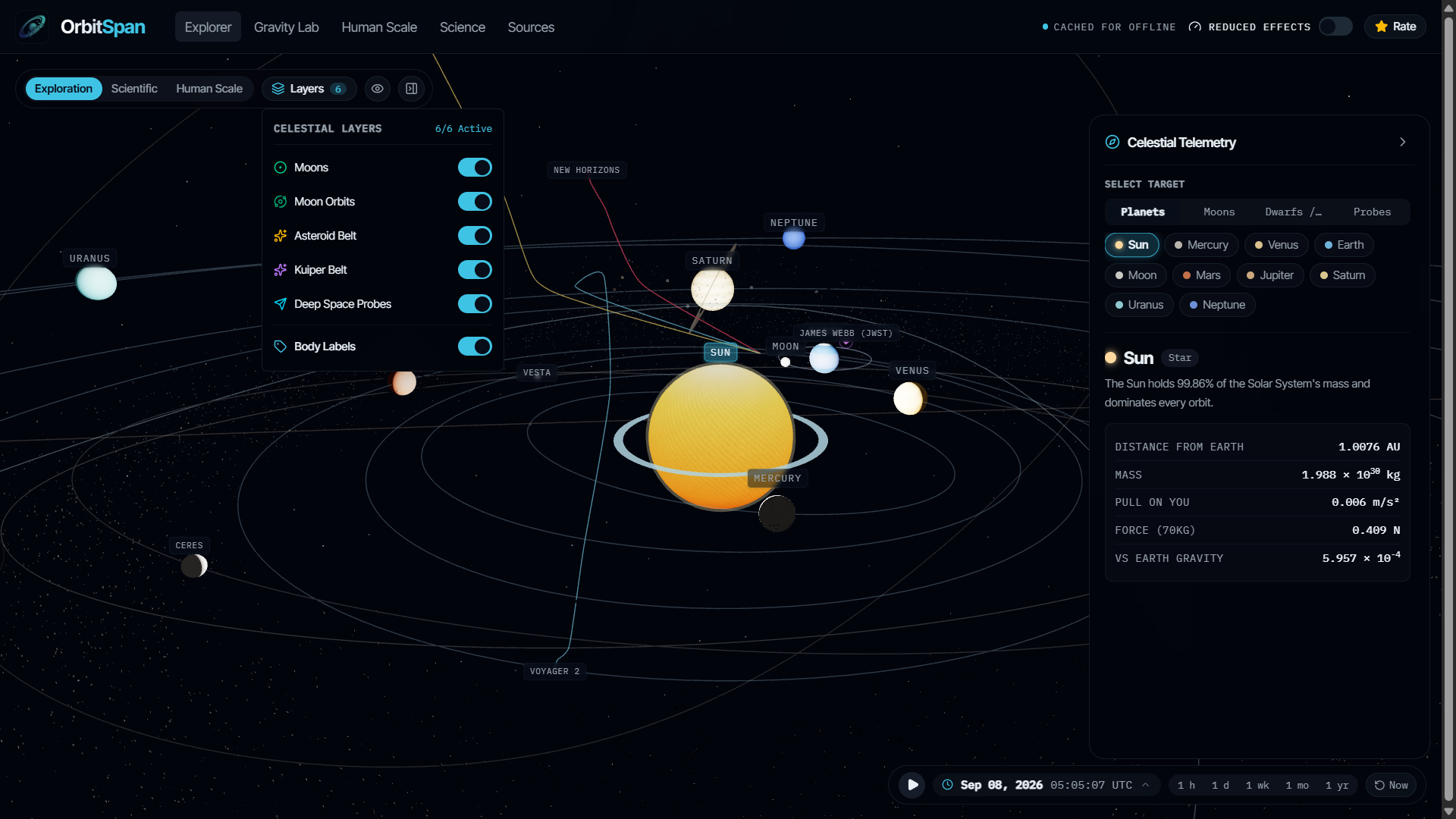
An interactive astrophysics and orbital scale engine that calculates real planetary positions, true Newtonian gravitational pull on the human body, and translates cosmic distances into intuitive, human-scale physical benchmarks.
🔗 Live Deployment: orbitspan.vercel.app · 📜 Changelog (v1.5.0)
🌌 Why I Built This — The Origin Story
This project started from a simple question born out of daily curiosity:
We frequently hear bold claims surrounding the planets:
- "Planets have gravitational effects on our lives."
- "Planetary alignments dictate human destiny, energy, and personality."
- "Mars or Saturn is pulling on you right now."
As an engineering student, this prompted a direct, quantifiable inquiry:
"If planets exert gravitational forces on us, exactly how large are those forces? Can I calculate them live? Can I compare them against everyday objects? And can I make those unfathomable astronomical distances truly understandable to a human mind?"
I wanted to move past abstract assertions and calculate the underlying physics directly.
Gravity is governed by a well-established mathematical law:
$$a = \frac{G \cdot M}{r^2} \quad \text{and} \quad F = m \cdot a$$
Where:
-
$G = 6.67430 \times 10^{-11} \text{ m}^3\text{kg}^{-1}\text{s}^{-2}$ (Universal Gravitational Constant)
-
$M$ = Mass of the celestial body $(\text{kg})$
-
$r$ = Instantaneous Euclidean distance between Earth and the celestial body $(\text{m})$
-
$m$ = Observer mass $(\text{kg})$
However, solving the equations revealed a second, deeper visualization challenge: astronomical scale is impossible for the human brain to intuitively picture.
Saying that the Sun is approximately 149.6 million kilometres away is scientifically accurate, but the human mind has no daily reference for 149,600,000 km. It is just an abstract string of numbers.
That prompted the central visualization breakthrough of this project:
"What happens if we shrink the entire Solar System down so Earth is the exact size of a human fist (~10 cm)?"
- How far away would the Moon sit? (A couple steps away — ~3 metres).
- How far would the Sun be? (A short walk down the road — ~1.17 kilometres).
- Where would Neptune be located? (In the next town — ~35 kilometres away).
OrbitSpan was engineered to turn that question into an interactive reality.
🎯 The Core Motive: Measurable Physics over Vague Claims
The goal of this project is not to claim that gravity is imaginary. Quite the contrary: gravity is real, universal, measurable, and mathematically predictable.
The critical distinction is between:
- The physical phenomenon: A celestial body exerts a gravitational acceleration on all mass in the universe.
- The astrological claim: That tiny gravitational acceleration dictates a human's destiny, fortune, or personality.
The first is rigorous physics. The second is an extraordinary claim that lacks empirical evidence or a known physical mechanism.
OrbitSpan approaches this with calm, factual scientific respect:
- Astronomy models and predicts measurable physical bodies and their orbits using Newtonian mechanics and general relativity.
- Astrology is a cultural and historical tradition, but its predictive claims regarding human affairs are not substantiated by the actual gravitational tugs computed here.
Instead of hand-waving, OrbitSpan provides live planetary coordinates, real-time Euclidean distance vectors, Newtonian acceleration readouts, and human-scale model benchmarks.
📏 The Human-Scale Intuition Model
Standard 3D Solar System visualizers distort distances so that planets can fit onto a computer screen. While convenient, it severely misleads human intuition about how empty space actually is.
OrbitSpan introduces a mathematically rigorous Human Scale Engine. Users can select a physical reference scale for Earth:
| Reference Earth Diameter |
Linear Scale Ratio |
Moon Distance |
Sun Distance |
Jupiter Distance (Avg) |
Neptune Distance (Avg) |
|
1 cm (Marble)
|
$1 : 1,274,200,000$ |
~0.30 m |
~117 m |
~610 m |
~3.5 km |
|
5 cm (Golf Ball)
|
$1 : 254,840,000$ |
~1.51 m |
~587 m |
~3.05 km |
~17.6 km |
|
10 cm (Approx. Fist)
|
$1 : 127,420,000$ |
~3.02 m |
~1.17 km |
~6.10 km |
~35.2 km |
|
25 cm (Basketball)
|
$1 : 50,968,000$ |
~7.54 m |
~2.93 km |
~15.26 km |
~88.1 km |
|
1.0 m (Giant Globe)
|
$1 : 12,742,000$ |
~30.17 m |
~11.74 km |
~61.05 km |
~352.5 km |
(Note: All distances are re-evaluated live from instantaneous planetary ephemeris vectors and vary as planets move through their orbits).
🏛️ Visual Comparison Pedestal
To anchor proportional scale physically, the Visual Scale Pedestal stages inspected planets on a unified virtual stage with two distinct perspectives:
-
Direct Planet vs. Earth (1:1 Ratio): Renders celestial bodies side-by-side under a unified pixels-per-metre scale factor ($S = 160 / \max(D_E, D_P)$), ensuring benchmark Earth and inspected bodies render with 100% identical pixel geometry.
-
With 1.8m Standing Human: Visualizes the true physical footprint of celestial objects next to a human observer ($S = 170 / (\max(1.8, D_E, D_P) \times 1.15)$).
-
Tangible Real-World Analogies: Links celestial diameters directly to everyday tactile objects—from a pebble (Ceres) and golf ball (Moon) to a grapefruit (Earth), yoga ball (Jupiter), and two-story house (Sun).
-
Zero Optical Stroke Distortion: Discs use pure vector fill boundaries (
stroke="none") to eliminate artificial visual inflation on miniature bodies.
🚶 "Walk the Solar System" City Expedition
The City Walk Journey Explorer projects scaled astronomical distances onto walkable metropolitan routes across four global cities:
-
New York City: Sun at Battery Park $\to$ Mars at Washington Square $\to$ Jupiter at Central Park $\to$ Neptune at Columbia University.
-
London: Sun at Trafalgar Square $\to$ Earth at British Museum $\to$ Saturn at Tower Bridge $\to$ Neptune at Greenwich Observatory.
-
Paris: Sun at Eiffel Tower $\to$ Inner Planets along the Champ de Mars $\to$ Saturn at Arc de Triomphe $\to$ Neptune at La Défense.
-
Tokyo: Sun at Imperial Palace $\to$ Inner Planets at Tokyo Station $\to$ Jupiter at Roppongi $\to$ Neptune at Shinjuku.
-
Biometric & Travel Telemetry: Calculates real walking durations (at 5.0 km/h), cumulative stride counts (~0.762 m/step), active energy expenditure (~0.04 kcal/step), vehicular transit times (100 km/h), and true scaled photon light travel latency.
⚡ Gravity Lab: Real-Time Newtonian Forces
In the Gravity Lab (/gravity-lab), users can input their exact body mass (e.g., $70\text{ kg}$) and inspect the true gravitational force exerted by every solar system body at its current astronomical distance.
$$\text{Acceleration: } a = \frac{G \cdot M_{\text{body}}}{r^2} \quad \left[\frac{\text{m}}{\text{s}^2}\right]$$
$$\text{Force: } F = m_{\text{observer}} \cdot a \quad [\text{N}]$$
Example Live Magnitude Comparison (70 kg human):
-
Earth Surface Gravity: $\approx 686.7\text{ N}$ ($9.80665\text{ m/s}^2$)
-
The Moon: $\approx 0.0023\text{ N}$ ($3.3 \times 10^{-5}\text{ m/s}^2$) — Dominant tidal body due to proximity.
-
The Sun: $\approx 0.41\text{ N}$ ($5.9 \times 10^{-3}\text{ m/s}^2$) — Largest raw acceleration.
-
Jupiter (at Closest Approach): $\approx 0.000029\text{ N}$ ($4.1 \times 10^{-7}\text{ m/s}^2$).
-
A Person Standing 1 Metre Away (70 kg): $\approx 0.00000033\text{ N}$ ($4.7 \times 10^{-9}\text{ m/s}^2$).
💡 Physical Insight: A building next to you or a fellow passenger on a train produces a gravitational acceleration on your body comparable to or greater than the distant outer planets.
🌟 Core Features
- 🪐 Real Ephemeris 3D Engine: Live planetary orbits computed via the VSOP87 analytical series and Meeus/ELP lunar theory (via Astronomy Engine).
- 🌌 Edge-to-Edge Spatial Canvas (
100dvh): Immersive, full-screen cosmos viewport across desktop and mobile, with collapsible telemetry sidebars and touch-safe bottom sheet drawers (via Vaul).
- 🎛️ Unified Glass Top Controls Bar: Floating HUD capsule integrating segmented scale modes, 1:1 real scale toggle, celestial layers popover (6 active toggles), and one-click Cinematic Zen Mode (
Z / Esc).
- ⏱️ Docked Mission Clock: Single-row playback speed selectors (
1h to 1y), live UTC clock, one-touch "Now" synchronization, and historic epoch milestone presets (Voyager 1, JWST, Halley).
- 🏛️ Visual Scale Pedestal Engine: Side-by-side proportional comparison staging (1:1 planet vs. Earth and with a 1.8m human silhouette) with zero stroke distortion and everyday physical object analogies.
- 🚶 "Walk the Solar System" City Journey: Scaled expedition routes across New York, London, Paris, and Tokyo with landmark milestones, walking duration, stride counts, and calorie burn metrics.
- 🌕 Major Planetary Moons System: 18+ major moons across Mars, Jupiter (4:2:1 Laplace resonance), Saturn, Uranus, Neptune (retrograde Triton), and Pluto with proximity-adaptive orbit ring shaders.
- ☄️ 5,000+ Instanced Asteroids & Kuiper Belt: GPU-accelerated asteroid belt with Kirkwood gap distribution, 3,000+ Kuiper Belt planetesimals, and analytical Keplerian solver for Dwarf Planets & Comet 1P/Halley with solar-radiation tail physics.
- 🛰️ Historic Deep Space Probes & JWST at L2: Trajectory ribbons for Voyager 1, Voyager 2, New Horizons, and James Webb Space Telescope at Sun-Earth L2.
- 🔬 100% Real Universe Scale Mode: Uncompromised 1:1 physical planetary radii and true astronomical distances ($3.667\times$ Earth-to-Moon diameter ratio and $60.33\times$ Earth radii orbital distance).
- 🌙 Universal Lunar Orbit Ring: Continuous 3D geocentric lunar orbit visualization dynamically tracked around Earth across all scale modes.
- ⚖️ Interactive Gravity Lab: Live gravitational force, acceleration, Earth percentage comparisons, and logarithmic force spectrum visualizations (via Recharts).
- 🏷️ Smart Distance-Adaptive 3D Labels: Floating spatial name badges that auto-fade when zooming in close to keep planetary surfaces unobstructed.
- 📴 Offline-First PWA (v2): Service worker shell architecture that caches simulation algorithms, ephemerides, and assets for 100% offline functionality.
- ♿ Adaptive Performance Mode: Hardware-aware reduced effects toggle for smooth 60fps rendering across low-power mobile GPUs.
🏗️ Technical Architecture & Data Flow
OrbitSpan is strictly client-first. There are zero runtime NASA API dependencies and no server-side physics bottlenecks. All ephemerides and vector mathematics execute locally in the client browser.
flowchart TD
    A[Canonical UTC Timestamp / User Input] --> B[Zustand Central Orbit Store]
    B --> C[useSolarSystemState Hook]

    subgraph Astronomy Engine [Astronomy Engine - VSOP87 & Meeus/ELP]
        C --> D[HelioVector Computation]
        C --> E[GeoVector & GeoMoon Computation]
        D --> F[Earth-Relative Euclidean Distances]
        E --> F
    end

    subgraph Physics [Physics & Scale Transformers]
        F --> G["Newtonian Gravity Engine: a = GM/r², F = ma"]
        F --> H[Human-Scale Linear Ratio Converter]
        F --> I[Compressed Exploration Coordinates]
    end

    subgraph ViewLayer [Interactive View Layer]
        I --> J[React Three Fiber / Three.js 3D Viewport]
        G --> K[Gravity Lab Charts & Readouts]
        H --> L[Human Scale Comparison Matrix]
        F --> M[Live Ephemeris Data Table]
    end
Loading
🛠️ Technology Stack
| Layer |
Technologies |
Purpose |