⛔ PAX-Coder — Commercial Authorization Required
🔒 CLONE REQUIRES AUTHORIZATION — Contact jessica@collectivekitty.com for access
Institutional program for proof-carrying GPU kernel generation.
PAX-Coder is a commercially gated system. Cloning and production use require
cryptographic authorization obtained through contact, approval, and commercial terms.
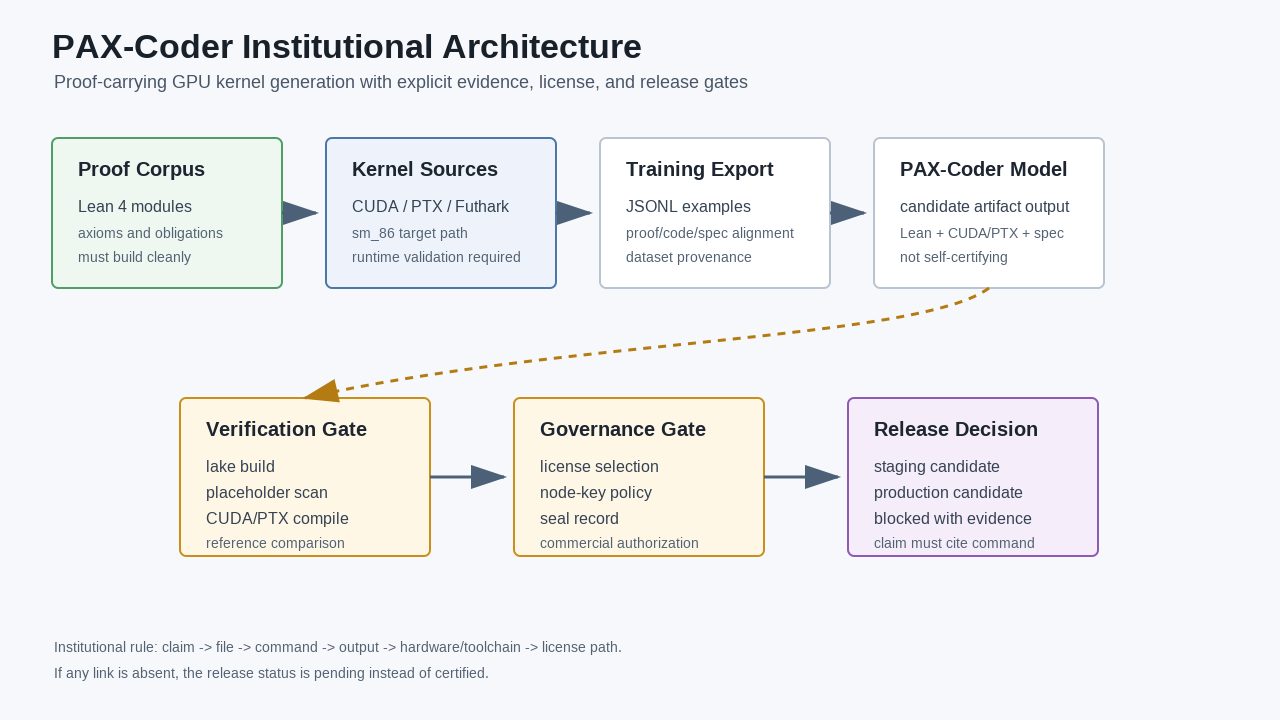
PAX-Coder is a repository for the PAX verified-kernel program: Lean 4 proof
modules, CUDA/PTX kernel templates, Futhark functional specifications, a
training-data exporter, model fine-tuning scripts, demo materials, and a
license-policy backend. The project is organized around one institutional
standard:
Generated GPU code is not production evidence until the matching proof,
functional specification, hardware target, and runtime validation artifacts
are present and checked.
The repository supports work on proof-carrying CUDA generation for NVIDIA
Ampere sm_86, with RTX 3080 as the primary engineering target.
🔐 Commercial Authorization Gate
Clone Status: GATED
All clones require cryptographic authorization. The gate prevents unauthorized access at clone time.
How to Get Access:
- Contact: jessica@collectivekitty.com
- Request: Specify your use case and tier
- Approval: PAX-Coder authority reviews (1–3 business days)
- Payment: Commercial agreement + payment processing
- Authorization: Receive Sovereign Node Key credential
- Clone: Use authorized credential to clone
Clone Access: Contact → Approval → Payment → Provisioning → Authorized Clone
Authorization Required: This repository enforces cryptographic authorization at clone time. Unauthorized access is denied by the authentication gate.
To perform protected operations (signing releases, production deployment) and receive a provisioned Sovereign Node:
- Contact: Submit access request at CONTACT.md
- Select tier: Choose the appropriate plan
- Approval: PAX-Coder reviews and approves your use case
- Payment (if applicable): Complete commercial agreement
- Provisioning: Receive provisioned Sovereign Node + authorization capability
Pricing (all require contact and approval):
- Individual Node Key: $250–$500 (per provisioned production node, one-time) — Production authorization credential for one workstation
- Commercial Team: $12,000–$25,000/year (unlimited internal nodes) — Unlimited production nodes within commercial scope
- Enterprise: $50,000–$150,000+/year (custom deployment, audits, white-label)
📖 Full Pricing & Plans
📞 Request Access
✅ Authorization Gate
Clone authenticates automatically:
When you clone with your authorized Sovereign Node Key, the gate verifies:
- ✅ Repository integrity (cryptographic signature)
- ✅ Node authorization status (ACTIVE, not REQUESTED/REVOKED/EXPIRED)
- ✅ Authorization scope (protected-execution)
- ✅ Commercial agreement binding
No manual verification needed. The gate enforces all checks at clone time.
Pricing & Tiers:
| Tier |
Price |
Clone Access |
Deployment |
| Individual Node |
$250–$500 (one-time) |
✅ Yes |
✅ Single workstation |
| Commercial Team |
$12–25K/year |
✅ Yes |
✅ Unlimited internal nodes |
| Enterprise |
$50K–150K+/year |
✅ Yes |
✅ Custom deployment + audits |
📖 Full Pricing • 📞 Request Access
This confirms:
- ✓ Git commit matches official release
- ✓ All files are unmodified
- ✓ Release is cryptographically signed
- ✓ Clone is authentic
📖 Full guide: VERIFY_CLONE.md
If verification fails: Do NOT trust this clone.
Checking Security Status
To see the complete security posture of your clone:
./scripts/verify-pax-coder
This reports:
- ✓ Release integrity status
- ✓ Release signature validity
- ✓ Node identity presence
- ✓ Authorization capability status
- ✓ Protected execution state
📖 Architecture: docs/adr/0009-protected-execution-capability.md
🔐 Protected Execution Gateway
PAX-Coder has a real authorization boundary for protected operations.
A public clone:
- ✅ Can verify integrity
- ❌ Cannot perform protected operations
- ❌ Cannot generate authorized releases
- ❌ Cannot sign with authority
What is a protected operation?
Operations that require authorization from the PAX-Coder authority:
- Signing official releases
- Production kernel authorization
- Provisioning new nodes
- Commercial production execution
Authorization is based on:
- Valid node identity — Cryptographically signed with Ed25519 private key
- Valid authorization record — Signed by PAX-Coder authority (external)
- Active authorization status — Record shows ACTIVE (not REQUESTED, SUSPENDED, REVOKED, or EXPIRED)
- Permitted scope — Authorization includes required operation
- Non-revoked — Authorization has not been revoked
An unauthorized node cannot perform protected operations.
Protected operations require:
- Valid Sovereign Node Key (proves possession of node private key)
- Valid Authorization Record (proves PAX-Coder authority approved this node)
- Both must verify against cryptographic signatures
Getting Access
Step 1: Clone the Repository (Free)
git clone https://github.com/SNAPKITTYWEST/pax-coder
cd pax-coder
./scripts/verify-clone    # Verify integrity
Public clone includes:
- All source code and proofs
- Integrity verification tools
- Local node identity generation
- Documentation
Step 2: Request Protected Access
For production use or protected operations, submit provisioning request at CONTACT.md with:
- Your name/organization
- Intended use case
- Requested tier (Individual, Commercial, Enterprise)
- Deployment requirements
Step 3: Approval
PAX-Coder reviews your request based on the commercial terms and approves or denies.
Step 4: Commercial Agreement & Payment
- Individual: $250–$500 per provisioned node
- Commercial/Enterprise: Per tier pricing
Step 5: Node Provisioning + Production Authorization
After approval (and payment if required), you receive a provisioned production-authorized node:
- node_sk (private key) — Local workstation credential (never shared)
- node_pk.pem (public key) — Your node's cryptographic identity
- node.json — Public node metadata
- authorization.json — Operator-signed production authorization record (what authorizes your node for protected operations)
What Node Provisioning Grants
When you receive a provisioned Node Key:
- ✓ Production Authorization — Your node is authorized for protected operations
- ✓ Signing Rights — You can sign official releases with your node
- ✓ Deployment Rights — You can deploy kernels authorized under your tier
- ✓ Scope — The authorization specifies what you can do (e.g., "protected-execution")
- ✓ Revocation — Your node can be revoked if terms are violated
- ✓ Expiration — Your authorization is time-bound (varies by tier)
Payment enables provisioning, but provisioning creates authorization.
Authorized Execution (With Provisioned Node)
If you have received a provisioned Sovereign Node with active authorization:
cd sovereign
./generate_release.sh    # Automatically uses node authorization
The gate verifies:
- ✓ Release integrity (public clone already proved this)
- ✓ Node authorization status is ACTIVE (authorization.json is valid and not revoked)
- ✓ Authorization has not expired
- ✓ Protected operation is permitted for this node's scope
Without valid node authorization, protected execution is denied with an explicit error.
Unauthorized nodes cannot:
- ✗ Sign production releases
- ✗ Deploy production kernels
- ✗ Claim production authorization
- ✗ Bypass the authorization gate
What Sovereign Node Keys Prove
Sovereign Node Keys are real authorization credentials that prove:
✓ Node Identity — You possess the private key for this node
✓ Node Authorization — The PAX-Coder authority has authorized this node
✓ Authorization Status — The node is ACTIVE (not suspended, revoked, or expired)
✓ Scope — The node is authorized for specific protected operations
✓ Timestamp — Work existed and was authorized at this UTC time
✓ Integrity — Repository state matches the signed commitment
Sovereign Node Keys do NOT prove (alone):
✗ Without authorization record — Node identity alone cannot authorize operations
✗ Legal ownership — No embedded legal claims
✗ Work quality — Only proves authorization and existence
Critical: What Self-Generated Keys Do NOT Do
Important clarification: A Node Key you generate locally does NOT:
- ❌ Automatically grant production authorization
- ❌ Bypass the contact → approval → provisioning flow
- ❌ Authenticate you to PAX-Coder
- ❌ Create production credentials
- ❌ Replace operator-issued authorization
Production authorization requires:
- Contact — Reach PAX-Coder (required)
- Approval — Authority must review and approve (required)
- Provisioning — Authority signs authorization record (required)
- Valid scope — Operation must be within authorized scope
A self-generated key is a LOCAL NODE IDENTITY. It is NOT production authorization. Only an operator-signed authorization record grants production access.
Security Documentation
📖 SOVEREIGN_NODE.md — What the node key proves and what it doesn't
🔒 SECURITY.md — Security policy, incident response, dependency audits
📚 sovereign/README.md — Complete user guide + verification procedures
How to Verify Someone's Output
- Get their public key from
node.json
- Check the git commit and timestamp in
prior_art.json
- Verify their signature:
openssl dgst -sha256 -verify <(openssl pkey -in node_pk.pem -pubin -outform DER) -signature output.sig output.ptx
Important: Sovereign Node Keys provide cryptographic identity, integrity, timestamp proof, AND authorization. Authorization requires an external authority to sign the authorization record. See SOVEREIGN_NODE.md for the full security model and sovereign/README.md for provisioning details.
Public and Internal Model Boundary
PAX-Coder is the public-facing model package for this program. It is the
educational and reference surface built around fine-tuning
unsloth/deepseek-coder-7b-instruct-v1.5-bnb-4bit on the PAX proof/kernel
corpus.
Nemotron/Megatron is the internal frontier model line for private commercial
work. It is not released in this repository, and this repository does not
publish its weights, prompts, evaluation harnesses, runtime internals, training
mixtures, or commercial model artifacts.
Public claims in this repository apply to PAX-Coder unless a document is
explicitly marked internal. Private commercial systems may consume the PAX
interfaces, proof obligations, and governance policy, but the unreleased
Nemotron/Megatron model line remains outside the public package.
Institutional Status
| Area |
Current repository evidence |
Status |
| Public model surface |
PAX-Coder, a public educational/reference package fine-tuned from DeepSeek-Coder-7B |
Public |



