
Socat-Network-Operations-Manager-Python-Variant
Python-based Socat session manager for network operations. Listeners, bidirectional forwards, TLS tunnels, and transparent redirectors with unique Session IDs, protocol-aware lifecycle management, and zero external dependencies.
- 1
- 4 mo ago
Repo Sandler73/Socat-Network-Operations-Manager-Python-Variant, read from GitHub 12 h ago. Sandler73 has not joined Take My Repo.
In short
Sandler73/Socat-Network-Operations-Manager-Python-Variant is a public repo on GitHub by Sandler73. Python-based Socat session manager for network operations. Listeners, bidirectional forwards, TLS tunnels, and transparent redirectors with unique Session IDs, protocol-aware lifecycle management, and zero external dependencies. It declares no license on GitHub. Public does not mean open source: without a license, nobody is granted the right to reuse it. It is written mainly in Python, has 1 stars and last changed on 2026-07-18. Nobody has reviewed it on Take My Repo yet, which says nothing about its quality. Read from GitHub on 2026-11-24.
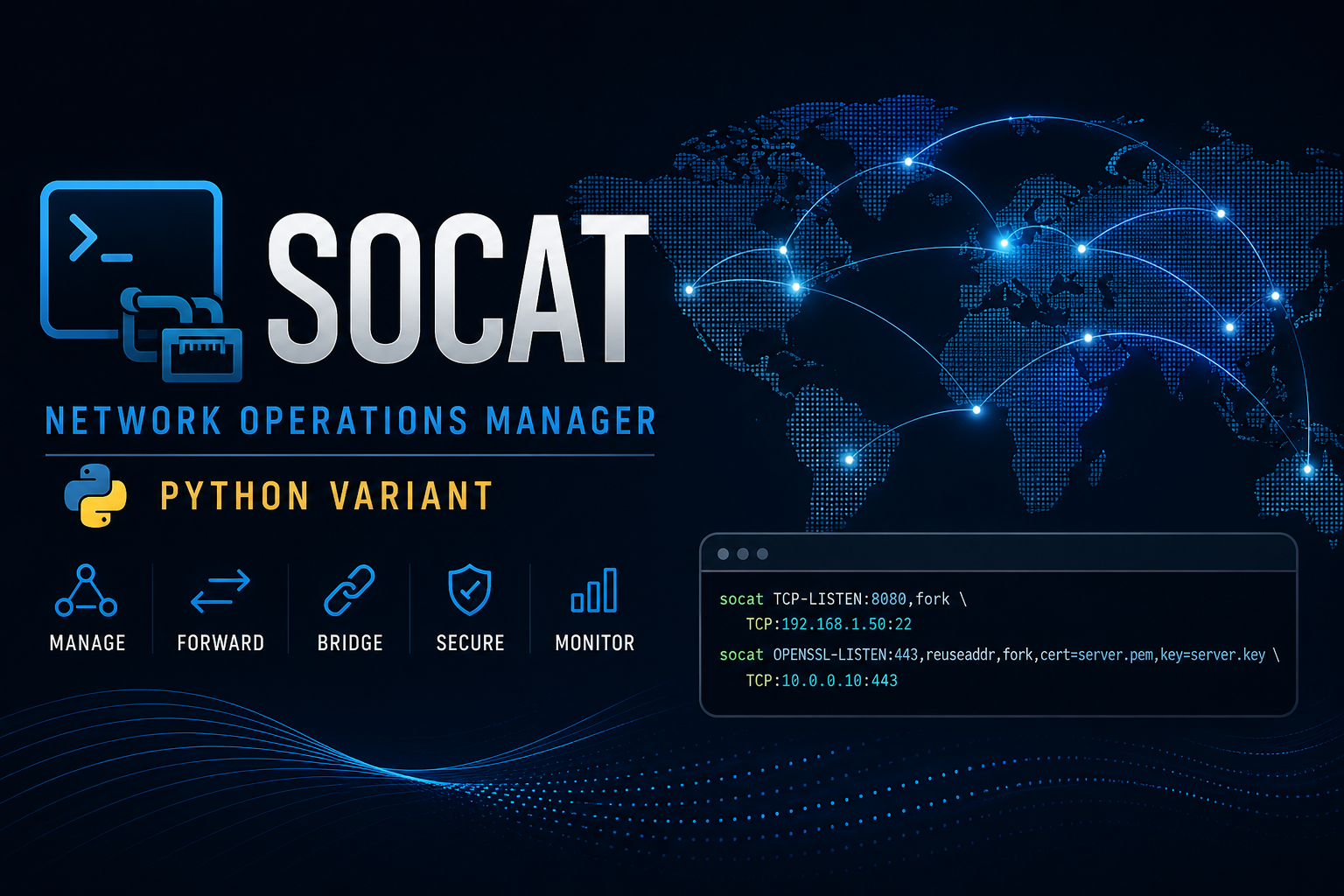
Socat Network Operations Manager
Python Variant
Production-grade socat session manager for network operations.
Listeners, bidirectional forwards, TLS tunnels, and transparent redirectors
with unique Session IDs, protocol-aware lifecycle management, and zero external dependencies.
Quick Start · Modes · Usage Guide · Changelog · Security · Testing · Contributing
Full Documentation Wiki — detailed guides, architecture with Mermaid diagrams, operational scenarios, and exhaustive developer reference.
Table of Contents
- Overview
- Key Highlights
- Features
- Architecture
- Prerequisites
- Quick Start
- Operational Modes
- Global Options
- Session Management
- Protocol Selection
- Traffic Capture
- Watchdog Auto-Restart
- Logging
- Directory Structure
- Security Considerations
- Troubleshooting
- Testing
- Contributing
- Documentation
- Version History
- Acknowledgments
- License
Overview
socat-manager provides a unified command-line interface and interactive menu for managing socat-based network operations. It wraps socat's complex syntax into seven structured operational modes, adding session tracking, process group isolation, protocol-aware lifecycle management, traffic capture, and automatic restart capabilities.
This is a complete Python 3.12+ reimplementation of socat_manager.sh v2.3.0 (4,470 lines of bash, 91 functions) with full functional parity. The Python variant uses only the standard library at runtime — zero external PyPI dependencies.
Every launched socat process receives a unique 8-character hex Session ID, is placed in its own process group via os.setsid(), and is tracked in a persistent .session metadata file. This enables reliable status queries and clean shutdowns across terminal sessions and script invocations — you can launch a redirector in one terminal, check its status from another, and stop it from a third.
Key Highlights
| Feature | Description | |
|---|---|---|
| 🔀 | Seven Operational Modes | listen, batch, forward, tunnel, redirect — plus status and stop for lifecycle management |
| 🔌 | Protocol Flexibility | TCP4, TCP6, UDP4, UDP6 individually (--proto) or both TCP+UDP simultaneously (--dual-stack) |
| 📡 | Traffic Capture | Verbose hex dump logging (--capture) on all modes — listen, batch, forward, tunnel, redirect |
| 🔖 | Session Tracking | Unique 8-char hex Session IDs with persistent .session metadata files |
| 🔒 | Process Isolation | Each socat process in its own process group via os.setsid() with direct PID access |
| 🛡️ | Protocol-Aware Stop | Stopping TCP does not affect UDP on the same port, and vice versa |
| 🖥️ | Interactive Menu | Run with no arguments for a guided, menu-driven interface with validation and cancel support |
| ⚡ | Non-Blocking Launch | Script returns to prompt immediately — no terminal blocking |
| 🔄 | Watchdog Auto-Restart | Monitor-first design with configurable exponential backoff and max restarts |
| 📦 | Batch Operations | Launch listeners on port lists, ranges, or config files in a single command |
| 📝 | Structured Logging | Dual-output (file + console) with correlation IDs and per-session audit trails |
| 🐍 | Zero Dependencies | Python standard library only — no pip packages required at runtime |
Features
Core Capabilities
- Seven operational modes: listen, batch, forward, tunnel, redirect, status, stop
- Protocol flexibility: TCP4, TCP6, UDP4, UDP6 individually via
--proto, or both TCP and UDP simultaneously via--dual-stack - Traffic capture: Verbose hex dump logging (
--capture) available on all operational modes (listen, batch, forward, tunnel, redirect) - Session management: Unique 8-char hex Session IDs with
.sessionmetadata files for persistent tracking - Process group isolation: Each socat process launched via
os.setsid()insubprocess.Popenfor reliable cross-invocation tracking - Protocol-aware stop: Stopping a TCP session does not affect a UDP session on the same port, and vice versa
- Non-blocking launch: Script returns to prompt immediately after launching sessions — no terminal blocking
- Watchdog auto-restart: Monitor-first design (no duplicate launch), configurable exponential backoff (1s, 2s, 4s... 60s cap), configurable max restarts and initial backoff via
--max-restartsand--backoff - Interactive menu: No-args launches a full-featured menu with guided input, validation, dependency checking, socat-opts examples, configurable watchdog prompts, paired forward after listener, and cancel support at every prompt
- Batch operations: Launch listeners on port lists, ranges, or config files in a single command
- Standalone runner:
python3 socat-manager.py— no pip install, no venv, no system modification - Cross-variant interoperability: Session files use the same KEY=VALUE format as the bash variant — both can read each other's session files
Input Validation and Security
- 9 whitelist-based validators at the trust boundary: ports, hostnames, protocols, file paths, socat options, session names, session IDs, port ranges, port lists
- Command injection prevention:
subprocess.Popenwith argument lists only —shell=Truenever appears in the 6,779-line codebase - No
eval(),exec(),compile(), or__import__()anywhere - Shell metacharacters (
; | & $ ` ( ) { } [ ] < > ! #) blocked in hostnames and file paths - Session directory permissions restricted to 0o700
- Session files restricted to 0o600
- Private key files restricted to 0o600
- Capture log files restricted to 0o600
- Only socat processes targeted during port-based fallback kill (process name verification via
/proc/{pid}/comm)
See SECURITY.md for the full STRIDE threat model, 7-layer defense-in-depth analysis, and secure deployment guidelines.
Logging and Audit
- Structured master execution log with correlation IDs
- Per-session log files for independent audit trails
- Traffic capture logs (socat
-vhex dumps) per session and protocol - Console output with color-coded severity levels (DEBUG, INFO, WARNING, ERROR, CRITICAL)
- Terminal-aware: ANSI colors gated on TTY detection (
sys.stderr.isatty())
Architecture
Process Launch Model
socat-manager (launcher)
    │
    ├── subprocess.Popen(cmd, preexec_fn=os.setsid, close_fds=True)
    │       │
    │       └── socat (PID == PGID, session leader)
    │               ├── socat fork (child for connection 1)
    │               ├── socat fork (child for connection 2)
    │               └── ...
    │
    ├── Popen.pid gives real socat PID directly
    ├── Registers session: SID, PID, PGID, protocol, port, command
    ├── Returns (sid, pid) tuple to caller
    └── Returns to prompt (non-blocking)
Key design decisions:
os.setsidaspreexec_fncreates a new process group. Socat becomes the group leader (PID == PGID), soos.killpg(pgid, signal)terminates socat and all itsforkchildren in one operation.Direct PID access via
Popen.pid: Unlike the bash variant which requires a PID-file handoff pattern (setsid wrapper PID problem), Python'sPopen.pidgives the real socat PID directly. No staging files, no polling, no race conditions.launch_socat_session()returns(sid, pid)tuple: The PID is passed to the watchdog for monitoring. This eliminates the critical bug where the watchdog would launch a duplicate socat on an already-bound port.close_fds=Trueprevents file descriptor leakage from the management script to the socat process.subprocess.Popenwith argument lists only: Thecmdparameter is alwayslist[str], never a shell string.shell=Trueis never used.
Session File Format
SESSION_FILE_VERSION=v2.3
SESSION_ID=a1b2c3d4
SESSION_NAME=redir-tcp4-8443-example.com-443
PID=12345
PGID=12345
MODE=redirect
PROTOCOL=tcp4
LOCAL_PORT=8443
REMOTE_HOST=example.com
REMOTE_PORT=443
SOCAT_CMD=socat TCP4-LISTEN:8443,reuseaddr,fork,backlog=128,keepalive TCP4:example.com:443
STARTED=2026-03-30T14:30:00+00:00
CORRELATION=a1b2c3d4
LAUNCHER_PID=9999
Stop Sequence
1. Read session metadata (PID, PGID, PROTOCOL, PORT)
2. Signal watchdog via .stop file (tells watchdog: do not restart)
3. SIGTERM entire process group: os.killpg(pgid, SIGTERM)
4. SIGTERM specific PID + children: os.kill(pid, SIGTERM); pkill -TERM -P pid
5. Wait grace period (5 seconds, checking every 0.5s)
6. SIGKILL if still alive: os.killpg + os.kill + pkill -KILL -P
7. Fallback: protocol-scoped port-based kill via ss (socat processes only)
8. Verify port freed (protocol-scoped, avoids cross-protocol interference)
9. Remove session file + .stop + .launching files after confirmed dead
Prerequisites
Required
| Dependency | Purpose | Install |
|---|---|---|
| Python 3.12+ | Framework runtime | Pre-installed on Ubuntu 24.04+; sudo apt-get install python3 |
| socat | Core network operations | sudo apt-get install -y socat |
Optional
| Dependency | Purpose | Install |
|---|---|---|
| openssl | TLS certificate generation (tunnel mode) | sudo apt-get install -y openssl |
| ss (iproute2) | Port status checking, session verification | sudo apt-get install -y iproute2 |
| pstree (psmisc) | Process tree display in status detail view |
sudo apt-get install -y psmisc |
| flock (util-linux) | Advisory file locking for session concurrency | Pre-installed on most Linux |
System Requirements
- Linux kernel (any modern distribution)
- Python 3.12+ (uses
match/case,slots=True,from __future__ import annotations) - Root/sudo for privileged ports (<1024)
- Zero external PyPI packages at runtime (standard library only)
Compatibility
Designed for the same 8 environments verified by the bash variant's CI pipeline:
| Distribution | Version | Python | Status | Notes |
|---|---|---|---|---|
| Ubuntu | 22.04 LTS | 3.12+ | ✅ Expected | May need python3.12 package |
| Ubuntu | 24.04 LTS | 3.12 | ✅ Expected | Python 3.12 pre-installed |
| Debian | 12 (Bookworm) | 3.12+ | ✅ Expected | May need python3.12 package |
| Kali Linux | Rolling | 3.12+ | ✅ Expected | socat typically pre-installed |
Questions
What is Socat-Network-Operations-Manager-Python-Variant?
Sandler73/Socat-Network-Operations-Manager-Python-Variant is a public repo on GitHub by Sandler73. Python-based Socat session manager for network operations. Listeners, bidirectional forwards, TLS tunnels, and transparent redirectors with unique Session IDs, protocol-aware lifecycle management, and zero external dependencies.