rea
Reverse engineer anything with agents, from app behavior down to native binaries.
- 474k
- TypeScript
- MIT
- 4 h ago
Open-source spam call and text blocker for Android. GitHub-hosted spam database, no API keys, no subscriptions.
Repo SysAdminDoc/CallShield, read from GitHub 4 h ago. SysAdminDoc has not joined Take My Repo.
SysAdminDoc/CallShield is a public repo on GitHub by SysAdminDoc. Open-source spam call and text blocker for Android. GitHub-hosted spam database, no API keys, no subscriptions. It declares the MIT license on GitHub. It is written mainly in Kotlin, has 84 stars and last changed on 2026-11-22. Nobody has reviewed it on Take My Repo yet, which says nothing about its quality. Read from GitHub on 2026-11-22.
Open-source spam call blocker and text screener for Android
30+ detection layers with an on-device ML model | 51,519 spam numbers | Real-time caller ID | RCS filter | No API keys

If CallShield helps keep spam out of your day, a coffee helps me keep its protection data and app current.
CallShield blocks spam calls and flags spam texts with an on-device engine of more than 30 detection layers. They include a gradient-boosted tree ML scorer, bounded campaign and churn evidence, conservative carrier identity signals, an RCS notification filter and real-time caller ID. Its 51,519-number database sits alongside a trending-numbers feed the app checks every 30 minutes. There are no accounts and no tracking.
The database keeps data/spam_numbers.json as a stable legacy GitHub-raw
endpoint for older clients, while current builds bundle a hash manifest and
256 content-addressed shards. The manifest, the legacy database, the trending
feeds and the model weights each carry a detached ECDSA P-256 signature, and the
app refuses any of them that doesn't verify against a key built into it. Devices
fetch only changed shards, check every shard against the signed manifest before
a transactional Room refresh, and fall back to the legacy snapshot when the
shard service is unavailable.
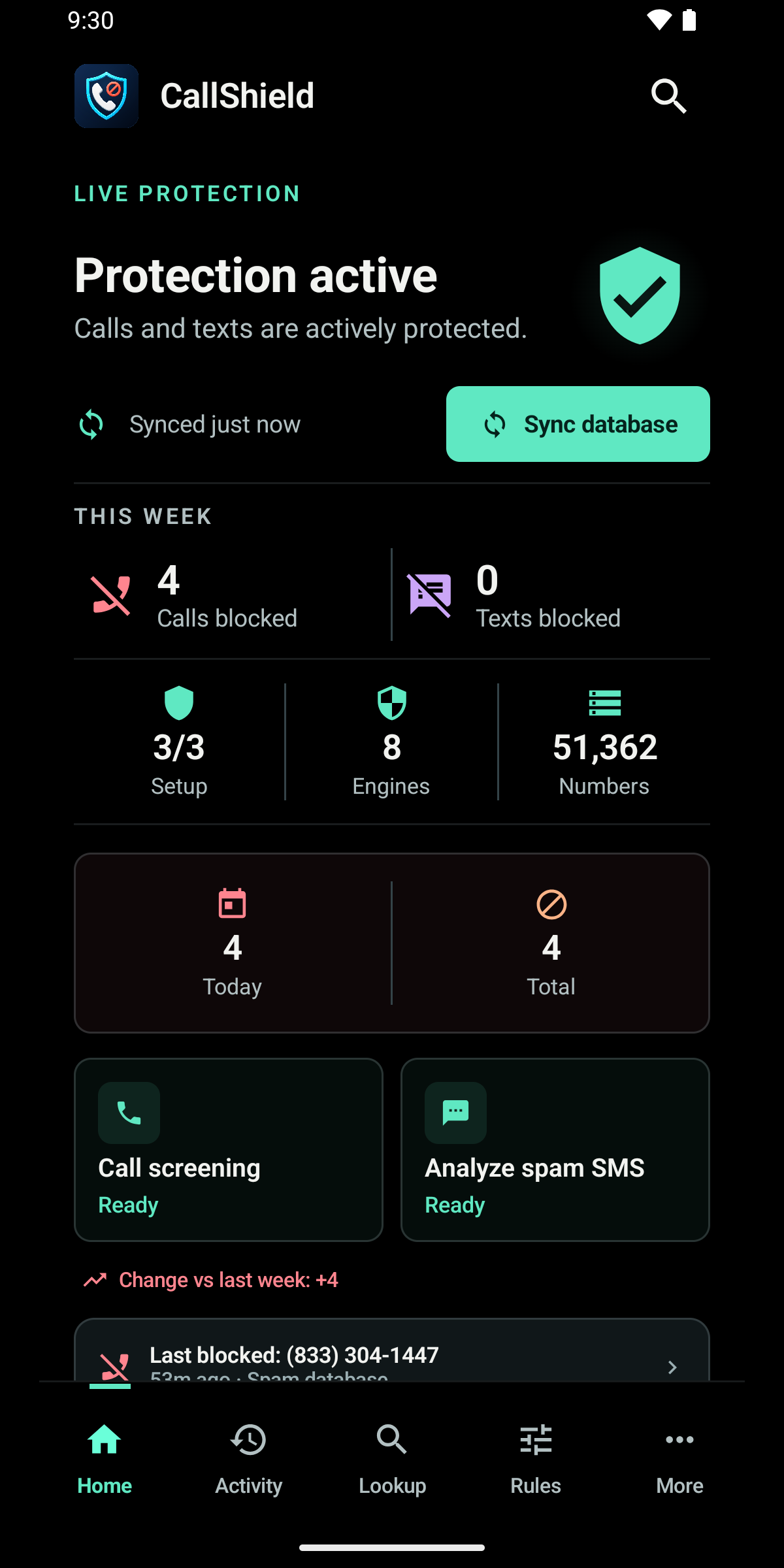
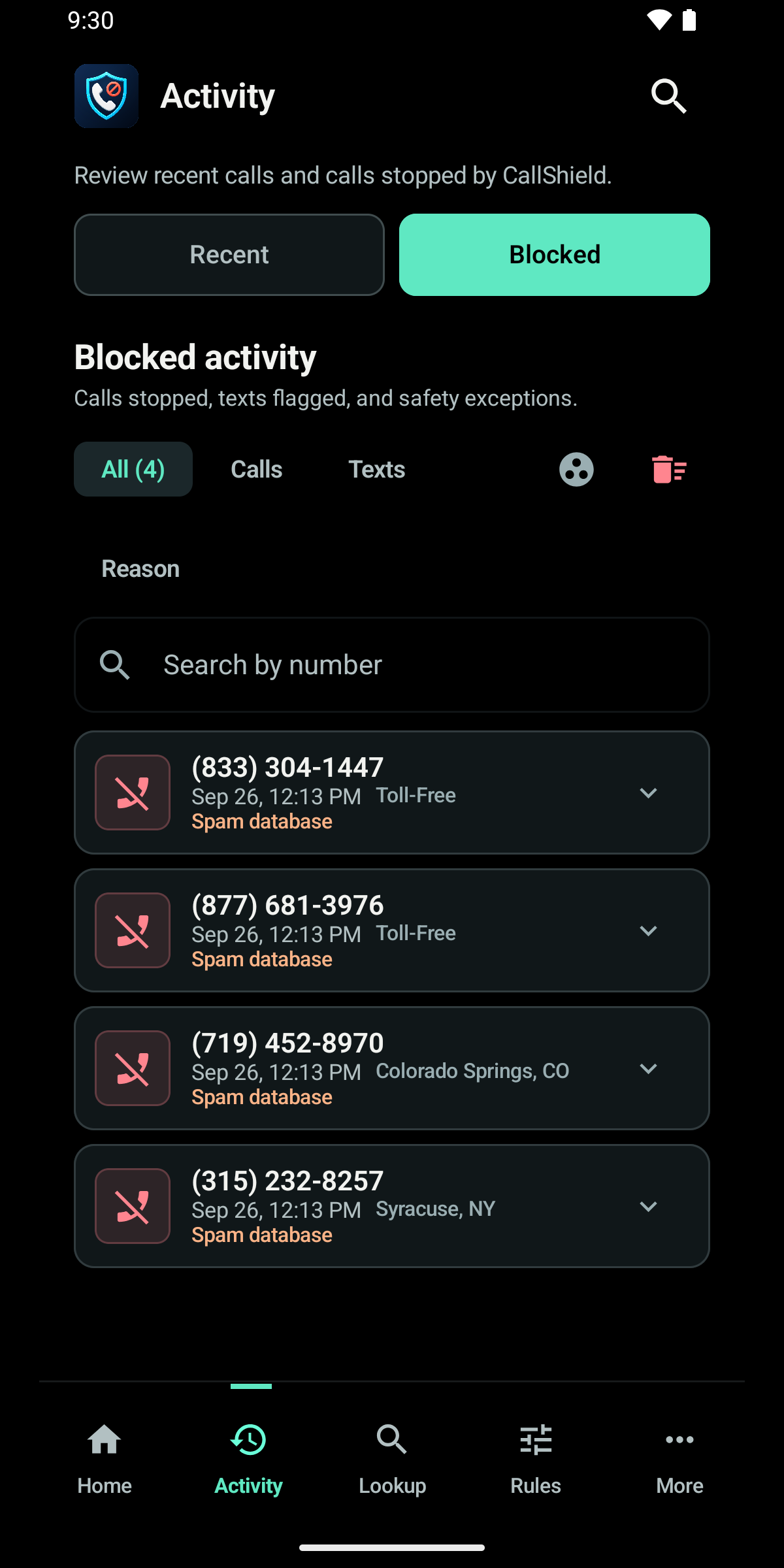
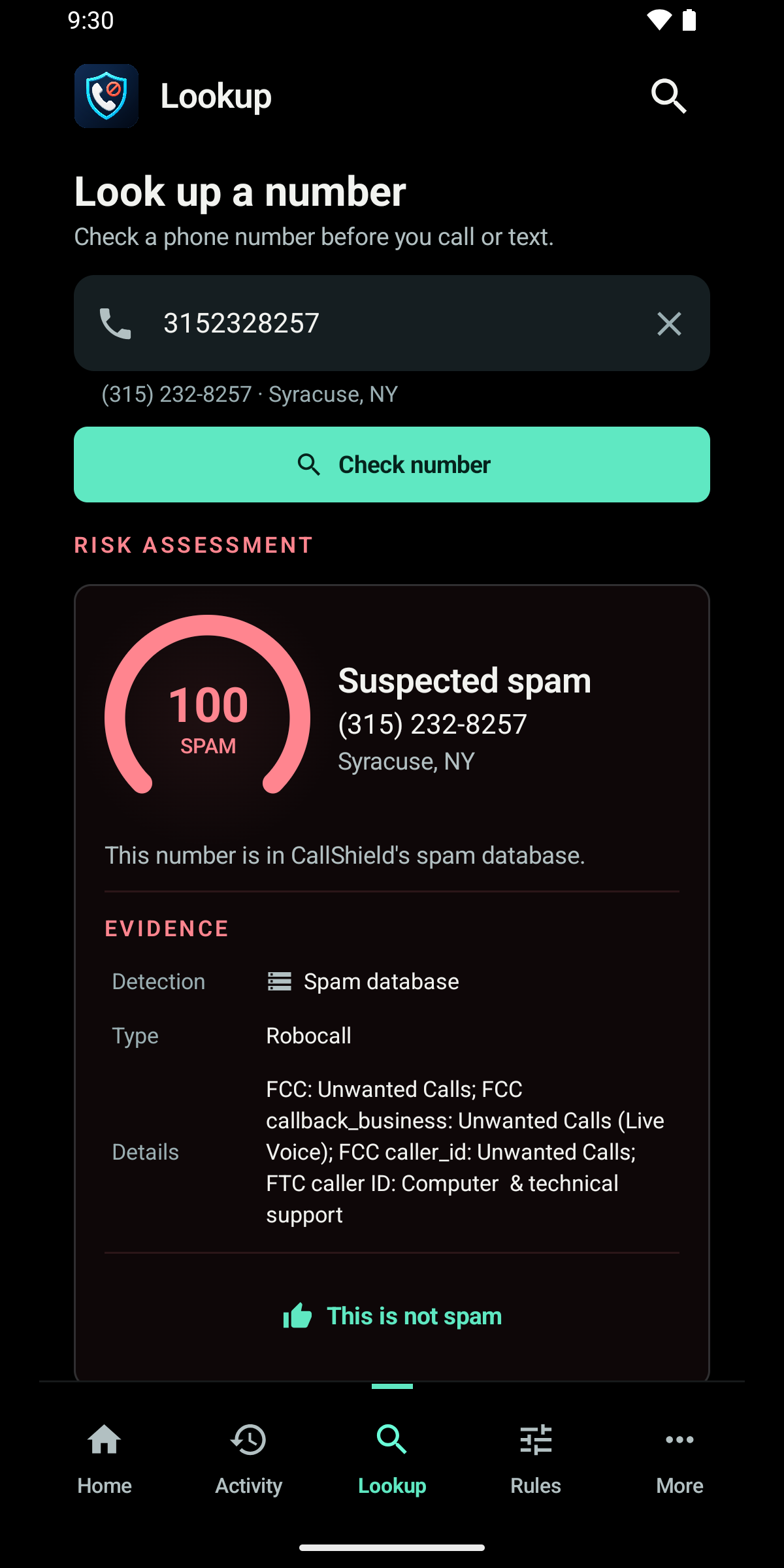
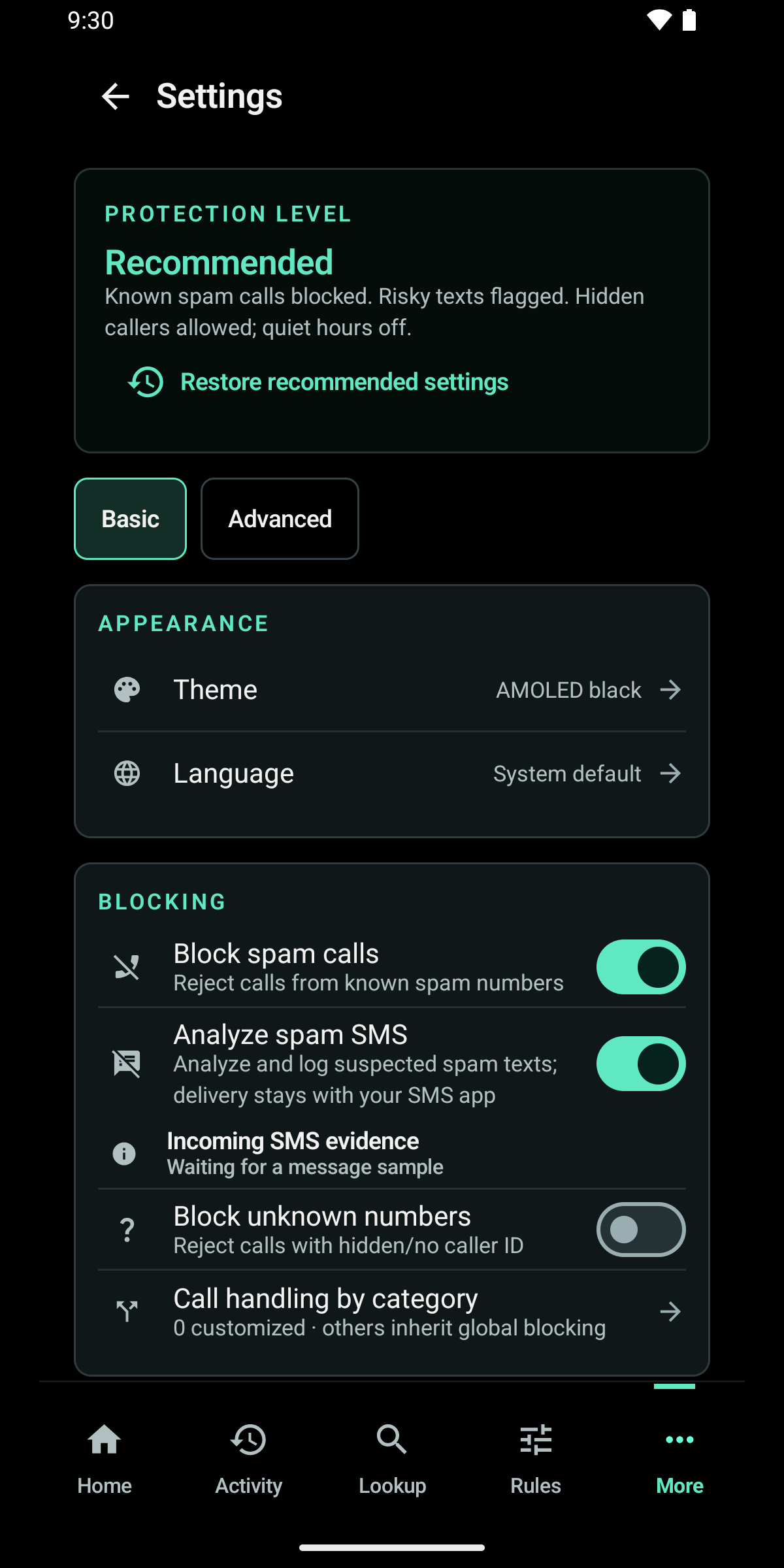
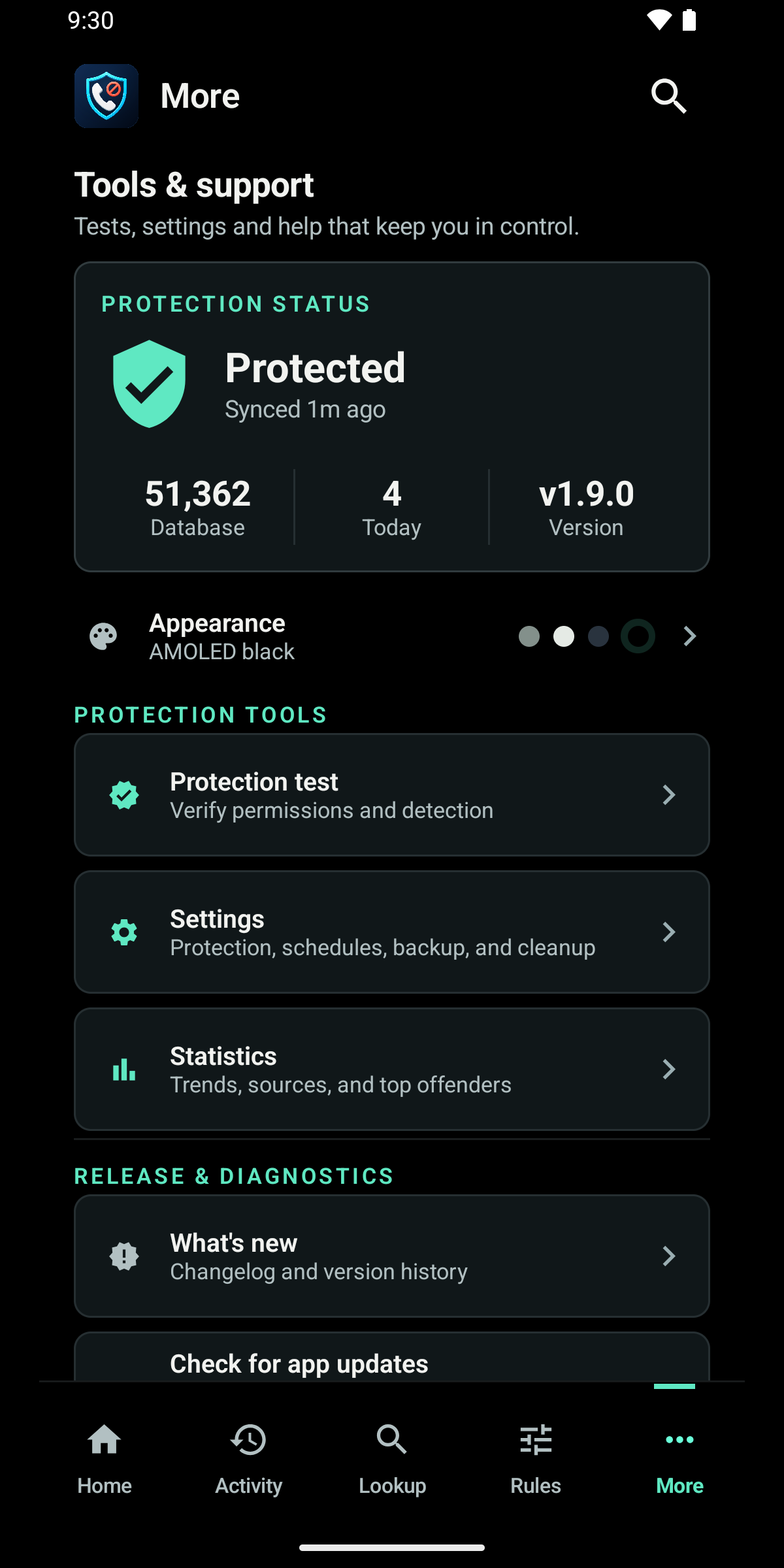
New installs use the AMOLED theme. Settings opens on Basic, which covers blocking, safety, notifications and appearance. Advanced holds detection, lists, backup and the rest. Switch the theme to Graphite, Light or System under Appearance.
For a full walkthrough of every toggle with its default, see docs/getting-started.md.
Version highlights for each release are in CHANGELOG.md.
Two new languages, and a switch that keeps the app off the network entirely.
Report now blocks the number for you, the Rules screen handles many rows at once, and links in chat apps stay on your phone.
Reports from other users now show before a number is confirmed, and Report on a number's screen finally reaches the database.
Better at the calls and texts scams lead to, and your own lists survive a damaged database.
Earlier releases are in CHANGELOG.md.
All detection layers implement a shared IChecker interface and run in priority order through CheckerPipeline.run. The first layer with a verdict wins, and each layer is tested on its own. Priorities are stable numbers, and the ladder below is the live order.
| Priority | Layer | Verdict | How It Works |
|---|---|---|---|
| 11000 | Emergency Number Floor | Allow | Recognized emergency and public-safety numbers always ring, ahead of every rule (calls only) |
| 10900 | One-Time Code Floor | Allow | Short texts carrying a verification code are never flagged, so sign-ins keep working (texts only) |
| 10000 | Manual Whitelist | Allow | Numbers you marked as always allowed, emergency contacts included, and the number block an entry covers when you chose one |
| 9000 | Contact Whitelist | Allow | Numbers in your phone's contacts always pass through |
| 8800 | Contacts-Only Mode | Block | Calls outside your contacts and trusted numbers are blocked |
| 8500 | STIR/SHAKEN Failed | Block | Carrier-authenticated caller ID failure gets blocked before heuristic layers |
| 7000 | User Blocklist | Block | Your own exact blocks, permanent or temporary |
| 6900 | System Block List (A4) | Block | Read-only bridge to Android's BlockedNumberContract. Respects stock Phone/Messages blocks |
| 5500 | Wildcard / Regex | Block | Custom patterns like +1832555* or full regex, now with optional schedule |
| 5400 | Range Patterns (A5) | Block | Length-locked # patterns like +33162######, with schedule + coverage safety rail |
| 5360 | Expecting a Call | Allow | Opt-in window (1 hour, 3 hours or until midnight) from Home or a Quick Settings tile. Unknown and hidden callers ring, and contacts-only mode and meeting mode step aside. Your own blocks, wildcard and range rules and a failed caller ID check still win |
| 5350 | Temporary Allow | Allow | One-off false-positive recovery from the Blocked Log. Beats all downloaded data, never your own rules |
| 5320 | Prefix Rules | Block | Downloaded wangiri country codes, US premium rate (+1900), international premium |
| 5310 | Regulatory Prefix | Block | Opt-in (Settings > Telemarketing ranges) blocks for ranges regulators set aside for sales calls: Spain 400 (from 17 October 2026), India 140 (TRAI), Brazil 0303 (ANATEL). Matches the number with its country code, and without it on a phone from that country |
| 5300 | STIR/SHAKEN Authenticated | Allow | Carrier-authenticated caller ID allows through heuristic/ML suspicion, and through a database match only when that row's newest evidence, community reports included, is over a year old and the number isn't trending right now. Explicit blocks still win first |
| 5250 | Regulatory Allow | Allow | Protected series that rings through past the database and statistics. India 1600 (banks, insurers and government offices) and 1601 (utilities, logistics and courier companies), per TRAI. On by default with an Indian SIM, and you can turn each one off |
| 5200 | Spam Database | Block | 51,519 imported spam numbers plus the trending-numbers feed |
| 5150 | Database Prefix Expansion | Block | Blocks last-two-digit siblings of confirmed database entries once enough of them are listed (one by default, up to ten in Settings) |
| 5000 | Recently Dialed | Allow | Numbers you called in the last 24h. They're probably calling back |
| 4980 | Emergency Callback | Allow | Unknown callbacks can ring through after a local emergency call during the configured grace window |
| 4950 | Answered Caller | Allow | Numbers answered repeatedly inside the configured lookback window |
| 4900 | Repeated Urgent | Allow | Same number calls 2x in 5 min → allowed through |
| 4850 | Caller Name Trust | Allow | Carrier-presented name matches one of your trust patterns (requires the device to provide a name during screening) |
| 4700 | Push-Alert Bridge (A3) | Allow | Uber/DoorDash/Amazon/Gmail notification about an arriving call? Let it through |
| 4500 | Campaign Recorder | None | Side effect only. It records the call for the burst detection below |
| 4300 | Region Rules | Block | Opt-in offline blocking outside the US/Canadian regions and country calling codes you allow |
| 4000 | Quiet Hours | Block | Block all non-contact calls during configurable hours (calls only) |
| 3500 | Frequency Auto-Block | Block | With call log access, numbers with 3+ incoming calls that rang in 7 days get auto-blocked. Screened blocks and silences don't count |
| 3000 | Heuristic Engine | Block | North American VoIP ranges, neighbor spoofing, toll-free and rapid-fire checks. International risk checks also run |
| 2500 | Campaign Burst | Block | NPA-NXX prefix clustering detects coordinated spam waves |
| 2250 | Caller Name Rules | Block | Carrier-presented names can match bounded, user-defined */? patterns after every allow layer (requires the device to provide a name during screening) |
| 2000 | ML Spam Scorer | Block | 20-feature on-device gradient-boosted tree model |
| 1500 | Meeting Mode | Silence | Opt-in. While a meeting app you pick shows a call in progress, calls from outside your contacts go quietly to voicemail. Runs on notification access, with no calendar permission |
One check runs before the ladder for calls. A number you marked as never calling you (a bank's published line, say) is blocked right away, ahead of your contacts and your allow list, because a call showing it has to be spoofed. Emergency numbers can't be marked.
SMS-specific layers run after the shared chain, in their own priority order: SMS Keyword Rules (5400, with schedules) → Carrier Scam Label (4750, a sender your carrier renamed to its scam label, such as Singapore's Likely-SCAM) → SMS Context Trust (4700, trusted-sender allow) → SMS Burst Protection (4650) → SMS Content Analysis (1900, with 30+ regex patterns, URL shorteners, suspicious TLDs and the spam-domain list). Both SMS rule layers read the text after fullwidth letters, invisible characters and Cyrillic or Greek letters posing as Latin are undone, and a link or brand name hiding such characters counts against the message. A stranger's first text that fishes for a reply without a link counts too: "Hi mum, this is my new number", "Is this Sarah?", "sorry, wrong number". It has to come from a phone number you've never texted or heard from, and on its own it only blocks in aggressive mode, because a real kid with a new phone writes the same words.
A flagged text still reaches your inbox. Calls are different from messages here, and the table above is about verdicts, not delivery. CallShield screens calls through Android's
CallScreeningService, which can actually reject a call. For messages it listens onSMS_RECEIVED_ACTION, and since Android 4.4 that broadcast cannot be aborted by anyone. Only the default SMS app receivesSMS_DELIVER_ACTIONand controls what lands in the inbox, and becoming the default SMS app would mean replacing your whole messaging app. So an SMS or RCS verdict logs the message, notifies you, and feeds the statistics. It does not delete the message or stop it arriving.
+1809) and country calling codes (+39) you allow, plus bounded */? trust and block patterns for carrier-presented caller names. Explicit number, system, prefix and wildcard blocks, and all allow layers, keep priority. Area codes absent from the pinned NANP table pass through this regional ruleAny wildcard, range, or SMS keyword rule can be time-gated to specific days of the week and an hour window. The hour picker supports overnight wrap. daysMask = 0 is the "no gating" sentinel, so rules created before v1.6 behave identically.
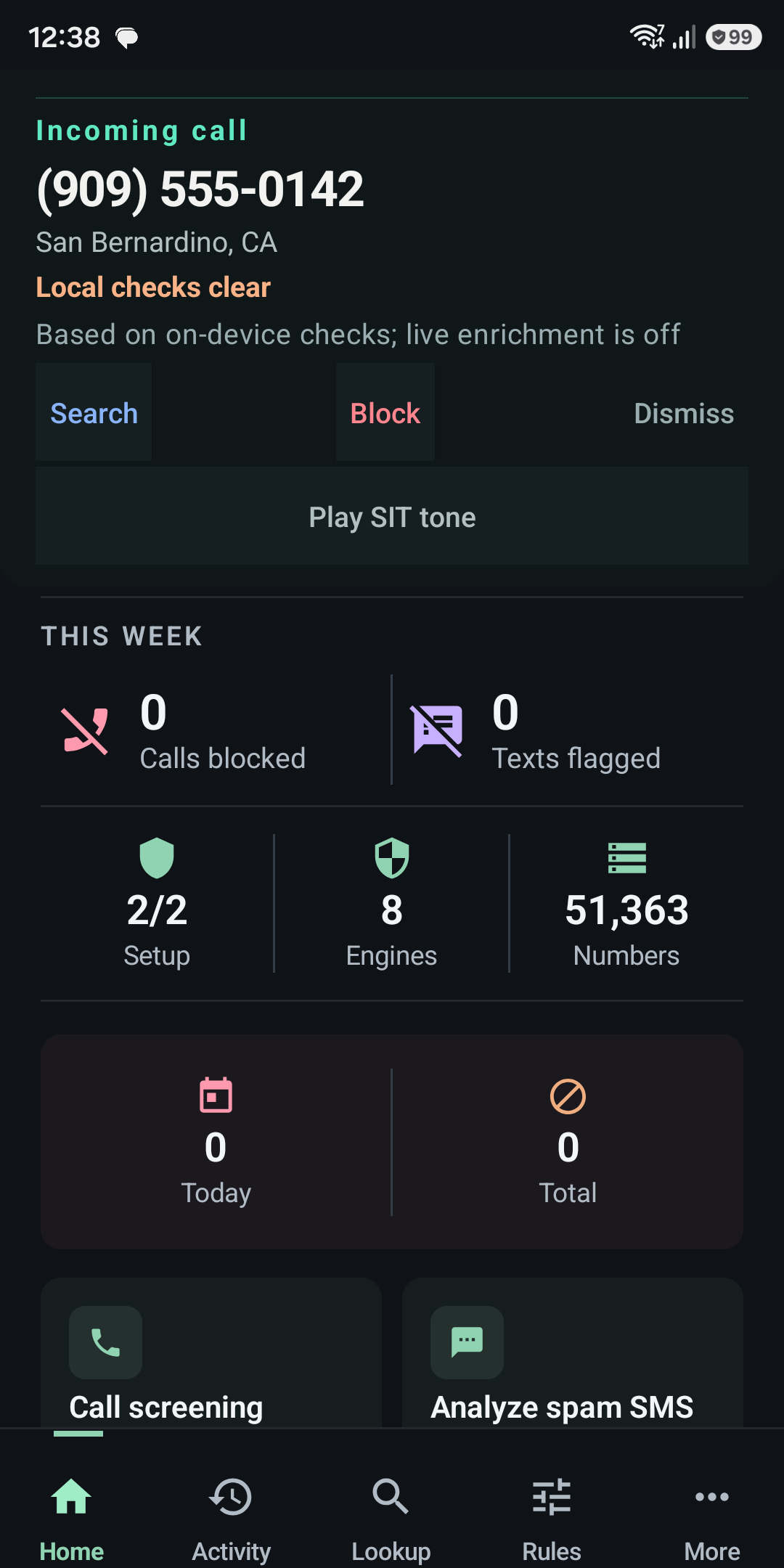
With the Overlay permission granted, a caller ID card appears as the phone rings. It shows the number, where it's from and CallShield's own verdict. For a locally suspicious call, the default-off Live caller enrichment setting also asks SkipCalls about the number:
┌──────────────────────────────────────┐
│ Likely spam                          │
│ (212) 555-1234                       │
│ New York, NY                         │
│ Spam score: 50% (Flagged)            │
│ ⚠ SkipCalls: Flagged                 │
│ All sources checked                  │
│ [Search]      [Block]      [Dismiss] │
│ [          Play SIT tone           ] │
└──────────────────────────────────────┘
PhoneBlock, OpenCNAM and WhoCalledMe were dropped in September 2026. PhoneBlock and OpenCNAM now require accounts, which CallShield never asks for, and WhoCalledMe's domain is parked. scripts/probe_live_sources.py checks that SkipCalls still answers the way the app reads it.
An on-device gradient-boosted tree of 50 trees over 20 features, with a logistic-regression fallback. It's pure Kotlin with no TFLite or other ML library, and it runs in microseconds.
| Feature | Description |
|---|---|
| toll_free | 800/888/877/etc. prefix |
| high_spam_npa | Area code in high FTC/FCC complaint set |
| voip_range | NPA-NXX in known VoIP spam carrier range |
| repeated_digits_ratio | Fraction of most-common digit |
| sequential_asc/desc_ratio | Sequential digit pairs |
| all_same_digit | All 10 digits identical |
| nxx_555 | Exchange is 555 (test numbers) |
| last4_zero | Subscriber is 0000 |
| invalid_nxx | NXX starts with 0 or 1 (NANP-invalid) |
| subscriber_all_same | Last 4 digits all same (9999) |
| alternating_pattern | Even/odd positions uniform (5050505050) |
| nxx_below_200 | Often unassigned ranges |
| low_digit_entropy | Fewer than 4 distinct digits |
| subscriber_sequential | Last 4 form ascending/descending run |
| + 6 additional | Campaign proximity, time-of-day, call frequency, area code density, prefix heat, neighbor spoof score |
The maintainer trains it by hand from the CallShield database (50K positive and 50K negative samples). The scorer uses the threshold stored in the weights file, which is 0.648 for the model that ships today. A quality gate scores the 20% of rows training held out, with the same inference the app runs, and fails when F1 drops below 0.45.
SMS content regressions use a separate CC0 corpus that CallShield wrote itself. It covers eight languages, the three sender forms, each kind of link, legitimate messages and hard negatives, and the test reports precision, recall and false-positive rate by language and message type without shipping personal data. Every spam message it catches is checked again in disguise (zero-width characters between letters, Cyrillic look-alike letters, fullwidth text, a hidden character in its link) and each copy has to be caught too: ./gradlew :app:testDebugUnitTest --tests com.sysadmindoc.callshield.data.SmsEvaluationCorpusTest.
The same test runs 5,000 real smishing reports sampled from the IMC 2025 dataset (Agarwal, Papasavva, Suarez-Tangil and Vasek, "Fishing for Smishing", CC BY 4.0) in 63 languages. It prints recall for each language, with precision and false alarms taken from the clean messages above, and each large language has a floor it can't drop below. The number is humbling. Content rules alone catch 30% of those reports, and 27% of the wrong number and "hi mum" scams. On the half of the sample the rules weren't written against it's 26%, and that's the fairer number. Part of the gap is the dataset: it replaced every link with a placeholder, so the link rules see a link but never its host. python scripts/sample_imc25_corpus.py redraws the sample from a pinned copy of the dataset, and IMC25-NOTICE.txt next to it in app/src/test/resources/sms-corpus/ credits it.
A second set keeps the rules honest. Mishra and Soni's SMS Phishing Dataset (Mendeley Data, 2022, CC BY 4.0) comes from a different collection, and no rule was written against it. It has 562 phishing texts, 435 older prize and ringtone spam texts (mostly UK and India, 2003 to 2012) and 4,834 real clean ones. Both sets are scored at aggressive mode's bar. There the rules catch 38% of the phishing and 14% of the spam, and they flag 23 of the clean texts. Recall can't drop below those numbers and the clean count can't rise. python scripts/sample_mendeley_sms_corpus.py rebuilds it from the pinned download, and MENDELEY-NOTICE.txt credits it.
(555) 234-56XX. It's off until you pick it, and a number in the block that you blocked by itself stays blocked# Expires: 12 hours, or "expires": "12h" in JSON), never more often than every six hours and at least weekly. A download that comes back empty or with under half the list's numbers isn't applied in the background. The list keeps its last good copy and says why on its row. Each row shows the list's name, the host it comes from, how many numbers it holds and when it last updated, and TalkBack reads it as one item. A row's switch turns its list off or on. Tapping the list's name does nothing. Removing a list takes its numbers out straight away, and Undo puts both back without downloading the list again3131918305, 03395051735 or 00573390714583 in the Colombian list) is stored as +57 whatever country your phone is in. That holds for the same link typed in by hand, too. The catalog ships in the app and a signed copy is refreshed on every sync, so a list can be added between releaseshttps://cdn.jsdelivr.net/gh/SysAdminDoc/CallShield@master/), which serves the same files and can run up to 12 hours behind. Mirrored files go through the same signature check, so a mirror can't alter the data, though it can hold back updates. data/README.md covers running your ownscripts/import_all_sources.py pipeline. Legacy direct writers aren't supported| Source | Method |
|---|---|
| FCC Consumer Complaints | Socrata API, 500K records, min 2 reports |
| FTC Do Not Call | api.ftc.gov (DEMO_KEY) |
| Saracroche | French telemarketing ranges, imported as compact prefixes when the maintainer asks for them |
| PhoneBlock | Optional authenticated bulk snapshot, maintainer import only |
| Nomorobo IRS | Optional carrier-authorized callback-scam CSV feed |
| ToastedSpam | Community curated list. It's served over plain HTTP, so the importer skips it unless the maintainer allows insecure sources |
| Reviewed numbers | Numbers the maintainer checked by hand, usually after a GitHub report, kept in data/spam_numbers_approved.json |
| Community Reports | Anonymous via Cloudflare Worker |
The source importer also has optional adapters for PhoneBlock's versioned
bulk list. PhoneBlock requires an account for bulk downloads, so that adapter
runs only when the maintainer has access, and the app itself no longer contacts
PhoneBlock. Run python scripts/import_all_sources.py --include-saracroche to
refresh the French ranges. Add --phoneblock-limit 5000 and
PHONEBLOCK_API_KEY only when the maintainer has bulk-feed access. Saracroche
range data is published under CC BY-NC-SA 4.0, must retain attribution and
those downstream restrictions, and is accepted only as a +33 French
allocation. A successful non-empty refresh expires removed Saracroche ranges.
A failed or empty response keeps the last known good set.
Every feed is declared in data/source-manifest.json with its access mode,
geography, licence, attribution, parser version, redistribution policy, and
freshness window. Each importer run writes a local data/source-snapshot.json
for release review. It's deliberately left out of the APK. After the
community merge, its health section adds per-source freshness, accepted and
quarantine counts, corroboration, and bounded false-positive rates without
copying phone numbers, contacts, SMS, or call audio. Anonymous not_spam
votes never change the database by themselves. Once they outnumber a
community-only row's reports, the row becomes a review candidate. After an
operator marks it approved: true,
python scripts/merge_community_reports.py --apply-reviewed-corrections
can decay or remove only that community-only contribution. FTC and FCC runs
persist bounded high-water cursors in data/source-cursors.json, which the
importer creates on its first run. They keep caller-ID and callback-business
evidence as separate roles, and don't promote unverified complaint-only rows
without independent caller corroboration. The importer leaves out complaints
with missing or future dates. data/source-freshness.json records the newest
complaint date (for FCC, the day FCC published it), and the weekly check flags an FTC or FCC feed when that date
falls outside its freshness window.
The importer also accepts a carrier-authorized Nomorobo IRS callback-scam CSV
feed without embedding credentials in the app. Pass the HTTPS URL with
--nomorobo-irs-url (or NOMOROBO_IRS_FEED_URL) and, if required by the feed,
the bearer token with --nomorobo-irs-token/NOMOROBO_IRS_TOKEN. The adapter
is disabled unless explicitly configured and rejects cleartext URLs. It doesn't
scrape Nomorobo's restricted carrier feed.
| File | Contents |
|---|---|
hot_numbers.json |
Top 500 trending numbers from the last 24 hours. Each needs 4 reports spread over at least two hours, from 3 reporters on the same UTC day |
hot_ranges.json |
NPA-NXX prefixes where at least 4 trending numbers drew reports from at least 6 reporters between them on one UTC day |
spam_domains.json |
Phishing/spam domains from community SMS reports |
| Source | What It Returns | Auth |
|---|---|---|
| SkipCalls | Spam flag and category | None |
| Source | What It Checks |
|---|---|
| Local spam-domain list | Checks known spam domains on the phone |
| PhishTank | Optional link lookup. It receives only the site's base domain |
| OpenPhish | Optional feed, checked for updates after six hours of use. Matches stay on the phone |
local.properties, not hardcoded in build filesCall and message decisions run on the phone. No personal data is collected. CallShield makes these network requests:
data/reports folder, and the next merge folds it into the database. It holds the reported number, the report type and time, the report's random id, and two reporter IDs that change every day (keyed HMACs of your network's /48 and /64, so the same network can't be linked across days or turned back into an address). An SMS report adds the linked domains and link labels, never message text. The report never holds your IP address. To stop floods and repeat reports, the Worker's short-lived store keys a duplicate check on your IPv4 address or IPv6 /64 for five minutes, and when Cloudflare's rate limiter is unavailable its fallback counter does the same for one minute. Both expire on their ownStrict offline mode (Settings > Advanced) turns every one of these requests off. Blocking keeps running on the database already on the phone.
No API keys. None required, none optional, no credential entry anywhere in the app. No accounts. No analytics. No ads.
Every release from v1.7.37 onward is signed with a new key. The original keystore password was lost in a machine rebuild, which also meant releases v1.7.26 through v1.7.29 shipped unsigned and would not install at all, so the key was rotated rather than recovered.
Upgrading over an older install can fail with a signature mismatch. Android refuses to replace an app with a build signed by a different key, and releases before v1.7.37 were signed with keys that are no longer available. If the install fails, you have to uninstall first, which erases your rules and logs, so export them before you do:
A fresh install is unaffected, and upgrades between v1.7.37 and later releases work normally.
Still on v1.7.37 or v1.7.38? Those builds can't download protection data anymore, because the server certificates they trust were replaced in August 2026. Install the latest release over them. It's signed with the same key, so your settings stay.
Verify an APK before installing it:
apksigner verify --print-certs CallShield-vX.Y.Z.apk
The signer certificate SHA-256 must be:
920e583ae6ce9f3863a6b3b8847e927d53a66c38a245e12e30ce124c9f4a75f5
Every release also ships a .sha256 sidecar for the APK itself.
Two different Android blocks cause this, and from the outside they look the same.
On Android 13 and later a sideloaded app is put behind restricted settings. The system holds back SMS permissions and notification access from an app that was installed from a downloaded file, and the permission dialog either never appears or appears and changes nothing. GrapheneOS and CalyxOS apply this the same way stock Android does, and it's the most likely reason CallShield sees no messages after a clean sideload.
To lift it:
Setup points you here too. If a permission you went to grant comes back still off, setup shows this hint with a button that opens App info. An app store or installer app that installs CallShield itself skips restricted settings, though the next block can still apply.
Since Android 10, SMS and call log access only work when whatever installed the app allowed them at install time. The phone's own package installer (what your Files app or browser hands an APK to) does, and so does adb. Some app stores and installer apps don't. Android then never asks about SMS or call logs, and their switches in App info flip straight back to Deny. Allow restricted settings doesn't help with this one.
To fix it, download the APK from the latest release, open it in your Files app and install it over the copy you have. It installs as an update, so your settings and history stay. On Android 13 and later you may then need the restricted settings steps above. When SMS and call logs don't take, setup names the app that installed CallShield and links the release.
If neither block fits, the permission was just denied. Grant it from App info → Permissions. After you deny a permission twice Android stops showing the prompt, so onboarding sends you to App info instead of asking again.
Since 2026-09-30, certified Android phones in Brazil, Indonesia, Singapore and Thailand enforce Google's developer verification, and Google plans to extend it to every country in 2027. A phone that enforces it holds back the normal install of an app whose developer hasn't registered with Google, and CallShield ships from GitHub without that registration. There are two ways around it.
The advanced flow. Turn on Developer options (tap Build number seven times in Settings → About phone), then open Developer options, which many phones keep under Settings → System. Turn on Allow apps from unverified developers and follow the prompts. Android makes you wait one day before the switch takes effect. The APK can then be installed from your browser or file manager.
ADB. An install over USB is exempt:
adb install CallShield-vX.Y.Z.apk
It isn't confirmed yet whether a phone in those countries refuses a downloaded APK outright or warns first. If you're there and run into either, an issue with your phone model and Android version would help pin it down.
./gradlew verifyReleaseMetadata verifyReproducibleBuildInputs verifyReleaseSbom verifyReleaseApkReproducibleMetadata
verifyReleaseMetadata invokes scripts/verify_release_drift.py, which prints
the synchronized app and changelog versions, locked dependency summary,
known-advisory dispositions, and source-snapshot provenance. Run the report
directly with python scripts/verify_release_drift.py when reviewing metadata
without building an APK.
Requires JDK 17 or 21. AGP 9 won't run on anything older and nothing newer is tested, so point
JAVA_HOME at 17 or 21. With release signing properties configured, the signed APK is
at app/build/outputs/apk/release/app-release.apk. Without them, the local
verification build emits app-release-unsigned.apk.
Generate the release hash sidecar with:
.\scripts\write-release-sha256.ps1
After gh release create has published the tag, write and sign the release notice that older builds show on Home, then commit data/app_release.json and its .sig:
python scripts/write_app_release.py
With the new APK installed on a phone, run the device pass. It prints PASS or FAIL for each step (sync, What's new, the recommended lists, the area code offers and their Undo, Not spam's Undo, More's Report spam number) and exits 1 if any failed:
python scripts/device_smoke.py --serial <adb serial>
--report <number> also checks that Report blocks the number on the phone. It sends a real anonymous report, so only use it for a number you mean to report.
verifyReleaseSbom also writes <release-apk-stem>.cdx.json,
<release-apk-stem>.provenance.json, and <release-apk-stem>.sha256 beside the
APK. The SBOM contains the exact releaseRuntimeClasspath coordinates from
app/gradle.lockfile, and the verifier fails if the APK, lockfile, SBOM, or
provenance record drift. CallShield releases are built locally, so the signed APK remains
governed by the maintainer release key and its SHA-256 sidecar. The local JSON
provenance is evidence, not a replacement for that signature.
See docs/reproducible-builds.md for the dependency-lock and hash-comparison
runbook.
CallShield ships from GitHub Releases only. There's no Google Play or F-Droid listing and none is planned. Obtainium can follow the releases for you.
Signing: Create local.properties in the project root with your keystore credentials:
RELEASE_STORE_FILE=path/to/keystore.jks
RELEASE_STORE_PASSWORD=...
RELEASE_KEY_ALIAS=...
RELEASE_KEY_PASSWORD=...
./gradlew testDebugUnitTest   # 2314 tests
./gradlew connectedDebugAndroidTest -Pandroid.testInstrumentationRunnerArguments.class=com.sysadmindoc.callshield.platform.TargetSdkBehaviorSmokeTest
./gradlew verifyPipelineTests # Cloudflare Worker (node) + data-pipeline and translation checks (python)
The suite is 2314 total JVM unit tests, run with Robolectric wherever a screen, a service or the database is involved.
Two GitHub workflows run without building the app. Validation runs the Worker and
pipeline suites on every push except report-only ones (run-pipeline-tests.ps1 -CorrectnessOnly),
and the runner fails if any suite changes a file under data/. Pipeline
liveness runs weekly: it fails when community reports sit unconsumed for over a week
or a daily or weekly upstream source misses its stale_after_days, and it keeps one issue
labelled pipeline-stalled open until the next passing run. A source that only imports with
an opt-in flag, such as --include-saracroche, is held to its limit once it has been imported.
Run tests, lint, release metadata checks, and artifact builds locally before publishing.
CallShield ships in English, Simplified Chinese, Brazilian Portuguese and Spanish. A string that isn't translated yet falls back to English. The Portuguese and Spanish text hasn't had a native speaker's review, so corrections are welcome. Pick a language under Settings, or in Android's per-app language screen.
More translations are welcome. See
docs/TRANSLATING.md for the resource layout, the priority
order for partial translations, and scripts/check_translations.py, which
verifies format specifiers and plural coverage before a PR lands. Claim a
language in issue #7.
| Component | Technology |
|---|---|
| Language | Kotlin 2.4.21 |
| UI | Jetpack Compose BOM 2026.09.00 + Material 3, Material 3 adaptive 1.3.0 |
| Theme | System, Light, Graphite, and true-black AMOLED |
| Database | Room 2.8.5 (SQLite), 10 entities |
| Networking | OkHttp 5.5.1 + certificate pinning |
| JSON | Moshi 1.15.2 |
| ML | Pure Kotlin gradient-boosted tree (20 features) |
| Settings | DataStore Preferences 1.3.0 |
| Background | WorkManager 2.12.0 |
| Community API | Cloudflare Workers |
| URL Safety | Local spam-domain data, with optional PhishTank and OpenPhish |
| Verification | Local Gradle, lint, and release-artifact checks |
| Tests | 2314 JVM unit tests (JUnit) |
| Strings | 1878 string resources and 63 plural groups (translation-ready) |
| Accessibility | 100+ content descriptions, 48dp touch targets |
| Min SDK | 29 (Android 10) |
| Target SDK | 36 |
MIT
The IMC 2025 smishing sample and the Mendeley SMS phishing set in app/src/test/resources/sms-corpus/ are CC BY 4.0, credited in IMC25-NOTICE.txt and MENDELEY-NOTICE.txt there.
SysAdminDoc/CallShield is a public repo on GitHub by SysAdminDoc. Open-source spam call and text blocker for Android. GitHub-hosted spam database, no API keys, no subscriptions.
It declares the MIT license on GitHub.
Its maker has not tagged a system, so it is unknown here. Its README says what it needs.
Open "Take it" on its page: Take My Repo writes an install plan for your machine and hands it to your AI agent (Claude Code, Codex or Cursor), which asks you before each step. Take My Repo has not tested it on any machine.
Its last change on GitHub was on 2026-11-22. Take My Repo does not judge from that whether it is maintained.
Nobody has reviewed it on Take My Repo yet, which says nothing about its quality.
Reverse engineer anything with agents, from app behavior down to native binaries.
:books: 免费的计算机编程类中文书籍,欢迎投稿
Flutter makes it easy and fast to build beautiful apps for mobile and beyond
f.k.a. Awesome ChatGPT Prompts. Share, discover, and collect prompts from the community. Free and open source — self-host for your organization with complete privacy.
Hushfacebook Morphe patches for Facebook. Hide ads, suggested posts, save videos and photos, tune playback and Reels, and use a focused Marketplace mode, and much more.
HushGram v0.0.21: Morphe patches for Instagram that hide ads, suggested posts and much more. 186 patches for Instagram 456.0.0.53.78.
Morphe patches for Facebook Messenger. Privacy switches and fewer promotions.
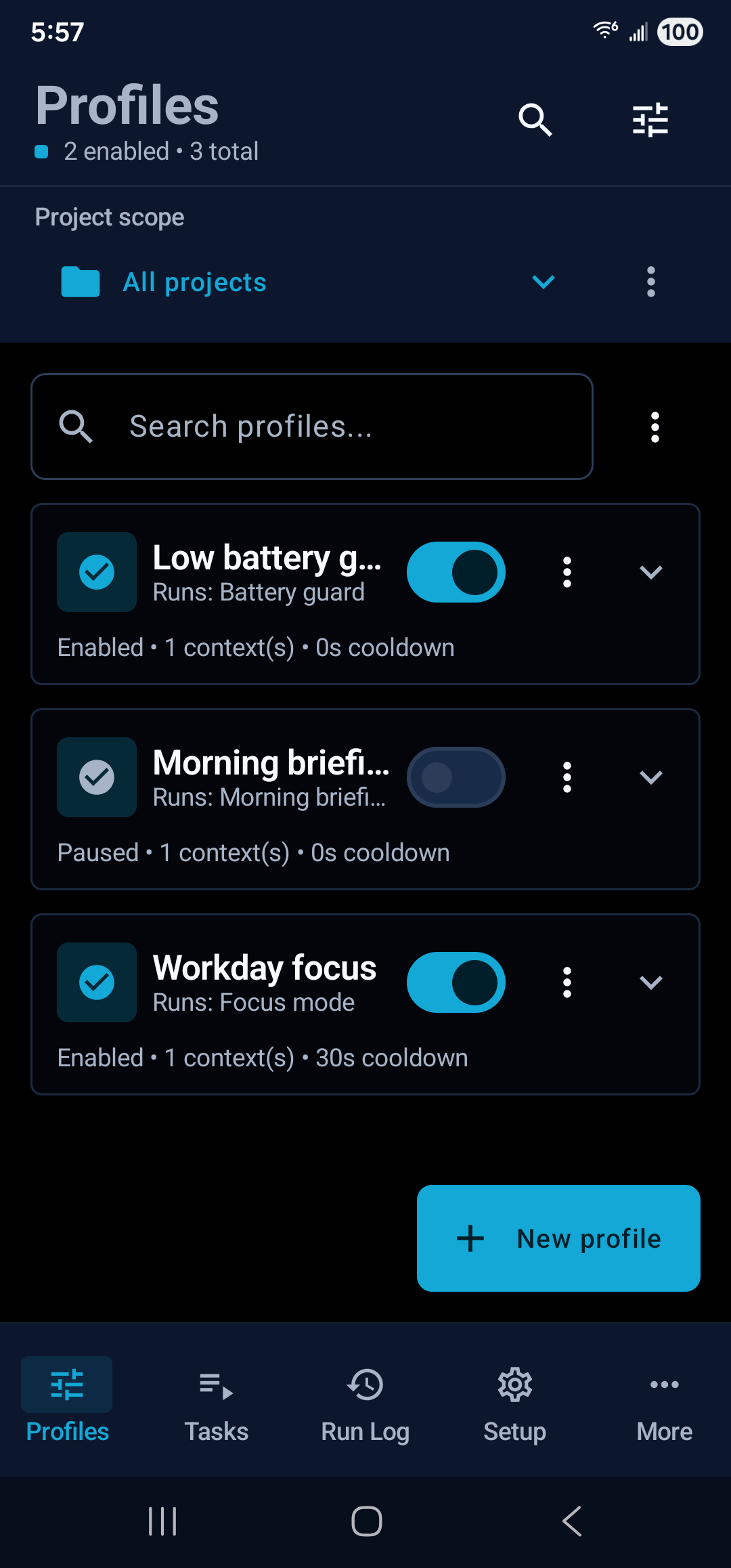
Local-first, open-source Android automation with readable rules, honest permission gates, and no account or cloud runtime.
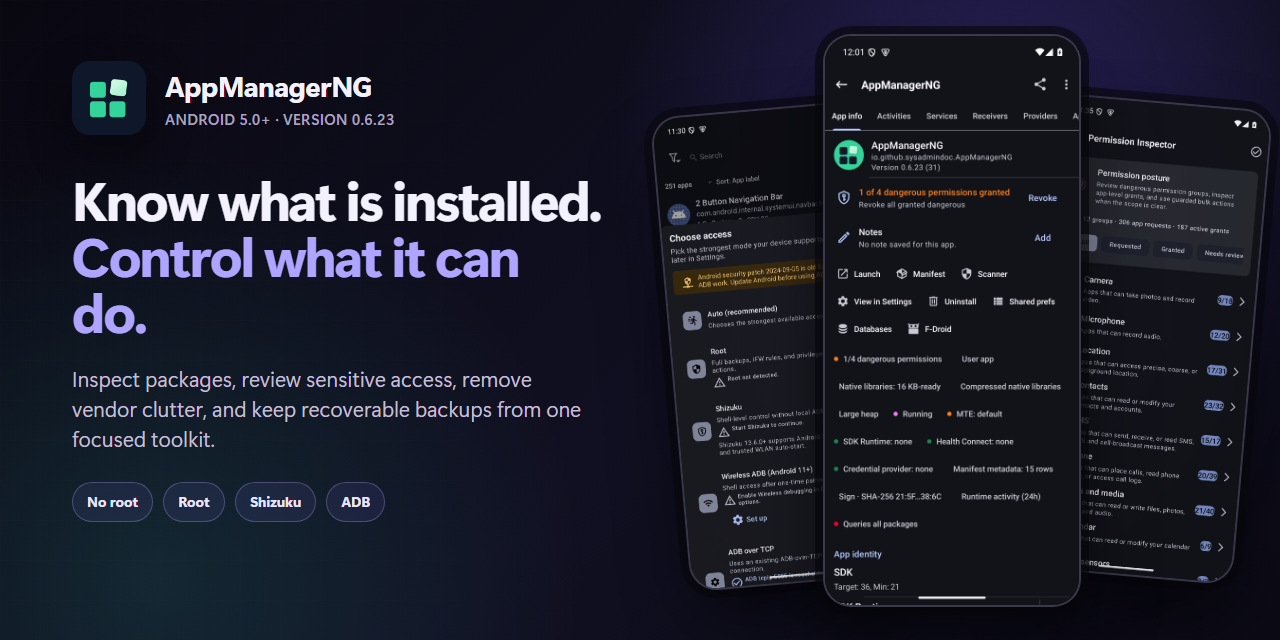
Inspect, debloat, back up, freeze, and control Android apps from one open-source package manager. Works without root, with Shizuku, ADB, or root when needed.