RumbleX
RumbleX is a comprehensive browser script that supercharges your Rumble.com experience. It injects a powerful suite of tools directly into the Rumble interface, giving you unparalleled control over everything from layout and privacy to video playback and downloading.
- 5
- MIT
- 8 wk ago
Repo SysAdminDoc/RumbleX, read from GitHub 1 d ago. SysAdminDoc has not joined Take My Repo.
In short
SysAdminDoc/RumbleX is a public repo on GitHub by SysAdminDoc. RumbleX is a comprehensive browser script that supercharges your Rumble.com experience. It injects a powerful suite of tools directly into the Rumble interface, giving you unparalleled control over everything from layout and privacy to video playback and downloading. It declares the MIT license on GitHub. It is written mainly in JavaScript, has 5 stars and last changed on 2026-09-25. Nobody has reviewed it on Take My Repo yet, which says nothing about its quality. Read from GitHub on 2026-11-21.
RumbleX
Rumble, rebuilt around the way you watch. RumbleX is an open-source control layer for Rumble with cleaner pages, serious download tools, a better player, and local-first privacy. Pick only the features you want. Leave the rest off.
Get the latest release | Installation guide | See every change
Make Rumble yours
| What you get | What changes |
|---|---|
| A calmer site | Remove ads, premium prompts, Shorts, noisy feed rows, overlays, and 50 more pieces of page clutter. |
| A player built for long sessions | Use Theater Split, persistent speed and volume, chapters, SponsorBlock, transcripts, a mini player, and per-channel preferences. |
| Downloads that explain themselves | Save direct MP4, convert HLS, export clips, batch a feed, or queue a channel. When something fails, RumbleX names the failed stage and gives you a useful next step. |
| Your own visual system | Choose from seven complete themes, three density levels, an optional ambient player, and layouts that hold up from a narrow side panel to a wide display. |
| Better live chat and comments | Keep paid messages, block noisy users, remove repeated spam, highlight keywords, sort comments, and export the conversation. |
| Privacy you can inspect | No telemetry, remote configuration, or RumbleX account. Settings, watch activity, bookmarks, diagnostics, and undo snapshots stay in your browser. |
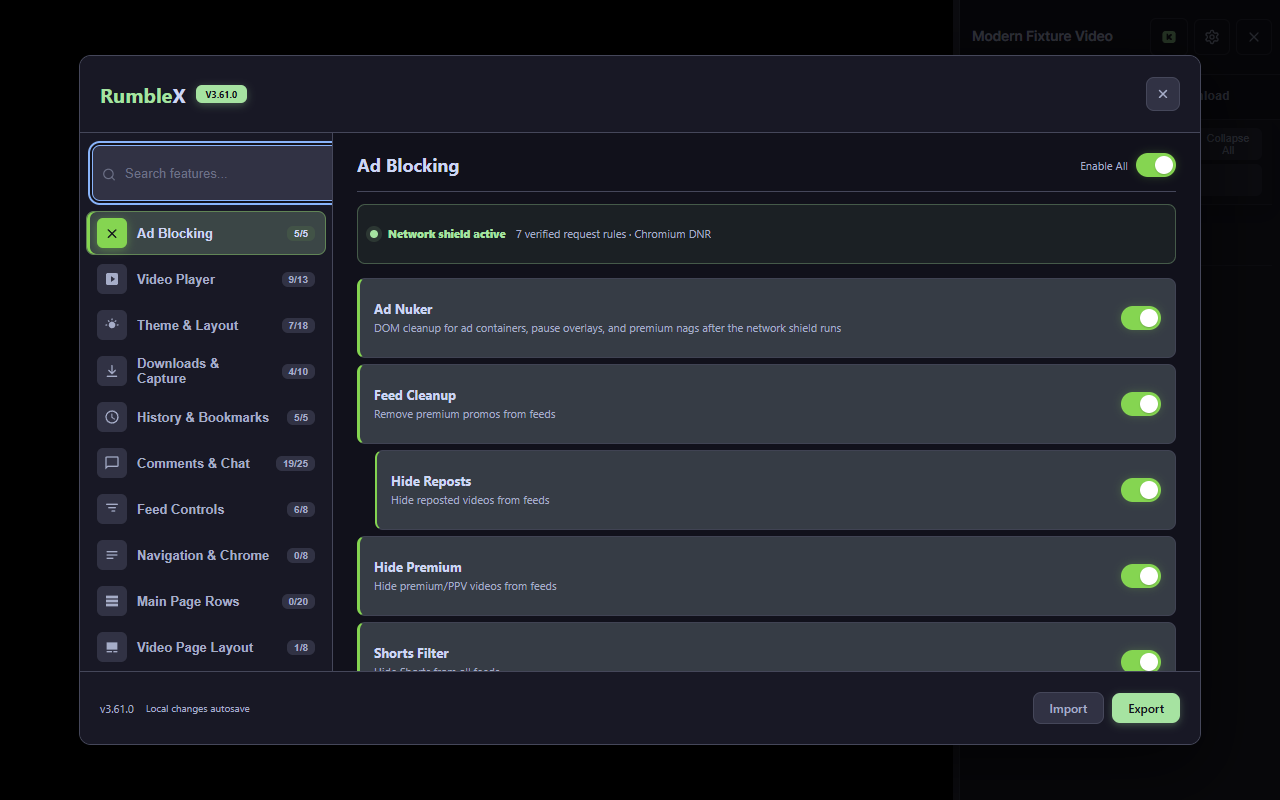
See it before you install
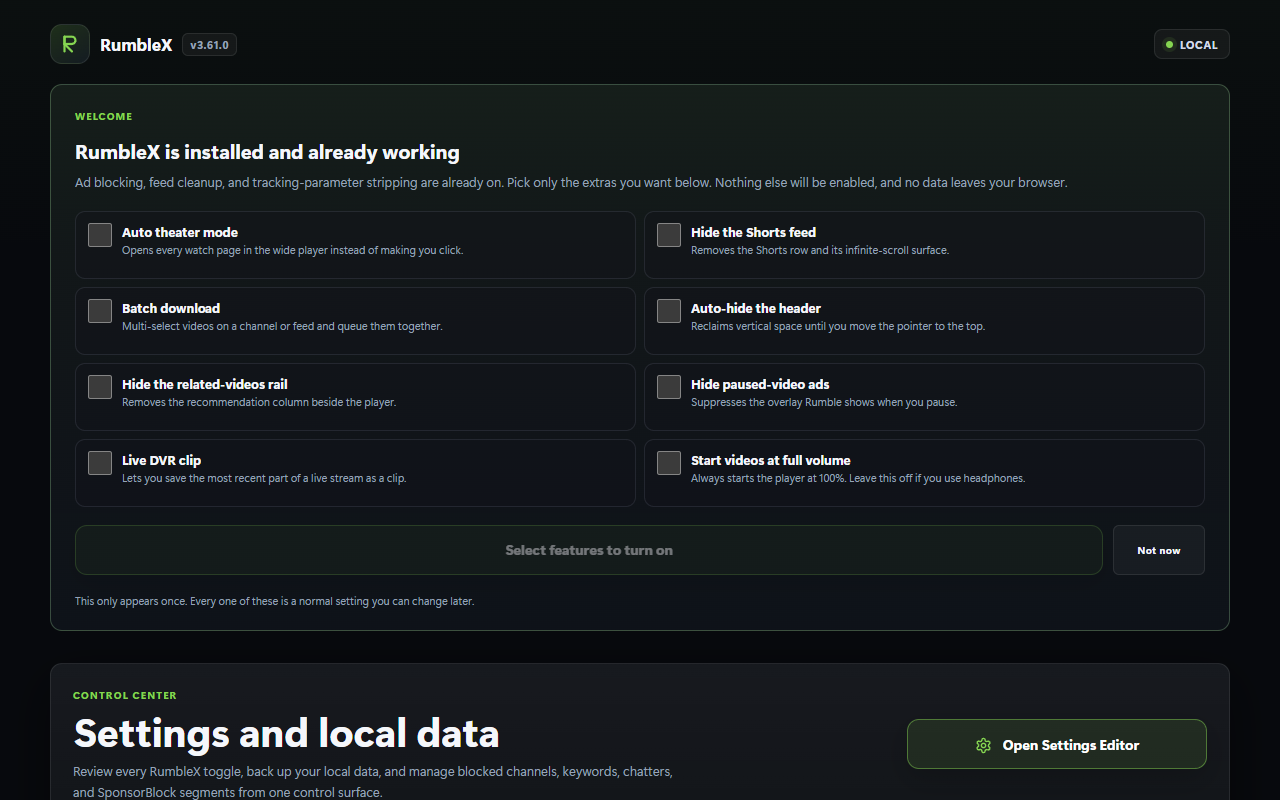
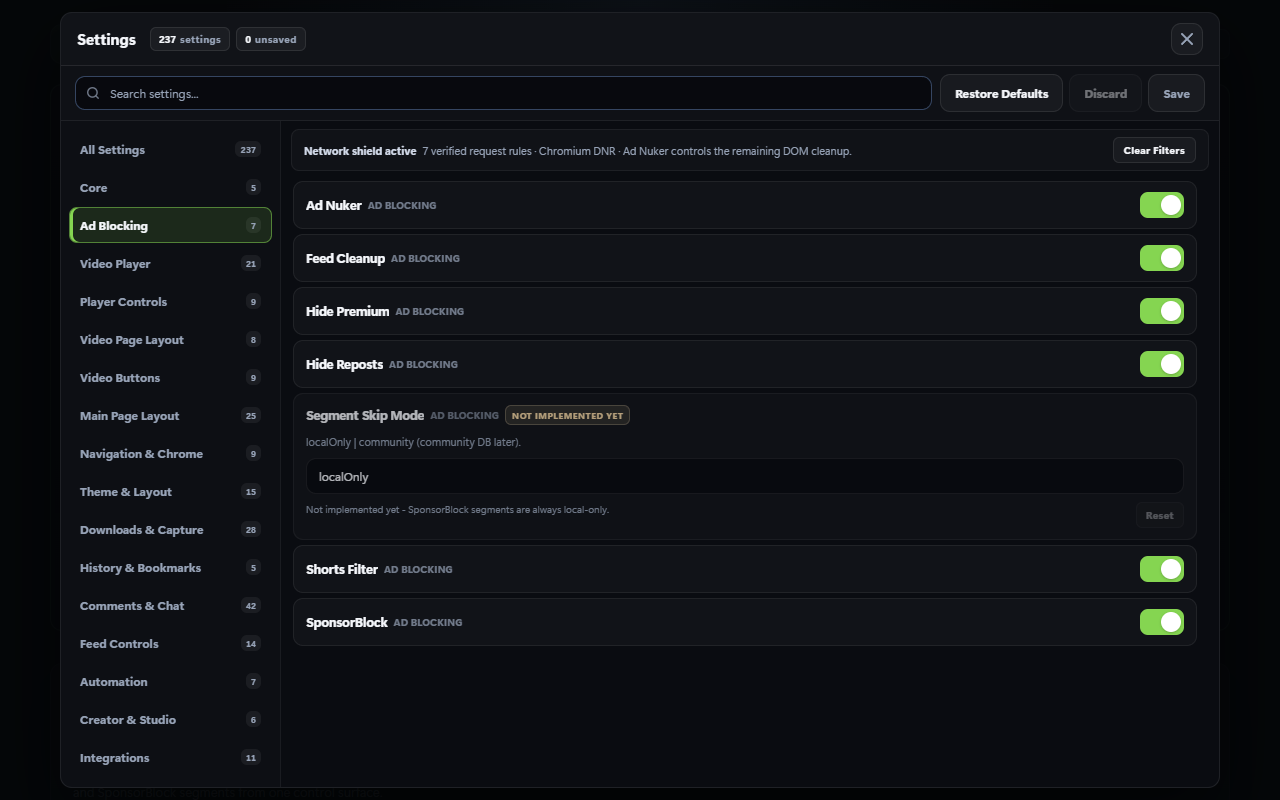
| Control center | Full settings editor |
|---|---|
 |
 |
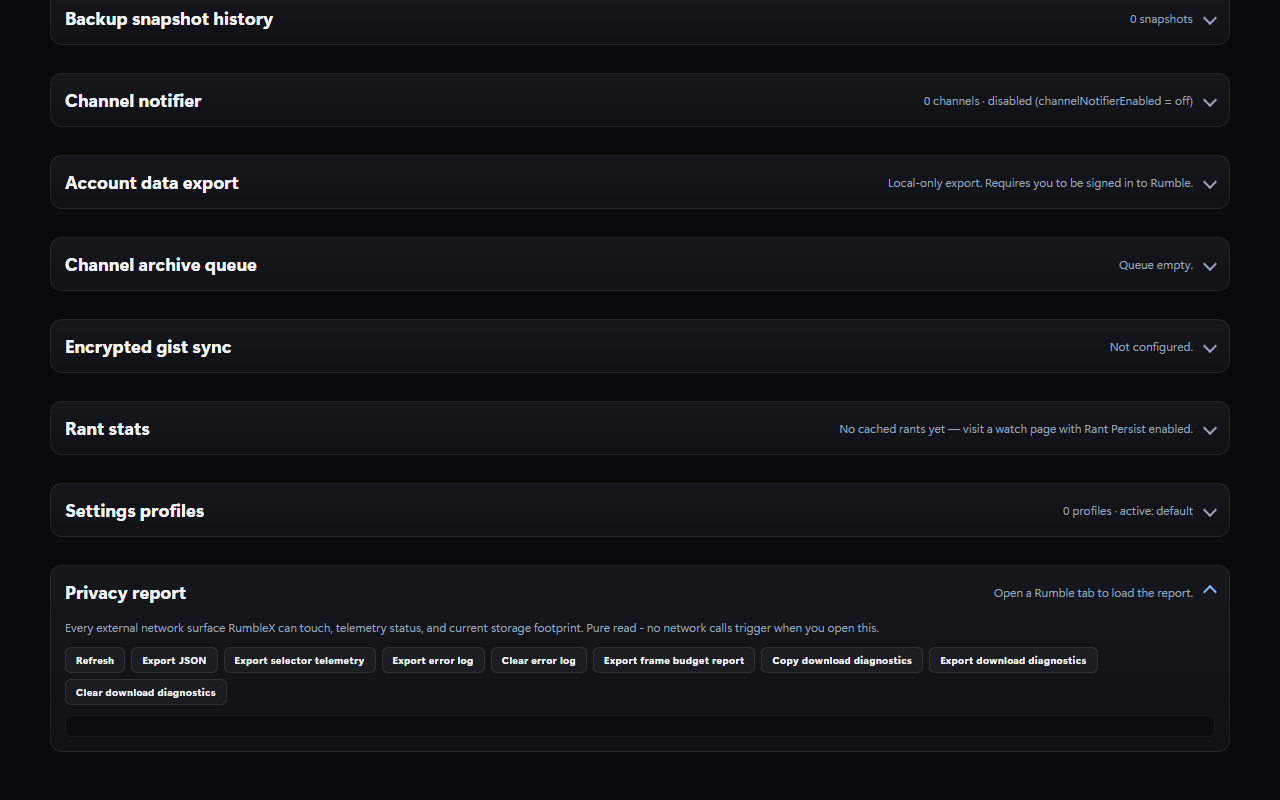
| Built-in privacy report | Quick controls on Rumble |
|---|---|
 |
 |
Pick the build that fits
- Chrome, Edge, or Brave: the complete Chromium extension, including the archive queue, browser-managed downloads, side panel, context menus, and request-level ad blocking.
- Firefox: the complete Firefox build with scoped request blocking. The current public package is for temporary installation while store signing remains pending.
- Tampermonkey, Violentmonkey, or ScriptCat: the portable userscript build. It carries the page features and media tools without the extension-only background services.
All builds use the same checked page-feature core. Release checks verify that the extension and generated userscripts have not drifted apart.
What's new in v3.61.0
This release is a full reliability and interface pass across the extension, userscripts, Options, popup, Theater, chat, downloads, backups, and release tooling.
- Stored activity survives interrupted work. Cross-origin migrations merge before cleanup, failed writes retry while the tab remains open, and partial restores stay recoverable instead of reporting success.
- Settings changes no longer overwrite each other. Tabs, the popup, Options, profiles, and background jobs share one serialized patch writer.
- Reset and Import have complete Undo paths. Snapshots now carry settings, saved activity, profiles, pending restores, and recovery records. Undo also works when no Rumble tab is open.
- Large local libraries stay usable. The extension requests local storage capacity for multi-megabyte SponsorBlock profiles and bounded history, while encrypted Gist backups encode large payloads without overflowing the JavaScript call stack.
- Secondary screens are easier to use. Settings search covers every group, dialogs manage focus correctly, narrow Theater controls stay within their real limits, and chat cards expose complete keyboard semantics.
- Themes now reach every owned surface. Injected panels use the active palette rather than hidden Catppuccin color literals. Aurora and Solar Ember remain first-class choices beside the five established palettes.
- Long-running pages do less work. Route-bound features remount cleanly, staged chat rows are processed once, and concurrent media probes share their first storage read.
- Release packages are harder to contaminate. The release gate requires a clean tree, copies tracked files only, verifies Firefox source contents, and ships Mediabunny 1.60.0 with pinned provenance.
Earlier release highlights
What's new in v3.60
This release expands the visual system while keeping the watch page focused.
- Seven site palettes share one source of truth. Aurora adds a deep navy and cyan direction. Solar Ember brings warm espresso surfaces and amber highlights. The popup and in-page editor now preview three tones from every palette instead of showing one accent dot.
- Page Density now changes the site. Pick Compact, Balanced, or Showcase spacing for feeds, cards, comments, and watch pages. The control works from Options, the popup, and the in-page editor.
- Ambient Player is an optional watch treatment. It frames the standard player with a restrained glow from the active palette, respects forced colors and reduced motion, and switches itself off in Theater.
- Paid chat cards stay above the message list. Theater gives the sticky rant rail its own bounded row, with scroll controls that no longer cover the first message.
- Floating controls are quieter. The page toolbar uses an opaque tokenized surface with no blur, while feed scroll and channel-block controls use compact rectangular shapes.
- The visual audit shows the new states. Fresh captures cover the palette picker, density controls, Aurora Ambient Player, settings workflows, live chat, comments, and narrow Theater.
What's new in v3.59
The extension controls and Theater panel have had a complete visual and accessibility pass.
- First run is easier to scan. Optional presets use a clear two-column grid on wide screens, while small windows collapse cleanly without squeezing the choices.
- The settings editor keeps its shape. Stronger hierarchy, an opaque backdrop, one-row navigation on narrow windows, and non-shrinking cards prevent content from bleeding through or overlapping.
- Popup feedback is visible. Group counts, expanded-state semantics, busy states, and a persistent status line make saves and updates clear without relying on a temporary tooltip.
- In-page settings follow the selected palette. Every surface now uses the active theme tokens across Catppuccin, YouTube, Midnight, Rumble Green, and OLED Green.
- Theater controls are calmer. Tabs and header controls have clearer states, the comments loader is centered, and the signed-out chat action no longer looks like a floating pill.
- Visual checks cover the real states. Desktop and narrow captures now include first run, clean and dirty editors, empty search, popup, in-page settings, live chat, comments, and the clean player.
What's new in v3.55
This pass finishes the visual work around watch pages and keeps secondary tools from crowding the native video details.
- Search and channel cards now match the main feed. The same border, spacing, hover, and focus treatment carries across every major video listing.
- Every palette owns its full state system. Success, warning, danger, selection, Theater, download, and Player Tools colors now follow the active theme.
- Live chat stays readable in every theme. Subscriber rows and the signed-out footer no longer inherit pale native backgrounds, and the same fix holds in narrow Theater layouts.
- Player Tools closes cleanly. Escape dismisses the menu without also leaving Theater. Clips, Subtitle Sidecar, and Transcripts are opt-in on new installs so the watch page opens with a compact tool set.
What's new in v3.54
Theater Split's side panel now behaves like one workspace instead of several stacked widgets.
- Live messages use the full panel width. Chat counters stay above the history instead of squeezing every message into a narrow column.
- Tabs replace the active surface cleanly. Choosing Comments hides Live Chat completely, and recorded videos open directly to Comments.
- Rumble's responsive chat move is handled in place. If the site shifts chat into its mobile drawer, RumbleX brings the live shell back without losing filters or export controls.
- Narrow windows get a useful stacked split. The video remains above a full-width panel with enough height for the active conversation.
What's new in v3.53
The main Rumble surfaces get another visual refinement pass after the larger v3.51 rebuild.
- Feed sections have a clearer rhythm. Home rows now use quiet separators, a restrained section wash, and a heading rule so a long scroll reads as a sequence of collections instead of one flat canvas.
- Video cards have a shared surface. Current custom-element cards and legacy feed cards now share a bordered, raised shell with consistent metadata spacing, creator treatment, hover lift, and focus visibility.
- Watch pages have a stronger reading order. The related rail has a defined edge, creator and action bands have breathing room, and descriptions read as their own panel without changing the site's content.
- Chat rows and category navigation match the shell. Scroll buttons, chat hover states, and sender names now use the same palette and interaction language as the rest of the page.
What's new in v3.52
This release finishes the current roadmap and hardens the shared runtime underneath the website overhaul.
- Large HLS downloads can become MP4 files without filling tab memory. Supported Chromium browsers stream transport data through Mediabunny and write bounded chunks straight to the selected file.
- Current Rumble pages have checked-in, privacy-safe fixtures. Home, watch, search, channel, and custom-card tests now fail before a selector drift reaches users.
- The extension and both userscripts share the same page core. Routing, selectors, card adaptation, and media helpers load in one guarded order across every package.
- Real Frame Previews are available as a local opt-in. A deliberate hover or keyboard focus captures the smallest safe video rendition, caches one frame locally, and keeps Rumble's original artwork available on hover.
- Theater Split now survives repeated panel toggles. Geometry updates immediately while the panel content uses a short fade and slide, avoiding a Chromium transition state that could leave the panel stuck closed.
What's new in v3.51
This release is a visual rebuild of the Rumble website itself.
- The five themes now style the whole site as one system. Header, search, navigation, category tabs, cards, watch-page actions, chat, comments, menus, forms, and the related-video rail share the selected palette and consistent focus states.
- Theater Split has a real side-panel control. Open and hide the panel with visible buttons, resize it with mouse or keyboard, and keep the selected theme across every side-panel tab. The compact layout also works in narrow windows.
- Player extras no longer cover the video. Screenshot, Stats, Loop, Bookmark, and Share at time live in one keyboard-accessible Tools menu. It repairs itself when Rumble swaps or delays the real player.
- Floating controls are one quiet rail. The page shortcuts now share a compact surface instead of sitting in separate circles.
What's new in v3.50
Downloads, captions and creator numbers, plus a notifier that had quietly stopped working.
- Downloads can drop the segments you marked. Mark a sponsor read with SponsorBlock and the download can leave it out. It works on whole stream segments so nothing is re-encoded, which means a second or two of a mark can survive at each edge. The panel tells you how much it will drop before you start.
- Captions load themselves. Rumble publishes creator-uploaded caption tracks, and RumbleX now picks them up. The transcript fills in without a file picker, and other languages appear as buttons.
- The channel notifier was reading markup Rumble no longer ships, so new uploads went unnoticed and live streams never registered. It reads the listing data the page is actually built from now, and a live alert opens the stream rather than the channel page.
- A Creator Program panel on channel pages, counting this month's shorts against the program's 20.
- Marked segments are written into download sidecars as chapters, in the format Jellyfin and Kodi already read.
What's new in v3.49
Live chat got the things every other chat platform already has, and rants became something you can total up.
- Mention autocomplete. Type
@and RumbleX offers the people who have actually spoken this session, ranked so prefix matches come first. Arrow keys and Escape work the way you expect. - Keyword highlight. Name the terms you care about and matching messages stand out, with an optional short tone. Matching covers the sender's name as well as the message.
- User cards. Click a name for what that person has said this session, plus mention, block, and a local nickname that sticks. Renaming is fully reversible.
- Chat readability. Alternating row shading, adjustable chat text size, and an option to keep deleted messages visible struck through instead of having them vanish.
- Rant archive. Totals, top supporters, and a CSV or JSON export of the rants captured for a video.
What's new in v3.48
- SponsorBlock skip controls. Each category can auto-skip, skip only the first time, or just say the segment is there. Every skip offers an Undo for five seconds, the panel keeps a running total of time skipped, and three categories were added, including flashing lights.
- Playback settings per channel. Volume, speed and an optional quality ceiling are remembered for each channel, so a podcast at 1.75x doesn't force a music channel to the same speed.
- Downloads bring their metadata. An
.info.json, a Jellyfin/Kodi.nfoand the thumbnail can be saved alongside a video, named to match so a media server pairs them. - Channel RSS, generated locally. Rumble has no per-channel RSS and server-side generators get rate-blocked. This one builds the feed from the page you're already on, so there's nothing to block.
- Title Normalizer, off by default: calms ALL CAPS, emoji spray and repeated
!!!while leaving ordinary titles and acronyms alone.
What's new in v3.47
- A project page, and a way to check what you downloaded. Install instructions for every browser now live at https://sysadmindoc.github.io/RumbleX/, along with the commands to verify a release. Release checksums can be signed, and a signature that doesn't match the published key stops the build instead of shipping.
- Mediabunny is the default converter. mux.js hasn't had a commit since October 2024; Mediabunny fixed three bugs in the exact conversion path RumbleX uses this summer. mux.js stays as the automatic fallback wherever WebCodecs isn't available, so nothing is lost.
- Exact view counts on watch pages. Rumble publishes structured data for search engines that includes the real numbers, the true duration and the upload date. RumbleX reads it now, and the local health report tracks it as its own layer.
- Time Remaining, off by default: how much is left at the speed you're actually watching, and the clock time you'll finish.
What's new in v3.41
- Trust-boundary fix for the notifier webhook.
discordWebhookUrlreached an outbound request without any URL validation, so a crafted backup, snapshot, or encrypted-Gist restore could silently install an arbitrary destination for followed-channel activity. Only HTTPS Discord webhook endpoints are accepted now, the destination is re-checked before every POST, and a configured webhook is listed in the local Privacy Report. - No more hangs and no more downgrade prompts. the default mux.js converter is bounded by the same termination watchdog the experimental engine already had, and the update check compares versions numerically instead of by string, so a published release older than your build is no longer advertised as an update.
- Failures stop reporting success. popup toggles surface a banner when a write fails, a feature whose startup throws reverts its own switch instead of claiming it turned on, and the local error ring records on every page so a bug report has something to attach.
- Reset fails closed. Reset All Data has no confirmation dialog by design because the pre-reset snapshot is the undo; if that snapshot cannot be captured, the reset now aborts instead of wiping anyway.
What's new in v3.40
- Calmer infinite feeds and live pages. twelve default-on DOM features now coalesce bursty Rumble/htmx mutations into at most one full-surface pass per animation frame, and disabling a feature cancels queued frame work.
- Clean player replacement. Speed Control and Scroll Volume release listeners and state from detached videos when Rumble swaps the player, then bind the replacement video and volume popup without retaining stale nodes.
- Reversible exact counts. disabling Exact Counts restores Rumble's original abbreviated text, classes, and markers instead of leaving host content permanently rewritten.
v3.39 highlights
- Catalog-wide feature verification. all 75 handwritten modules and all 51 CSS toggles now have registry, initialization, teardown, and route-aware regression coverage; the browser suite also exercises current search cards and destructive account tools in dry-run mode.
- Reliable hot toggles. cancellable feature waits and timers prevent disabled modules from reviving controls, observers, or listeners after Rumble finishes an htmx render. Speed, volume, timestamps, history, chat, comments, SponsorBlock, queue, export, and media-sidecar cleanup paths were hardened.
- Current Rumble routes and cards. modern
article.video-itemsearch results now work with quick-save, batch download, progress, filters, title/thumbnail controls, and health checks. Bulk Unsubscribe recognizes/followed-channelsand/account/recurring-subs, and Wallet Tip recognizes the current QR endpoint.
v3.38 highlights
- One settings trust boundary. content scripts, options, popup, Chrome and Firefox backgrounds, and the generated userscript now consume the same canonical defaults and schema normalizer.
- Safe profile and encrypted-Gist recovery. legacy or crafted restores cannot inject unknown keys, invalid enums/types, off-site autoplay URLs, CSS-shaped categories, malformed notifier channels, or unsafe SponsorBlock data. Gist pulls keep the local token and Gist ID instead of trusting the remote copy.
- Smaller runtime surface. removed more than 1,000 lines of duplicated defaults and validation logic while adding direct schema and hostile-restore regression tests.
v3.46 highlights
- Every error raised during boot was silently discarded.
RxErrorLog.record()carried a readiness guard left over from when capture consulted a setting; it threw away the one window a user cannot retry, so the diagnostics export was empty for exactly the failures worth reporting. - Two intermittent test failures, root-caused rather than re-run until green. The first was that same guard, reproduced deterministically. The second was a bare
locator.count()racing an asynchronous render. - French and Italian at full parity. six locales, 433 keys each. The blocker they clear had demanded install heat maps from a project that deliberately ships no telemetry; the replacement criterion needs no analytics at all.
v3.45 highlights
- Playback resilience.
AutoMaxQualityalways pinned the highest rendition, which is the worst possible answer to buffering. It now honours a quality ceiling and floor, andqualityMode. which shipped with four documented values and no runtime consumer at all. Three stalls inside 30 seconds drops one rendition and says why. /playlists/<id>is a route RumbleX understands. Batch Download mounts and multi-selects there, and Channel Archive can enqueue a whole playlist. This also fixed the archive parser, which only matched relative card hrefs and so would have found nothing on a playlist page.- Document Picture-in-Picture. Where the API exists, the mini player pops out into a real always-on-top window instead of a floating div that dies on navigation.
- Store listing assets, with a guard that fails on an unjustified permission or a mis-sized image. Capturing the 640x400 screenshot exposed a layout bug: the settings modal's narrow-viewport rules sat above the desktop rules they override, so in a small window the sidebar and content pane collapsed.
v3.44 highlights
- The in-page UI is actually translated now.
content.jshad zero i18n calls, so four locales covered the extension's own pages while every string on rumble.com stayed English. 313 keys are wired: every toast, the download panel, and the whole settings modal including all 137 feature labels and 124 descriptions, in German, Spanish and Brazilian Portuguese. Feature search indexes the translated text, so searching in German finds German. - Five injected controls were unreachable without a mouse. description timestamps, blocked-list chips, progress-bar chapter markers, transcript rows and the batch-download selection toggle were all click-only
<div>/<span>elements. All 22 injected surfaces now get a per-surface axe WCAG 2.2 AA scan, which also caught secondary text failing contrast at 3.35:1 and four buttons under the 24x24 target-size minimum. - Six features could not be re-enabled without reloading the page. Their
destroy()detached the panel but kept the reference, and the mount guard reads that reference. Found by the new per-surface scan, which could not mount three of them for exactly this reason.
v3.43 highlights
- Settings written during startup are no longer discarded.
Settings.init()replaced the whole cache and reset its pending-write set, so any save that landed while it was still reading storage vanished while reporting success. This was also the root cause of an intermittent test failure that had been reproducing roughly one run in three. - Two injected controls were unreachable by keyboard. chapter rows and the search-history delete control were click-only
<div>/<span>elements. Both are real buttons now, and twelve injected panels that carried zeroariaattributes have roles and accessible names. - Behavioral tests for the 21 modules that were only proven to mount. Mounting is not behavior: these now assert stripped parameters, parsed chapters, persisted history, skipped segments, CSV escaping, and that MiniPlayer tears out its cloned
<video>instead of leaving it decoding audio.
v3.42 highlights
- Settings that do nothing now say so. 41 of 210 keys rendered live controls that no runtime code read. flip the switch, watch it save, nothing happens. Two were wired up (
encryptedGistSync,privacyReport), two dead duplicates were removed with a schema migration, and the remaining 38 are labelled "Not implemented yet" with a stated reason and disabled inputs. A guard fails in both directions so the list cannot rot. - First-run welcome naming eight default-off, genuinely wired extras. Nothing is preselected, the action stays disabled until you choose something, and dismissing it writes no settings.
- Deleting a settings profile is reversible. inline Undo plus a pre-delete snapshot. The pre-switch snapshot never actually fired before this release either.
a-delivery.rmbl.wsis blocked. It is a CNAME alias of the already-blocked ad host, and hostname matching never follows CNAMEs, so it had been passing through every runtime. All three hand-synced host lists are now machine-checked against each other.RumbleX.lite.user.js. a Greasy Fork-compliant build with the same shared runtime, minus the bundled transmuxers.- One
aria-liveannouncer for all in-page feedback, replacing three implementations of which only one was announced to assistive tech. - Release packages are staged instead of mutating the working tree; Mediabunny upgraded to 1.55.1.
v3.37 highlights
Large HLS without tab-sized buffering. supported Chromium desktops can stream a selected HLS quality directly into a user-chosen
.tsfile, one response chunk at a time. Cancellation aborts the network reader and staged file write; MP4 remuxing remains safely capped at 512 MiB.Visible drift detection. the local Privacy Report now identifies critical route selectors as healthy, fallback, or broken, and a missing high-value anchor produces a one-time in-page warning instead of silently disabling features.
Proven Firefox MV2 runtime. a repeatable Firefox temporary-addon smoke covers content injection, storage, deletion, response messaging, and bundled media assets. Shield UI now distinguishes Chromium DNR, Firefox
webRequest, and manager-dependent userscripts.One shared feature core. Chrome MV3, Firefox MV2, Tampermonkey, and Violentmonkey now execute the same canonical page-feature code. A build-time guard rejects stale userscripts, version drift, missing settings/modules, direct
chrome.*use, and remote code loading.Current Rumble support. Public
<rum-video-thumbnail>cards, signed-in<rum-card-video>feeds, SPA watch-route changes, the floating related grid, visible action anchors, and every current embed HLS response shape are covered by committed fixtures and loaded-extension tests.Safer downloads and imports. downloads are cancellable and bounded before large media can exhaust tab memory; imported settings, snapshots, queue URLs, and compressed backups are size- and schema-validated.
Complete local media bundle. the userscript embeds the pinned mux.js and Mediabunny workers/libraries. It never fetches or evaluates executable code from a CDN.
Request-level ad shield. Chrome/Edge/Brave use a Rumble-scoped MV3 ruleset and Firefox uses a scoped MV2 blocking listener for the verified ad-delivery/measurement surface; Ad Nuker remains the DOM cleanup layer for sponsored cards, overlays, and reserved space.
Desktop settings redesign. the options control center, complete settings editor, popup, and in-page modal now share an OLED-black/Rumble-green system with clearer discovery, network-shield state, save/reset feedback, and verified 1440×900 and 1920×1080 layouts.
Earlier v2.x milestones
- v2.0. Core engine: schema-v2 migration, selector registry (27 named surfaces with stable+fallback selectors), route lifecycle (history + htmx hooks), 70+ new settings keys, OLED Green theme.
- v2.1. Premium UI superset: thumbnail hider (master/feeds/related scopes), dense mode, account-pagination compaction, reduced-motion path, home cleanup presets (focused/minimal/custom), DarkEnhance now writes Rumble's native CSS tokens.
- v2.2. Download Manager 2.0 phase 1: external player handoff (MPV/PotPlayer/custom URI), shared media probe cache with TTL.
- v2.3 / v2.4. Live chat hardening + feed moderation: rant-tier filter, chat username colors (deterministic/tiered), keyword-filter modes (literal/regex/wildcard), tracking-param stripping (e9s, utm_*, fbclid, gclid, etc.).
- v2.6. Privacy & data: privacy report API, backup-snapshot history, selector-telemetry export.
Features
Ad Blocking
- Network Shield (extension). blocks the verified Rumble ad-delivery and measurement request surface before page code runs. Chrome-family browsers use seven Rumble-scoped Declarative Net Request rules; Firefox uses its scoped blocking webRequest listener.
- Ad Nuker. CSS + DOM cleanup of ad containers, pause overlays, premium nags, sponsored units, and reserved whitespace, including content reinserted after navigation.
- Feed Cleanup. Remove premium promos from feeds
- Hide Reposts. Hide reposted videos from feeds
- Hide Premium. Hide premium/PPV videos via CSS
:has() - Shorts Filter. Hide Shorts cards from all feeds
- Platform Cleanup. Optionally redirect the dedicated Shorts feed, hide Rumble Wallet tip controls, and remove Premium/Perplexity promos
- SponsorBlock. Per-video local segments with auto-skip (sponsor / intro / outro / selfpromo / interaction), progress-bar markers, JSON import + export, and an opt-in trim that keeps marked segments out of downloads
Video Player
- Theater Split. Fullscreen video with a resizable side panel. Live Chat or Comments fills the panel, with Download available in its own tab. Live streams and recorded videos each remember where you left the divider and whether you closed Theater, so a chat-heavy live layout and a video-first recording layout don't overwrite each other. After you close it, Rumble's own theater button opens it again. Turn on Per-Channel Theater Layout to give a channel its own layout, and reset Theater Layout Memory in Options to go back to the Split Ratio default.
- Auto Theater. Auto-enter native theater mode on load
- Full-Width Player. Maximize player width; on live streams, side-by-side chat layout with responsive stacking ≤ 1100 px
- Adaptive Live Layout. Expand main content whenever chat is visible on live streams
- Speed Control. Persistent playback speed (0.25x to 3x) with live stream detection
- Scroll Volume. Mouse wheel volume + middle-click mute + overlay
- Auto Max Quality. Auto-select highest resolution on load
- Autoplay Block. Prevent auto-play of next video
- Loop Control. Legacy full-video and A-B loop engine with no watch-page launcher
- Mini Player. Floating draggable video when scrolling away
- Keyboard Nav (legacy). YouTube-style hotkeys (J/K/L, F, M, 0-9, arrows). Disabled by default in v2. visible controls preferred; flip on under Core if you still want them.
- Video Stats. Legacy statistics overlay engine with no watch-page launcher
- Chapters. Parse description timestamps, render tick marks on the seek bar + clickable chapter list
- Autoplay Queue. FAB-pinned queue of Rumble URLs, auto-advances when current video ends
Theme & Layout
- Site Theme. Multi-theme engine with 7 built-in themes and player bar coloring
- Catppuccin Mocha (default). Purple/blue accents
- YouTubify. YouTube dark-mode look with red accent and progress bar
- Midnight AMOLED. Pure black with indigo accents
- Rumble Green. Dark with Rumble's native green identity
- OLED Green. Near-black OLED surfaces with Rumble-green accents
- Aurora. Deep navy surfaces with cyan and teal accents
- Solar Ember. Warm espresso surfaces with amber highlights
- Custom Page Density. Apply Compact, Balanced, or Showcase spacing across feeds and watch pages
- Ambient Player. Optional palette glow around the standard watch player. Theater stays clean.
- Site Theme Sync. Mirror Rumble's native system / dark / light setting
- Wide Layout. Full-width responsive grid on home and subscriptions
- Auto-Hide Header. Fade the header out, reveal on top-edge cursor
- Auto-Hide Nav Sidebar. Hide nav, reveal on left-edge hover (30-px trigger strip)
- Logo to Feed. Rumble logo navigates to Subscriptions feed
- Auto Expand. Auto-expand descriptions and comments
- Auto Load Comments. Scroll-triggered Show more comments clicks
- Notif Enhance. Themed notification drawer with readable current-site text and a bell pulse
- Full Titles. Remove title truncation on video cards
- Title Font. Unbold + normalize title typography
- Real Frame Previews. Off by default. Pause over a feed card to capture one frame from the lowest Rumble MP4 rendition. The frame stays local, is cached for 30 days, and fades away on hover or keyboard focus so the original artwork is always available.
Downloads & Capture
- Video Download. Download direct MP4, HLS-to-MP4, or raw HLS TS. On Chromium desktops with the File System Access picker, large HLS media can convert to MP4 on disk through Mediabunny or save as TS on disk without retaining the complete stream in memory. Streams whose published size is missing take the disk path too. While Cancel is shown, cancelling stops the conversion and discards partial file changes. The control disappears before the browser starts its final file commit, which cannot be rolled back reliably. Firefox and unsupported userscript environments keep the 512 MiB in-tab ceiling plus direct and TAR fallbacks. Mediabunny 1.55.7 is the default MP4 engine, with mux.js kept as the bounded fallback when WebCodecs, module startup, or conversion is unavailable. RumbleX-owned browser transfers pause on offline events and queue safe ID-only resumes for the next online event without persisting signed media URLs. The automatic Deep Scan (RUD) probes
hugh.cdn.rumble.cloudfor quality variants the embed API did not surface, with live progress, per-row copy-link buttons, and TAR live-replay support. - Failure guide. A failed download names the stage that failed (embed metadata, HLS master playlist, the rendition stream, MP4 conversion, writing the file, or the direct MP4 download), says what kind of failure it was (a refusal, an expired link, sign-in required, a browser block on reading the media server, a playlist RumbleX could not read, a conversion the browser could not do, running out of room, or a dropped connection) and offers the one next step most likely to work, with a button where there is one. A stream link that has expired is swapped for a fresh one from the embed payload once, automatically. Nothing retries in a loop, nothing leaves Rumble's own hosts, and nothing touches your cookies.
- Failure diagnostics. Failed quality discovery, direct downloads, HLS fetches, clip exports, archive jobs, and muxing paths expose copy/export controls beside the error and in Options → Privacy & Data. The local-only 50-attempt ring includes failure stage, selected quality, muxer/fallback path, and worker/offscreen capabilities; URL credentials, query values, fragments, cookies, and token-like data are redacted before storage.
- Audio-Only Download. Many Rumble videos publish a separate audio-only track, and this saves it as
.m4aexactly as Rumble serves it, with no conversion. Videos that don't publish one say so rather than handing you a video file. Set Audio Extraction toexternalto copy the track's link for a download tool instead, or tooffto hide the control. - Video Clips. Mark In/Out on the player and export a clip as MP4 (segment slicing + transmux)
- Live DVR. Save the last 30 s / 1 m / 5 m / 10 m of a live stream as MP4
- Batch Download. Multi-select thumbnails across feeds to bulk-download direct MP4s
- Channel Archive Queue. Queue a channel for persistent background downloads, preflight selected quality and known size, pause/resume or retry failures, round-trip the queue as local JSON, and optionally stream into a persisted Chrome/Edge folder with browser Downloads as the fallback. Connectivity loss aborts selected-folder streams safely, pauses resumable browser transfers, and leaves restartable archive jobs waiting for the online event/alarm recovery pass.
- Screenshot. Legacy frame-capture engine with no watch-page launcher
- Share@Time. Copy video URL at current playback timestamp
- Subtitle Sidecar. Load Rumble's own caption track when the video has one, or a local SRT/VTT, and overlay it on the player
- Transcripts. Clickable, searchable transcript panel synced to the player
History & Bookmarks
- Watch Progress. Save/resume position + red progress bars on thumbnails
- Watch History. Local browsable watch history with search
- Search History. Recent searches dropdown on search input
- Bookmarks. Save videos locally for later (200 max)
- Quick Save. Watch Later button on thumbnail hover
Comments & Chat
- Auto Like. One-shot auto-click of the like button on watch pages
- Comment Blocking. Per-commenter block list with inline block button on every comment (parallel to the existing chat user-block)
- Chat Enhance. @mention highlights without an extra filter row (TreeWalker-safe. no
innerHTMLround-trip) - Chat Scroll. Smart auto-scroll with pause on scroll-up
- Unique Chatters. Session participant counting without a bar above chat
- User Block. Per-user chat hide with inline block button on every message
- Spam Dedup. Hide recently-repeated identical messages (30-message rolling window)
- Chat Export. Legacy TXT and JSON export engine without a chat-header button
- Popout Chat. Legacy popout engine without a chat-header button
- Timestamps. Clickable timestamps in comments and description
- Comment Nav. Navigate, expand/collapse, OP-only filter
- Comment Sort. Reorder comments: Top / New / Oldest / Controversial
- Rant Highlight. Glow rants by tier without a running-total bar
- Rant Persist. Keep rants visible past their expiry + per-video cache + JSON export
Feed Controls
- Channel Blocker. Block/hide channels from all feeds
- Keyword Filter. Hide videos whose titles contain blocked keywords
- Loaded Results Filter. On search and channel pages, filter the results already loaded by title or channel and sort them by date, length or views, using only the facts the cards carry (a sort nothing on the page can answer is not offered). It says on the page that it works on loaded results, not on Rumble's search. Results that arrive as you scroll join the filter, and an empty list tells you whether Rumble returned nothing or the filter hid everything.
- Related Filter. Search and filter related sidebar videos
- Exact Counts. Show full numbers instead of 1.2K/3.5M abbreviations
Hide-X Toggles (51 modules, all opt-in)
Driven by the RX_CSS_TOGGLES registry. each toggle is a proper feature module with its own setting key, hot-reload support, and options-page card:
| Group | Count | Sample toggles |
|---|---|---|
| Main Page Layout | 25 | widenSearchBar, hideUploadIcon, hideHeaderAd, hideFeaturedBanner, hideForYouRow, hideGamingRow, hideFinanceRow, hideNewsRow, hideSportsRow, hideFooter, … |
| Video Page Layout | 5 | hideRelatedOnLive, hideRelatedSidebar, widenContent, hideVideoDescription, hidePausedVideoAds |
| Player Controls | 9 | hideRewindButton, hideCCButton, hideAutoplayButton, hideTheaterButton, hidePipButton, hideFullscreenButton, hidePlayerRumbleLogo, hidePlayerGradient, … |
| Video Buttons | 8 | hideLikeDislikeButton, hideShareButton, hideRepostButton, hideEmbedButton, hideSaveButton, hideCommentButton, hideReportButton, hidePremiumJoinButtons |
| Comments | 2 | moveReplyButton, hideCommentReportLink |
| Chat | 1 | cleanLiveChat |
Settings
Options Page (full editor)
Click the extension icon → gear button to open the dedicated options page. Modelled on Astra-Deck's settings workspace:
- App bar with version + live storage status
- Workspace hero + Open Settings Editor CTA
- 5-card stats overview (Enabled features, Storage size, Channels, Keywords, Chatters)
- Full-parity Export / Import. backups include both
rx_settingsAND your activity (watch progress, watch/search history, bookmarks, volume memory, rant archives), plus the cross-video rant summary. Export format:exportVersion: 3. Files from versions 1 and 2 still import. Imports are allowlisted by key so a crafted file cannot smuggle arbitrary localStorage keys onto rumble.com. - Frame budget report. Off by default. Turn on Frame Budget Report under Privacy & Data and RumbleX keeps a local list of its own page scans that took longer than one frame (16 ms), with the module that ran each one and the kind of page it happened on. The last 100 are kept, and nothing leaves the browser unless you press Export frame budget report.
- Credential-safe backups. Normal exports omit every configured credential. A warned checkbox can include them for a deliberate device migration. Privacy reports, error logs, clipboard diagnostics, and encrypted Gist payloads always redact or omit credential values.
- Optional GitHub access. GitHub API access is not requested at install time. Clicking the update check or an encrypted Gist action asks for the host permission at that moment. If access is declined, RumbleX sends no GitHub request and explains what happened in the current language.
- Reset All Data broadcasts
clearLocalDatato every open Rumble tab and reports the honest "Cleared N per-site keys across M tabs" count - Settings editor modal with dirty-draft workflow: search, sidebar group nav (9 groups), chips for unsaved / needs-attention, Restore Defaults / Discard / Save toolbar, per-field Reset buttons, and non-blocking close/reset feedback
- Per-control editors infer from value type: toggle / number / text / textarea / list / JSON / enum-dropdown (theme & siteTheme)
- Focus trap, no confirmation prompts, live re-sync via
chrome.storage.onChanged - Major popup/options labels and settings groups resolve through the shipped locale catalogs with English fallbacks.
In-page Quick Modal (on-tab)
Click the visible RumbleX settings gear on any Rumble page (or shift-click the extension popup gear) to open the in-page settings modal with:
- 7 categorized sidebar tabs with color-coded icons
- Theme picker with live preview dots
- Playback speed slider
- Homepage category visibility toggles
- Blocked channels / keywords / chatters chip lists
- Hot-reload: most features re-init without a page reload
Popup
Click the extension icon for quick toggles, grouped by category with enabled-count badges:
- Polished compact command surface with status feedback, 7 collapsible category groups, visible focus states, and accessible icon labels
- Debounced writes (120 ms) with
pagehideflush. rapid toggles coalesce into one write - Settings gear. Opens the options page (shift-click for in-page modal)
- GitHub link. Direct link to this repository
- Update checker. Checks GitHub Releases for new versions
Install
Install instructions for every browser, plus the checksum and signature commands, also live on the project page at https://sysadmindoc.github.io/RumbleX/. That page and this repository are the only official sources.
Chrome / Edge / Brave (111+)
- Grab
RumbleX-chrome.zipfrom Releases - Extract the zip
- Visit
chrome://extensionsand enable Developer mode - Click Load unpacked and select the extracted folder
Each release also includes RumbleX-chrome.crx, signed with the project's local self-host key. It is a secondary package for managed or policy-enabled browsers. Standard Chrome, Edge and Brave installs outside their stores can reject direct CRX installation, so the ZIP and Load unpacked remain the dependable path.
Chromium 111 is the minimum because RumbleX uses color-mix() for themed translucent controls and the modern abort timeout API for bounded network work. Current Chrome, Edge, and Brave releases meet that floor. RumbleX still detects either the chrome or browser extension namespace so the shared page-feature core remains browser neutral.
Firefox (121+)
- Download
RumbleX-firefox-amo-unsigned.zipfrom Releases and extract it - Go to
about:debugging#/runtime/this-firefox - Click Load Temporary Add-on and select
manifest.jsoninside the extracted folder
Firefox 121 is the minimum because RumbleX uses :has() selectors and color-mix() across its cleanup rules and seven themes.
That ZIP is the reproducible AMO submission and a temporary testing package. It is not a permanently installable add-on. An installable RumbleX-firefox.xpi is published only after Mozilla returns a signed package and the artifact check confirms its signature entries.
Tampermonkey (Userscript)
Install RumbleX.user.js directly. It is generated from the byte-identical shared page-feature core and embeds the pinned mux.js and Mediabunny media workers.
The userscript supports settings, themes, page cleanup, selectors/routes, screenshots, direct/HLS/clip/audio/batch downloads, diagnostics, and local backup data. Browser-extension-only capabilities that require a persistent privileged background remain intentionally unavailable: the channel archive queue/recovery service, alarms, native notifications, context menus, side panel, and tab grouping.
Its metadata also requests early ad cancellation through the userscript-manager @webRequest facility. Manager/browser support is not uniform: current Chromium MV3 Tampermonkey does not expose that request hook, so the userscript UI and Privacy Report mark the shield as manager-dependent and do not claim extension-level network blocking there. Ad Nuker still performs document-start and reinsertion cleanup.
Direct downloads save by name through the manager's GM_download, which Tampermonkey and Violentmonkey both provide. A manager without it can't hand a file on Rumble's media server to the browser under a name of RumbleX's choosing, so RumbleX fetches the file through GM_xmlhttpRequest and saves that copy instead. The whole file sits in the tab until it's saved, so that route stops at 512 MB and tells you. Anything bigger needs Tampermonkey, Violentmonkey or the extension.
Chrome and Edge need user scripts switched on
On Chromium browsers a correctly installed userscript can sit there doing nothing until you grant the manager permission to run user scripts. Nothing warns you on the page, so this looks exactly like RumbleX being broken.
Chrome 138 and newer: open chrome://extensions/?id=<your manager's ID> (or right-click the Tampermonkey icon and pick Manage extension) and turn on Allow User Scripts. It is a per-extension toggle and it is off by default on a new install. Chrome 137 and older use the global Developer mode switch at the top of chrome://extensions instead.
Edge: Edge builds have not shipped the per-extension toggle. Users still report it missing as recently as Edge 143, so the working answer there is the Developer mode switch at the top of edge://extensions.
Once it is on, reload the Rumble tab. If the RumbleX button still does not appear, see the next section before assuming a match failure.
Telling a gated manager apart from a match failure
Both faults look identical from the page: no RumbleX button, no toast, no console error. They need opposite fixes, and there is a way to tell them apart.
Open any rumble.com page, open DevTools, and run:
Object.keys(localStorage).filter((k) => k.startsWith('rx_'))
- Anything comes back. RumbleX has run in this browser before, so its
@matchrules are fine and the script is reaching the page. What changed is permission or state: check the Allow User Scripts toggle above, then check the script is still enabled in the manager dashboard. - An empty array. This tells you nothing on its own, because a browser that has never run RumbleX and a browser that is blocking it both look this way. Open the manager dashboard: if RumbleX is listed and enabled, the manager is being blocked from injecting it, which is the toggle again. If the manager reports zero scripts running on the tab, the install did not take.
The extension builds are not affected by any of this. They have no userscript manager in the path.
Verifying a download
Every release ships SHA256SUMS.txt covering the Chrome ZIP and signed CRX3, the unsigned Firefox AMO submission, its source archive, and both userscripts. Check what you downloaded against it:
sha256sum -c SHA256SUMS.txt --ignore-missing
That proves the file arrived intact. It does not prove who built it. A release can also carry SHA256SUMS.txt.sig after the project publishes an SSH signing identity in allowed_signers. When both files are present, verify the origin too:
ssh-keygen -Y verify -f allowed_signers -I release@rumblex -n file \
  -s SHA256SUMS.txt.sig < SHA256SUMS.txt
A Good "file" signature result means the checksums came from the key published in this repository. If either check fails, do not install the files. The only official sources are this repository's Releases page and the raw userscript URLs above; copies elsewhere are not ours.
v3.61.0 is unsigned because the project does not yet have a published release signing identity. Use SHA256SUMS.txt to verify download integrity, and treat the lack of a signature as an explicit limit on provenance.
Request-shield support matrix
| Runtime | Early request layer | Reported state |
|---|---|---|
| Chrome / Edge / Brave extension (MV3) | 7 scoped Declarative Net Request rules | chromium-dnr, runtime-enforced |
| Firefox extension (MV2) | 7 scoped blocking webRequest checks |
firefox-webrequest, runtime-enforced; Firefox 137 temporary-addon smoke covered |
| Tampermonkey / Violentmonkey userscript | Static 7-host @webRequest request, where the manager exposes it |
userscript-manager-dependent; DOM cleanup guaranteed, early cancellation not claimed |
All three copies of the blocked-host list are machine-checked against each other by npm run test:ad-blocking, so a host cannot be added to one runtime and forgotten in another. One difference is structural and intentional: @webRequest selectors are globs, so the first-party affiliate rule (a regex over rumble.com/l/...?af=) exists in the DNR ruleset and the Firefox listener but cannot be expressed in the userscript at all. Every blocked host is present in all three.
Last verified against production Rumble: 2026-09-25. A cold-load audit of the home and watch surfaces recorded no completed ad responses and no visible ad DOM (RUMBLEX_AD_NETWORK_AUDIT=1 npx playwright test tests/e2e/ad-network-live.spec.js). That audit only observes hosts it already knows about, so it is a regression check rather than a discovery tool. Re-date this claim on every release rather than treating it as permanent.
RumbleX intentionally does not request Declarative Net Request feedback/debug permission for per-rule history. The settings and Privacy Report expose the enforcement mode and declared rule count without retaining request URLs or browsing history.
Tech Stack
- Vanilla JavaScript. no runtime framework; a deterministic build generates the single-file userscript
- Chrome Extension Manifest V3 + Firefox Manifest V2 (parallel manifests)
chrome.storage.local(extensions) orGM_*Value(userscript) for settings persistence- Activity (watch progress, volume memory, history, bookmarks, rant archives) lives in extension storage in the extension builds, so clearing rumble.com's site data leaves it alone. Userscripts have no extension storage and keep it in rumble.com's
localStorage. Existing installs move it over once, on the first Rumble page after updating, keeping a copy of what was there to roll back to. - Mediabunny 1.60.0 (bundled) for default HLS-to-MP4 conversion, including direct-to-disk streaming
- mux.js 7.1.0 (bundled) as the bounded fallback when Mediabunny or WebCodecs is unavailable
AbortController+ generation-counter guards for cancellable async work- Anti-FOUC: CSS injected at
document_start - GitHub Releases API for update checking
- Download host allowlist (
rumble.com,1a-1791.com,rumble.cloud) enforced in the background worker
Architecture
flowchart LR
    Site[Rumble page] --> Core[Routing + selectors + cards + media]
    Extension[Chrome / Firefox adapter] --> Core
    Userscript[Tampermonkey / Violentmonkey adapter] --> Core
    Core --> Content[content.js feature modules]
    Content <--> Worker[worker.js / mediabunny-worker.js]
    Content <--> Background[background.js service worker]
    Popup[Popup / Options / Side panel] <--> Background
    Content <--> Storage[chrome.storage.local, or site localStorage in userscripts]
    Background <--> Storage
    Background --> Downloads[chrome.downloads]
    Background <--> Offscreen[offscreen document]
    Userscript --> Embedded[Embedded pinned media workers]
settings-schema.js owns defaults, migration, and validation for every runtime. activity-store.js owns activity merge rules and the snapshot key registry. Four core-*.js files own routing, selector health, card adaptation, and media/probe helpers. content.js holds the injected feature modules. The browser extension and generated userscripts load those sources in the same order, with a hash guard that catches drift. extension/platform.js and userscript/platform.js adapt storage, downloads, network requests, assets, localization, and capabilities. background.js remains the extension-only privileged boundary for serialized durable writes, persistent downloads, context menus, notifications, tab operations, queue alarms, and offscreen work. Popup, options, and side-panel pages edit the same validated settings catalog in chrome.storage.local. Browser-extension activity such as history and bookmarks also lives in extension storage. Userscripts keep that activity on the Rumble origin because they have no extension store.
Feature-module template
const ExampleFeature = {
    id: 'exampleFeature',
    name: 'Example Feature',
    _control: null,
    _routerUnsub: null,

    _mount() {
        const anchor = Selectors.find('watch.share');
        if (!anchor || this._control) return;
        this._control = document.createElement('button');
        this._control.type = 'button';
        this._control.textContent = 'Example';
        anchor.after(this._control);
    },

    init() {
        if (!Settings.get(this.id)) return;
        this._mount();
        this._routerUnsub ||= Router.onChange(({ changed }) => {
            if (!changed) return;
            this._control?.remove();
            this._control = null;
            this._mount();
        });
    },

    destroy() {
        this._routerUnsub?.();
        this._routerUnsub = null;
        this._control?.remove();
        this._control = null;
    },
};
Add the module to features, put new DOM contracts in Selectors._map, and keep its setting/default metadata synchronized across content, popup, and options catalogs. destroy() must remove every node, style, observer, listener, timer, and route subscription created by init().
Security Notes
- All download URLs are validated against a host allowlist before hitting
chrome.downloads. LiveChatEnhanceuses aTreeWalkeronTextnodes only. Rumble's chat markup is never re-parsed throughinnerHTML.- Download UI is built via DOM APIs; no network-influenced text (error messages, response bodies, CDN probe results) ever reaches the HTML parser.
- Download diagnostics never leave the browser automatically and are sanitized before entering extension storage; exports contain redacted source paths and capability metadata only.
- Backup imports are allowlisted:
setLocalDatarejects any key outside theRX_LOCAL_STORAGE_KEYSlist +rx_rants_prefix, so a crafted file cannot write arbitrary keys to rumble.com's origin.
Build
Run the mandatory local gate from the repository root:
npm run verify
This runs every non-live source guard, the selector contracts, the headless Firefox smoke, and the full Playwright suite before it writes a package. It then builds the Chrome package, unsigned Firefox submission, AMO source archive, and userscripts before checking the archived files.
Create a clean local release with the same gate:
npm run release:local
The release command first refuses a dirty Git tree, then removes known old package outputs, runs npm run verify, rebuilds the final files, and checks the archive bytes again. Browser packages and the AMO source bundle only copy Git-tracked files, so an ignored browser file or a local scratch file cannot leak into an archive. A failed guard stops before packaging. Requires zip; on Windows without zip, the build uses the Windows-bundled bsdtar so ZIP entries keep browser-safe forward-slash paths.
The selector tests use checked-in, synthetic desktop captures. Private MHTML captures in Sample Pages/ are optional local evidence and never enter release packages: test_selectors.py reports their absence and carries on. Live-site checks remain opt-in because network and account state are not deterministic release inputs.
Five specs need a page rich enough for every injected surface to mount, so they use tests/fixtures/platform/offline-watch.html, a reduced capture that is committed. npm run verify therefore runs on a clean clone with nothing but npm ci and npm run test:e2e:install.
The fixture keeps the real structure and replaces everything that identifies a person, a session, or the capturing browser: channel and account names wherever they appear including visible text, the follow list's slug, title and id attributes, numeric ids inside hx-vals JSON, chat usernames and message ids, the video's own title, description, canonical URL, slug and embed id, server-minted data-epk and event blobs, CDN path segments, every asset URL, and Dark Reader's attributes and inline properties. Each identity hashes to one synthetic value, so a name that appears in five places still reads as the same person. tests/e2e/secret-policy.spec.js asserts every one of those classes on the committed bytes.
Regenerate it from a local capture rather than hand-editing. npm run test:offline-fixture compares the file against the generator where a capture exists, and against offline-watch.sha256 everywhere else, so a hand-edited fixture fails even in a clone:
npm run build:offline-fixture -- path/to/capture.html
Release builds can sign the checksums after a public identity exists. Point RUMBLEX_SIGNING_KEY at the matching private key and the build writes SHA256SUMS.txt.sig, then verifies it against allowed_signers before finishing:
RUMBLEX_SIGNING_KEY=~/.ssh/rumblex_release npm run release:local
A signature that does not verify against the published key fails the build rather than shipping. Builds without the variable set are unsigned and say so. Unsigned public releases must state that on the release page.
Each build produces RumbleX-firefox-amo-unsigned.zip as the unsigned AMO submission and RumbleX-source.zip as the source bundle AMO review asks for, since the package ships two minified libraries. It never renames the unsigned ZIP to .xpi. Run npm run build-for-amo from the repository root to reproduce the Firefox submission bytes, then run npm run test:firefox-artifacts to verify the artifact boundary. If RumbleX-firefox.xpi exists, that check requires a complete Mozilla JAR or COSE signature entry set.
The Chromium build also creates RumbleX-chrome.crx from the exact files in RumbleX-chrome.zip. It reuses the gitignored RumbleX-selfhost.pem key, creating it on the first local build. The package guard verifies the embedded ID and RSA-SHA256 proof, rejects a changed signed payload, then compares every CRX3 file with the ZIP before release.
Provenance for the vendored libraries is recorded in extension/lib/VENDOR.json: package, version, npm tarball URL, SHA-256, and the command that reproduces the exact bytes. npm run test:vendor-manifest checks that record against the files on disk and against the hashes pinned in build.sh, so the three cannot drift apart.
docs/updates.json is the Firefox update feed for self-distributed signed builds, served from GitHub Pages. Regenerate it when a signed XPI exists:
npm run build:update-manifest -- --xpi path/to/rumblex-<version>-signed.xpi
npm run test:update-manifest
License
MIT
Questions
What is RumbleX?
SysAdminDoc/RumbleX is a public repo on GitHub by SysAdminDoc. RumbleX is a comprehensive browser script that supercharges your Rumble.com experience. It injects a powerful suite of tools directly into the Rumble interface, giving you unparalleled control over everything from layout and privacy to video playback and downloading.
Is RumbleX open source?
It declares the MIT license on GitHub.
Does RumbleX run on macOS, Windows or Linux?
Its maker has not tagged a system, so it is unknown here. Its README says what it needs.
How do I install RumbleX?
Open "Take it" on its page: Take My Repo writes an install plan for your machine and hands it to your AI agent (Claude Code, Codex or Cursor), which asks you before each step. Take My Repo has not tested it on any machine.
Is RumbleX still maintained?
Its last change on GitHub was on 2026-09-25. Take My Repo does not judge from that whether it is maintained.