🎵 Music Generation with LSTM — CodeAlpha Task 3
CodeAlpha AI Internship · Task 3
Symbolic piano music generation using a Stacked LSTM + Attention model trained on ~12,000 MIDI files
Demo
🎧 Sample output: artifacts/generated.wav
🤗 Model weights: KalineZephyr/music-lstm-midi-codealpha
Overview
This project builds a symbolic music generation system from scratch using classical deep learning — no pre-trained LLM, no external AI API.
The model learns to predict the next musical token given a sequence of 64 past tokens, where each token encodes three musical attributes simultaneously: pitch, duration, and velocity (dynamics). After training on 46 million musical events extracted from ~12,000 MIDI files, it can generate new piano pieces token by token in an autoregressive fashion — the same principle used by language models to generate text.
Architecture
flowchart TD
    A([Token sequence — 64 tokens]) --> B
    B[Embedding layer\ntoken index → 256-dim vector]
    B --> C[LSTM Layer 1 — 1024 units\nlearns local patterns: intervals, rhythm]
    C --> D[LSTM Layer 2 — 1024 units\nlearns higher-level patterns: phrases, motifs]
    D --> E[Attention layer\nweighted sum over all past positions]
    E --> F[Linear + Softmax\n6543 token vocabulary]
    F --> G([Next token prediction])
Loading
Why LSTM + Attention?
Standard LSTM has limited memory — it forgets context from many steps ago. The attention layer addresses this by computing a weighted sum over the entire LSTM output sequence, letting the model "look back" at any past token when predicting the next one. This is a lightweight alternative to a full Transformer that stays within the scope of the task while improving musical coherence.
Dataset
| Dataset |
Files |
Events |
Source |
| Maestro v3.0.0 |
1,276 |
~6M |
Google Magenta — professional piano recordings |
| GiantMIDI-Piano v1.21 |
10,841 |
~41M |
ByteDance — piano transcriptions from YouTube |
| Total |
12,109 |
~46M |
|
Each MIDI file is parsed with symusic (C++ parser, 100x faster than music21) and encoded as (pitch, duration_bucket, velocity_bucket) triples:
- 128 pitch values (MIDI standard)
- 10 duration buckets (thirty-second → whole note)
- 8 velocity buckets (ppp → fff, classical nuances)
Final vocabulary: 6,543 unique tokens.
Training
| Hyperparameter |
Value |
Rationale |
| Hidden size |
1024 |
Large enough for 46M events without overfitting |
| Layers |
2 |
Layer 1 = local patterns, Layer 2 = phrase-level |
| Embedding dim |
256 |
Standard for vocab size ~6k |
| Batch size |
256 |
Fills ~26GB of 30GB VRAM on 2×T4 |
| Dropout |
0.3 |
Regularization between LSTM layers |
| Optimizer |
Adam (lr=0.001) |
Standard for sequence models |
| Scheduler |
ReduceLROnPlateau |
Halves LR if val loss stagnates for 2 epochs |
| Grad clip |
5.0 |
Prevents exploding gradients in deep LSTMs |
Training ran on Kaggle 2×T4 GPUs with torch.nn.DataParallel. Early stopping triggered at epoch 13, best model saved at epoch 8 (val_loss = 5.805).
For reference: a random baseline would score ln(6543) ≈ 8.78. The model reaches 5.80 — significantly better than chance.
Training curves
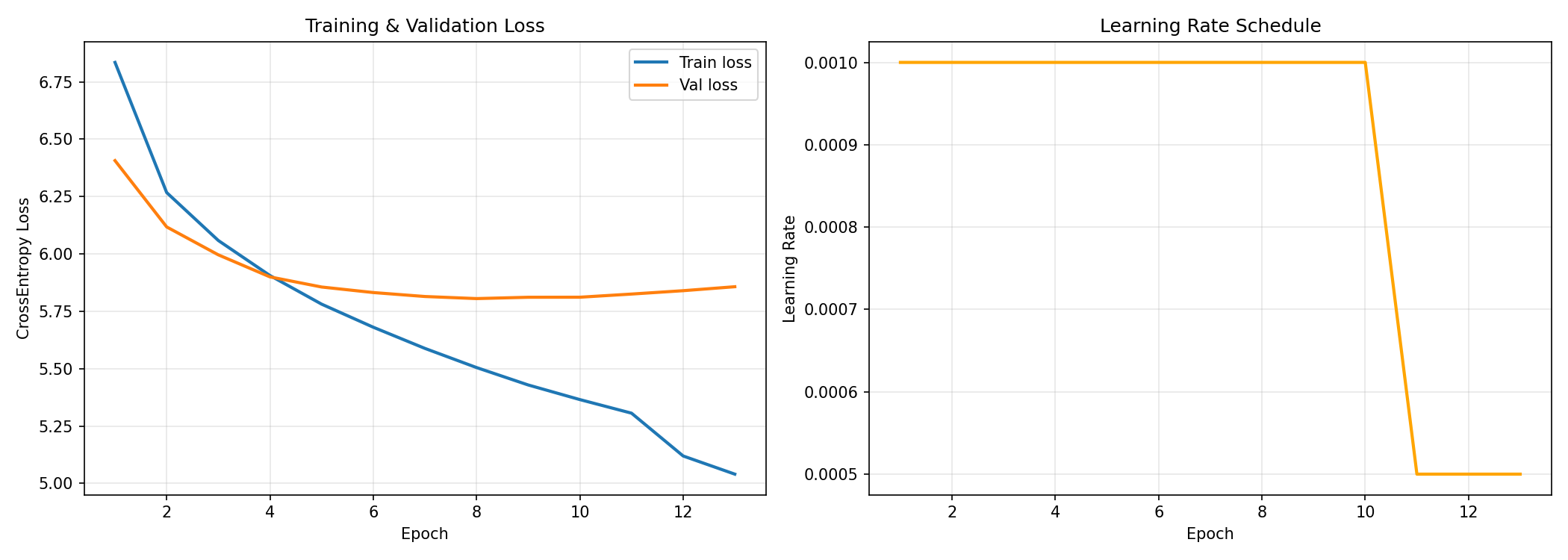
The validation loss diverges from training loss around epoch 8 — classic early overfitting on a LSTM due to its limited long-range memory. The best checkpoint is used for generation.
Project Structure
CodeAlpha_Music_Generation/
│
├── artifacts/
│   ├── vocab.json              ← token ↔ (pitch, duration, velocity) mappings
│   ├── training_curves.png     ← loss & LR schedule plots
│   └── generated_temp09.mid   ← sample generation (temperature=0.9)
│
├── notebooks/
│   ├── 01_preprocessing.ipynb  ← MIDI parsing, tokenization, .npy export
│   └── 02_training.ipynb       ← model training, generation, MIDI export
│
├── generate.py                 ← inference script (CLI)
├── requirements.txt
├── .gitignore
└── README.md
Model weights (best_model.pt, 264MB) are stored on HuggingFace and downloaded automatically by generate.py.
Quickstart
Install
git clone https://github.com/Tahsine/CodeAlpha_Music_Generation
cd CodeAlpha_Music_Generation
python -m venv .venv && source .venv/bin/activate
pip install -r requirements.txt
Generate MIDI
# Basic — downloads model automatically from HuggingFace on first run
python generate.py

# With options
python generate.py \
    --n_tokens    512 \
    --temperature 0.9 \
    --bpm         120 \
    --output      artifacts/my_music.mid
Generate MIDI + WAV
# Install FluidSynth (system dependency)
sudo apt-get install fluidsynth   # Linux
brew install fluidsynth            # macOS

# Generate — soundfont downloads automatically on first run (~30MB)
python generate.py --n_tokens 512 --temperature 0.9 --audio
Temperature guide
| Temperature |
Effect |
Best for |
0.7 |
Conservative — coherent but repetitive |
Background music |
0.9 |
Balanced — musical and varied |
General use |
1.1 |
Creative — surprising but less coherent |
Exploration |
How it works
Generation is autoregressive — the model predicts one token at a time, appending it to the sequence and using it as context for the next prediction. This is the same mechanism used by GPT to generate text.
seed (64 tokens) → model → next token
append → slide window → model → next token
...repeat N times...
→ decode tokens → music21 → .mid → FluidSynth → .wav
Temperature controls the randomness: logits / temperature → softmax → sample. Lower temperature sharpens the distribution (more predictable), higher temperature flattens it (more creative) — identical to the temperature parameter in LLMs.
Dependencies
| Package |
Role |
torch |
Model training & inference |
symusic |
Fast MIDI parsing (C++, preprocessing only) |
music21 |
MIDI generation from token sequences |
midi2audio |
WAV conversion via FluidSynth |
huggingface_hub |
Automatic model download |
numpy |
Array handling |
tqdm |
Progress bars |
License
MIT